A car crash can change your life in seconds, but you don’t have to face recovery alone.
If you’re dealing with State Farm after a Texas wreck, you’re probably juggling more than paperwork. Your car may be in the shop. Your phone keeps ringing. You may be missing work, trying to get medical care, and wondering whether the adjuster is helping or building a cheaper version of your claim.
That confusion is common. The state farm claims process looks simple from the outside, but injury claims in Texas rarely stay simple for long. The pressure points usually show up fast: fault disputes, recorded statement requests, missing documents, a slow investigation, or an offer that doesn’t come close to covering what the crash has already cost you.
Texas law gives you rights, but rights only help if you know how to use them. Under Texas Civil Practice & Remedies Code Chapter 33, fault matters. Under Chapter 41, some damages have their own legal rules and limits. In plain English, that means two things: first, you need proof; second, you need a strategy.
Your First Moves After a Texas Car Accident
The first minutes after a crash matter for your health and for your claim.
Start with safety. Move to a safe location if you can do it without making your injuries worse. Call 911 if anyone may be hurt, if traffic is blocked, or if the scene feels unsafe. Accept medical help if you need it. A lot of injured people try to push through the shock, then wake up the next day with neck pain, back pain, headaches, or dizziness.
Once you’re safe, start thinking like someone who may have to prove what happened later.
What liability means in plain English
Liability means legal responsibility. In a car accident claim, the basic question is who caused the crash and who should pay for the harm that followed.
Texas uses a modified comparative fault rule under Chapter 33. In everyday terms, that means your compensation can be reduced if you share blame, and if you are found more than 50% responsible, you usually can’t recover damages from the other side. Comparative fault is the process of assigning each driver a share of blame.
A Houston driver rear-ended at a stoplight may think fault is obvious. Sometimes it is. But if the insurer argues the driver stopped suddenly, had broken brake lights, or made an unsafe lane move before impact, the claim can become a liability fight. That is why early evidence matters so much.
Practical rule: Don’t assume the police report, the vehicle damage, or common sense will speak for itself. Gather proof while it still exists.
What to collect before the scene changes
Use your phone carefully and thoroughly. Conditions change fast. Cars get moved. Skid marks fade. Witnesses leave.
Here is the evidence worth collecting right away:
| Evidence Type | What to Collect |
|---|---|
| Vehicle photos | Damage to all cars, license plates, debris, and final resting positions |
| Scene photos | Traffic lights, stop signs, lane markings, weather, road conditions, and any obstructions |
| People involved | Names, phone numbers, insurance details, driver’s license information |
| Witness information | Names and contact details for anyone who saw the crash |
| Police details | Officer name, agency, report number, and how to request the report |
| Injury evidence | Visible bruising, cuts, swelling, and notes about pain or symptoms |
| Nearby proof | Business signs, intersection names, and any cameras that may have captured the wreck |
If you can, write down what happened while it’s still fresh. Keep it factual. Time, direction of travel, lane position, signal color, point of impact, and anything the other driver said at the scene.
For a broader checklist, review these steps to take after a car accident.
What damages means under Texas injury law
Damages means the losses the law allows you to recover. In a Texas car wreck case, that can include medical bills, lost income, property damage, pain, and the ways your injury disrupts daily life. If a crash causes a fatal injury, surviving family members may also have a claim for wrongful death compensation.
Chapter 41 of the Texas Civil Practice & Remedies Code deals with certain damage rules, especially in cases involving exemplary damages. That chapter does not control every car accident claim, but it is part of the larger legal framework that shapes how damages are handled in Texas courts.
What not to do at the scene
A few mistakes cause lasting problems:
- Don’t admit fault: Even a polite apology can be twisted into an admission.
- Don’t minimize injuries: Saying “I’m fine” at the roadside often shows up later when you seek treatment.
- Don’t skip medical care: Delayed treatment gives the insurer room to argue your injuries came from something else.
- Don’t rely on memory: Photograph and document what you can before the scene is cleared.
Texas claims often turn on details that seem small in the moment. A missing witness name. A deleted photo. A vague statement to an insurer. A crash on I-45 or a side-impact collision in a Houston intersection can look straightforward, then turn into a comparative fault argument weeks later.
The strongest claims usually begin the same way. The injured person gets medical care, preserves evidence, reports the crash, and avoids saying more than necessary before the facts are clear.
How to Report Your Claim to State Farm in Texas
Filing the claim starts the machine.
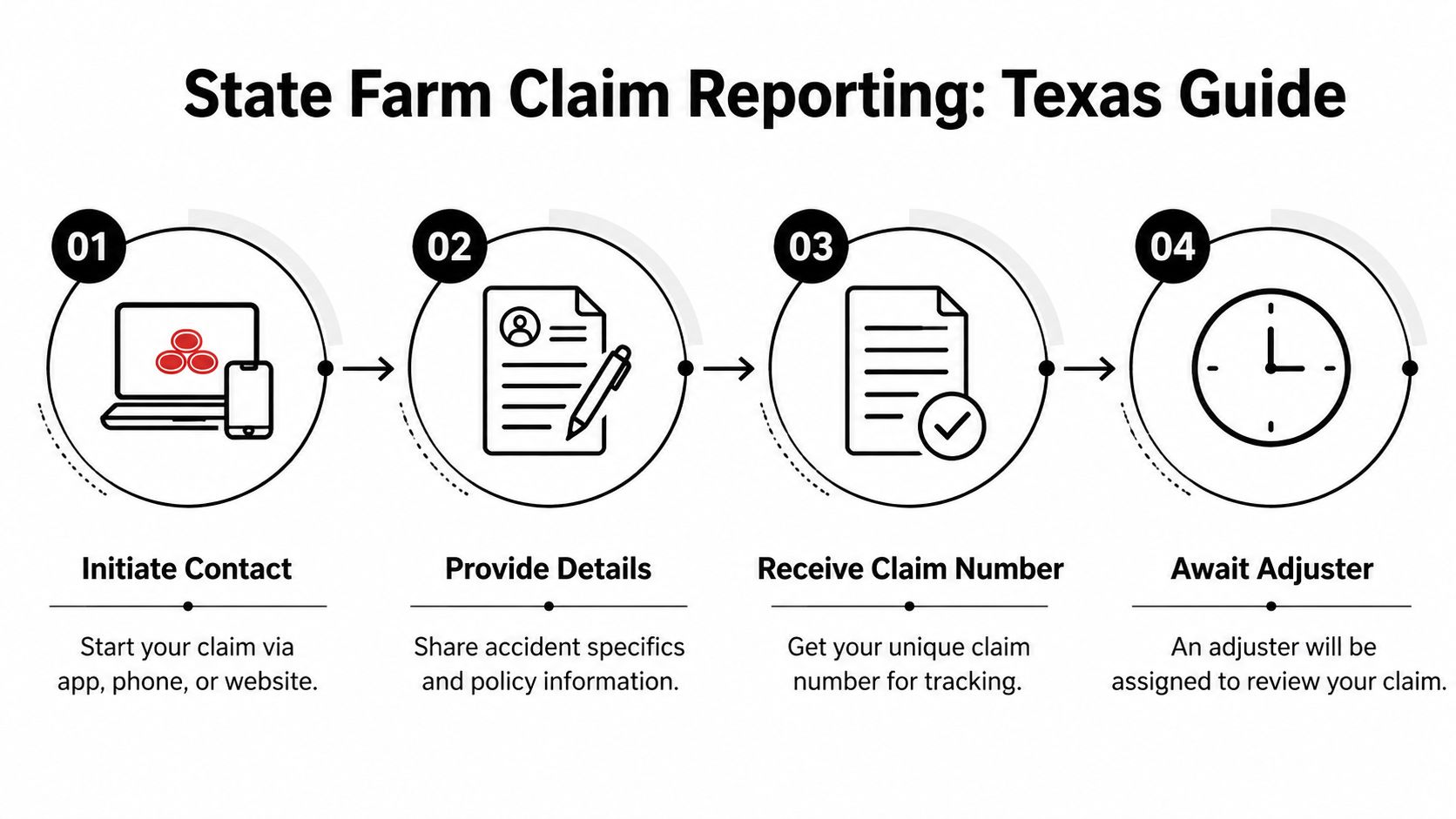
State Farm lets you report a crash by phone, through its website, or through the mobile app. In Texas claims, speed matters, but accuracy matters more. State Farm says digital reporting through the website or app can be 20 to 30% faster than phone reporting, and an adjuster may be assigned within hours. The same guidance notes that incomplete documentation causes 40 to 50% of initial claim delays in the State Farm claim filing guide.
The three ways to open the claim
Each reporting method has trade-offs.
Phone reporting
You can call 800-SF-CLAIM and give the details to a representative. This works well if you’re not comfortable uploading documents or if the situation is messy and you need immediate guidance. The downside is that phone reporting can feel rushed, and people often say too much.Website reporting
Filing online gives you more control over what you submit. You can move carefully, confirm dates, and upload supporting material. That usually helps avoid early errors.Mobile app reporting
The app is often the easiest option when you’re away from a computer. It also tends to move faster in the opening phase, especially when you already have photos and basic details on your phone.
For a more detailed walkthrough, read this guide on how to report an accident to insurance.
What to have ready before you file
Before you start, gather the key facts in one place. That helps you stay brief and consistent.
- Your policy information: Policy number, vehicle information, and your contact details.
- Crash basics: Date, time, location, direction of travel, and a short factual description.
- Other driver details: Name, insurer, policy information if available, plate number, and vehicle description.
- Police information: Agency, report number, and responding officer if you have it.
- Supporting proof: Photos, witness contacts, repair estimates if already obtained, and medical information if treatment has begun.
What to say and what to leave out
Keep the first report simple. State the facts you know. Don’t guess about speed, distance, injury duration, or fault percentages. Don’t say you’re unhurt if you haven’t been evaluated. Don’t volunteer theories.
A good opening report sounds like this: where it happened, when it happened, what vehicles were involved, and that you’re seeking evaluation or treatment if you’re experiencing symptoms.
Report promptly, but don’t turn the first notice of loss into a debate about blame or the full value of your injuries.
What happens after you submit
Once the claim is opened, State Farm gives you a claim number. Save it. You’ll use it every time you call, upload records, or ask for a status update.
After that, an adjuster is usually assigned. The adjuster may ask for photos, the police report, witness information, repair estimates, and medical records depending on the type of claim. This is the first point where many people lose momentum. They report quickly, then respond slowly. That gap creates delay and gives the insurer room to control the pace.
If your claim involves only vehicle damage, the reporting stage may stay relatively straightforward. If it includes physical injuries, the file gets more sensitive. The insurer begins looking at treatment records, fault, credibility, and whether your symptoms match the crash.
That is why the opening report should be clear, accurate, and limited. You want the claim started. You do not want to hand over unnecessary ammunition on day one.
What to Expect from the State Farm Adjuster
After the claim is filed, the adjuster becomes the person who controls most of the day-to-day movement. That doesn’t mean the adjuster is neutral. The adjuster works for State Farm.

A good way to think about the adjuster is this: they gather facts, evaluate exposure, and try to resolve the claim for as little money as the company believes it can pay. Some are polite and responsive. Some are not. Either way, their role is not to maximize your recovery.
The timeline most people actually face
Many injured drivers expect a quick answer because they reported the crash right away. That isn’t how most injury claims work.
According to this overview of State Farm claim timing, simple property damage claims may resolve in 2 to 4 weeks, moderate auto accident or injury claims typically take 1 to 3 months, and severe injury or liability dispute cases can take 3 months or longer. The same discussion notes that straightforward claims often resolve in around 30 days, while more complex files can stretch much longer.
That range matters because many people panic too early or wait too long. A routine fender-bender and a Houston crash with ongoing treatment are not on the same track.
What the adjuster is looking for
The adjuster usually focuses on four issues:
- How the crash happened
- Who was at fault
- Whether the medical treatment relates to the crash
- What the claim may cost
That sounds basic, but each issue creates room for disagreement. If the adjuster sees a gap in treatment, inconsistent statements, missing photos, or conflicting witness accounts, the file becomes easier to discount.
Damages in a Texas injury claim may include medical expenses, lost wages, property damage, and pain and suffering. The adjuster will review each category separately. Medical bills might be questioned. Lost income may require employer records. Pain and suffering is often challenged because it doesn’t come with a receipt.
How to deal with adjuster communication
Most claim problems start with careless conversations.
Use these habits instead:
- Keep a claim log: Record every phone call, voicemail, email, upload, and promise made.
- Confirm in writing: If the adjuster says they are waiting for a record or sending an inspection request, email back and confirm.
- Stay factual: Don’t exaggerate, but don’t minimize.
- Be careful with casual talk: Friendly questions about how you’re feeling can become useful soundbites later.
If you want a broader primer, this piece on how to deal with insurance adjusters is worth reading alongside your claim file.
The recorded statement issue
One of the most important moments in the state farm claims process is the request for a recorded statement. People often assume this is routine and harmless. It may be routine, but it is not harmless.
A recorded statement can lock you into wording before you know the full extent of your injuries. If you later need more treatment, the insurer may compare your early comments to your later records and argue that your condition is overstated.
If a question calls for guessing, don’t guess. If a question is vague, ask for clarification. If a statement request feels premature, slow the process down.
This is also where claim type matters. Property claims and injury claims move differently. If your concern is vehicle repair or roof damage, resources focused on understanding State Farm property claim process can help you compare how adjusters approach documentation and valuation in different settings.
Here’s a short video that breaks down common insurance claim dynamics and can help you frame these conversations more carefully.
A Texas example
Take a driver hit in a side-impact wreck in Houston. The vehicle damage looks serious, but the emergency room records are brief because adrenaline masked the pain. A few days later, the driver develops shoulder and neck symptoms, starts treatment, and misses work. The adjuster may question whether the delayed complaints came from the crash or from something else.
That doesn’t mean the claim is weak. It means the file has to be built carefully. The injured person needs consistent treatment, complete records, and disciplined communication.
The adjuster controls the file. You control the quality of the proof.
Common Pitfalls and Why State Farm May Deny Your Claim
The biggest mistake people make is trusting the first phase of the claim too much.
They think that because the crash happened, the insurer will eventually pay fairly. That assumption causes real damage. In Texas injury claims, State Farm’s approval rates can fall to 50 to 60% when fault is contested, according to attorney analysis of State Farm injury claims. That same analysis states that 82% of initial settlement offers are undervalued, that a formal demand letter can produce 150 to 300% more than the first offer, and that attorney involvement is correlated with an average 3x higher payout on injury claims.

Those numbers do not mean every denied claim is wrongful or every low offer becomes a large recovery. They do show a clear pattern. The first offer is often a business decision, not a fair reading of your losses.
The recorded statement trap
A recorded statement is often framed as a routine step. In practice, it can become a fault tool.
Texas comparative fault law under Chapter 33 gives the insurer a reason to search for words that shift blame to you. In a multi-car pileup on I-10, one uncertain answer about speed, following distance, or whether you “might have looked down for a second” can be used to chip away at liability.
That matters because comparative fault reduces what you can recover. If the insurer can assign enough blame to you, your claim value drops sharply. If they push your share of fault too high, recovery may be barred.
Why claims get delayed, reduced, or denied
The reasons usually fall into a few categories:
- Incomplete documentation: Missing records, missing photos, or treatment gaps make the file easier to challenge.
- Disputed liability: Conflicting driver accounts, no witnesses, or unclear scene evidence give the insurer room to argue.
- Medical causation arguments: The insurer may question whether your treatment was caused by this crash.
- Policy issues: Coverage disputes can complicate what would otherwise be a straightforward claim.
- Deadline problems: Delay by the claimant often turns a manageable issue into a denial issue.
The first offer problem
A low opening offer works because injured people are under pressure. Bills arrive before fair settlements do.
A Houston driver who is rear-ended and misses work may be tempted to accept a quick check just to stabilize things at home. That is exactly why early offers are often structured to feel convenient. Once you sign a release, you usually can’t reopen the claim later because your treatment turned out to be longer or more expensive than expected.
A fast offer can be the most expensive money you ever accept.
The Texas deadline you cannot miss
The statute of limitations is the legal deadline for filing a lawsuit. In most Texas car accident injury cases, that deadline is two years. If you miss it, you can lose the right to pursue compensation in court.
That deadline matters even when negotiations seem active. An adjuster may continue talking while the clock keeps running. If the statute expires, your advantage can disappear overnight.
Real-world claim pressure
Take a chain-reaction crash in Houston. One insurer blames the lead driver for stopping suddenly. Another blames the middle driver for following too closely. State Farm may argue that your own driving contributed to the impact sequence. Without strong scene photos, witness statements, vehicle damage documentation, and medical proof, the claim can shrink from several directions at once.
This is why people get blindsided. The denial letter or low offer often arrives after weeks of friendly communication. By then, the insurer has already built its theory.
The answer is not panic. It is preparation. Every gap in the file is a place where the insurer can save money.
Fighting Back Against a Low Offer or Denial
A denial or low offer is not the end of your case. It is the point where you need to stop reacting and start strengthening your position.
Some people call the adjuster and argue. That rarely works by itself. The better approach is structured, documented, and hard to ignore. You need to show what the insurer got wrong, what proof supports your position, and what fair compensation should look like under the facts and Texas law.
Start with a written response
If State Farm denied the claim or offered too little, ask for the reason in writing if you do not already have it. Then compare that explanation against your file.
Look closely at these issues:
Liability findings
Did the insurer rely on an incomplete statement, ignore a witness, or overstate your role in the crash?Medical support
Are there records missing from the file? Did treatment continue after the insurer stopped paying attention?Damage calculation
Did they leave out wage loss, future care concerns, or the human impact of your injuries?
A short emotional complaint won’t do much. A documented rebuttal can.
Build a demand letter that means something
A demand letter is a formal written presentation of your claim. It should include a clear crash summary, the basis for liability, your injuries, treatment, losses, and the amount you are demanding to settle. It should also attach supporting records.
A strong demand letter usually includes:
- The crash narrative: Simple, factual, and consistent with the evidence.
- Liability support: Police report references, photos, witness statements, and any other proof.
- Medical documentation: Records, bills, diagnoses, treatment timeline, and provider notes.
- Lost income proof: Employer verification, wage records, or other work-related losses.
- Damage explanation: Not just what you paid, but how the injuries changed daily life.
The point is not to sound angry. The point is to make undervaluing your claim harder.
Use Texas law when delay becomes the issue
Sometimes the problem is not the number. It is the stall.
State Farm is said to aim to complete investigations in about 30 days, but there is a real gap between that goal and what many policyholders experience. This discussion of Texas bad faith issues involving State Farm delays notes that unreasonable delays under the Texas Insurance Code can expose an insurer to additional damages, including attorney’s fees and interest.
That matters because delay can be its own pressure tactic. Medical bills do not pause while an investigation drags on. Lost income does not wait. If the insurer keeps asking for the same materials, goes silent without explanation, or extends the review without a legitimate reason, the delay itself may become part of the dispute.
Keep every delay in writing. Dates matter. Promises matter. Silence matters.
When an appeal needs more than paperwork
Some denials can be resolved by supplying the missing proof. Others point to a deeper fight.
A claim may need legal escalation when:
- liability is being pushed onto you without solid support
- the insurer keeps changing the reason for delay
- the offer does not cover obvious documented losses
- the insurer demands broad statements or records that do not fit the claim
- the filing deadline is getting close
This is also where legal definitions become practical. Damages are your recognized losses. Liability is who caused them. Comparative fault is the insurer’s effort to reduce its share by increasing yours. Once you see the dispute through those three lenses, the insurer’s strategy becomes easier to spot.
A Texas example of a better response
Suppose a driver in Houston is hit while turning with the right of way. State Farm later argues the driver entered the intersection too quickly and offers a reduced settlement. A better response is not “that’s unfair.” A better response is a packet showing intersection photos, vehicle damage points, witness statements, the police report, treatment records, wage loss proof, and a demand that directly explains why the liability finding is wrong.
Insurers negotiate differently when the file looks trial-ready.
When to Call a Houston Car Accident Lawyer
Some claims can be handled without a lawyer. Many cannot.
You should seriously consider calling a Houston car accident lawyer or Texas injury attorney if State Farm is delaying the claim, disputing fault, asking for a recorded statement after things have become complicated, or making an offer that does not cover your medical care and lost income. The same is true if the crash involved serious injury, a commercial vehicle, a multi-car collision, uninsured or underinsured issues, or a fatality with possible wrongful death compensation.
One practical reason is advantage. Another is economics. State Farm reported that its hail claim costs increased by more than $1 billion from 2021 to 2022, with Texas accounting for $510 million in hail-related payouts, according to State Farm’s report on rising hail claim costs. That data concerns hail losses, not auto injury claims. But it still shows the scale of financial pressure large insurers manage. When costs rise across the business, claim handling often becomes more aggressive.
A lawyer levels the field. Your attorney can control communication, protect you from damaging statement traps, gather the records the adjuster says are missing, present the claim in a disciplined way, and file suit if that is what the case requires.
The timing matters. Waiting too long can hurt. Evidence gets harder to collect. Witnesses become harder to reach. The statute of limitations gets closer. And once you have said the wrong thing in the wrong format, it can be difficult to undo.
If you are asking whether you need legal help, the better question is this: has the claim stayed simple, fair, and well-documented? If the answer is no, it is time to get advice.
If State Farm is making the process harder than it should be, you don’t have to sort it out alone. The team at The Law Office of Bryan Fagan, PLLC helps injured Texans understand their rights, deal with insurance companies, and pursue fair compensation after a crash. If you need answers about an auto insurance claim, comparative fault, serious injuries, or wrongful death compensation, contact the firm for a free consultation.