Skip to content
A car crash can change your life in seconds, but you don’t have to face recovery alone.
A Houston driver gets tapped from behind at a neighborhood stoplight. The crash seems minor. Then the airbag explodes open, and the driver leaves with a broken nose, burned skin, ringing ears, and a question nobody expects to ask after a “small” wreck: can an airbag kill you?
The Hidden Danger in a Life-Saving Device
The honest answer is yes. An airbag can kill you, and when it happens, it is heartbreaking.
That answer surprises many people because airbags are supposed to protect you. In most crashes, they do. In fact, frontal airbags have saved over 50,000 lives in the United States over a 30-year period and reduced driver fatalities by 29% in frontal crashes, according to Consumer Reports’ summary of NHTSA data.
But the same safety device can become dangerous in the wrong circumstances. The same source reports that NHTSA recorded 238 airbag-related deaths from 1990 to 2002 in low-speed collisions where no other cause was possible. That means some people survived the crash itself, but the airbag deployment caused the fatal injury.
Why this confuses so many families
An airbag is often perceived as a soft cushion. It isn’t soft when it first comes out. It deploys with violent speed because it has to open before your body hits the steering wheel, dashboard, or windshield.
That split-second timing is what saves lives. It is also what creates risk.
A low-speed crash in Dallas, Austin, or Houston can still produce a devastating airbag injury if a person is sitting too close, riding unbelted, carrying a child in the wrong seat, or driving a vehicle with an aging or defective inflator. Families often struggle with this because the crash may not look severe from the outside.
Airbag injury cases are often emotionally difficult because the vehicle’s safety system may have contributed to the harm instead of preventing it.
A Texas legal issue, not just a medical one
If an airbag caused or worsened your injury, there may be more than one claim. You may have a case against the driver who caused the crash. You may also have a product-related claim if the airbag system was defective, deployed wrong, or failed in a dangerous way.
Under Texas law, liability means legal responsibility for the harm that happened. In plain English, it answers one question: who should pay for the damage?
That matters because airbag cases often involve overlapping fault. One driver may have caused the wreck. A manufacturer may have built a dangerous inflator. A repair shop may have installed the wrong part. Sorting that out takes evidence, not guesswork.
If you’re reading this after a frightening deployment, your concern is reasonable. Your injuries are real. And your rights may be broader than you think.
How Airbags Can Cause Catastrophic Harm
An airbag works fast because it has almost no time to work at all.
When your car senses a serious impact, the system triggers an inflator. A chemical reaction creates gas, the bag bursts out of its compartment, and it inflates in front of you before your body moves fully forward. Then it starts to deflate almost immediately.
That sounds simple on paper. Inside a crash, it’s closer to a controlled explosion.
What actually happens during deployment
Think of an airbag as a safety device that wins by speed. If it opens too late, it fails. If it opens too hard, or with a defective inflator, it can injure the very person it was meant to protect.
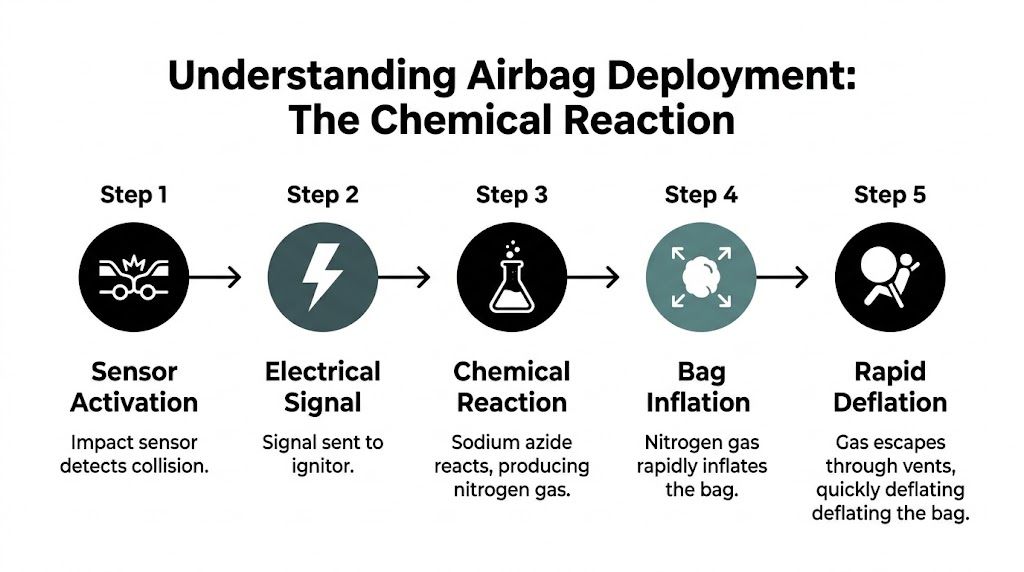
Here is the basic chain of events:
- A crash sensor detects sudden deceleration
- The system sends an electrical signal
- The inflator triggers a chemical reaction
- Gas fills the folded bag almost instantly
- The bag vents and deflates after impact
That speed is why proper seat position matters. If your chest, face, or arms are already too close when the bag bursts out, the bag can strike you before it becomes a cushion.
Why older airbags were especially dangerous
Older systems were much more aggressive. According to NHTSA-related data summarized by Spada Law Group, from 1990 to 2008, deployed frontal airbags caused approximately 300 deaths in low-speed crashes. Nearly 90% of those deaths occurred in pre-1998 vehicles, where first-generation airbags deployed with up to 2,000 pounds of force at speeds of 200 miles per hour.
Those numbers help explain why some low-speed crashes turned fatal. The bag wasn’t gently unfolding. It was blasting outward with extreme force.
A person sitting upright with a seatbelt on had a better chance of receiving the airbag as intended. A person leaning forward, driving too close to the wheel, or sitting unbelted could get hit by the bag during its most violent phase.
Practical rule: An airbag is designed to work with a seatbelt, not instead of one.
Why a minor crash can still lead to major injuries
Many people become frustrated with insurance companies because the insurer may argue, “It was only a low-speed collision.” But low vehicle damage doesn’t always mean low injury risk when an airbag deploys.
Consider a few common Texas examples:
- A Houston commuter on I-45 gets rear-ended, jolts forward, and the frontal airbag deploys while the driver is close to the wheel.
- A San Antonio parent is in a parking lot crash, and a child in the front seat is exposed to a deployment zone that is too close.
- An older driver in Fort Worth suffers severe chest or facial trauma because brittle bones and short seating distance increase vulnerability.
The force is the point, and the problem
The airbag must beat your body to the hard surface in front of you. That is why it uses brute force. In most crashes, that force is protective. In a small number of tragic events, that same force causes blunt trauma, fractures, burns, or death.
That isn’t a contradiction. It’s the hard truth about how the device works.
When readers ask can an airbag kill you, the right answer isn’t fear-based. It’s factual. Airbags save many lives, but they can also cause catastrophic harm when design, position, restraint use, or product failure turns a safety system into a hazard.
The Wide Range of Airbag Deployment Injuries
Airbag injuries are often dismissed as “just a bruise” or “normal soreness.” Sometimes that’s true. Other times, the injuries are serious, permanent, or fatal.
The problem is that airbag harm doesn’t come from only one source. A deployment can injure you through direct impact, through chemicals and heat, or through the blast effect itself.

According to Hall & Lampros’ discussion of airbag deployment injuries, airbag deployment creates a noise over 160 decibels and releases hot gases and chemical residues like sodium hydroxide. This can cause auditory trauma, chemical burns, and pulmonary damage. The 2,000 psi pressure wave can even rupture eardrums and contribute to traumatic brain injuries.
Impact injuries
These are the injuries commonly expected. The bag strikes the body, often the face, chest, arms, or neck, at the instant it bursts out.
Common impact injuries include:
- Facial trauma such as fractures, cuts, swelling, and dental damage
- Upper body injuries involving the chest, ribs, shoulders, wrists, or hands
- Neck injuries caused by sudden extension and rebound
- Head injuries ranging from concussion symptoms to more severe brain trauma
A person may also suffer abrasions from the bag fabric or from being pushed into another surface. If the crash also involved belt loading, the injury pattern can become more complex. For related crash-force injuries, readers often find this discussion of seat belt syndrome injuries helpful.
Chemical and heat injuries
This category surprises people the most.
An airbag deployment doesn’t just produce motion. It also releases hot gas and residue. If those chemicals contact your skin, eyes, or lungs, they can cause another layer of harm beyond the blunt impact.
Some people report:
- Skin burns or irritation on the hands, arms, face, or chest
- Eye irritation with redness, tearing, blurred vision, or corneal injury
- Breathing problems after inhaling powder, fumes, or vented material
- Worsening of asthma or other lung conditions
If a bag is punctured or vents abnormally, the fumes may spread more directly into the cabin.
After an airbag deployment, don’t shrug off coughing, wheezing, eye pain, or burning skin. Those symptoms may point to chemical exposure, not just crash stress.
Blast and sensory injuries
The blast itself can injure you even if there is no obvious cut or fracture. A deployment can be so loud and forceful that people leave the crash with ringing ears, muffled hearing, dizziness, headaches, or balance problems.
That matters because these symptoms are easy to miss in the chaos after a wreck. A person may focus on a broken arm and not realize they also suffered hearing damage or a mild traumatic brain injury.
Types of injuries caused by airbag deployment
| Injury Type | Cause | Common Examples |
|---|---|---|
| Impact injuries | The bag strikes the body during rapid inflation | Facial fractures, chest bruising, rib injury, neck strain, hand or wrist trauma |
| Chemical injuries | Hot gases and alkaline residue contact the body | Skin burns, eye irritation, breathing problems, lung irritation |
| Auditory and sensory injuries | Blast noise and pressure wave from deployment | Ringing ears, hearing loss, ruptured eardrums, dizziness, headache |
Why medical follow-up matters
A crash victim in Houston may leave the ER with a diagnosis of “airbag abrasion” and still develop breathing trouble, worsening neck pain, or vision symptoms later. Another person may think the ringing in their ears will fade, only to learn the hearing loss is lasting.
This is one reason insurance companies should not be the ones deciding whether your injuries are minor. Your doctor should decide that. If needed, a specialist should decide it.
Keep every medical record. Save photos of burns, cuts, swelling, and residue. If your symptoms changed over the next few days, write that down too. In airbag cases, the pattern of injury often tells part of the story.
Which Passengers Are Most at Risk?
Airbags don’t affect every person the same way. Body size, seat position, age, and restraint use all matter.
That does not mean injured people are to blame. It means some occupants are more vulnerable to the force of deployment, and families deserve clear safety guidance without being shamed.
Children and front-seat passengers
Children are especially vulnerable because they are smaller and often sit closer to the dashboard. A rear-facing child seat in front of an active passenger airbag is particularly dangerous because the back of the child seat sits directly in the deployment zone.
The safest approach is simple. Children should ride in the back seat using the right restraint for their age and size.
If a family had to make a hard choice during an emergency, that doesn’t excuse a defective product or negligent driver. It just means the facts have to be examined carefully.
Shorter adults and drivers who sit close
Many shorter drivers move their seat forward so they can reach the pedals and see clearly. That makes sense. But it can also place the chest, face, and arms too close to the steering wheel airbag module.
A common Texas example is a petite driver commuting through Houston traffic who keeps the seat very near the wheel for comfort and control. In a crash, the airbag can hit before the driver has enough distance for the bag to fully inflate into a cushion.
Helpful habits include:
- Sit back as far as practical while still reaching the pedals safely
- Keep your arms slightly bent, not locked close to the wheel
- Wear the seatbelt correctly with the lap and shoulder portions in the right place
- Sit upright, rather than leaning forward
Distance matters. The closer your body is to the airbag module, the more likely the deployment phase itself can cause injury.
Older adults and pregnant passengers
Older adults may face a higher risk of serious harm because bones and soft tissue can be more fragile. A deployment that causes bruising in one person may cause fractures in another.
Pregnant drivers and passengers face a different concern. Proper belt placement and seating position matter even more because the force of a crash affects both the adult body and the pregnancy. The answer usually isn’t disabling the airbag on your own. It’s adjusting seating position, wearing the belt properly, and checking the vehicle instructions.
One point families need to hear
Safety advice is not a defense for carelessness by others.
If a distracted driver hits your car, that driver may still be responsible. If a defective inflator ruptures, the manufacturer may still be responsible. If a repair shop installed the wrong part, that shop may still be responsible.
Knowing who is most at risk helps prevent injuries. It doesn’t erase legal accountability when harm happens.
Who Is Liable for an Airbag Injury or Death in Texas?
Airbag cases usually raise two questions at once. First, who caused the crash? Second, did the airbag itself cause extra harm?
In Texas, liability means legal responsibility. A person or company with liability may have to pay for the injuries and losses they caused.
An airbag injury case can involve one liable party, or several.

The at-fault driver may still be responsible
If another driver caused the wreck, that driver is often the starting point of the claim. Texas negligence law generally asks whether someone failed to use reasonable care and caused injury.
A simple example is a Houston driver rear-ended on I-45 by someone texting behind the wheel. If the crash triggered an airbag that caused facial fractures or burns, the careless driver may still be legally responsible for the chain of harm flowing from the collision.
This is why an auto insurance claim after an airbag case should not focus only on vehicle damage. The full injury picture matters.
The manufacturer may also be responsible
Some airbag cases involve product liability, which means a company made or sold a product that was unreasonably dangerous. That may involve a faulty inflator, a bad sensor, a dangerous design, or a failure to warn.
One of the most important examples involves Takata inflators. According to IIHS material on airbags, the ongoing Takata airbag recall crisis was linked to over 30 U.S. deaths by 2023, and humid states like Texas face added concern because long-term propellant degradation increases rupture risk.
That humid-climate issue matters in Texas. Heat and moisture can affect aging vehicles over time. A person may drive the same car for years without realizing the inflator inside the steering wheel or dashboard has become dangerous.
Aging vehicles create a hidden Texas problem
Many families drive older cars because that is what fits the budget. There is nothing careless about that. But if your vehicle is older, it is wise to check recalls and repair history.
If you’re reviewing maintenance records or trying to understand whether a vehicle had major safety issues missed during service, a practical overview of Texas vehicle inspection requirements can help you understand how inspection and maintenance questions sometimes fit into a larger case.
A repair shop or dealer may also become part of the case if someone ignored recall work, installed the wrong component, or failed to complete repairs correctly.
Texas comparative fault in plain English
Texas follows a modified comparative fault system under Chapter 33 of the Texas Civil Practice & Remedies Code. In plain English, that means fault can be divided among multiple people or companies.
It also means your compensation can be reduced if you were partly at fault. If your share of responsibility is too high under Texas law, you may be barred from recovery.
Insurance companies use this rule aggressively. They may argue you sat too close, failed to wear a seatbelt correctly, or ignored a recall notice. Sometimes those arguments are fair. Sometimes they are an attempt to shift blame away from a defective product or negligent driver.
That is why evidence matters. The vehicle, recall history, crash data, medical records, and witness accounts all matter.
The discovery rule and late-discovered defects
Texas also has a statute of limitations, which is the deadline for filing a lawsuit. In many injury cases, that deadline is two years. Wrongful death cases often involve the same general deadline.
But not every airbag defect is obvious right away.
The same IIHS material notes that Texas’s discovery rule may allow victims to file beyond the standard two-year statute of limitations if they can prove the defect was concealed or unknown. In plain language, the discovery rule can help when a person could not reasonably have known that a hidden product defect caused the injury until later.
That can matter in Takata-related cases, older vehicle cases, and wrongful death matters where the family learns about a defective inflator only after investigating the crash. For families dealing with a fatal case, this overview of a wrongful death lawsuit can provide a useful starting point.
What damages means under Texas law
Under Chapters 33 and 41 of the Texas Civil Practice & Remedies Code, damages means the losses a person seeks to recover in a case. That can include medical bills, lost income, physical pain, mental anguish, and other harms recognized by law.
In some cases, there may also be a dispute over exemplary damages under Chapter 41, but those claims depend on specific facts and proof standards.
The key point is simple. If an airbag injured you, more than one party may share responsibility, and Texas law gives you a framework to pursue accountability.
Critical Steps to Protect Your Rights After an Airbag Injury
The hours after a crash are chaotic. You may be in pain, rattled, or trying to care for your child or spouse. A short checklist helps.

Get medical care right away
Tell the doctor everything that happened during deployment, not just the crash. Mention face pain, chest pain, burns, residue on your skin, ringing in your ears, breathing trouble, dizziness, blurred vision, and headache.
That detail matters because airbag injuries can involve more than blunt trauma.
If you’ve already left the scene and are wondering what to do next after the crash itself, this guide on what to do after a car accident can help you organize the basics.
Preserve the vehicle
Do not let the car be repaired, salvaged, or destroyed until it has been properly documented and, if needed, inspected.
The airbag module, steering wheel, dashboard area, onboard data, and crash condition may all matter later. In a product case, the vehicle is evidence.
Document what you can
Some evidence disappears quickly. If you are physically able, or if a family member can help, gather:
- Photos of the car from multiple angles, including the deployed airbag area
- Photos of your injuries over time, especially burns, bruising, cuts, and swelling
- Recall and maintenance paperwork if you have it
- Witness names and contact information
- Your own notes about what you smelled, heard, felt, and noticed immediately after deployment
Write down your symptoms the same day if possible. Memory fades quickly, and early notes can help connect the injury to the deployment.
Be careful with insurance adjusters
You should report the crash to the appropriate insurance company, but be cautious with recorded statements, especially to the other driver’s insurer. Adjusters often ask questions in a way that minimizes injuries or locks you into early answers before doctors know the full extent of the harm.
A fair answer is often simple: you are still receiving medical evaluation and are not ready to discuss the full scope of your injuries.
This short video also walks through core actions that can protect your claim after a wreck.
Know the filing deadline
A statute of limitations is the legal deadline to file a lawsuit. In Texas, many personal injury and wrongful death claims must be filed within a limited time. Waiting can put your case at risk.
If the case involves a hidden defect, recall issue, or delayed discovery, the timing may be more complicated. That is one reason to speak with a lawyer early, even if you are unsure whether you have a case.
If the crash caused a death
Families often face immediate costs while still in shock. If you’re dealing with a fatal airbag or crash case, practical planning resources such as this overview of funeral costs in Texas can help you understand near-term financial burdens while legal questions are being sorted out.
A wrongful death case may allow surviving family members to seek wrongful death compensation for losses caused by the death. Those cases are personal, and the paperwork should not fall on grieving families alone.
How a Houston Car Accident Lawyer Can Fight for You
Airbag cases are rarely simple. A normal crash claim is hard enough. An airbag case may add product defects, recall issues, engineering evidence, and multiple insurance carriers.
A skilled Houston car accident lawyer can help by identifying what kind of case you have.
What a lawyer does in an airbag case
A strong investigation often includes:
- Securing the vehicle before evidence is lost
- Reviewing recall history and repair records
- Analyzing who caused the crash
- Examining whether the airbag caused enhanced injuries
- Working with experts when a defect, inflator rupture, or sensor problem is suspected
- Handling insurance communications so you don’t get boxed into a weak statement
A Texas injury attorney also helps identify every potentially liable party. That might include the at-fault driver, the driver’s employer, a manufacturer, a parts supplier, a dealer, or a repair facility.
Damages are more than hospital bills
In plain English, damages are the losses the law allows you to recover.
That may include medical expenses, lost wages, reduced future earning ability, physical pain, mental anguish, rehabilitation, and long-term care needs. In a fatal case, the family may also pursue wrongful death compensation and related losses recognized by Texas law.
Texas law in Chapters 33 and 41 of the Texas Civil Practice & Remedies Code affects how fault and damages are evaluated. That is one reason these cases need careful preparation from the start.
Why early legal help matters
Insurance companies often treat airbag injuries as routine. They may argue the injuries were expected, minor, or unrelated. A lawyer can push back with documentation, medical proof, and vehicle evidence.
Just as important, a lawyer can help you avoid mistakes. Saying the wrong thing to an adjuster, allowing the vehicle to be destroyed, or waiting too long to investigate a possible defect can weaken a case quickly.
If you’re asking can an airbag kill you, you may already know how serious this issue can become. You don’t need to sort out driver negligence, product liability, comparative fault, and recall history on your own.
Frequently Asked Questions About Airbag Injuries
What if my airbag didn’t deploy in a serious crash?
That can matter just as much as a violent deployment. If the crash was serious and the airbag failed to open, the question becomes whether the system should have deployed and whether that failure made your injuries worse.
Do not repair or dispose of the vehicle until the issue has been reviewed. The vehicle itself may hold the evidence needed to determine whether there was a defect, sensor problem, or another explanation.
Can I legally turn off a passenger-side airbag in Texas?
Sometimes there are limited situations involving child safety and vehicle design where deactivation issues come up, especially if a child must ride in front because no safe rear seating position is available. The correct answer depends on the vehicle, the airbag system, and the manufacturer instructions.
Do not guess. Check your owner’s manual and get specific advice before making any change.
Will my own car insurance cover injuries from airbag deployment?
It may. Coverage such as Personal Injury Protection or MedPay can sometimes help with medical costs after a crash, depending on your policy. The at-fault driver’s liability coverage may also come into play. In some cases, uninsured or underinsured motorist coverage matters too.
A lawyer can review all possible sources of recovery, not just the other driver’s insurance.
What does comparative fault mean?
Comparative fault means more than one person or company may share responsibility for the same injury. Under Texas law, your recovery may be reduced if you were partly at fault.
For example, the defense may argue that a driver sat too close to the wheel or failed to wear a seatbelt properly. Whether that argument changes the case depends on the evidence.
What should I bring to a lawyer after an airbag injury?
Bring the crash report if you have it, photos, medical records, insurance information, recall notices, repair receipts, and any letters or emails from insurers. If the vehicle still exists, tell the lawyer where it is being stored.
Small details often become important in airbag cases.
If you or someone you love was hurt after an airbag deployed, or failed to deploy, you deserve clear answers and steady help. The Law Office of Bryan Fagan, PLLC helps Texas families investigate serious crash injuries, deal with insurance companies, and pursue the compensation the law allows. Your consultation is free, and you won’t pay attorney’s fees unless the firm wins your case. If you need a Houston car accident lawyer who will take your concerns seriously, reach out today.