Skip to content
A car crash can change your life in seconds, but you don’t have to face recovery alone.
If you’re reading this, you may be hurting, missing work, dealing with car repairs, and getting calls from insurance adjusters who want answers before you’ve had time to breathe. That’s a hard place to be. Many people in Texas aren’t sure whether they need to file an auto insurance claim, a lawsuit for car accident injuries, or both.
Both paths can matter. An insurance claim is usually the first step. A lawsuit may become necessary when the insurance company denies responsibility, disputes your injuries, or offers less than your losses deserve. Knowing the difference can help you make calmer, smarter decisions.
This guide is written in plain English for Texas drivers, passengers, and families. If you’re searching for a Houston car accident lawyer or a Texas injury attorney, you probably want clear answers, not legal jargon. You need to know what liability means, how comparative fault works, what damages may be available, and when the legal deadline runs out.
You also need reassurance that help is available.
A serious crash can leave you feeling like everything is out of your control. The legal process gives you a way to push back. It gives you a way to demand accountability, protect your future, and seek compensation for medical care, lost income, pain, and other losses.
A Crash Can Change Your Life But You Are Not Alone
The hours after a wreck often feel blurry. You may be trying to get medical care, arrange a rental car, call your employer, and answer insurance questions all at once. At the same time, you’re expected to make decisions that can affect your case.
That’s why it helps to slow the process down and look at it in simple terms.
Two paths after a Texas crash
Most injury cases begin with an insurance claim. That usually means reporting the collision, submitting records, and trying to negotiate a settlement. Sometimes that works. Sometimes it doesn’t.
A lawsuit for car accident injuries is the formal court process used when informal negotiations fail or the deadline to protect your rights is getting close. Filing a lawsuit doesn’t mean your case will definitely go to trial. It means you’re using the legal system to require a fair response.
Practical rule: If the insurer is delaying, denying, or blaming you without real support, it may be time to speak with counsel before you say anything else.
What this process is really about
Texas law allows injured people to seek compensation when another person’s negligence causes harm. Negligence means someone failed to use reasonable care. In a traffic case, that can involve speeding, distracted driving, following too closely, unsafe lane changes, or driving while impaired.
A lawsuit can also help in more complex cases, including crashes involving company vehicles, rideshare drivers, delivery vehicles, or fatal wrecks that may lead to a wrongful death compensation claim by surviving family members.
You don’t need to know every legal rule today. You do need to understand that your confusion is normal, your rights matter, and there is a path forward.
Do I Have a Case Understanding Liability in Texas
The initial question many individuals ask is simple. Do I have a case?
In Texas, that question usually turns on liability. Liability means legal responsibility. If another driver, company, or manufacturer caused the crash, they may be liable for the losses that followed.
The four parts of negligence
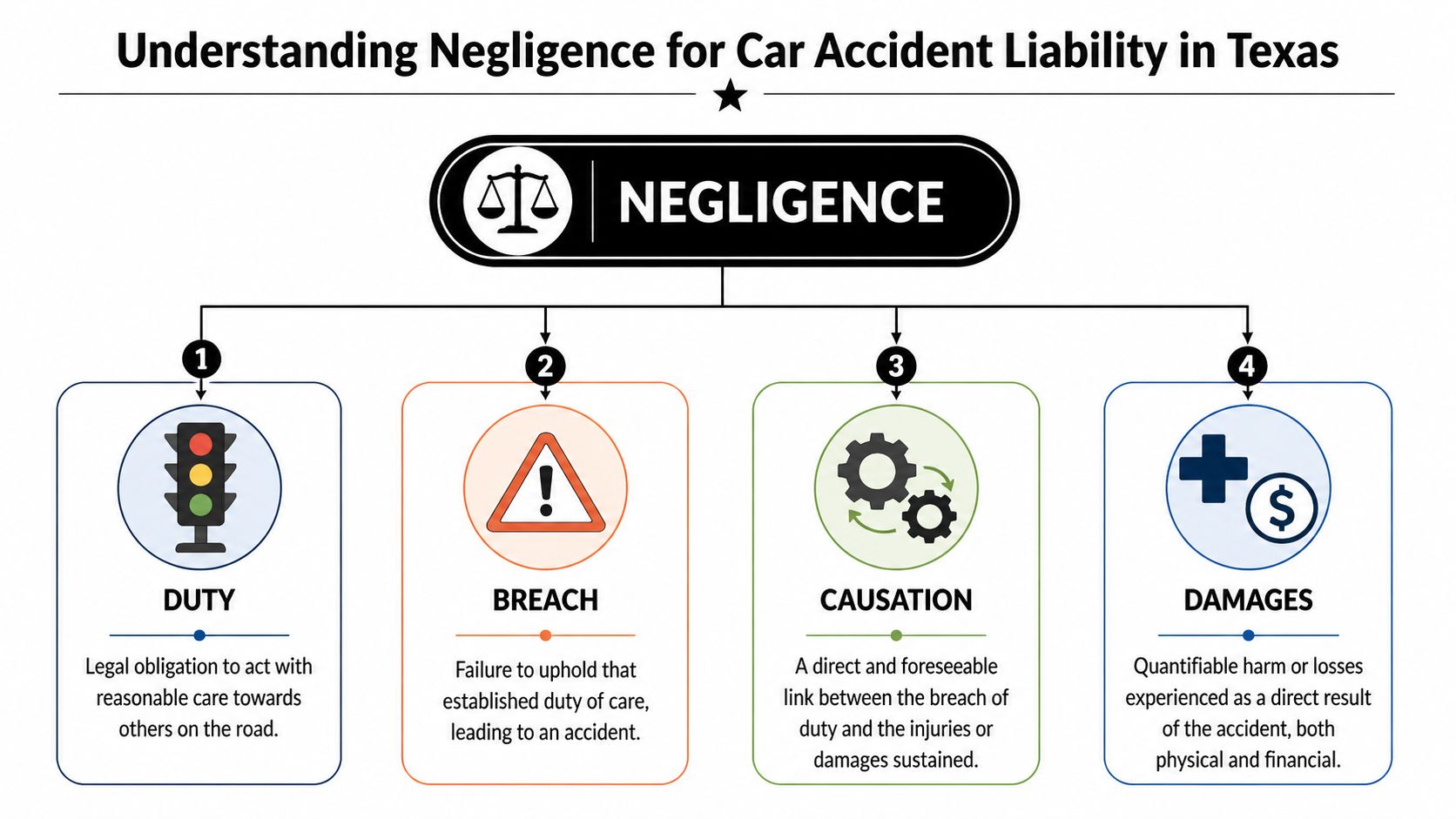
Most Texas car accident cases are based on negligence. Think of negligence as four building blocks. If the evidence supports each one, you may have a strong claim.
Duty
Every driver has a legal duty to use reasonable care. That includes obeying traffic laws, watching the road, and driving in a way that avoids preventable harm.
Breach
A breach happens when someone breaks that duty. Running a red light, texting while driving, or drifting into another lane are common examples.
Causation
Causation means the breach caused the crash and your injuries. If a driver rear-ends you at a stoplight and you suffer neck pain afterward, the case may seem straightforward. In a pileup or chain-reaction crash, proving causation can be more complicated.
Damages
Damages are the losses you suffered because of the crash. These can include medical bills, lost wages, pain, mental anguish, and property damage.
Texas comparative fault can change your case
Texas follows modified comparative negligence under Texas Civil Practice and Remedies Code § 33.001. You can recover damages only if you are 50% or less at fault. If you are 51% or more at fault, you are barred from recovering compensation, as explained in this discussion of Texas’s 51% bar under comparative fault law.
That rule matters in almost every disputed case.
Suppose a Houston driver is rear-ended on I-45 during heavy traffic. The rear driver may argue the front driver stopped suddenly. The front driver may say traffic forced the stop and the rear driver followed too closely. In that situation, fault may be divided instead of assigned entirely to one person.
If your own actions may have played some role, that doesn’t automatically destroy your claim. What matters is whether the other side carries the larger share of fault.
Why people often misjudge their own liability
Many injured people blame themselves too quickly. They tell an adjuster, “Maybe I could have reacted faster,” or “I might have been going a little over the limit.” Those statements can be used to increase your fault percentage.
That’s one reason legal advice matters early.
Here are common situations where liability is less obvious than it first appears:
- Intersection crashes: One driver says the light was green. The other says the same.
- Multi-vehicle wrecks: Several drivers may have contributed to the impact sequence.
- Commercial vehicle cases: The company may share blame, not just the driver.
- Vehicle defect cases: A failed system or defective part may have contributed to the collision.
A simple way to think about your claim
Ask these questions:
- Did someone owe you care on the road? They almost always did.
- Did they act carelessly? Look at speed, attention, signals, right-of-way, and road behavior.
- Did that careless act lead to the crash?
- Did you suffer real losses afterward?
If the answer to those questions is yes, you may have a valid claim worth discussing with a lawyer.
Insurance Claim vs Lawsuit What Is the Difference
Many people use these terms like they mean the same thing. They don’t.
An insurance claim is a demand for payment made to an insurance company. A lawsuit is a formal case filed in court. Most car accident cases start as claims and only become lawsuits if the insurance process stops being fair.

What happens in an insurance claim
After a crash, you or your lawyer notify the insurer. The company investigates, reviews documents, and may ask for a recorded statement or medical authorization. The adjuster’s job is to evaluate the claim and try to settle it.
That process can move quickly in small cases. It can also become frustrating when injuries are serious or fault is disputed.
Here’s the practical difference:
| Process | What it is | Who controls it |
|---|---|---|
| Insurance claim | A pre-lawsuit request for payment | Mostly the insurance company and the parties |
| Lawsuit | A court case seeking legal relief | The court controls deadlines and procedure |
When a claim should become a lawsuit
A lawsuit often becomes necessary when one or more of these things happen:
- The insurer denies liability: They say their driver didn’t cause the wreck.
- The offer is too low: It doesn’t cover your medical care, wage loss, and human losses.
- Your injuries are still developing: Settling too early could leave you paying later costs yourself.
- The adjuster shifts blame to you: Comparative fault becomes the central fight.
- The deadline is approaching: Filing can preserve your rights even if negotiations continue.
A lawsuit is not a sign that you’ve done something wrong. It’s the legal tool available when the insurance system stops working the way it should.
A short video can help clarify how that shift happens in real cases.
Why insurers often push for quick resolution
Insurance companies prefer speed and finality. If you settle early, you usually sign a release. That means the claim is over, even if your symptoms worsen later or you learn you need more treatment.
That’s why a quick check isn’t always a fair one.
For example, a Dallas commuter might get rear-ended, feel sore, and assume it’s minor. A week later, the pain spreads, work becomes difficult, and treatment continues. If that person accepted an early settlement before understanding the injury, the insurer may owe nothing more.
A lawsuit can create leverage
Once a lawsuit is filed, each side must follow court rules. Evidence can be requested formally. Witnesses can be questioned under oath. A judge can resolve disputes. That structure often changes the way insurers evaluate the case.
For many injured Texans, the turning point is not the crash itself. It’s the moment they realize the insurer is not going to value the claim fairly without pressure.
The Texas Car Accident Lawsuit Process Step by Step
A lawsuit feels intimidating until you break it into pieces. In reality, the process follows a sequence. Your lawyer handles the legal work while you focus on treatment and recovery.
Step one starts before filing
A good case is built before the petition is filed. Your attorney gathers records, identifies witnesses, reviews the crash report, and looks for missing evidence such as video, phone data, vehicle damage photos, or black box information.
If the crash involved a delivery van, work truck, or rideshare vehicle, the investigation may also look at company policies, app records, driver status, and employment issues. Under respondeat superior, an employer can be financially responsible for an employee’s negligence within the scope of the job, as explained in this overview of vicarious liability in delivery truck accident cases.
Filing the Original Petition
In Texas, the lawsuit usually begins when your lawyer files an Original Petition in the proper court. This document identifies the parties, explains what happened, and states the legal claims.
After that, the defendant must be served with the lawsuit and given a chance to respond.
Discovery is where cases are built
Discovery is the formal exchange of information. It often includes:
- Interrogatories: Written questions that must be answered under oath.
- Requests for production: Demands for documents, photos, records, and other evidence.
- Depositions: In-person questioning under oath, usually with a court reporter present.
This stage can feel personal because the defense may ask about your medical history, work history, and daily life after the crash. That’s normal. Your attorney prepares you so there are no surprises.
Most people don’t need to know every court rule. They do need a lawyer who knows how to use those rules to uncover the truth.
Mediation often comes before trial
Texas courts often encourage or require mediation before trial. Mediation is a settlement conference guided by a neutral third party. The mediator doesn’t decide the case. The mediator helps both sides try to reach agreement.
Many lawsuits settle here because both sides have finally exchanged enough information to evaluate the case more realistically.
Trial is the last step, not the first
If settlement doesn’t happen, the case may go to trial. A judge or jury hears the evidence, decides fault, and determines damages.
Trials take preparation. Your lawyer may present medical records, testimony from treating providers, accident reconstruction, wage-loss proof, and your own account of how the crash changed your life.
The statute of limitations matters
Texas has a statute of limitations, which is the legal deadline to file a lawsuit. In plain English, it means you don’t have unlimited time to act. Missing the deadline can keep you from recovering compensation at all.
If you want a deeper look at timing issues, this guide on statutes of limitations in Texas is a useful starting point.
What to expect emotionally
The process can take many months. Complex cases can take longer. That doesn’t mean your case is weak. It usually means the injuries, evidence, or liability questions need careful work.
A Houston family dealing with a serious wreck on I-10 may spend part of that time waiting for treatment progress, future care opinions, and complete records. In many cases, patience protects the value of the claim.
What Compensation Can You Recover in a Lawsuit
One of the hardest questions after a crash is, “What is my case worth?” The legal term for the money you seek is damages. In Texas, damages are meant to compensate you for losses caused by the crash.
Texas law commonly divides them into economic, non-economic, and, in limited cases, exemplary damages. Chapter 41 of the Texas Civil Practice and Remedies Code addresses exemplary damages, which are sometimes called punitive damages.
The three main categories
| Type of Damage | What It Covers | Examples |
|---|---|---|
| Economic damages | Financial losses that can often be documented | Medical care, lost wages, vehicle repair, out-of-pocket costs |
| Non-economic damages | Human losses that don’t come with a fixed invoice | Pain, mental anguish, physical impairment, loss of enjoyment of life |
| Exemplary damages | Damages that may punish extreme misconduct under Chapter 41 | Cases involving especially reckless conduct, such as some drunk driving situations |
Economic damages are the foundation
These are often the easiest to identify because they leave a paper trail. Bills, receipts, treatment records, repair invoices, and payroll records all help show what the crash cost you.
A person hit by a distracted driver in Houston might recover ambulance charges, emergency room care, follow-up treatment, physical therapy, and income lost during recovery. If the injuries affect future work, those losses may also matter.
Non-economic damages matter just as much
Not every loss shows up on a bill.
Pain, sleep disruption, anxiety during driving, physical limitations, and the inability to enjoy daily life are all real harms. If you can’t pick up your child, return to hobbies, or sit through a workday without pain, those are part of the case too.
Your claim is not just about what the hospital charged. It’s also about what the injury took from your day-to-day life.
Exemplary damages are different
Exemplary damages are not available in every case. They are reserved for conduct that goes beyond ordinary negligence. Chapter 41 places special rules on these claims, and they usually require stronger proof than a standard injury case.
Medical billing can affect value
An emerging legal trend in some places limits recovery for medical care to the amount paid by insurance rather than the full amount billed. One example discussed in this video on actual-paid medical damages and claim value uses a hospital bill of $50,000 with an insurance payment of $10,000 to show how recoverable amounts may be limited in some reform systems.
That issue matters because billing rules can affect settlement advantage. It also shows why careful documentation and negotiation over bills, liens, and payment records can be important.
If you want to better understand valuation, this article on how to calculate damages can help you see how lawyers organize these losses.
A common misunderstanding
People often focus only on the property damage because it feels concrete. But a badly damaged car does not automatically mean a strong injury case, and a modestly damaged car does not automatically mean a weak one. The value of a lawsuit for car accident injuries depends on the full picture, including medical proof, liability, and how the injury changed your life.
Building Your Case The Evidence That Matters
Strong cases are usually built from ordinary documents gathered early and preserved carefully. The best evidence often comes from the first hours and days after the crash.
Your evidence checklist
Keep these items if you have them, and don’t panic if you’re missing some. A lawyer can often help obtain what you don’t have.
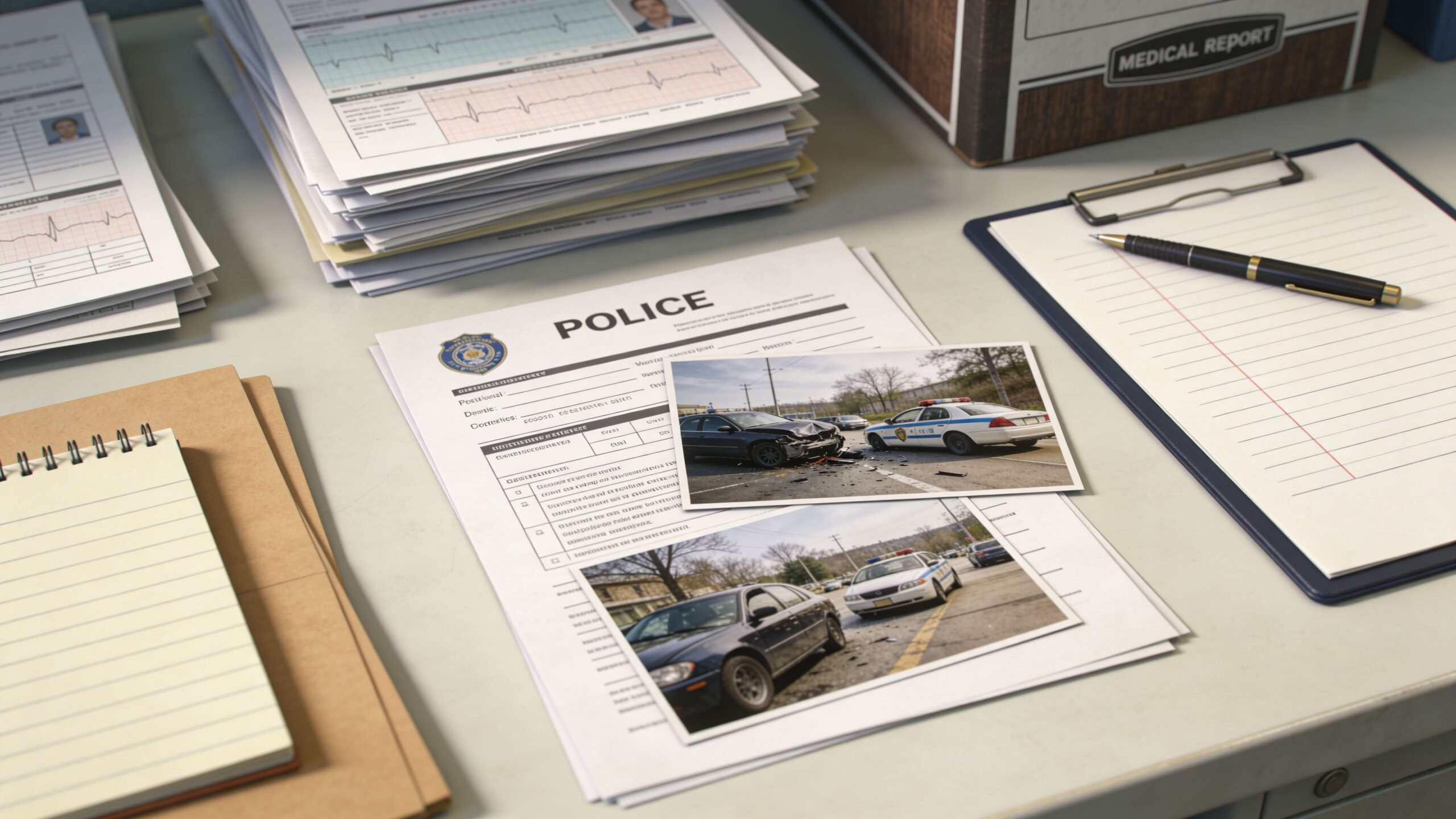
- Crash report: The officer’s report may identify drivers, witnesses, insurers, and initial observations. If you’ve never looked at one closely, this guide on how to read a police accident report can make it less confusing.
- Photos and video: Take pictures of vehicle positions, damage, skid marks, debris, traffic signs, weather, and visible injuries.
- Witness information: Names and phone numbers matter because memories fade quickly.
- Medical records and bills: These connect the crash to your injuries and show the care you needed.
- Proof of lost income: Pay stubs, employer letters, missed shifts, and disability paperwork can support wage claims.
- Repair estimates and vehicle records: These help document property damage and the force of impact.
Modern evidence can cut both ways
Cars, phones, and apps collect more data than many people realize. Insurers and tech companies may gather driving data through telematics in vehicles and smartphone apps such as GasBuddy or Life360. That information can include speed, hard braking, and location, and it may be used to build a risk profile during a claim or lawsuit, as discussed in this article on driver data privacy and Texas telematics disputes.
That doesn’t always mean the data is accurate, complete, or admissible. It does mean you should take data preservation seriously.
What not to do with adjusters
Insurance adjusters often ask for recorded statements early. You may think you’re just being helpful. In reality, they may be looking for details they can use later to argue you weren’t badly hurt or that you admitted fault.
Avoid these common mistakes:
- Guessing about speed or timing: If you don’t know, don’t estimate.
- Minimizing your pain: Saying “I’m fine” at the scene or on the phone can be taken out of context.
- Signing broad medical releases: These may allow the insurer to dig through unrelated history.
- Posting freely online: Photos and comments can be misread or used selectively.
Save first, speak carefully second. Evidence disappears faster than most people expect.
The goal of evidence
Evidence does two jobs. It helps prove liability, and it helps prove damages. One without the other is not enough. The more clearly your records tell the story of what happened and what it cost you, the stronger your position becomes.
Why You Need a Houston Car Accident Lawyer on Your Side
A week after a crash, you may still be in pain, your car may still be in the shop, and the insurance company may already be asking for statements, records, and quick answers. That is the point when many Texas cases start to turn. What looked like a routine claim can become a dispute about fault, medical treatment, or whether the insurer will pay fairly.
A Houston car accident lawyer helps at that turning point. In Texas, timing and strategy matter because the rules do. An attorney can assess whether your case should stay in the insurance-claim stage or whether it is time to prepare for a lawsuit under Texas law. That includes looking closely at disputed fault under the state’s modified comparative fault rule, preserving evidence before it disappears, and making sure the statute of limitations does not run out.
Some cases are larger than they first appear
That is common in work-related, commercial, and delivery crashes. The person who hit you may not be the only party that matters.
If the driver was working, making deliveries, or using a company vehicle, there may be questions about employer responsibility, company policies, or additional insurance coverage. A lawyer can examine whether the case involves only an individual driver or a business with deeper responsibility for what happened.
A lawyer helps shape the case before a lawsuit is filed
Many people assume hiring a lawyer means going straight to court. In practice, good legal help often starts earlier. It starts by getting control of the facts.
That matters because the shift from claim to lawsuit usually happens for a reason. Maybe the insurer is denying liability. Maybe they are blaming you for more of the crash than the evidence supports. Maybe they are offering money that does not come close to covering treatment, missed income, and future care. A lawyer prepares the case with court in mind, which puts real pressure on an insurer to take the claim seriously.
Here is what that help often looks like:
- Evaluating fault under Texas rules: If the insurer says you were partly to blame, a lawyer can test that claim against the evidence.
- Identifying every liable party: This is especially important in company vehicle, rideshare, and defective vehicle cases.
- Calculating the full value of harm: A case is not just about current medical bills. It may include future treatment, lost earning ability, pain, and daily limitations.
- Preparing evidence for litigation: Records, witness statements, photos, and expert opinions carry more weight when they are organized early and built for possible court use.
If prior vehicle damage or ownership history becomes part of the dispute, it may help to uncover an accident history by VIN before the other side turns an assumption into an argument.
Contingency fees, in plain English
Many personal injury firms handle car accident cases on a contingency-fee basis. The Law Office of Bryan Fagan, PLLC, uses that model for these cases. That means attorney’s fees are paid from a recovery if the case succeeds, not up front.
For an injured family, that can make legal help realistic at a time when bills are already piling up.
Legal help gives you room to recover
You do not have to decide today that you want a trial. You do not have to know every legal term, either.
You only need to know when the claim is no longer being handled fairly. A lawyer can step in, deal with the insurer, explain your options in plain English, and help you decide whether filing suit is the right next step under Texas law. That gives you a clearer path, and often a calmer one, while you focus on healing.
Your Next Steps Toward Justice and Recovery
After a serious crash, the legal system can feel cold and confusing. It doesn’t have to stay that way.
Your rights in Texas depend on a few key ideas. Someone else must be legally liable. Your fault must stay within Texas’s modified comparative fault rule. Your damages must be documented. And your case must be filed before the statute of limitations expires.
Those are legal rules. They are important. But they are not the whole story.
The human side matters too. You may be worried about missing work, paying for treatment, replacing a vehicle, or caring for a loved one with serious injuries. If your family is grieving a fatal crash, questions about wrongful death compensation can feel overwhelming. You deserve answers that are clear, respectful, and grounded in Texas law.
Start with a few practical steps:
- Get medical care and follow up consistently
- Save records, photos, and insurance letters
- Avoid casual recorded statements
- Talk with a lawyer before accepting a settlement
Taking action doesn’t mean you’re being aggressive. It means you’re protecting yourself.
Frequently Asked Questions About Car Accident Lawsuits
How much does it cost to hire a car accident lawyer in Texas
Most personal injury lawyers handle these cases on a contingency-fee basis. In plain English, that means you usually don’t pay attorney’s fees up front. The lawyer is paid from the recovery if the case resolves successfully. That arrangement allows many injured people to get help even when money is tight after a crash.
Will I have to go to court
Not always. Many cases resolve through insurance negotiations, informal settlement talks, or mediation. Filing a lawsuit for car accident injuries does not automatically mean you will testify before a jury.
Still, your lawyer should prepare the case thoroughly in case court becomes necessary. That preparation often improves settlement discussions because the other side knows the claim is being taken seriously.
What if the other driver had no insurance or not enough insurance
You may still have options. Depending on your policy, uninsured motorist or underinsured motorist coverage may apply. These claims can become disputed too, especially when your own insurer questions fault, injuries, or value.
A lawyer can also examine whether other parties share responsibility, such as an employer, vehicle owner, or another driver involved in the crash sequence. In some cases, that broader investigation changes the whole direction of the claim.
What does comparative fault mean in plain English
Comparative fault means more than one person can share blame for the same crash. In Texas, your recovery can be reduced if you were partly at fault. If your share of fault is too high under Texas law, you can be barred from recovery entirely.
That’s why small statements can matter. A casual apology, an inaccurate estimate about speed, or an incomplete police report can affect how fault gets argued later.
Can I recover for emotional distress after a crash
Texas law may allow recovery for non-economic damages tied to pain, suffering, and mental anguish when the evidence supports them. These losses are real even though they don’t come with a receipt. Good documentation, consistent treatment, and clear testimony often matter when proving them.
If you were hurt in a crash and need clear guidance about your rights, contact The Law Office of Bryan Fagan, PLLC for a free, confidential, no-obligation consultation. We can help you understand your options, deal with the insurance process, and decide whether filing a lawsuit for car accident injuries is the right next step for you and your family.