Skip to content
A work injury can throw your life off course in a single shift. One minute you're lifting, driving, stocking, climbing, or making a delivery. The next, you're in pain, missing work, and wondering who pays for treatment, whether your employer will believe you, and how you're supposed to keep your household running.
If that's where you are today, take a breath. Texas workers' compensation law is confusing, especially in Dallas where many injured workers learn too late that their employer may not even carry standard workers' comp coverage. A good dallas workers compensation attorney helps you understand which path your case is on, what deadlines matter, and how to protect yourself if your employer or an insurance company starts pushing back.
Understanding the Texas Workers Compensation System
A Dallas worker can get hurt doing the same job, in the same way, and still end up in a very different legal system than a coworker across town. The difference often comes down to one question: did the employer subscribe to Texas workers' compensation, or did it opt out?
That split confuses people for a good reason. Texas is unusual. Private employers can choose whether to carry workers' compensation coverage. So before anyone can evaluate benefits, fault, or whether a lawsuit is possible, they have to identify which system applies.
Two different paths after the same injury
If your employer is a subscriber, your claim usually goes through the Texas Department of Insurance, Division of Workers' Compensation. You can generally seek medical and income benefits without proving your employer was careless. In exchange, you usually cannot sue that employer for ordinary negligence.
If your employer is a non-subscriber, there may be no standard workers' comp claim at all. Your case may become a negligence claim against the employer or involve a private occupational injury plan with its own rules, forms, and restrictions.
That distinction matters a lot in Dallas-Fort Worth, where many injured workers first learn about non-subscriber status only after they report an injury and get handed unfamiliar paperwork. Some are told to use a private claims administrator. Others are pushed toward internal reporting systems that sound official but are not the state workers' comp process. If you want a broader primer on what to do after getting hurt at work in Texas, that can help you place your case in the right category early.
How to tell which system applies to you
Do not assume your employer carries workers' comp because the company is large, has an HR department, or gave you onboarding documents. None of those facts confirms subscriber status.
Start with a few direct questions:
- Who handles work injury claims for the company
- Whether the employer carries Texas workers' compensation insurance
- Whether you signed a non-subscriber plan, injury benefit plan, or arbitration agreement
- Whether HR sends injured workers to the Division of Workers' Compensation or to a private administrator
Here is a simple way to understand the difference. In a subscriber case, the rules come from the state system. In a non-subscriber case, the employer often built its own process, and that process may be designed to limit the company's exposure.
A warehouse employee with a shoulder injury might be sent to an approved doctor under the state comp system. A delivery driver with the same injury might be told the company has a private benefit plan and that all disputes go through arbitration. Same injury. Different rules. Different risks.
Practical rule: Before you decide what forms to sign or what statements to give, confirm whether your employer is a subscriber or a non-subscriber.
Why this distinction changes everything
In a subscriber claim, early disputes usually focus on medical evidence, work restrictions, whether the injury was reported properly, and whether benefits should start or continue.
In a non-subscriber case, the questions often shift quickly to negligence. Was the worker properly trained? Was equipment missing or broken? Did the employer ignore prior complaints? Was the job rushed in a way that made injury more likely?
This is also where many Dallas workers run into a problem competitors often gloss over. Employer retaliation fears are real, especially in non-subscriber settings. Injured workers may worry about losing hours, being written up, getting moved to a harder job, or being eased out after asking questions. That fear can lead people to stay silent, sign forms too quickly, or accept the company's version of events before they understand their rights.
Silence helps the employer, not the worker.
Where personal injury law can overlap
Some job injuries involve more than a workers' comp issue. A third party may have caused or contributed to the harm. In those cases, personal injury law can overlap with a subscriber claim or a non-subscriber case.
In plain English:
- Liability means legal responsibility for causing the injury.
- Damages means the losses the law may allow you to recover, such as medical bills, lost wages, and in the right case, pain and suffering.
- Comparative fault means a court can examine whether more than one person shares blame.
- Statute of limitations means the deadline for filing a legal claim.
For example, if a worker is struck by another driver's vehicle while making deliveries, there may be a work injury claim and a separate claim against the negligent driver. If defective equipment contributed to the injury, a manufacturer may also be involved.
That is why the first goal is clarity. You need to know which legal system applies, who may be responsible, and whether your employer is using a private non-subscriber plan that changes the rules from the start.
The First Steps After Your Dallas Work Injury
The first day after an injury is often the most important. Not because you need to know every law. You don't. It matters because the early record of what happened can shape everything that follows.
Step one is medical care
Get the care you need right away. If it's an emergency, call for emergency help or go to the ER.
If it isn't life-threatening, don't just "wait and see" for a week because you hope it will pass. Delayed treatment gives employers and claims handlers room to argue that you weren't really hurt at work or that something else caused your condition.
When you talk to the doctor, be specific. Say where you were, what task you were doing, what part of your body hurts, and when symptoms started.
Step two is written notice to your employer
Tell your employer about the injury in writing as soon as you can. Email, text, or a written incident report is often better than a hallway conversation that nobody remembers later.
Include these basics:
- Date and time of the incident or when you first became aware of the condition
- Location where it happened
- What you were doing at the time
- Body parts affected
- Names of witnesses, if any
A common mistake is being too casual. "I tweaked my back" sounds very different from "I hurt my lower back while lifting inventory from a pallet during my shift."
If you'd like more practical guidance after an on-the-job injury, this overview on what to do if you're hurt at work in Texas can help you think through the next moves.
Step three is preserving proof before it disappears
Workplaces get cleaned up. Cameras record over footage. Supervisors move equipment. Witnesses forget details.
Try to preserve:
- Photos of the scene including tools, floors, vehicles, ladders, shelves, or machinery
- Photos of visible injuries if there are bruises, cuts, swelling, or burns
- Witness names and contact information
- Your own notes about what happened and how you felt afterward
Write down the facts while they're fresh. Short notes made the same day are often more reliable than memory weeks later.
Step four is formal filing if the case is in the comp system
For workers in the formal Texas workers' compensation system, filing deadlines matter. According to the Texas Bar demographic and economic trends page, a claim must be filed through Form DWC-041 within one year of the injury date.
That same source notes that Dallas County had 17,620 active attorneys in 2024, while workers' compensation specialists remain a small share of the field. That matters because injured workers often assume any lawyer handles these claims. Many don't.
A short example
Say a Dallas forklift operator feels a sharp shoulder injury while unloading a truck. He tells a coworker, goes home, and hopes rest will fix it. A week later, he reports it. By then, the employer says there was no incident report, no witness statement, and no reason to connect the injury to work.
The same worker would be in a stronger position if he got checked the same day, sent written notice that night, photographed the work area, and kept a copy of every form.
Critical Timelines and Deadlines You Cannot Miss
Deadlines in work injury cases aren't suggestions. They can decide whether you get benefits, preserve a lawsuit, or lose an advantage before your case really starts.
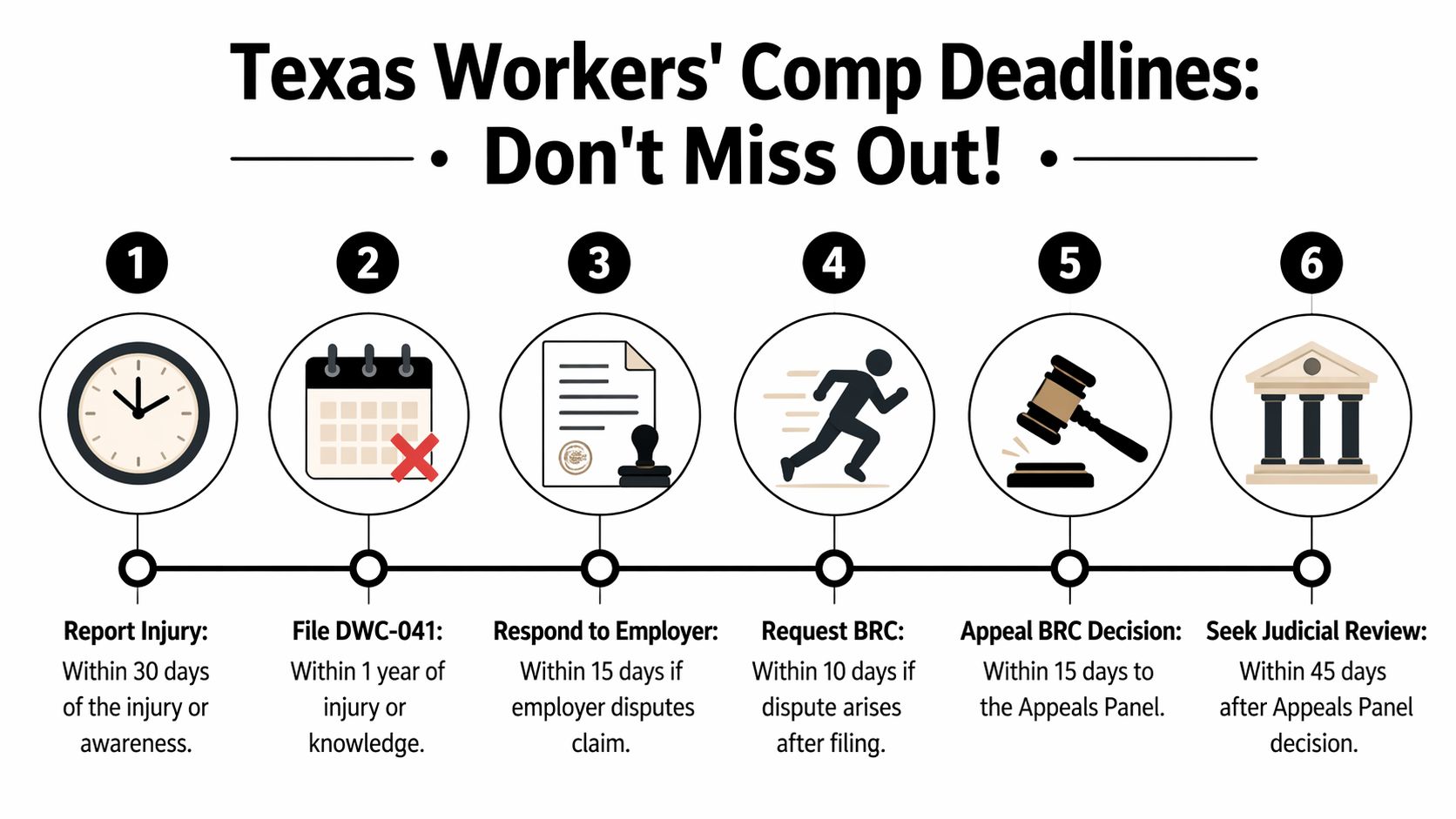
The two dates most injured workers need to know first
The first deadline is the deadline to notify your employer. In Texas work injury matters, prompt notice is critical. The rules are strict, and delay gives the other side a ready-made defense.
The second deadline is the filing deadline for the formal workers' comp claim. If your case is in the state system, the filing window doesn't stay open forever.
Here's the simplest timeline to remember:
| Deadline | Why it matters |
|---|---|
| Report the injury to your employer within 30 days | Late notice can lead to disputes about whether the injury happened at work |
| File Form DWC-041 within one year | Missing this can block a formal workers' compensation claim |
Why these deadlines are so unforgiving
A late report creates doubt. Employers may say they couldn't investigate. Insurers may say there is no reliable connection between the job and the injury. Even if you know you're telling the truth, the legal issue becomes proof.
A late filing creates a different problem. The state system runs on forms, deadlines, and documented steps. If the filing deadline passes, your options may narrow sharply.
For a broader look at legal filing periods in injury cases, this guide on Texas statutes of limitations is a useful reference.
Missing a deadline doesn't just delay a case. It can change whether a case exists at all.
Confusion is common in gradual injuries
Not every work injury comes from one obvious accident. Some develop over time, like repetitive lifting injuries, worsening knee damage, or conditions that become impossible to ignore only after weeks or months.
That creates confusion about when the clock started. Was it the first day you felt pain, the day you sought treatment, or the day you understood it was work-related? These cases need careful handling because employers and insurers may argue for the earliest possible date.
Keep your own calendar
Don't rely on HR, a supervisor, or an adjuster to track your rights for you. Keep a simple timeline with:
- The injury date or date of awareness
- The date you gave notice
- Every doctor visit
- Every letter, email, or text about the claim
- Every deadline mentioned in forms or notices
A notes app, paper calendar, or folder on your phone is enough. The key is consistency.
A simple example
A Dallas nurse strains her back while moving a patient but thinks it's minor. She continues working, then seeks treatment when the pain gets worse. If she waits too long to report the incident because she thought it would heal, the employer may argue that the injury wasn't tied to work at all.
The legal lesson is straightforward. Report first. Sort out the details with help later.
Common Pitfalls and Employer Defenses to Watch For
A Dallas warehouse worker reports a shoulder injury after lifting inventory. Two weeks later, the conversation has changed. The employer is no longer focused on what happened. The questions become whether the worker had prior shoulder pain, whether he lifted the box the "right" way, and whether he waited too long to speak up.
That shift catches many injured workers off guard. A claim can turn into a credibility fight very quickly, especially in Dallas-Fort Worth cases involving non-subscriber employers, internal benefit plans, or managers who care more about controlling costs than getting the facts right.

Defenses you are likely to hear
Employers, insurers, and third-party administrators tend to rely on a familiar set of arguments. Once you know what they are, you can spot them earlier and respond with better proof.
Pre-existing condition
This defense argues that your back, knee, neck, or shoulder problem started before the work incident. Prior treatment does not automatically defeat a claim. Often, the key question is whether work caused a new injury, worsened an old one, or made a manageable condition disabling.Outside the course and scope of employment
This means they claim you were not doing work that counted as part of your job. These disputes often come up during travel, breaks, off-site tasks, parking lot incidents, or errands your supervisor informally approved but never documented.Safety rule violation
An employer may argue that you ignored training, failed to use equipment, or broke a policy. Sometimes that is a fair issue. Sometimes the rule gets emphasized only after someone gets hurt, which is why training records, witness statements, and past enforcement matter.Late report
Delay gives the other side room to argue that the injury happened at home, was not serious, or was never reported clearly enough. In a close case, a few missing details can become the center of the dispute.
A claim file works a lot like a puzzle. The employer will point to the missing pieces. Your job is to preserve them early, before they disappear.
Non-subscriber paperwork can change the case
Dallas workers often assume every job injury goes through the same state system. Texas does not work that way. Many employers are non-subscribers, which means they do not carry standard workers' compensation coverage and may use private occupational injury plans instead.
Those plans can come with claim packets, medical releases, arbitration agreements, recorded statement requests, and tight internal reporting rules. The forms may look routine. They are not routine. A single signature can affect where a dispute gets decided and how your medical history gets handed over.
Claims administrators also shape these cases in practical ways. Delays, repeated document requests, and narrow readings of medical restrictions are common pressure points. This overview of Sedgwick workers' comp issues in Texas claims explains how that process can stall or complicate a case.
If English is not your first language, get help before signing anything. Misreading one sentence in a release or benefit election form can create problems later. Some workers use expert document translation services in Dallas to make sure they understand exactly what they are being asked to accept.
Retaliation often starts before an outright denial
Some employers do not fire an injured worker on day one. They apply pressure in smaller ways first.
Hours get cut. A worker with restrictions gets assigned the hardest tasks anyway. Write-ups begin after years of no discipline. A supervisor starts saying the worker is "not a team player" for following medical restrictions. Return-to-work pressure builds even though the treating doctor has not cleared full duty.
Texas law prohibits retaliation for pursuing a workers' compensation claim in many circumstances, and state law on employment discrimination and retaliation also shapes how these disputes are analyzed. The Texas Workforce Commission's retaliation overview is a good starting point for understanding how retaliation complaints are treated.
Retaliation can be subtle. That is what makes it dangerous.
What retaliation can look like in real life
Watch for patterns like these:
- Demotion after you report the injury
- Sudden schedule cuts that reduce your paycheck
- Discipline that begins only after claim activity
- Pressure to resign instead of remain on restrictions
- Threats tied to medical appointments or light-duty requests
- A transfer to harsher work because you "caused trouble"
Save the proof. Keep texts, emails, write-ups, changed schedules, time records, and notes of conversations with dates and names. In retaliation cases, the timeline often matters as much as the words themselves.
A short explainer may help if you're dealing with a disputed claim or pressure from your employer.
Some work injury cases also involve negligence law
This issue comes up often with non-subscriber employers, contractors, staffing companies, and third parties such as delivery drivers or equipment manufacturers. In those cases, the dispute is no longer only about benefits. It may also be about fault and damages under Texas personal injury law.
Under Texas Civil Practice & Remedies Code Chapters 33 and 41, several ideas can affect the value of the case:
- Liability means who was legally responsible for causing the injury.
- Comparative fault asks whether the worker and another party share blame.
- Damages refers to the losses the law may allow, such as medical costs, lost income, and other harm recognized by law.
- Statute of limitations means the deadline for filing suit.
A simple example helps. If a Dallas construction worker gets hurt because a machine guard was removed, the employer may blame the worker for using the equipment incorrectly. A negligence case looks deeper. Who removed the guard? Who knew it was unsafe? Who allowed the job to continue anyway? Those questions can determine whether the injured worker has a stronger case than the employer first suggests.
How a Dallas Workers Comp Attorney Protects Your Rights
You report the injury. By the next day, your supervisor stops returning calls, someone asks for a recorded statement, and a manager hints that your job may disappear if you "make this a problem." That is the point where many Dallas workers realize the claim is no longer only about medical care. It is also about protecting their job, their income, and the facts.
A dallas workers compensation attorney helps put structure around a stressful situation. The lawyer's role is part shield, part builder. First, they slow down the pressure. Then they build the proof needed to support your side of the case.
A lawyer brings order to a process that often feels stacked against you
After a work injury, small mistakes can grow into larger problems. A missed doctor visit may be framed as proof you were not badly hurt. An incomplete incident report may later be used to argue that your injury happened somewhere else. If your employer is a non-subscriber, the risk is even greater because the case may turn into a negligence claim, where the company and its insurance team start looking for ways to shift blame.
A lawyer addresses those problems early by:
- gathering the incident report, photographs, witness names, and safety records
- comparing what you told your employer, doctor, and insurer for consistency
- reviewing whether you are dealing with a subscriber claim, a non-subscriber case, or both a work injury claim and a third-party case
- handling adjuster and employer communications so you do not get pushed into harmful statements
- spotting retaliation issues, such as reduced hours, sudden discipline, or termination after reporting the injury
That last point gets missed in many articles, but Dallas workers ask about it all the time. The fear is real. Some workers stay quiet about symptoms because they need the paycheck and worry they will be replaced if they speak up.
Non-subscriber cases often require a different kind of proof
Texas gives many private employers the choice not to subscribe to the state workers' compensation system. The Texas Department of Insurance explains the difference between subscribers and non-subscribers on its employer workers' compensation coverage guide. For an injured worker, that choice changes the road map.
A subscriber case usually centers on benefits rules, medical evidence, and agency procedure. A non-subscriber case often centers on negligence. That means your lawyer may need to prove the employer failed to use ordinary care, such as by ignoring known hazards, keeping too few workers on a shift, failing to train new hires, or pushing production over safety.
The strategy also changes when the employer argues you were not really an employee. That issue shows up with staffing agencies, delivery work, app-based work, and some construction jobs. A lawyer examines payroll records, supervision, schedules, contracts, and who controlled the work. Those details can decide whether the company can avoid responsibility or not.
Everyday communication can strengthen or weaken your case
Many injured workers do not lose ground in a courtroom first. They lose ground in text messages, intake forms, and recorded calls.
A lawyer helps you answer questions carefully and consistently. That does not mean hiding facts. It means saying what is true, clearly and completely, without guessing or minimizing your symptoms. A case works a lot like building a chain. Each medical record, report, and statement is one link. If several links do not match, the other side will pull on that weak spot.
Language can create another problem. If your medical records, employment papers, or witness statements involve more than one language, accuracy matters. In those situations, expert document translation services in Dallas can help make sure important paperwork says exactly what it should.
A lawyer also protects you from rushed settlements and hidden exposure
Early offers can look appealing when the rent is due. But a quick settlement before the diagnosis is clear can leave you paying for future treatment or living with restrictions that were never fully valued.
A careful attorney asks questions injured workers often do not yet know to ask:
- Has the full injury been diagnosed, including related back, neck, or nerve damage?
- Will future treatment, surgery, or therapy be needed?
- Has the employer taken any action that looks like retaliation for reporting the injury?
- Is a third party involved, such as a subcontractor, driver, property owner, or equipment company?
- Are there documents, camera footage, or maintenance records that need to be preserved now?
Those questions matter in serious injury cases and fatal incidents alike. They also matter in work-related vehicle crashes, where one event can involve job injury rules, liability insurance, and a negligence claim against someone outside the company.
Good legal help does more than file paperwork. It protects the story of what happened, preserves evidence before it disappears, and gives an injured worker a fair chance to stand up to an employer or insurer that is already preparing its defense.
The Types of Compensation You Can Recover
A Dallas worker who gets hurt on the job usually wants a straight answer fast. How will the bills get paid. What happens to missed paychecks. Can you recover anything for pain, long-term limits, or the job you may not be able to do the same way again.
The answer starts with one fork in the road. Was your employer a workers' compensation subscriber, or a non-subscriber?
That difference shapes almost everything about recovery. A subscriber claim usually provides defined benefits under Texas rules. A non-subscriber case may allow a broader negligence claim, which matters a great deal in Dallas-Fort Worth because many workers are surprised to learn their employer opted out of the state system.
Benefits in a standard workers' comp claim
Texas workers' compensation is built more like a benefits system than a personal injury lawsuit. The goal is to cover approved medical care and replace part of your lost income. It does not usually pay the full range of damages you may hear about in a lawsuit.
Here is the basic framework:
| Benefit Type | Purpose | Payment Details |
|---|---|---|
| Medical Benefits | Pay for reasonable and necessary care related to the work injury | Can include doctor visits, hospital care, medications, therapy, and other approved treatment |
| Temporary Income Benefits | Help replace wages while you can't earn your usual pay during recovery | Paid under workers' comp rules while you have qualifying disability |
| Impairment Income Benefits | Address lasting impairment after you reach maximum medical improvement | Tied to impairment findings under the comp system |
| Supplemental Income Benefits | Help some workers with ongoing wage loss after serious lasting effects | Available only in certain cases |
| Lifetime Income Benefits | Provide long-term support for the most severe qualifying injuries | Limited to specific catastrophic situations |
Temporary Income Benefits often create confusion, so it helps to slow down here. Texas law generally calculates these benefits as a portion of your average weekly wage, subject to state limits. The Texas Department of Insurance explains these benefit categories and how income benefits work under the workers' compensation system on its workers' compensation benefits overview.
In plain terms, workers' comp usually pays part of lost wages, not your full paycheck.
What compensation can look like in a non-subscriber case
A non-subscriber claim works very differently. It is usually a negligence case against the employer, not a claim for preset statutory benefits. That means the injured worker may be able to pursue losses that standard workers' comp does not cover.
Depending on the facts, damages may include:
- Medical expenses
- Lost wages
- Loss of future earning capacity
- Physical impairment
- Pain and suffering
- Mental anguish, where the evidence and law support it
This is one reason non-subscriber cases deserve close attention in Dallas. The upside can be broader recovery. The tradeoff is that you must prove the employer's fault. In real life, that often means fighting over unsafe staffing, missing training, broken equipment, ignored complaints, or pressure to work through dangerous conditions.
Retaliation concerns also show up here more often than injured workers expect. A worker reports an injury, then shifts disappear, discipline starts, or a supervisor begins building a paper trail. Those facts may not change the medical harm itself, but they can affect evidence, witness cooperation, and the pressure an injured worker feels to accept less than the claim is worth.
Plain-English legal terms that affect value
A few legal terms can make this feel harder than it is.
Liability means legal responsibility for the injury.
Comparative fault means the defense may argue that you share some blame in a negligence case. This issue matters outside the standard workers' comp system, especially in non-subscriber and third-party injury claims.
Damages means the specific losses the law allows you to recover.
A work-related driving case shows how these pieces can overlap. If a Dallas delivery driver is injured by another motorist, the worker may have a job injury issue and a separate negligence claim against the at-fault driver. The value of that case depends on the medical proof, wage loss, future limits, and who can be held legally responsible.
Your case value depends on two things at the same time. How serious the harm is, and which legal path applies.
Why early settlement can be risky
Early money can feel like relief when the mortgage is due and your doctor is restricting work. But a claim is hardest to value before the full medical picture is clear.
A back injury may later involve nerve damage. A shoulder injury may turn into surgery. A worker who expects to return in two weeks may learn months later that lifting restrictions are permanent.
That is why timing matters so much, especially in non-subscriber cases. Once a settlement is signed, reopening the claim is often difficult or impossible. If the employer has already started pushing back, denying fault, or treating you differently after the report, a quick offer may be less about fairness and more about closing the file before the full cost of the injury is known.
Frequently Asked Questions for Injured Dallas Workers
A warehouse worker in Dallas hurts his back lifting inventory, reports it, and expects the company to explain what happens next. Instead, his supervisor tells him to "use your own insurance," cuts his next shift, and warns him not to "make this a legal thing." That kind of confusion is common here because Texas does not require every private employer to carry workers' compensation insurance, and that single fact changes almost everything.
Do I need a lawyer for every work injury
Some claims stay straightforward. Many do not.
The hard part is not the injury alone. It is figuring out which rulebook applies. A subscriber claim usually runs through the Texas workers' compensation system. A non-subscriber claim can look more like a negligence case against the employer. If you are also facing pressure not to report the injury, a sudden change in schedule, or blame-shifting after the accident, legal advice can help you avoid a costly mistake early.
Workers' compensation law is a specialized area of practice. The Texas Board of Legal Specialization keeps a directory of attorneys certified in Workers' Compensation Law, which gives injured workers one way to identify lawyers who focus on this field.
What if my employer says I can't file
Your employer does not decide whether you have rights.
Start by treating this like preserving evidence after a car crash. Report the injury in writing. Keep copies of every text, email, incident report, work restriction, and medical record. If the employer is a non-subscriber, the company may try to steer you away from making a claim at all. If the employer subscribes to workers' compensation, management still cannot erase the reporting process by saying no.
Silence helps the company, not you.
Can I be fired for reporting a work injury
Texas workers often ask this question in a whisper, because retaliation is one of the biggest real-world fears after an injury.
A sudden drop in hours, reassignment to a worse job, write-ups that begin only after you report the injury, or pressure to resign can all matter. The pattern matters as much as the single event. Save messages. Take screenshots. Write down who said what and when. In Dallas-area cases involving non-subscribers, retaliation concerns often appear alongside disputes about fault, safety rules, and whether the worker was hurt on the job at all.
What if I was hurt while driving for work
A driving injury can involve several layers at once.
If you were making deliveries, traveling between job sites, or driving for another work duty, you may have a job injury issue and a separate claim against the at-fault driver. Those cases can feel like trying to solve two puzzles on one table. The employment side determines what benefits or claims may exist through your job. The crash side raises questions about negligence, insurance coverage, and who caused the wreck.
That overlap is one reason workers should be careful before giving recorded statements or signing early paperwork.
What does comparative fault mean
Comparative fault is the rule that more than one person can share legal blame for an injury.
It comes up more often in non-subscriber and third-party cases than in a standard subscriber workers' compensation claim. For example, an employer may argue that you lifted the box the wrong way, ignored training, or failed to watch where you were walking. That argument is not just about telling the story of the accident. It can be a strategy to reduce what the employer pays or avoid responsibility altogether.
How long do I have
The answer depends on the type of claim, and that is why delay is risky.
A subscriber claim has one set of deadlines. A non-subscriber injury claim or third-party lawsuit may have another. Retaliation claims can involve separate timing issues as well. The safest approach is simple. Report the injury right away, get medical attention, preserve your records, and speak with a lawyer before the calendar starts working against you.
If you were hurt on the job in Dallas or anywhere in Texas, you do not have to sort through this system alone. The Law Office of Bryan Fagan, PLLC offers compassionate, clear guidance for injured workers and families trying to protect their rights after a serious accident. Whether your case involves a subscriber claim, a non-subscriber employer, retaliation, a driving-related workplace injury, or questions about wrongful death compensation, the firm can help you understand your options in a free consultation.