Skip to content
A car crash can change your life in seconds, but you don’t have to face recovery alone.
You may have walked away from the wreck thinking you were lucky. Maybe you were rear-ended on I-10 in Houston during rush hour. Your car has damage, your back feels tight, and the other driver’s insurer acts like this should be a simple auto insurance claim. Then the next morning comes. Your lower back burns. Pain shoots into your leg. Sitting, driving, and sleeping all become hard.
That’s a common way a herniated disc enters someone’s life.
People often search for “settlement herniated disc” because they need straight answers fast. They want to know whether their injury is serious, whether Texas law protects them, and whether the insurance company is trying to pay less than the claim is worth. Those are fair questions.
A herniated disc case sits at the crossroads of medicine and law. You need proof of what happened inside your spine. You also need to show who caused the crash, how the injury changed your daily life, and how Texas rules affect your right to recover money.
A Crash Can Change Your Life But You Are Not Alone
A rear-end crash doesn’t always look dramatic. A pickup taps your car in slow-moving traffic on I-45. You exchange information. You tell the officer you’re shaken up but okay. You go home expecting soreness for a few days.
Then things change.
By the weekend, your pain isn’t just soreness. It travels from your lower back into your hip or leg. Your foot may tingle. You may feel weak climbing stairs or getting out of bed. Work becomes harder. Driving becomes stressful. Normal chores start feeling like heavy lifting.
Why this catches people off guard
Disc injuries often don’t announce themselves clearly at the scene. Adrenaline can hide symptoms. Some people feel stiff for a day or two before nerve pain starts. Others are told they have a “strain” and only later learn the crash injured a spinal disc.
That delay creates confusion, and insurance companies often take advantage of it. They may suggest your pain is minor, unrelated, or based on a condition you already had. Many injured Texans start doubting themselves right when they need clarity the most.
You don’t need to guess whether your symptoms matter. Persistent back pain, numbness, weakness, or pain that radiates into an arm or leg deserves medical attention and careful documentation.
A Texas example
A Houston driver gets hit from behind on a freeway entrance ramp. At first, the main concern is vehicle damage. A week later, the driver can’t sit through a workday without severe back pain and leg numbness. An MRI later shows a herniated disc.
That kind of case is exactly why legal and medical timing matters. The earlier you connect the crash, the diagnosis, and your symptoms, the stronger your claim becomes.
Understanding Herniated Disc Injuries After a Crash
Your spine is made up of bones stacked with soft discs between them. Those discs act like cushions. A simple way to think about a disc is a jelly donut. The outside is tougher. The inside is softer. When a crash puts sudden force on your body, the outer layer can tear and the inner material can push outward. That’s a herniated disc.
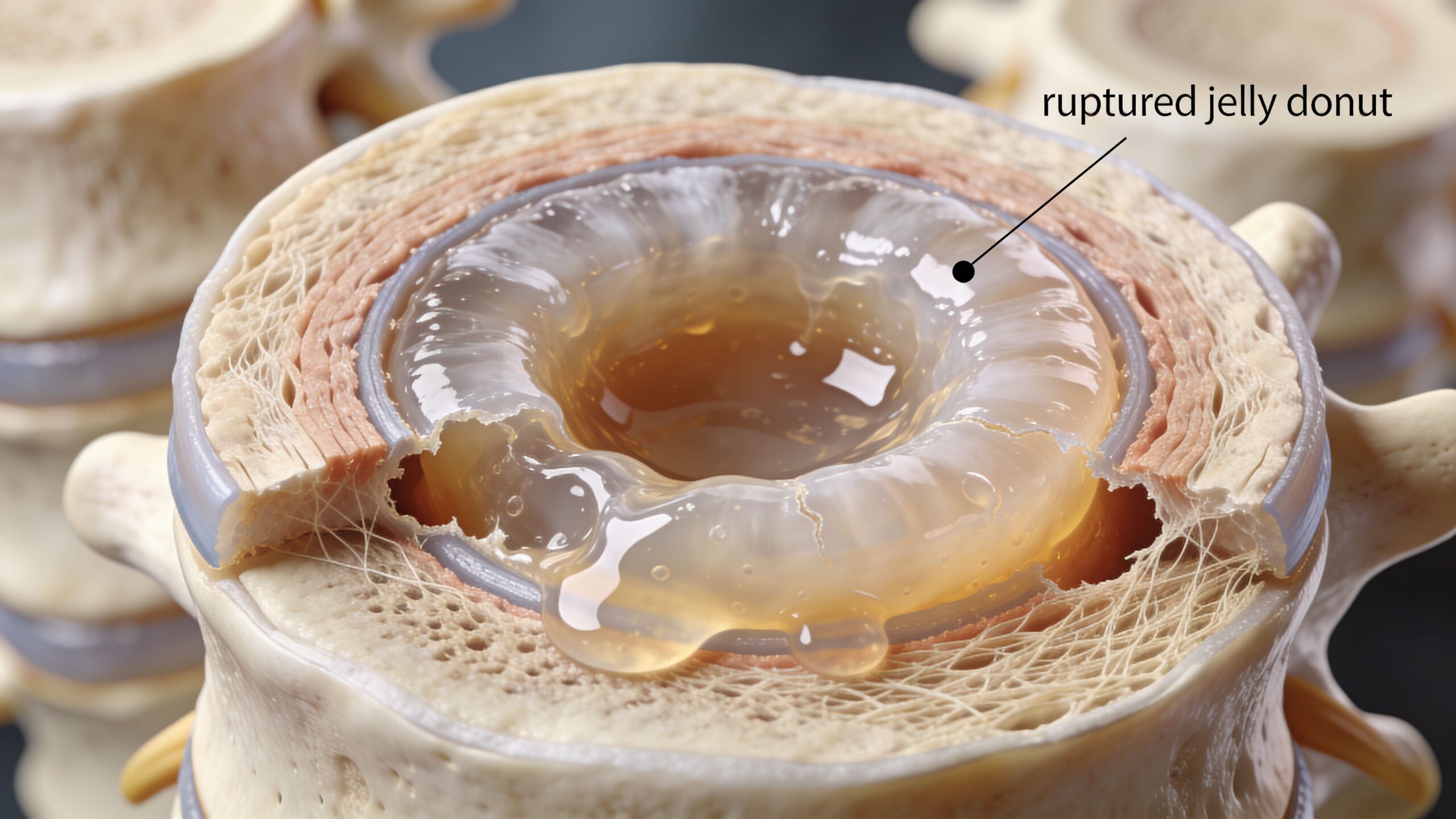
What it can feel like
A herniated disc doesn’t affect everyone the same way. Some people feel sharp back pain. Others feel burning, tingling, numbness, or weakness because the injured disc presses on a nerve.
Common symptoms include:
- Localized pain: Pain in the neck, mid-back, or lower back where the disc was injured.
- Radiating pain: Pain traveling into an arm or leg. In the lower back, people often call this sciatica.
- Numbness or tingling: Pins and needles in the hand, foot, leg, or arm.
- Weakness: Trouble lifting, walking, gripping, or standing for long periods.
How a car crash causes this injury
A crash moves your body in ways the spine isn’t built to handle. In a rear-end collision, your torso can snap forward and back. In a T-bone crash, the force can twist your spine sideways. In a head-on collision, your body may brace hard against the seat belt and steering system while your spine absorbs violent pressure.
That’s why disc injuries show up in many Texas crashes, including freeway rear-end wrecks, intersection collisions, rideshare accidents, and trucking crashes. The injury may start with inflammation and pain, then grow more obvious as swelling increases or the nerve irritation worsens.
Why diagnosis matters
An insurance adjuster may treat “back pain” like a complaint. A confirmed disc injury is different. Imaging and doctor notes turn your symptoms into documented medical evidence.
If you’re trying to manage symptoms while waiting for treatment, practical guidance on best pain relief for back pain can help you think through comfort measures, but it shouldn’t replace a doctor’s evaluation after a crash.
For a fuller look at how Texas claims handle this type of injury, see this guide on back injury from a car accident.
A herniated disc is more than soreness. When a disc irritates a nerve, the injury can affect sleep, work, driving, exercise, and basic daily movement.
Where readers often get confused
People often hear terms like bulging disc, slipped disc, ruptured disc, and herniated disc used almost interchangeably. Doctors may distinguish them more carefully, but from a legal point of view, the key question is simpler. What did the crash do, what symptoms followed, and what medical proof supports it?
That’s why symptom timing, imaging, and follow-up care matter so much. They help connect the wreck to the injury in a way a jury or insurance company can understand.
Your Legal Rights Under Texas Personal Injury Law
Texas injury law starts with a simple idea. If another driver caused the crash, that driver can be legally responsible for the harm that followed. In legal terms, that begins with negligence.
Negligence means someone failed to use reasonable care. A driver who texts behind the wheel, runs a red light, follows too closely, or turns without checking traffic may be negligent.
Liability means legal responsibility. If the other driver’s negligence caused your crash, that driver is liable for the losses tied to your injury.

How Texas comparative fault works
Texas follows a modified comparative fault system under Texas Civil Practice & Remedies Code Chapter 33. That rule matters in many settlement herniated disc cases because insurers often argue that the injured person was partly to blame.
As explained in this discussion of herniated disc settlements and Texas fault rules, under Texas's modified comparative fault rule (often called the 51% Bar Rule), you are barred from recovering any damages if you are found to be 51% or more responsible for the accident. If your fault is 50% or less, your recovery is reduced by your percentage of fault.
That sounds technical, but the everyday version is straightforward.
| If you are found at fault | What happens |
|---|---|
| 50% or less | You can still recover, but the amount is reduced |
| 51% or more | You are barred from recovering damages |
Plain-English definitions that matter
Some legal words sound intimidating until you strip them down.
- Damages: The money the law allows you to recover for your losses. Under Chapter 41, damages can include financial losses and other harm recognized by Texas law.
- Statute of limitations: The deadline to file a lawsuit. In Texas personal injury cases, that deadline is often two years. Miss it, and you may lose the right to bring your case in court.
- Causation: Proof that the crash caused the injury, or worsened an existing condition.
- Claim: Your demand for compensation, usually first made through insurance before a lawsuit is filed.
A real-world example
Suppose a Dallas driver is hit in an intersection. The other side says the injured driver was speeding. The injured driver says the other vehicle ran the light. If the evidence shows the injured driver was partly careless but still 50% or less responsible, Texas law may still allow recovery. The final amount would be reduced by that share of fault.
That’s why crash reports, photos, witness statements, and vehicle damage matter. Liability isn’t just about what happened. It’s about what you can prove.
What Chapter 41 means for your case
Texas Civil Practice & Remedies Code Chapter 41 deals with damages. In everyday terms, it helps define what kinds of losses may be recoverable and how certain damage issues are handled in court. In a herniated disc case, that often means the law looks at both your financial losses and the human cost of the injury.
Practical rule: You can have a real injury and still lose value in your case if you can’t clearly prove fault, causation, and damages.
Why timing matters
Many people wait because they hope pain will fade or because the insurer says it’s “too early” to involve a lawyer. That delay can hurt the case. Medical records become less clear. Witnesses become harder to find. The insurance company gets more room to argue.
The statute of limitations doesn’t mean you should wait until the last minute. It means the clock is already running.
How a Herniated Disc Settlement Value Is Calculated
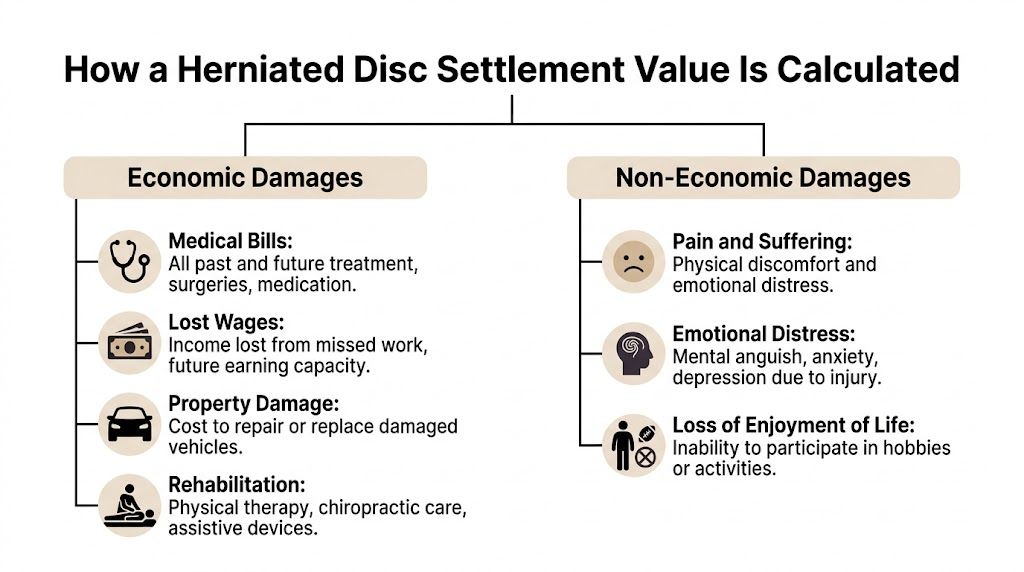
A settlement isn’t one magic number pulled from the air. It’s a combination of losses tied to the crash and supported by evidence. In a settlement herniated disc case, lawyers and insurers usually look at two broad categories. Economic damages and non-economic damages.
According to this overview of herniated disc settlement values, nationally, the median settlement for herniated disc injury cases is between $65,000 and $75,000. However, when cases go to trial, average jury verdicts can reach approximately $350,000 to $360,000.
Those numbers give context, not a guarantee. A claim in Houston, Dallas, Austin, or San Antonio still turns on its own facts.
Economic damages
These are the losses you can usually count with bills, records, and pay information.
Medical bills
A disc injury can lead to emergency care, imaging, follow-up visits, pain management, physical therapy, injections, medication, and sometimes surgery. Future treatment matters too. If your doctor believes you’ll need more care, that expected cost may become part of the claim.
Lost wages
If pain kept you from working, your missed income belongs in the demand. This can apply whether you work in an office, drive for a rideshare company, make deliveries, or do physical labor.
A Dallas warehouse worker with a serious low-back disc injury may miss weeks of work, then return with restrictions. That time away has a value. So does any future reduction in earning ability if the worker can’t safely return to the same job.
Other out-of-pocket losses
Depending on the case, this may include mileage to appointments, prescription costs, medical equipment, and vehicle damage related to the crash. If your car is heavily damaged, learning the basics of how damages are calculated after a crash can help you see how property loss fits into the broader claim.
Non-economic damages
These losses are real, even though they don’t come with a receipt.
Pain and suffering
This covers the physical pain of the injury and the way it interferes with daily life. A herniated disc can make sitting, sleeping, lifting, bending, walking, and driving painful.
Mental anguish
Injured people often deal with stress, fear, irritability, and loss of confidence. Some become anxious every time they get on a Texas freeway again.
Physical impairment and loss of enjoyment
Maybe you used to coach your child’s baseball team, work in the yard, go to church comfortably, or take long drives to visit family. Now each of those activities hurts or isn’t possible. That loss matters.
A short visual explanation can help make this easier to picture.
A simple way to think about value
Here’s a practical breakdown:
| Part of the claim | What it covers |
|---|---|
| Economic damages | Medical care, missed income, future treatment, related financial loss |
| Non-economic damages | Pain, emotional harm, physical limits, lost enjoyment of life |
A Texas example
Take a construction worker in Dallas with a herniated disc after a crash on the way to a jobsite. He goes from earning steady income to missing work, attending appointments, struggling to sleep, and needing help with basic tasks. The settlement value isn’t just “what’s the injury worth.” It’s the total of what the injury took from him, financially and personally.
That’s why good documentation matters:
- Medical proof: MRI reports, treatment notes, specialist opinions
- Work proof: Pay records, employer letters, tax documents if self-employed
- Daily-life proof: A pain journal, family observations, photos, activity limits
Why the first offer is often low
Insurance companies often start with the narrowest view of your case. They may focus only on early bills. They may ignore future treatment. They may downplay pain because it’s harder to measure than a receipt.
A fair valuation takes the whole picture seriously. That means looking at where you were before the crash, what the crash changed, and what your recovery may look like months or years from now.
Factors That Increase or Decrease Your Compensation
Not every herniated disc case settles the same way. Some claims gain strength because the evidence is clear and the injury is severe. Others lose value because the insurer finds room to argue. The biggest difference usually comes from a handful of value drivers.

Surgery changes the conversation
The strongest single value driver is often whether surgery becomes necessary.
As explained in this settlement calculator guide for back injuries, the need for surgery is the most significant factor affecting settlement value. Non-surgical herniated disc cases typically settle for $30,000-$100,000, whereas cases requiring surgical intervention like a spinal fusion can escalate the value 3 to 5 times, often into the $100,000-$350,000+ range, because surgery provides objective proof of a severe, permanent injury.
Why does surgery matter so much? Because it tells a powerful story. It shows the injury wasn’t a temporary ache. It required serious intervention, carries more risk, and often suggests longer recovery and more lasting limitations.
Objective medical evidence adds weight
In plain English, objective evidence means proof that doesn’t depend only on your description of pain. MRI findings, specialist notes, and documented treatment all help.
That kind of evidence matters because insurers often challenge spine claims. If your records show only general complaints with little follow-up, they may call the injury minor. If the records consistently show symptoms, imaging, and treatment that fit together, the claim becomes harder to discount.
Medical records should tell one clear story. The crash happened, symptoms followed, treatment was consistent, and the diagnosis matches what you’ve been experiencing.
Pre-existing conditions can hurt or help, depending on proof
In this context, many Texas cases get complicated.
A lot of adults already have some back history. Maybe you had old back pain, degenerative changes, or prior treatment. Insurance companies often seize on that history to argue the crash didn’t really cause your current problems.
The source material provided for this article notes that insurers often challenge pre-existing-condition claims and that non-surgical settlements can drop from a median of $80,000 to under $50,000 when they point to prior issues. The same source also notes that strong physician testimony and post-accident MRI proof of aggravation can still support strong case value. I’m not repeating the link here because source links should only appear once, but that earlier point is important.
Gaps in treatment reduce credibility
One of the fastest ways a claim loses strength is when the medical timeline becomes patchy.
If you wait too long to get care, skip follow-up appointments, or stop treatment without explanation, the insurer may argue one of two things. Either you weren’t badly hurt, or something else caused the later symptoms. Sometimes there’s a legitimate reason for a gap, like cost or transportation issues, but the gap still needs context.
Inconsistent reporting creates problems
If one doctor’s note says left-leg numbness, another says no radiating pain, and another says the symptoms began weeks before the crash, the insurer will use those inconsistencies against you. Small differences can happen in any medical chart, but repeated contradictions weaken causation.
Shared fault lowers recovery
Texas comparative fault doesn’t just decide whether you can recover. It also affects how much you keep.
If the evidence suggests you contributed to the crash, the insurance company will push that argument hard. A settlement can drop if fault is disputed, even when the injury itself is serious.
A quick comparison
| Factor | Likely effect on value |
|---|---|
| Surgery | Strong increase |
| Clear MRI and specialist support | Increase |
| Consistent treatment | Increase |
| Pre-existing condition without strong aggravation proof | Decrease |
| Treatment gaps or inconsistent symptoms | Decrease |
| Shared fault | Decrease |
A Texas example
A Fort Worth driver has a prior history of back soreness but was working full time and living normally before a crash. After being rear-ended, the driver develops new radiating leg pain, seeks prompt treatment, follows through, and has imaging that supports the changed condition. That case looks very different from one where the injured person waits months, treats off and on, and has little medical explanation tying the current symptoms to the wreck.
The lesson is simple. You can’t change the crash after it happens, but you can protect how clearly the evidence shows what it did to you.
Navigating the Herniated Disc Claim Process in Texas
A herniated disc claim feels less overwhelming when you break it into steps. The legal side doesn’t move all at once. It unfolds in a sequence, and each step affects the next one.
Right after the crash
Start with your health and safety. Call for help if anyone is hurt. Report the crash. Exchange information. If you can do so safely, take photos of the vehicles, the roadway, visible injuries, and anything else that may later help explain what happened.
If you feel back pain, numbness, tingling, or weakness, get checked promptly. Don’t try to “tough it out” for days hoping it disappears.
In the first days
Medical follow-up is where many strong cases are built or lost.
Tell your doctor exactly what you feel. Don’t minimize symptoms because you want to seem tough. Don’t exaggerate either. Be accurate. If pain shoots down your leg, say that. If sitting makes it worse, say that. If you can’t sleep, tell the provider.
Keep a simple file with:
- Crash records: Police report number, exchange information, photos, witness names
- Medical records: Visit summaries, imaging reports, prescriptions, therapy notes
- Financial records: Pay stubs, missed work notes, receipts, repair estimates
- Personal notes: A pain journal describing your limits day by day
Dealing with the insurance company
Be careful here. The other driver’s insurer may sound polite, but its job is to protect its money.
You generally should report the crash to your own insurer. But when the at-fault carrier calls asking for a recorded statement, broad medical releases, or quick settlement talk, slow down. Early statements often lock people into incomplete descriptions before the full injury is known.
The safest answer is often simple. “I’m still treating, and I’m not ready to discuss the full extent of my injuries.”
If your vehicle may be declared a total loss, this guide on total loss settlement negotiation can help you understand the property-damage side while your injury claim develops.
Building the demand
Once treatment shows a clearer picture of your injury, your claim is usually organized into a demand package. That package often includes medical records, bills, wage proof, and a written explanation of liability and damages.
A helpful overview of what that can look like appears in this resource on personal injury demand letters.
This stage is where the details matter. The insurer needs to see not just that you were hurt, but how the evidence connects the crash to the disc injury and the losses that followed.
What if you had back problems before
Texas law recognizes that a negligent driver can worsen an existing condition. As explained in this discussion of Texas herniated disc claims and the eggshell skull doctrine, Texas law allows negligent drivers to be held responsible for aggravating pre-existing conditions under the 'eggshell skull' doctrine. If a car crash worsens your pre-existing degenerative disc disease, you are entitled to full compensation for the aggravation. Proving this often requires expert medical testimony linking the new or worsened symptoms directly to the trauma of the accident.
That rule matters a lot in Texas. It means the defense doesn’t get a free pass just because your back wasn’t perfect before the wreck. But it also means documentation is critical.
Negotiation and possible lawsuit
Most claims involve negotiation before any lawsuit is filed. The insurer reviews the demand, makes an offer, and the back-and-forth begins. Some cases resolve there. Others don’t.
If the insurer keeps denying liability, minimizing the injury, or refusing to pay fairly, filing suit may be the next step. That doesn’t always mean a trial will happen, but it does mean deadlines, evidence rules, and court procedures become part of the process.
For many injured people, working with a Houston car accident lawyer or Texas injury attorney reaches a point where it becomes less about convenience and more about protection. Once the stakes rise, handling the claim alone gets much harder.
Common Questions About Herniated Disc Settlements
People usually reach this point with the same worries. They want to know how long this takes, whether court is coming, whether an old back problem will ruin the case, and whether hiring help is affordable.
How long does a herniated disc settlement take in Texas
There isn’t one fixed timeline. Some claims resolve in months. Others take much longer, especially if treatment is ongoing, fault is disputed, or the insurer won’t make a reasonable offer.
The biggest mistake is settling before you understand the injury. A disc claim often needs time for imaging, specialist review, and a clearer sense of future care. Fast isn’t always better if fast means underpaid.
Will I have to go to court
Not always. Many personal injury cases settle before trial. But you should prepare as if the insurance company may force you to prove the case more formally.
That preparation often helps settlement. Insurers tend to take a claim more seriously when the medical proof is organized, liability is documented, and the injured person is ready to push forward if needed.
What if the insurance company says my old back problems caused this
That’s one of the most common defenses in a settlement herniated disc case.
According to this analysis of average herniated disc settlements and pre-existing-condition disputes, insurance companies often challenge claims by citing pre-existing issues, which can drop non-surgical settlements from a median of $80,000 to under $50,000. However, with strong physician testimony and post-accident MRIs showing clear aggravation of the condition, settlements can still reach high values, making expert legal and medical documentation critical.
The practical takeaway is this. A prior back problem doesn’t automatically defeat your claim. But you do need strong medical proof showing what changed after the crash.
Can I afford a lawyer
Most Texas personal injury lawyers handling car wreck cases work on a contingency fee. That means you don’t pay upfront attorney’s fees, and the lawyer is paid only if there’s a recovery.
That structure matters because disc cases often require work that injured people can’t easily do alone. Gathering records, dealing with adjusters, addressing comparative fault arguments, handling UM or UIM issues, and valuing future losses take time and legal judgment.
What if the crash was fatal
In the most tragic cases, families may need to explore wrongful death compensation. When a crash causes a fatal injury, the legal issues are different from a standard injury claim, but the same basic truth remains. The family deserves clear guidance, careful investigation, and respectful advocacy.
Final thought
If your back pain keeps growing, if numbness or weakness has started, or if the insurer keeps acting like you should settle quickly and move on, trust your instincts. Disc injuries can affect your health, your work, and your future for a long time. You don’t have to figure out Texas negligence law, Chapter 33 comparative fault, Chapter 41 damages, medical proof, and insurance tactics by yourself.
If you’re dealing with a serious back injury after a Texas crash, The Law Office of Bryan Fagan, PLLC offers free consultations for injured drivers and families. Whether you need guidance from a Houston car accident lawyer, help with an auto insurance claim, or answers about wrongful death compensation, the firm can explain your rights in plain English and help you pursue the compensation you may be owed. You pay nothing upfront, and you don’t pay unless the firm wins your case.