Skip to content
A car crash can change your life in seconds, but you don’t have to face recovery alone.
You may be living this already. You were hit in Houston traffic, or rear-ended on I-45, or sideswiped turning through a Dallas intersection. At first, you felt shaken and sore. Then a different problem showed up. Every time you try to drive, your leg starts aching, burning, cramping, or going numb.
That kind of pain is easy to dismiss. Many people tell themselves it’s just stiffness, stress, or normal soreness after a wreck. Insurance companies often hope you’ll do exactly that. But your pain is real, and in Texas, it can matter both medically and legally.
A Car Crash Can Change Your Life But Your Pain Is Real and It Matters
A lot of injured drivers notice the problem when they try to get back to normal life. You take your child to school. You sit in traffic on the way to work. You move your foot from brake to gas, and suddenly your knee hurts, your calf tightens, or pain shoots from your lower back into your leg.
That isn’t a small complaint. It can be the first sign of a significant injury.
Alexander Orthopaedics reports that severe lower extremity injuries occur in 37% of car accidents, and notes that the U.S. has 234.4 million licensed drivers facing this risk. Leg pain can start right away, or it can appear days later after swelling, inflammation, or nerve irritation develops.
Why people overlook leg pain after a wreck
Drivers often focus on what seems more obvious. Neck pain. Back pain. Headaches. Damage to the car. Calls from the insurance adjuster.
Leg symptoms can get brushed aside because they feel inconsistent. You might feel okay while resting, then hurt badly once you’re seated behind the wheel. That pattern confuses people. It also gives insurers room to argue that the pain must come from something else.
Practical rule: If your leg pain started after a crash, got worse after a crash, or shows up when driving after a crash, treat it as part of your injury until a doctor says otherwise.
A Texas example that feels familiar
A Houston driver gets rear-ended during stop-and-go traffic. At the scene, she feels sore but walks away. Two days later, she notices pain in her right leg every time she presses the brake pedal. A week later, she’s avoiding longer drives because her knee and thigh start throbbing.
That story is common. The legal problem is common too. If she waits too long to get care, the insurance company may argue her symptoms aren’t related to the wreck. If she gets evaluated, follows treatment, and documents how driving triggers the pain, her claim gets much stronger.
Your body is giving you useful information. Listen to it.
Why Your Legs Hurt When You Drive Common Medical Causes Explained
Driving seems simple, but your body is doing more than you think. Your back supports your posture. Your hips stay flexed. Your knee and ankle repeat the same motion. Your nerves travel from your spine through your pelvis and down into your legs.
After a collision, even a short drive can aggravate an injury that hasn’t fully declared itself yet.
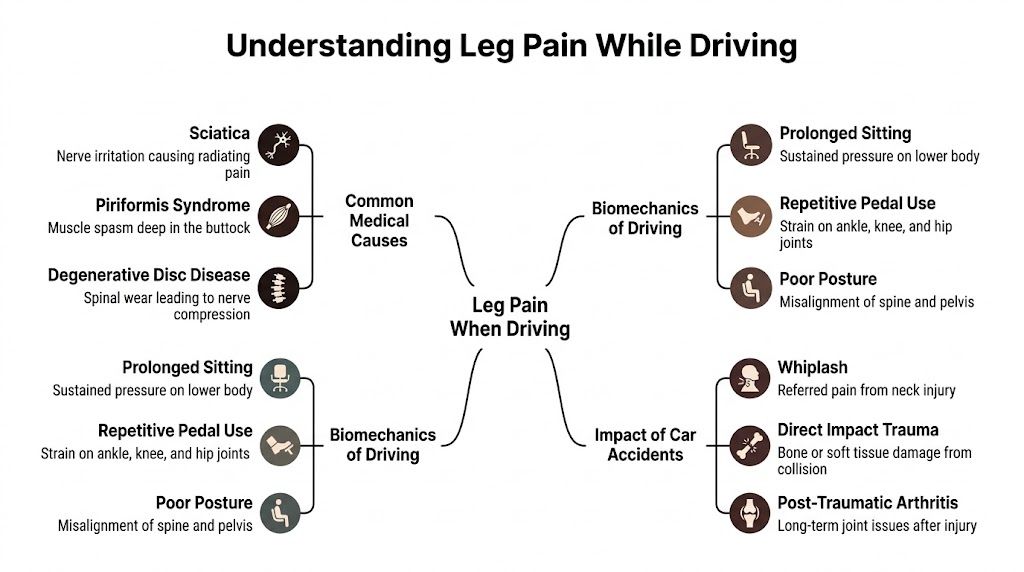
Sciatica and nerve irritation
One common reason for leg pain when driving is sciatica. That term usually means irritation of a nerve that starts in the lower back and sends pain down into the buttock, thigh, calf, or foot.
Anthros explains that slouched driving posture can flatten the lumbar spine, compress discs, and irritate the sciatic nerve, causing radiating leg pain. After a crash, this can happen because the force of impact inflames the lower back or worsens a disc injury.
Think of a nerve like a cable that carries signals. If that cable gets squeezed, the pain may show up far away from the actual source. That’s why someone with a back injury may feel burning in the thigh or numbness in the foot.
If you want a deeper explanation of disc-related crash injuries, this guide on a herniated disc from a car accident can help you connect the symptoms to what doctors often look for.
Joint strain, muscle injury, and repetitive pedal use
Not all driving pain is nerve pain. Sometimes the crash injures the muscles, tendons, or joints in a more direct way.
Your knee may have hit part of the dashboard. Your hip may have twisted during impact. Your ankle may now hurt because the muscles are compensating for a changed posture. Even if there was no fracture, the tissues can stay irritated for weeks or months.
Houston traffic makes this worse. Repeated braking and accelerating load the same structures again and again. That’s especially true if you’re guarding against pain and unconsciously moving differently.
Some people also deal with hip tightness after a wreck, especially if they’re sitting more during recovery. This practical resource on tight hip flexors may help you understand why the front of the hip can feel locked up and why that tension can affect the way your leg feels while driving.
Other conditions that can show up in the driver’s seat
A few problems deserve special attention because they often confuse people:
- Meralgia paresthetica: This happens when a nerve in the outer thigh gets compressed. You may feel burning, tingling, or numbness along the outside of the leg.
- Peroneal muscle fatigue: Repetitive foot motion can irritate the lower leg and foot, leading to aching or numbness.
- Deep vein thrombosis: Prolonged immobility after an injury can increase concern for a blood clot in the leg. That needs urgent medical attention.
Some pain means “rest and monitor.” Some pain means “get checked today.” Knowing the difference can protect both your health and your case.
Decoding Your Leg Pain Symptoms and Potential Causes
| Symptom | Potential Medical Cause | What to Do |
|---|---|---|
| Sharp pain shooting from low back into leg | Sciatica or disc-related nerve irritation | Schedule a medical evaluation and describe exactly when the pain travels |
| Outer thigh burning or numbness | Nerve compression such as meralgia paresthetica | Tell your doctor where the numbness starts and whether sitting worsens it |
| Knee pain with braking or stop-go traffic | Joint strain, soft tissue injury, or repetitive motion aggravation | Track when it starts, what pedal motion triggers it, and how long it lasts |
| Calf pain with swelling or warmth | Possible vascular problem including a blood clot concern | Seek urgent medical care |
| Foot numbness or weakness | Nerve involvement or muscle fatigue pattern | Get examined promptly, especially if it affects driving control |
Red Flags and When to Seek Immediate Medical Attention
Some symptoms should not wait for your next available appointment. If your leg pain is severe, sudden, or paired with weakness or swelling, you need medical care first.
That’s true even if you don’t want to “make a big deal” out of it. Serious post-crash symptoms can worsen fast. They can also become harder to connect to the wreck if you delay treatment.
Symptoms that need urgent attention
Get emergency care or immediate medical evaluation if you notice:
- Sudden weakness: Your leg gives out, drags, or feels too weak to safely use the pedals.
- Numbness that spreads: Especially if it moves through the groin, thigh, or foot.
- Visible swelling, redness, or warmth: These can be warning signs of a clot or another urgent condition.
- Loss of bladder or bowel control: This can signal a serious spinal nerve problem.
- Severe pain that keeps escalating: Especially if it’s paired with back pain after the crash.
If your symptoms involve the spine, this guide on a back injury from a car accident may help you recognize how back trauma can create leg symptoms that seem unrelated at first.
Why fast treatment helps your legal claim too
Insurance adjusters look for gaps. If you wait, they may say your pain came from yard work, a gym session, a long road trip, or a pre-existing condition.
A prompt medical visit creates a time-stamped record. It shows when the pain began, what symptoms you reported, and what your doctor found on exam. That matters because causation is a big issue in Texas injury claims. Causation means showing that the crash caused the injury or made an existing condition worse.
Go to the ER if you need to. Go to urgent care if that’s appropriate. Follow up with a specialist if your doctor recommends it. The right record is often built one visit at a time.
Don’t test your limits behind the wheel
A lot of people try one more commute, one more school pickup, one more grocery run. That can be risky if your pain affects reaction time or pedal control.
A San Antonio driver with leg numbness may think the issue is “just annoying” until his foot hesitates moving from accelerator to brake. At that point, the condition is no longer only painful. It’s unsafe.
Your first job is to protect your health. Your second is to protect the record of what happened.
Documenting Your Pain How to Build a Strong Foundation for Your Claim
If I were giving a new client their first assignment after a crash, it would be this. Start documenting your symptoms today.
You don’t need perfect medical language. You need a clear, honest record of what you feel, when you feel it, and how it affects your life. That kind of detail can make a major difference in an auto insurance claim.

Start a simple pain journal
Use your phone notes app, a notebook, or a calendar. Keep it plain and consistent.
A useful entry might say: “Tuesday. Drove 25 minutes to work. Pain started in right knee after first red light. Worse when braking. Tingling in calf by the time I parked. Trouble sleeping because leg throbbed.”
That kind of entry is stronger than saying, “My leg still hurts.”
Research on driving discomfort found that 92.1% of drivers agreed prolonged repetitive motion contributes to knee pain. In a crash claim, that matters because an accident can aggravate stress that daily driving already places on the body. Your notes help show that change.
What to track each day
Try to record the same categories so the pattern is easy to follow:
- Pain location: Knee, thigh, calf, ankle, hip, foot, or pain shooting down from the back.
- Trigger: Braking, accelerating, sitting still, getting in or out of the car, walking, climbing stairs.
- Duration: Did it last a few minutes, the whole drive, or all day?
- Effect on life: Missed work, trouble sleeping, skipped errands, needed help with chores.
- Medical response: Ice, medication, brace, physical therapy, doctor visit, imaging.
For a fuller look at the legal side of symptom evidence, this article on how to prove pain and suffering can help you understand why daily details matter.
Show your doctor exactly how driving affects you
Don’t just say, “My leg hurts.” Be specific.
Tell the doctor whether the pain begins after a certain amount of sitting. Explain whether it gets worse when moving from brake to gas. Mention numbness, weakness, burning, swelling, or a feeling that the leg may give out.
Doctors document what you report. If you leave out the driving trigger, the chart may never show the full pattern.
Important: Medical records don’t just list treatment. They often become the backbone of settlement negotiations.
Gather supporting evidence outside the clinic
Medical records are central, but they aren’t the only proof. Build a file.
- Photos matter: Take pictures of bruising, swelling, seat position changes, braces, compression sleeves, or mobility aids.
- Save receipts: Keep records for prescriptions, copays, parking, rides to appointments, and any equipment your doctor suggests.
- Preserve work impact: If driving is part of your job, save messages about missed shifts, route changes, or reduced duties.
- Track family observations: A spouse may notice you limping after a drive or avoiding trips you used to handle easily.
A Dallas commuter who can’t drive more than a short distance without pain has lost more than comfort. That person may have lost income, independence, and daily routine. Good documentation helps show the full picture.
Your Legal Rights After a Texas Car Accident
Texas law gives you the right to seek compensation when someone else’s negligence caused your injury. That sounds formal, but the idea is straightforward. If another driver failed to use reasonable care and you got hurt, you may have a claim.
Legal words start showing up. They matter, but they shouldn’t feel mysterious.

Basic Texas terms in plain English
Liability means legal responsibility. If a distracted driver rear-ended you, that driver may be liable for the harm caused.
Negligence means someone failed to act with reasonable care. Running a red light, texting while driving, or following too closely can all be negligence.
Damages means the losses you suffered. That includes financial losses like medical bills and lost wages, and human losses like pain, physical limitation, and reduced enjoyment of life.
Statute of limitations is the filing deadline. In most Texas personal injury cases, you generally have a limited window to file suit. Waiting too long can jeopardize your right to recover.
How fault works in a Texas crash case
Texas uses rules found in Texas Civil Practice & Remedies Code Chapter 33 for proportionate responsibility, often called modified comparative fault. In plain English, that means more than one person can share blame.
Here’s a simple example. A Houston driver is rear-ended on the freeway. The other driver was looking at a phone. The injured driver also had a brake light out. The insurance company may argue the injured driver shares some fault.
If the injured driver is partly responsible, compensation can be reduced by that share of fault. If the injured person is found more responsible than Texas law allows, recovery can be barred. That’s why facts, records, photos, and witness statements matter so much.
What compensation can include
Leg pain when driving affects more than your comfort. It can reach into nearly every category of damages.
Economic damages may include:
- Medical expenses: ER visits, imaging, physical therapy, specialist care, medication, injections, and future treatment
- Lost income: Missed work, reduced hours, or inability to keep driving for a job
- Out-of-pocket costs: Transportation to appointments, braces, supports, and related expenses
Non-economic damages may include:
- Pain and suffering: The physical pain itself and the strain of living with it
- Loss of enjoyment of life: Not being able to travel, exercise, drive your kids, or handle normal routines
- Physical impairment: Limits on walking, standing, sitting, or driving for meaningful periods
Texas Civil Practice & Remedies Code Chapter 41 also addresses certain rules involving damages in civil cases. The legal details can get technical, but the key point is simple. Texas law recognizes that an injury claim is about more than a stack of medical bills.
A claim is strongest when it shows both the diagnosis and the disruption. What hurts, what treatment you needed, and what your life looked like before and after the crash.
A real-world Texas example
A driver in Dallas is hit in a rear-end crash during rush hour. At first, he thinks he only has a sore back. But each time he drives, pain runs from his hip into his right leg, and he starts missing work because he can’t tolerate long commutes.
Legally, his case may involve several layers:
- The other driver’s fault for causing the collision
- Medical proof that the crash caused or aggravated the leg symptoms
- Wage loss evidence if the injury affected his job
- Pain and suffering evidence from his daily limitations
If he’s a passenger, the same basic negligence principles apply. If the crash was fatal, surviving family members may also need to explore wrongful death compensation under Texas law. Different rules can apply in those cases, and families often need immediate legal guidance.
You may also find this overview helpful before speaking with an adjuster:
Dealing with the insurance company
Insurance companies aren’t neutral fact finders. Their job is to evaluate exposure and control payouts.
That doesn’t mean every adjuster is hostile. It does mean you should be careful.
- Be accurate: Don’t guess about speed, distance, or medical details.
- Don’t minimize your symptoms: Saying “I’m fine” in the first few days can come back later.
- Don’t accept a quick settlement before you understand your injury: Leg pain that shows up while driving may signal a problem that needs more treatment than you expected.
- Be careful with recorded statements: What sounds harmless can later be used against you.
If you’re searching for a Houston car accident lawyer or a Texas injury attorney, you’re probably already seeing how quickly a simple auto insurance claim can become complicated.
Special Considerations for Rideshare and Professional Drivers
For rideshare drivers, delivery drivers, truckers, and others who drive for work, leg pain when driving creates a double problem. It hurts, and it threatens income.
A person who drives occasionally may be able to avoid traffic for a while. A person who drives for work usually can’t. The same motion that causes pain also pays the bills.

Why these claims are more complicated
A 2020 review found that 1 in 5 professional drivers experienced knee musculoskeletal pain due to prolonged sitting and repetitive movement. After a crash, that background strain can turn into a disabling problem.
The legal issue is not that you drove for work, so your claim is weaker. Often, it’s the opposite. Your job may make the consequences easier to see. If driving is essential and pain prevents it, your wage loss and functional limits may be substantial.
Still, insurers often push back with arguments like:
- “This was a pre-existing condition.”
- “Your work caused it, not the crash.”
- “You’re an independent contractor, so coverage is limited.”
Each of those arguments needs a careful response built on records, timelines, medical opinions, and insurance analysis.
Who may pay after a crash
The answer depends on the facts. A negligent third-party driver may be primarily responsible. In other situations, rideshare company coverage, commercial coverage, personal coverage, or uninsured or underinsured motorist coverage may become part of the picture.
A delivery driver in Austin may be hit by a distracted driver while making a route. An Uber driver in San Antonio may be rear-ended while waiting for a pickup. Those cases can involve multiple insurers, coverage disputes, and disagreement over whether the driver was logged into the app at the time.
That’s one reason these claims can’t be handled like a routine fender bender.
The contractor problem
Many gig drivers run into the same wall. The platform says they’re independent contractors, not employees. That can affect what benefits or protections are available.
In practical terms, that means injured drivers often have to pursue third-party claims aggressively and document income losses carefully. App screenshots, trip logs, mileage history, bank deposits, and communications with the platform can all matter.
A rideshare or delivery driver should also be careful not to let the insurer blur two separate questions:
- Did the crash cause or worsen the injury?
- Which policy has to pay?
Those are different issues. A valid injury doesn’t disappear because the coverage structure is complicated.
Your Next Steps to Recovery and Justice
Start with your health. Get evaluated. Follow medical advice. Keep records. If driving triggers the pain, say that clearly at every appointment.
Then protect your claim. Save photos, bills, work records, and your pain journal. Be careful with insurance calls, especially if you still don’t know the full extent of your injury.
Recovery often takes a team. That may include a primary doctor, a specialist, a physical therapist, and legal help when fault or insurance becomes disputed. If your doctor recommends home exercises during rehab, resources like these best resistance bands for physical therapy can help you understand common equipment options to discuss with your provider.
You don’t have to prove your case perfectly on day one. You do need to start taking your symptoms seriously on day one.
If your leg pain started after a wreck, got worse after a wreck, or now makes driving difficult, don’t brush it off. A fair case begins with a clear record and steady action.
Frequently Asked Questions About Leg Pain and Accident Claims
What if my leg didn’t start hurting until days after the crash
That can still fit a valid injury claim. Some symptoms show up later as inflammation builds, muscles tighten, or nerves become irritated. What matters is getting checked once you notice the problem and explaining when it started.
What if the insurance company says I already had arthritis or back problems
A pre-existing condition does not automatically defeat your claim. If the crash aggravated an existing issue, that aggravation may still be compensable. The key is medical evidence showing the change in symptoms, function, or treatment after the wreck.
How much is my case worth
There’s no honest one-size-fits-all number. Case value depends on liability, medical proof, severity of symptoms, treatment needs, lost income, and how the injury affects your daily life.
I drive for Uber or delivery apps. Does that change things
It can make the insurance side more complex. One source says Texas rideshare drivers in urban areas have a 25% higher injury rate, and many face claim denials tied to contractor status. That doesn’t mean you don’t have a claim. It means the claim may need closer legal review.
If you’re dealing with leg pain when driving after a crash, you deserve answers, not guesswork. The Law Office of Bryan Fagan, PLLC offers free consultations for Texas accident victims and families. You can talk with a team that understands car wreck injuries, insurance disputes, truck and rideshare claims, and wrongful death compensation. If they take your case, you pay nothing unless they win for you. Reach out today and get clear guidance about your rights, your auto insurance claim, and your next step forward.