Skip to content
A car crash can change your life in seconds, but you don’t have to face recovery alone.
You may be reading this because your neck still hurts days after a rear-end collision. Or your lower back pain started as soreness, then turned into burning pain running down your leg. Maybe the ER said nothing was broken, but you still can’t sit, sleep, or work normally. That’s often where a herniated disc from car accident cases begin. The injury is real, but proving it takes more than saying, “My back hurts.”
Many people in Texas get stuck in the same place. They know something is wrong. They know the crash changed their body. But the insurance company starts asking questions about old aches, minor vehicle damage, or delayed symptoms. That’s confusing and frustrating when you’re already trying to heal.
A Houston driver rear-ended on I-45 might go home thinking it’s only whiplash. A week later, that same driver may feel numbness in an arm, weakness in a hand, or sharp pain shooting down a leg. Those symptoms can point to a damaged spinal disc, not just muscle strain.
Medical proof and legal strategy have to work together. You need treatment that helps your body. You also need records, imaging, and a clear timeline that connects the collision to the injury.
A Car Crash Can Change Your Life But You Are Not Alone
The hardest part for many people isn’t just the pain. It’s the uncertainty.
You may be wondering whether your symptoms are serious enough to report, whether an MRI will show anything, or whether the adjuster will claim this was a pre-existing condition. Those questions are common, especially when a crash looked “minor” from the outside but felt major inside your body.

A herniated disc can be a hidden injury. You may not see blood or a cast. Friends may say you look fine. But spinal disc damage can affect how you walk, drive, lift, sleep, and earn a living. It can also trigger fear. If pain shoots into your arm or leg, it’s natural to worry about whether you’ll recover fully.
Why this injury gets missed
After a crash, adrenaline can cover up symptoms. Soft tissue pain and stiffness can also distract from a deeper spinal problem. That’s one reason people delay care or underestimate what happened.
A common Texas scenario looks like this:
- A Dallas commuter gets rear-ended in slow traffic. The car has modest bumper damage, so the other driver’s insurer acts like no one could be badly hurt.
- The injured person feels neck stiffness first. A few days later, pain begins radiating into the shoulder and hand.
- Work becomes harder. Sitting at a desk, lifting boxes, or turning the head while driving starts to hurt.
- The insurance company pushes back. The adjuster asks whether the person had prior back or neck problems.
That pattern doesn’t mean your claim is weak. It means your case needs careful documentation.
Practical rule: When pain changes, spreads, or starts affecting movement, treat it like a medical issue and a legal issue at the same time.
Why hope still matters
A disc injury can be serious, but serious doesn’t mean hopeless. Many people improve with the right diagnosis and treatment. Many also recover compensation through an auto insurance claim when another driver caused the crash.
If the collision led to a fatal spinal injury, surviving family members may also have questions about wrongful death compensation under Texas law. Different cases call for different legal paths, but the first step is the same. Get clear answers early.
What a Herniated Disc Is and How Car Accidents Cause It
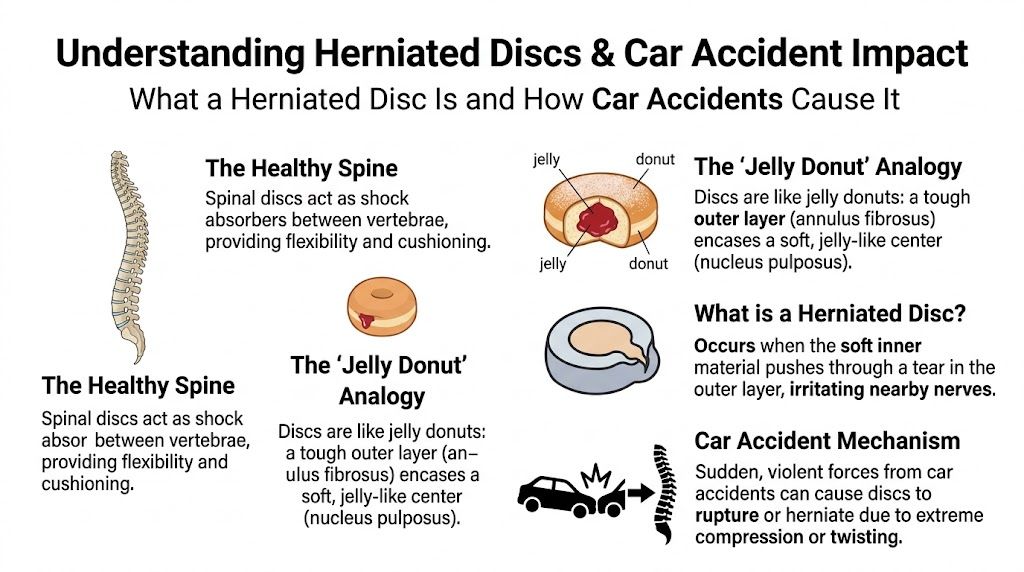
Your spine is built like a stack of bones with cushions between them. Those cushions are called discs. They absorb shock and help your back and neck move smoothly.
A simple way to picture a disc is a jelly donut. The outside is tougher. The inside is softer, almost gel-like. A herniated disc happens when the outer layer tears and some of the inner material pushes out. If that material presses on a nerve, pain can travel far beyond the spine itself.
Herniated disc versus bulging disc
People often mix these terms up. They aren’t always the same thing.
| Condition | Plain-English meaning | Why it matters |
|---|---|---|
| Bulging disc | The disc pushes outward, but the outer layer stays intact | Often less severe, though still painful |
| Herniated disc | The outer layer tears and inner material pushes through | More likely to irritate or compress nerves |
That distinction matters medically and legally. A herniation usually suggests a more significant structural injury than a bulge.
How a crash creates the injury
A collision doesn’t have to break a bone to damage a disc. The body can be thrown forward, backward, sideways, or twisted while the seatbelt holds part of the torso in place. That creates stress inside the spine.
In a rear-end crash, the neck and back can snap forward and backward in a whip-like motion. In side-impact crashes, the body can twist and compress unevenly. In head-on crashes, the body may lurch forward while the spine absorbs heavy force.
A source discussing crash biomechanics notes that car accidents are the leading cause of spinal injuries at 39% of cases in the US, and it reports lumbar disc herniations in up to 35% of moderate-to-severe motor vehicle accident victims, while also explaining that pre-existing degeneration can increase vulnerability and that imaging is important for proving causation in claims (discussion of crash biomechanics and spinal injury risk).
Why whiplash can be more than “just soreness”
Whiplash isn’t always limited to muscles and ligaments. Disc damage can be part of the picture.
A review of whiplash-related disc trauma reports that 25% of victims develop herniated discs, 20% experience radicular symptoms such as shooting pain from nerve compression, and 39% show disc degeneration 5 to 10 years after the accident (whiplash and disc herniation statistics).
That helps explain why some people feel worse over time rather than better.
A Texas road example
Think about a driver stopped on a Houston freeway entrance ramp. Another car doesn’t brake in time and slams into the rear bumper. The injured driver’s head snaps back, then forward. The torso moves one way while the seatbelt restrains another part of the body. Even if the person walks away from the scene, that sudden force can overload a disc.
You may hear people say, “If the car isn’t crushed, the injury can’t be serious.” That’s not how the spine works. Vehicles are built to absorb impact. Your discs are not.
The key question is not whether the bumper looks expensive to repair. The key question is what force traveled through your body.
Recognizing Symptoms and Getting a Proper Diagnosis
A disc injury doesn’t always announce itself right away. Some people feel sharp pain at the scene. Others notice stiffness first, then nerve symptoms later.
That delay creates trouble because insurers often act as if delayed pain means unrelated pain. Medically, that isn’t always true. Inflammation can build after the crash, and nerve irritation can become more obvious as hours or days pass.

Symptoms people often notice
Watch for patterns, not just one symptom in isolation.
- Neck or back pain: This may feel deep, sharp, burning, or constant.
- Radiating pain: Pain may travel into an arm, shoulder, buttock, or leg.
- Numbness or tingling: Many people describe pins and needles in fingers or toes.
- Weakness: You may drop items, struggle with stairs, or notice one side feels less reliable.
- Limited movement: Turning your head, bending, standing, or sitting may become difficult.
A useful clue is when the pain moves along a path. Local soreness can come from many injuries. Pain that shoots down a limb often points toward nerve involvement.
Why medical timing matters
Get evaluated promptly, even if your symptoms seem manageable. Early records create a timeline. That timeline can become one of the strongest parts of your claim.
Doctors may start with a physical exam and ask where the pain goes, what movements trigger it, and whether you have numbness or weakness. They may check reflexes, strength, and range of motion.
X-rays can help rule out fractures. CT scans can provide more structural detail. But when the issue is a disc itself, MRI is often the most useful imaging tool because it shows soft tissue more clearly.
What to tell your doctor: Describe when the pain started, where it travels, and what daily tasks now hurt. Don’t minimize symptoms just because you’re trying to be tough.
Why an MRI can change the legal picture
Insurance companies often question soft-tissue complaints. An MRI gives the claim something more concrete. It may show the location of the herniation, whether a nerve is compressed, and whether the findings match your symptoms.
That doesn’t mean every case needs the same treatment. It does mean your records should tell a consistent story.
This short video gives a helpful overview of how disc injuries are evaluated and why symptoms can be deceptive after a crash:
A simple checklist after the crash
- Get checked out early. Don’t wait until pain becomes severe.
- Report every symptom. Include tingling, weakness, headaches, and radiating pain.
- Follow up if symptoms change. New nerve pain deserves another evaluation.
- Keep copies of records. Visit summaries, imaging orders, and test results matter.
- Avoid guessing your own diagnosis. Tell the doctor what you feel, not what you think they want to hear.
Your Path to Recovery Medical Treatments and Timelines
Treatment for a herniated disc from car accident injuries usually starts with the least invasive options. The goal is to reduce pain, calm inflammation, restore movement, and help you avoid long-term loss of function.
Some people improve with conservative care. Others need injections or surgery. Your path depends on your symptoms, imaging, work demands, and how your body responds over time.
Conservative care first
Doctors often begin with a mix of treatments rather than one single fix.
- Physical therapy: This helps improve strength, posture, and movement patterns. A therapist may focus on core support, neck stabilization, or nerve-friendly movement.
- Medication: Your doctor may use anti-inflammatory medicine, pain relief, or muscle relaxers depending on your symptoms.
- Activity changes: You may need to avoid heavy lifting, prolonged sitting, repeated bending, or long drives for a period.
- Injections: Some patients receive epidural steroid injections to reduce inflammation around irritated nerves.
Recovery doesn’t move in a straight line. Some days are better than others. If lying flat makes your lower back worse, If you find your lower back hurts when lying on your back, exploring resources that offer wellness guidance can be beneficial.
When surgery enters the conversation
Surgery is usually considered when pain remains severe, weakness develops, or conservative treatment doesn’t give enough relief.
Common procedures include:
| Procedure | What it means in plain language | Why it may be recommended |
|---|---|---|
| Discectomy | The surgeon removes the part of the disc pressing on the nerve | To relieve nerve compression |
| Fusion | Two spinal bones are joined to stabilize the area | When stability is a major concern |
These procedures can help, but they also affect claim value because they usually involve more treatment, more downtime, and more lasting impact on daily life.
Timelines vary more than people expect
A mild case may improve with consistent therapy and careful activity changes. A more serious case may involve prolonged pain, work restrictions, repeat imaging, specialist visits, or surgical recovery.
That’s why settling too early is risky. If you accept money before doctors understand your long-term needs, you may end up paying later costs yourself.
Keep a short recovery journal. Note pain levels, sleep trouble, missed work, driving problems, and tasks you can’t do. Those details often matter more than people realize.
Why treatment choices affect the legal claim
Your medical records show more than diagnosis. They show effort, consistency, and the effect of the injury on your life. Gaps in treatment can give insurers room to argue that you healed quickly or weren’t badly hurt.
If you want a fuller overview of common care options after a wreck, this guide on medical treatment after a motor vehicle accident can help you understand how providers document injuries and why follow-up visits matter.
What families often overlook
A spinal injury can affect more than pain levels. It can change mood, sleep, parenting, housework, driving tolerance, and the ability to return to the same job. A warehouse worker, nurse, delivery driver, or mechanic may face very different limits than someone who works at a desk.
That’s why treatment planning should focus on your real life, not just your MRI.
How to Prove Your Injury and Navigate the Texas Legal System
Texas follows a fault-based system for car wrecks. That means the person who caused the crash is generally responsible for the harm that followed. In legal terms, that’s liability. If another driver was careless, their insurer may owe compensation.
The basic legal idea is negligence. Negligence means someone failed to use reasonable care. A driver who texts, speeds, follows too closely, runs a red light, or drives drunk may be negligent if that conduct causes a crash.

The Texas rules that matter most
Under Texas Civil Practice & Remedies Code Chapter 33, Texas uses a modified comparative fault system. In plain English, comparative fault means more than one person can share blame. If you were partly at fault, your compensation can be reduced by your share of responsibility. If your share is too high under Texas law, recovery may be barred.
Damages means the money the law allows for losses caused by the crash. Those losses may include medical bills, lost income, pain, and other harm. Chapter 41 addresses certain rules involving damages, especially exemplary damages in the right kind of case.
The statute of limitations is the legal deadline to file suit. If that deadline passes, you can lose the right to bring your case in court. The exact timing can depend on the facts, so it’s smart to get legal advice early instead of guessing.
What proof wins these cases
A disc claim becomes stronger when the evidence tells one consistent story from crash to diagnosis to treatment.
The most important records
- Crash report: This helps show how the collision happened and who may be at fault.
- Medical records: ER notes, clinic visits, specialist records, and therapy notes connect symptoms to the wreck.
- Imaging records: MRI reports are often central in herniated disc claims.
- Work records: Missed time, job restrictions, and lost earning details show practical impact.
- Witness statements: These can support how the crash occurred and how you appeared afterward.
A Houston car accident lawyer will usually build the claim around both liability proof and causation proof. Liability asks who caused the wreck. Causation asks whether the wreck caused this injury.
The two insurance defenses you should expect
Insurers often challenge disc cases in very predictable ways.
They say it was pre-existing
Many adults have some age-related spinal changes. Insurance companies know that. They often point to old wear and tear and argue the collision didn’t cause anything new.
That argument is incomplete. A crash can aggravate a prior condition or turn a silent one into a painful one. The legal issue becomes whether the wreck caused new symptoms, worsened old ones, or accelerated the need for treatment.
They say the crash was too minor
This is common in low-property-damage collisions. The adjuster may focus on the bumper, not the body.
A source discussing low-impact causation disputes states that insurers deny these claims 40% to 60% of the time without MRI evidence of acute changes, and it explains that expert testimony may help prove the crash turned an asymptomatic condition into a painful herniation (low-impact crash causation disputes and MRI evidence).
Vehicle damage and body damage are not the same thing. A modest repair bill does not answer what happened inside your spine.
Step-by-step legal guidance after the crash
Report the crash accurately
Give the facts to police and your insurer. Don’t exaggerate, but don’t leave out pain either.Get the right medical follow-up
If symptoms continue, ask about specialist care and whether MRI imaging makes sense.Organize your timeline
Keep appointments, prescriptions, imaging dates, therapy visits, and missed work in one place.Be careful with adjusters
A recorded statement can be used to minimize your claim. Short, careful communication is usually better than casual conversation.Document daily limits
Trouble sleeping, driving, lifting your child, or working a full shift can support non-economic damages.Get legal help before accepting a settlement
Once you settle, you usually can’t reopen the claim because symptoms got worse later.
For a deeper look at documenting non-economic harm, this guide on how to prove pain and suffering is worth reviewing.
A real-world example
A Houston driver gets rear-ended at a stoplight. The other driver’s insurer admits fault for the crash but argues the back injury isn’t related because the vehicles stayed drivable. The injured driver later gets an MRI showing a herniated disc that matches leg pain and numbness that started after the wreck.
That case often turns on detail. Did the person report symptoms early? Did treatment stay consistent? Do the records show a before-and-after change? Did a doctor connect the imaging findings to the crash? Good legal strategy makes those answers easier to present.
What Is Your Herniated Disc Claim Worth in Texas
This is one of the first questions people ask, and it’s a fair one. A disc injury can bring bills, missed work, stress, and uncertainty fast.
In a Texas injury case, damages usually fall into two broad groups. Economic damages are financial losses you can measure, such as medical bills, future treatment, lost wages, and reduced earning ability. Non-economic damages cover harder-to-measure harm like pain, mental anguish, and physical impairment.
What usually drives value
The value of a claim often depends on facts like:
- How severe the injury is
- Whether surgery is recommended or performed
- How clear the MRI findings are
- Whether nerve symptoms limit work or daily life
- How strong the liability evidence is
- Whether the insurer accepts or disputes causation
A source focused on disc settlements reports that herniated disc cases average $30,000 to $250,000, can exceed $300,000 when surgery is involved, and that cervical herniations average $75,000 to $250,000 while thoracic herniations can reach $125,000 to $400,000. The same source reports average jury awards for herniated discs of $413,917 (settlement and jury award ranges for herniated disc claims).
Those figures are reference points, not promises. Every case turns on its own records, treatment path, and proof.
A practical way to think about damages
| Type of damage | What it can include |
|---|---|
| Economic | ER bills, MRI costs, specialist care, therapy, injections, surgery, lost income, future care |
| Non-economic | Ongoing pain, interrupted sleep, limits on driving or parenting, loss of mobility, emotional strain |
A San Antonio delivery driver offers a good example. If that driver suffers a neck herniation, misses work, needs ongoing treatment, and can’t return to the same schedule, the claim may include both current wage loss and reduced future earning capacity. If the pain also interferes with sleep, lifting, and normal activity, those daily losses matter too.
If you want a broader consumer-friendly perspective on maximizing an auto accident settlement, that resource can help you think about documentation, negotiation, and timing.
You can also review this guide on how to calculate damages to see how lawyers break down both financial losses and human losses in a Texas injury claim.
Settlement value rises or falls on proof. Strong medicine without strong documentation leaves money on the table. Strong documentation without proper treatment can do the same.
Frequently Asked Questions About Herniated Disc Claims
What if my pain started weeks after the accident
That can still be medically valid. Delayed symptoms happen with spinal injuries, especially when inflammation builds over time or adrenaline masked pain at first.
The important part is documentation. Tell your doctor exactly when symptoms began, how they changed, and what tasks now hurt. Don’t let embarrassment or uncertainty lead you to downplay the timeline.
What if the at-fault driver is uninsured
You may still have options through your own policy, especially uninsured or underinsured motorist coverage if you carry it. A claim may also involve medical payments coverage or personal injury protection, depending on your policy.
These cases often become paperwork-heavy fast, so organized records matter even more.
I’m a rideshare or delivery driver. Do I still have a claim
Often, yes. But these cases can be more layered because there may be questions about personal coverage, company coverage, and whether you were actively working at the time.
A source addressing delayed-onset symptoms in gig workers notes that symptoms emerging 1 to 4 weeks after the crash can still support a claim if documented promptly, and it states that Texas has seen a 15% rise in rideshare accidents involving uninsured motorists according to that source’s discussion of claim complexity (delayed symptoms and rideshare claim issues).
Will I definitely have to go to court
No. Many injury cases resolve through settlement negotiations. But preparing a case as if it may need litigation often improves the quality of the claim.
That means keeping your records clean, following treatment, and not rushing into a low offer just because you want the process over with.
What does a Texas injury attorney actually do in a disc case
A Texas injury attorney gathers the records, frames the medical proof, deals with the insurer, values the claim, and pushes back when the defense argues low impact, delayed symptoms, or pre-existing degeneration. If the insurer still won’t be reasonable, the lawyer can file suit before the statute of limitations expires.
Take Control of Your Recovery Contact a Texas Injury Attorney Today
A herniated disc from car accident trauma can disrupt nearly every part of your life. The medical side is frustrating enough. The legal side gets even harder when the insurance company argues your pain came from somewhere else.
You deserve answers you can understand and a plan that protects both your health and your rights. If you’re dealing with neck pain, back pain, radiating symptoms, an unfair auto insurance claim process, or questions about liability, comparative fault, or wrongful death compensation, legal help is available.
If you need guidance after a serious Texas crash, contact The Law Office of Bryan Fagan, PLLC for a free consultation. A Houston car accident lawyer can review your case, explain your options in plain English, and help you pursue the compensation you may be owed. You pay nothing unless the firm wins your case.