A car crash can change your life in seconds, but you don’t have to face recovery alone.
If you were hurt on the job and your employer sent your claim to Sedgwick, you may already feel like the ground shifted under you twice. First, there was the injury. Then came the paperwork, the phone calls, the waiting, and the fear that someone behind a desk is deciding whether you get treatment, wage benefits, or nothing at all.
That’s even harder in Texas. Some employers carry workers’ compensation coverage. Some don’t. Some delivery drivers and fleet workers get pushed into a gray area where a work injury claim turns into an auto insurance claim, a negligence claim, or both. If you’re searching for answers about sedgwick workers comp, you probably need more than a definition. You need a clear plan.
This guide explains how Sedgwick claims usually work, what can go wrong, and what you can do to protect yourself. It also covers how Texas negligence law can matter after a work-related vehicle crash, especially for drivers, gig workers, and families dealing with severe injuries or wrongful death compensation claims.
Your Life Changed at Work Now What
A Houston warehouse worker slips while loading a truck. A delivery driver gets rear-ended on I-45 during a route. A home health aide hurts her back getting equipment out of a vehicle. In each case, the injury happens fast. The fallout doesn’t.
One day you’re thinking about your shift, your next stop, or how to get home on time. The next day you’re trying to figure out where to get medical care, whether your paychecks will stop, and why a company you’ve never heard of is now calling the shots.

Sedgwick is not your doctor. It’s not your employer. It’s generally a third-party administrator, often called a TPA, that handles claims for employers. That means you may be speaking with a company whose job is to manage the claim process and control claim costs.
For injured workers, that difference matters.
A lot of people assume that if they report an injury accurately and follow instructions, the system will take care of them. Sometimes it does. Sometimes it doesn’t. The problem starts when you think the claim handler is there to guide your recovery the way your own lawyer or doctor would. That’s not the role.
What this means for you: treat every step from day one like it may need to be proven later.
That doesn’t mean panic. It means get organized.
If you’re overwhelmed, start with the basics. Report the injury. Get proper medical attention. Save every document. Keep your story consistent. Don’t guess. Don’t exaggerate. Don’t minimize what happened either.
For many Texans, the hardest part is not the pain. It’s the confusion. If that’s where you are, learning how a job injury attorney approaches these cases can help you understand what records matter and what mistakes to avoid early.
Why Sedgwick feels so frustrating
Workers often describe the process the same way. They feel like they’re doing everything they’re told, but progress stalls. Calls don’t answer the core question. Medical approval feels uncertain. Forms multiply.
That’s because a claim is both a health problem and a documentation problem. If you don’t handle both, the file can drift away from the reality of your injury.
What helps right away
A simple approach works best in the first days:
- Write down the facts: date, time, place, who saw it, and what body parts were hurt.
- Get examined quickly: tell the provider this happened at work and explain every symptom.
- Save proof: emails, texts, discharge papers, work restrictions, mileage logs, and photos.
- Stay steady: be truthful and precise every time you describe the injury.
You don’t need to know everything today. You do need to protect the record starting now.
The First 48 Hours Reporting Your Injury and Getting Care
The first two days after a workplace injury can shape the entire claim. Small mistakes made here can become big arguments later.

Report it in writing
Tell your supervisor right away, but don’t stop with a verbal report.
Send an email, text, or written incident report that says:
- When it happened: include the date and approximate time.
- Where it happened: name the job site, road, warehouse area, parking lot, or customer location.
- How it happened: keep it simple and factual.
- What hurts: list every injured body part, even if some symptoms seem minor at first.
- Who saw it: include witnesses if there were any.
A vague report creates room for later disputes. “I got hurt lifting” is weaker than “I felt sharp pain in my low back and right leg while lifting a package into the van near the loading dock.”
If the injury came from a crash, say that clearly. For example: you were driving for work, on an assigned route, during work hours, and the collision happened while performing your job.
Get medical care that matches the claim
If it’s an emergency, get emergency care first. Your health comes before paperwork.
After that, pay attention to who is directing your treatment and whether your employer has a workers’ compensation network. In Texas, that can affect provider choice. The wrong clinic is not always fatal to a claim, but confusion about authorized care can slow things down fast.
When you see any provider, do three things:
- Say it was work-related
- Describe all symptoms
- Ask for written work restrictions before you leave
If your shoulder hurts, say so. If your neck is stiff after a work crash, say so. If your knee hit the dashboard and now feels unstable, say so. Waiting too long to mention a symptom gives the claim handler an opening to argue it came from something else.
Older workers should be especially careful
Sedgwick’s own published discussion of claim trends says workers aged 60 and older had a 2.8% increase in claim volume, the largest increase among age groups, and that this group averaged nine more temporary total disability days than average, according to Sedgwick’s article on workers’ compensation hot topics shaping 2025.
That doesn’t mean older workers are weak. It means injuries can affect recovery and time off work differently, so early medical documentation matters even more.
Don’t talk yourself out of care because you think you should be tough enough to “walk it off.”
Build a paper trail immediately
Sedgwick files often turn on records. Start your own file the same day if you can.
Use your phone or a folder at home to keep:
- Incident reports
- Emails and texts with supervisors
- Doctor notes
- Medication lists
- Work status slips
- Mileage to appointments
- Photos of injuries or the scene
- Pay records if you miss work
A handwritten notebook also helps. Log every call, every missed call, every appointment, and every instruction you receive.
Be careful with employer forms
Read before signing. If a form contains a summary you disagree with, don’t sign it just to keep things moving.
You can correct it in writing. A short note like “I am signing only to confirm receipt, not agreement with the description of the incident” may help in the right situation. If you’re unsure, ask for a copy before signing anything.
This video gives a helpful overview of early steps after a workplace injury:
What to do if the injury involved a car crash
A work-related crash can create two claims at once. One may involve workers’ comp or a work injury benefit system. The other may involve an auto insurance claim against the at-fault driver.
That means you should also gather:
- Crash report information
- Vehicle photos
- Witness names
- Dashcam footage if available
- The other driver’s insurance details
A Houston car accident lawyer or Texas injury attorney often looks at both sides of that problem, because the work claim may cover some losses while a negligence claim may address others.
Communicating with Your Sedgwick Adjuster
Once Sedgwick opens the file, an adjuster usually becomes the main gatekeeper for benefits, medical coordination, and paperwork. Your relationship with that person matters. So do your boundaries.
Sedgwick has publicly described a cost-control method built around six factors, including reducing claim duration and litigation, and in one case study involving a transit authority, Sedgwick said the approach closed more unresolved claims in three months than in the previous five years, as described in Sedgwick’s write-up on using data analytics to keep workers’ compensation claims on track.
That tells you something important. The system rewards speed and closure. Your job is to make sure speed does not come at the expense of your health or your rights.
Know the adjuster’s role
An adjuster may sound polite, efficient, and helpful. Sometimes they are.
But the adjuster is still managing the claim for the employer or plan. That means you should communicate professionally, not casually. Friendly is fine. Loose is not.
Use this mindset: every conversation may shape how the injury is documented.
What to say and what to avoid
When an adjuster calls, keep your answers factual and short.
Good examples:
- Stick to the incident: what happened, where, when, and what symptoms began.
- Use clear limits: “I don’t know” is better than guessing.
- Correct errors quickly: if they summarize something wrong, say so immediately.
What to avoid:
- Speculation: don’t guess why something happened.
- Minimizing statements: “I’m probably fine” can come back to hurt you.
- Personal chatter: unrelated health history or offhand comments can create distractions.
- Absolutes: don’t say you’re fully recovered unless your doctor has released you and that’s true.
A common mistake is trying to sound cooperative by filling silence. Don’t do that.
Practical rule: answer the question asked, then stop.
Should you give a recorded statement
Maybe. Maybe not.
A recorded statement can lock you into wording before you understand the full extent of your injuries. That’s risky, especially after a vehicle crash, a back injury, or any case where symptoms worsen over time.
If you’re asked for one, slow down. Ask:
- Why is it needed?
- What topics will it cover?
- Can questions be provided in advance?
- Can you respond in writing instead?
If you already have counsel, direct the adjuster to your attorney. If you don’t, you can still ask for time before agreeing.
Put important communication in writing
Phone calls are hard to prove later. Emails are better.
After a call, send a follow-up note:
- Confirm the date and time of the call
- Summarize what was discussed
- List any promised next steps
- Request correction if something was inaccurate
A simple email can make a big difference: “This confirms our conversation today. I reported ongoing neck pain, low back pain, and right shoulder pain. You advised that treatment review is pending.”
That kind of record keeps the file from drifting.
Keep a contact log
Your log should include:
| Date | Who contacted whom | Topic | Result |
|---|---|---|---|
| Monday | Adjuster called | Initial intake | Requested records |
| Tuesday | You emailed adjuster | Work note sent | No reply yet |
| Thursday | Clinic faxed note | Restrictions | Confirm receipt needed |
You don’t need anything fancy. A notes app works.
If you want more general guidance on dealing with claims representatives, this article on how to deal with insurance adjusters gives a useful framework that also applies when a work injury claim starts sounding like an insurance dispute.
Stay polite but don’t surrender control
You can be respectful and still protect yourself.
Say things like:
- “Please send that request by email.”
- “I want to make sure the record is accurate.”
- “I’ll wait for my doctor’s written restrictions.”
- “I’m not comfortable speculating about that.”
That tone works better than anger. It also creates a cleaner record if the claim later turns into a formal dispute.
If the adjuster pressures you to rush
It happens. Sometimes the pressure is subtle. Sometimes it isn’t.
Be alert if you’re pushed to:
- return to work before your doctor clears you,
- accept a version of the injury that leaves out symptoms,
- treat with a provider you don’t trust without asking questions,
- sign broad releases without reviewing them.
Fast resolution sounds appealing when bills are piling up. But a quick close on the wrong terms can leave you with unpaid care, lost income, or a harder fight later.
Recognizing Sedgwick's Common Claim Denial Tactics
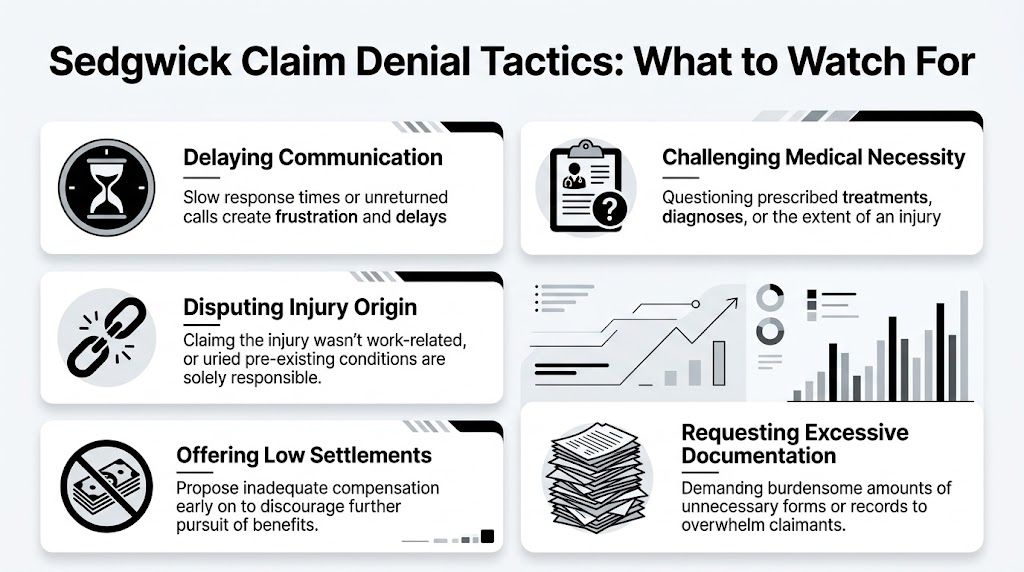
Most claim denials don’t arrive with a dramatic warning. They usually show up as delay, doubt, or paperwork friction.
One day you’re waiting on treatment approval. Then you hear the care is under review. Then you’re told more records are needed. Then someone says the condition may not be related to work. By the time the issue becomes obvious, you’ve already lost time.
Follow the pattern, not just the wording
According to reporting that reviewed Sedgwick marketing materials, Sedgwick promoted a 54% treatment denial rate for care recommended by injured workers’ physicians. The same report also states that industry analysis in 2025 found Sedgwick-managed claims had a 22% denial rate compared with a 14% industry average, with AI systems playing a role in auto-flagging claims, as discussed in this article on Sedgwick’s denial rates for injured worker treatment.
If you’re in the middle of a dispute, those numbers don’t decide your individual case. But they do show that denial and reduction are not random events. They’re part of a larger cost-control system.
The denial tactics workers run into most often
- Treatment review challenges: your doctor recommends care, but someone reviewing the file questions whether it’s medically necessary.
- Causation disputes: the claim handler argues your current symptoms came from a prior condition, not the work incident.
- Documentation overload: repeated requests for forms or records can slow care and wear people down.
- Employment status arguments: common in Texas driving and gig work cases.
- Early settlement pressure: a fast payment may be offered before the full injury picture is clear.
Sometimes these issues overlap. A back injury after a work crash can be challenged as both pre-existing and insufficiently documented, even when the worker reported it promptly.
Utilization review can block care
One of the most frustrating parts of sedgwick workers comp claims is utilization review, often called UR.
That process looks at whether recommended treatment will be approved. In practice, it can become the point where your treating doctor’s plan gets second-guessed.
If treatment is delayed this way, your response should be concrete:
- Get the denial reason in writing
- Ask your doctor to address that reason directly
- Request all records used in the review
- Keep proof of worsening symptoms or missed work
This is one place where organized records matter more than emotion. Anger is understandable. Paper wins the dispute.
An IME is not your treating doctor
If Sedgwick sends you for an independent medical examination, be careful with that label. The exam may feel neutral, but the doctor was not chosen by you.
Go prepared. Be honest. Be consistent. Don’t exaggerate. Don’t downplay.
Bring a short timeline of the injury, treatment, and current symptoms. If the doctor’s report is inaccurate, that may need to be challenged with your treating records and a clear written response.
A one-page timeline often helps more than trying to remember months of details under stress.
AI and automation can make the process colder
Workers often say claim handling now feels less human. That tracks with the way modern claims systems work.
When technology flags a file for missing proof, treatment mismatch, or classification issues, the worker may never get a plain-English explanation. You’re left arguing with an outcome instead of a person.
That’s why appeals and responses should focus on specifics:
- what happened,
- what medical records show,
- what work duties you were performing,
- and what is wrong with the denial basis.
For readers who want a broader look at how denials function in other administrative systems, this overview of medical billing denial management is useful because it shows how denial workflows often depend on coding, documentation, and repeatable process points rather than common sense.
What doesn’t work
These responses usually hurt more than help:
- Waiting: silence is often treated as acceptance.
- Calling without confirming in writing: verbal complaints disappear.
- Assuming the doctor “handled it”: your provider may support you, but you still need your own records.
- Settling too early: once you close the wrong issue, reopening it may be difficult.
The better approach is calm, documented, and persistent.
Special Challenges for Texas Drivers and Gig Workers
Texas workers who drive for a living face a different kind of risk. A job injury can become a road collision case in the same instant.
A Houston courier gets hit while delivering packages. A rideshare driver is struck while heading to a pickup. An Amazon Flex driver is hurt unloading after a crash. Now there may be questions about workers’ comp, employer status, personal injury law, auto coverage, and who pays for your losses.

Why Texas is different
Texas allows many employers to opt out of the traditional workers’ compensation system. These employers are often called non-subscribers.
That matters because if your employer is a non-subscriber, you may not have a normal workers’ compensation claim at all. Instead, you may need to pursue a negligence case against the employer, a third-party auto claim against another driver, or both.
For delivery and app-based drivers, that overlap can get messy quickly. A source discussing Texas delivery driver claims notes that delivery drivers face motor vehicle injury rates 2 to 3 times higher than the average worker, and many gig workers managed through Sedgwick run into denials tied to independent contractor status and non-subscriber issues, as described in this discussion of workers’ compensation for delivery drivers in Texas.
The legal terms you need to know
If your work crash turns into a personal injury case, these terms matter.
Liability means legal responsibility. If another driver caused the crash, that driver may be liable. If an employer failed to provide a safe system of work in a non-subscriber case, the employer may be liable.
Comparative fault comes from Texas Civil Practice and Remedies Code Chapter 33. In plain English, it means blame can be divided. If you were partly at fault, your recovery may be reduced. If your share of responsibility is too high under Texas law, recovery can be blocked.
Damages means the losses the law allows you to claim. That may include medical bills, lost income, pain and suffering, impairment, and in fatal cases, wrongful death compensation.
Statute of limitations means the deadline to file a lawsuit. If you miss it, you can lose the claim even if the facts were on your side.
Exemplary damages are addressed in Texas Civil Practice and Remedies Code Chapter 41. These are not available in every case. They involve stricter rules and usually require proof beyond ordinary negligence.
A work crash may involve more than one claim
A single collision can create several tracks at once:
| Possible claim | Who it may be against | What it may cover |
|---|---|---|
| Work injury claim | Employer plan or administrator | Medical care and certain wage-related benefits |
| Auto insurance claim | At-fault driver | Vehicle crash losses |
| Non-subscriber injury case | Employer | Negligence-based damages |
| UM or UIM claim | Your own or available policy | Uninsured or underinsured driver losses |
That’s why a Texas injury attorney often asks two separate questions right away. First, were you working? Second, who caused the crash?
A Houston driver rear-ended on I-45 while making deliveries may have a claim against the negligent driver. If the employer is a non-subscriber, the worker may also have a separate case depending on the facts, work status, and employer conduct.
Gig worker classification is often the first fight
Many app-based workers hear some version of this: “You’re an independent contractor, so this isn’t covered.”
Sometimes that’s the entire dispute.
The label alone doesn’t settle everything. The actual working relationship matters. Control, route expectations, app instructions, schedules, required procedures, and the realities of the job can all matter in a legal review.
If you’re trying to protect yourself financially while a claim is disputed, practical planning matters too. Workers who rely on app income often need to think about ongoing treatment access, and this guide to health insurance for gig workers can help you think through coverage issues while the legal side gets sorted out.
What to gather after a work-related crash
If you were driving for work, preserve more than the crash report.
Keep:
- Screenshots of your app status
- Route assignments
- Delivery logs
- Time stamps
- Employer texts
- Vehicle inspection records if relevant
- Photos from the scene
- Any notice from Sedgwick or the employer benefit plan
Those details often help prove you were acting in the course of your work when the collision happened.
How to Appeal a Denial and Preserve Your Deadlines
A denial letter is not the end of the case. It is the point where deadlines start to matter even more.
If your claim falls within the Texas workers’ compensation system, disputes may move through the Texas Division of Workers’ Compensation. Two terms you may hear are the Benefit Review Conference and the Contested Case Hearing.
Start with the denial letter
Read the letter carefully. Look for:
- The exact reason given
- The date of the decision
- Any deadline listed
- Missing records or disputed facts
Don’t assume the problem is obvious. Sometimes the written reason is narrow. Your response should address that reason directly.
Build the appeal around proof
An effective appeal usually includes a clean packet, not a pile of frustration.
That packet may include:
- Your written timeline
- Medical records tied to the denied issue
- Work status notes
- Accident or incident reports
- Witness information if available
- A short explanation of why the denial is wrong
The best appeal is easy for a reviewer to follow.
If the dispute is over whether the injury happened at work, focus on reporting, witnesses, and timing. If it’s over treatment, focus on the treating doctor’s reasoning and records.
Know what statute of limitations means
A statute of limitations is the legal deadline to bring a claim or take required action. Miss it, and your rights can shrink or disappear.
That term matters in workers’ comp disputes, non-subscriber injury cases, and third-party car accident claims. If you need a plain-English explanation, this resource on statutes of limitations in Texas gives a helpful overview.
Don’t let delay become defeat
People lose valid claims because they wait for the adjuster to “fix it.” That rarely works on its own.
If you were denied, act like the clock is already running. Request the file. Organize your records. Confirm every step in writing. If the injury involved a crash, preserve the auto claim evidence too. The workers’ comp dispute and the negligence case may depend on some of the same facts, but they are not the same thing.
You Don't Have to Face Sedgwick Alone
Sedgwick workers comp claims can wear people down. That’s especially true when the injury is serious, the treatment is delayed, or the case involves a work-related car wreck in Texas.
You do not have to figure out every rule by yourself. You do need to take the process seriously. Report early. Document everything. Be careful with adjusters. Push back against bad denials with records, not guesses. And if the claim involves a non-subscriber employer, a crash caused by another driver, or a fatal injury, get legal advice before important evidence slips away.
The hardest cases usually involve overlap. Work injury rules. auto insurance claim issues. Texas negligence law. comparative fault disputes. damages questions. In those cases, the right legal strategy is often the difference between a stalled file and a real path forward.
If you were hurt on the job, injured in a work-related crash, or lost a loved one in a fatal collision, The Law Office of Bryan Fagan, PLLC can help you understand your rights and your options. Our team helps Texans with workplace injury disputes, car and truck accident cases, insurance problems, and wrongful death compensation claims. A Houston car accident lawyer or Texas injury attorney from our firm can review your case, explain liability, comparative fault, damages, and deadlines in plain English, and help you decide what to do next. Your consultation is free, and you won’t pay attorney’s fees unless we recover compensation for you.