A car crash can change your life in seconds—but you don’t have to face recovery alone. In the world of Texas personal injury law, the words you use matter, and the term “accident” is one of the most misunderstood. Legally, it almost never means what people think it does.
From a legal standpoint, a true accident is an event that was completely unforeseeable and unavoidable. Think of a sudden, un-forecasted tornado causing a driver to lose control. It’s an act of God, and no one is at fault. But the truth is, the vast majority of collisions on Texas roads are not accidents; they are caused by someone’s preventable choices.
This guide will explain the crucial difference and show you why understanding the correct legal definition of accident is the first step toward protecting your rights and securing the compensation you deserve.
Why 'Just an Accident' Doesn't Exist in Texas Injury Law
After a crash, it’s natural to call what happened an "accident." But in the eyes of the law and insurance companies, that single word can undermine your entire personal injury claim.
When you call a crash an "accident," you suggest it was just bad luck—an event that couldn't be helped. But was the other driver really powerless? Or did they make a choice—a conscious decision or a careless mistake—that led directly to your injuries? An experienced Texas injury attorney knows that this distinction is everything.
Negligence Is Not an Accident
The reality is that nearly every car crash is the result of negligence. This isn't just a legal buzzword; it’s a core concept that means someone failed to use reasonable care, and that failure caused you harm. This is the crucial difference your entire case hinges on.
Careless choices that are often mislabeled as "accidents" include:
- A Houston driver on I-10 glancing at a text message instead of the road.
- Someone going 15 mph over the speed limit in a Dallas school zone.
- A driver running a red light in Austin because they were late for a meeting.
These are not random, blameless events. They are the direct and predictable outcomes of poor decisions.
Legal Accident vs. Negligent Act in a Texas Car Crash
| Characteristic | True Legal Accident | Negligent Act (Most Car Crashes) |
|---|---|---|
| Foreseeability | The event was completely unpredictable by a reasonable person. | The risk of harm was predictable (e.g., texting and driving is known to be dangerous). |
| Avoidability | No reasonable action could have prevented the outcome. | The crash could have been avoided if the person had acted with reasonable care. |
| Fault | No one is legally at fault. | One or more parties are at fault for failing to meet their duty of care. |
| Example | A sudden, massive sinkhole opens up and swallows a car. | A driver rear-ends you on I-45 in Houston because they were following too closely. |
| Legal Outcome | No basis for a personal injury claim. | The at-fault party is legally and financially responsible (liable) for the damages. |
Understanding this distinction is the key to holding the right person accountable and securing the compensation you need to recover.
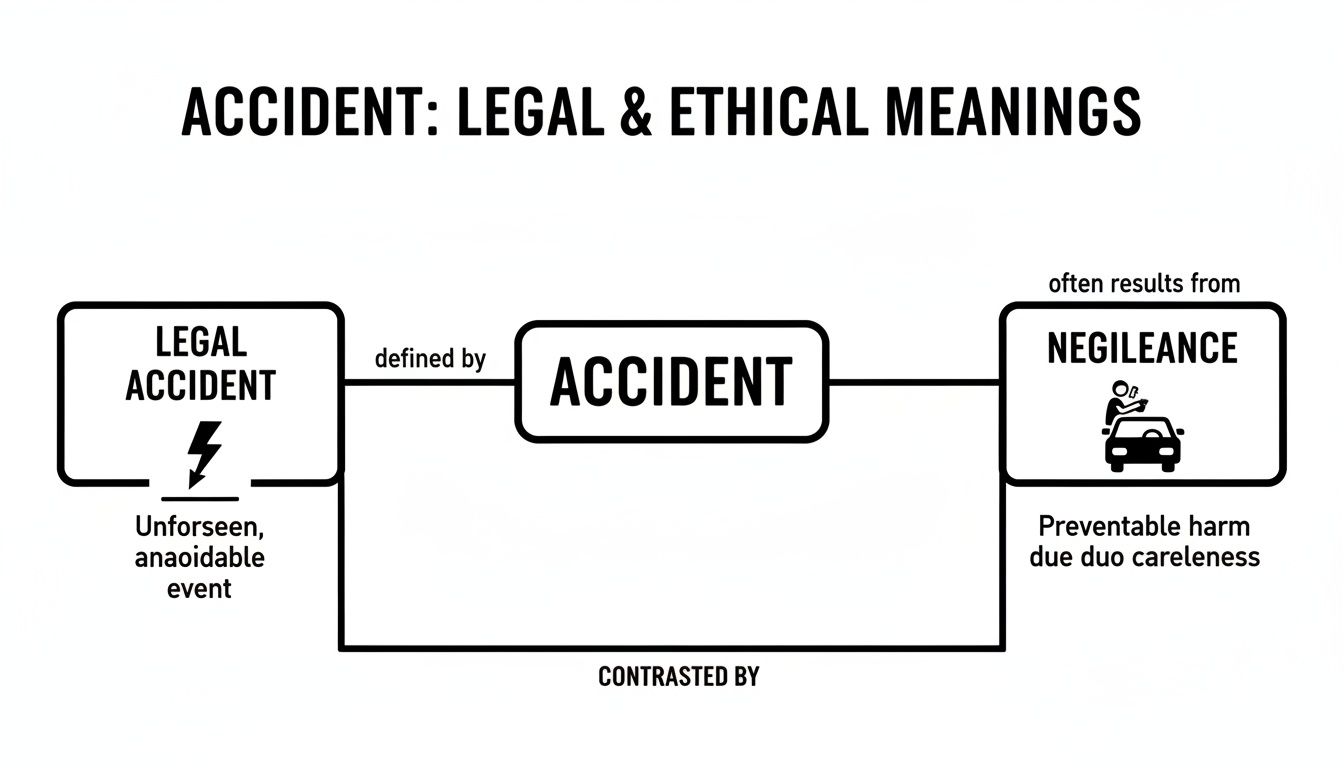
The image above helps visualize this critical difference. On one side, you have truly unavoidable incidents. On the other, you have crashes caused by carelessness, which form the basis of nearly every successful injury claim.
Why This Definition Is Key to Your Recovery
Watch out—insurance adjusters love the word "accident." They use it to downplay the other driver's responsibility and, in turn, minimize the amount of money they have to pay you. They want you to think it was just a case of bad luck for everyone involved.
At The Law Office of Bryan Fagan, PLLC, we see through this tactic every day. Our job is to prove the other driver was negligent, not just part of an "accident." Doing so establishes their liability—their legal and financial responsibility for the harm they caused.
Under Texas law, establishing another party's negligence is the foundation for recovering damages—the legal term for compensation for your losses. This includes medical bills, lost wages, and the pain and suffering you've endured.
Our compassionate Houston car accident lawyers are here to help you understand your rights and fight back against insurance company strategies. We know how to gather the evidence needed to prove your crash was no accident.
Who Is Liable in a Texas Car Accident?
In a courtroom or an insurance negotiation, the term accident has a very specific and narrow meaning. Understanding this difference is one of the most important first steps in protecting your right to compensation after a car, truck, or other motor vehicle crash.
A true legal accident is an event with no one to blame. Think of a sudden tornado touching down and tossing a parked car into yours. It's a completely unforeseeable and unavoidable act of nature. No one acted carelessly, so there’s no one to hold legally responsible.
But the crash that injured you? It almost certainly wasn’t an accident in the legal sense. It was the result of negligence.

Unforeseeable Event vs. Preventable Choice
The line between a true accident and a negligent act is drawn at foreseeability and choice. Negligence isn’t about bad luck; it’s about a person failing to use reasonable care, and that failure causing harm to someone else.
Most car wrecks are mislabeled as "accidents" when they are actually caused by preventable choices. For example:
- A driver on I-45 in Houston barrels into traffic because they were texting instead of watching the road.
- A commercial trucker driving through San Antonio causes a pileup after falling asleep at the wheel, having driven past federally mandated rest limits.
- A driver in a Dallas parking lot, knowing their brakes are bad, can't stop in time and hits a pedestrian in a crosswalk.
In every one of these cases, the wreck wasn't an unavoidable event. It was the direct, predictable result of a driver breaching their duty to operate their vehicle safely.
The Problem With the Word 'Accident'
Insurance adjusters love the word "accident." They use it deliberately. By calling your crash an "accident," they create a subtle narrative of shared misfortune, implying that no one was really at fault.
This is a tactic. It’s designed to make you feel that a lowball settlement offer is fair because, well, "accidents happen."
Don’t fall into this trap. When you let an insurance company frame your crash as a simple "accident," you are allowing them to downplay the other driver's responsibility and, by extension, their financial liability for your damages.
The foundation of every successful personal injury claim in Texas is proving the other party's negligence caused your injuries. This is how you establish liability (legal and financial responsibility). Once liability is proven, you can demand damages—the money you are owed for everything you’ve lost, from medical bills and lost income to your pain and suffering.
For victims in Texas, correctly framing the incident as the result of negligence—not some uncontrollable fluke—is the key that unlocks the door to recovery. It’s how you hold the right people accountable and get the resources you need to put your life back together. You can learn more about how experts analyze crash causation by exploring the insights on traffic accident causation at OSHwiki.
How Proving Negligence Wins Your Car Accident Claim
Proving negligence is the absolute cornerstone of every single personal injury claim in Texas. This isn’t about pointing fingers out of anger. It’s a methodical process of showing how another driver’s failure to be careful directly caused your injuries and that they are legally responsible for the outcome.
The Four Elements of a Negligence Claim
To build a successful case, a Texas injury attorney must prove four specific points. Think of it like a four-legged stool—if even one leg is missing, the whole thing collapses.
Duty: Every person who gets behind the wheel in Texas automatically takes on a legal duty to drive with reasonable care. This means following traffic laws, paying attention, and not creating a foreseeable risk to others on the road.
Breach: This is where the at-fault driver fails to live up to that duty. The breach is the specific irresponsible action they took—or failed to take. Texting, speeding, or driving after drinking are all clear-cut examples of a driver breaching their duty of care.
Causation: Next, we must draw a direct line from their careless act to your injuries. It's not enough to show the other driver was texting. We have to prove their texting caused them to run the red light, which in turn caused the collision that broke your leg.
Damages: Finally, we must demonstrate that you suffered real, provable harm, legally known as damages. This includes everything you’ve lost—from concrete costs like medical bills and lost paychecks to the very real physical pain and emotional trauma you’ve been forced to endure.
Let’s see how this plays out in a common scenario.
Real-World Example: You're driving along I-10 in Houston when traffic ahead slows. The driver behind you is looking at their phone. They slam into your car, leaving you with a serious whiplash injury and a totaled vehicle.
- Duty: That driver had a legal duty to watch the road and keep a safe distance.
- Breach: They breached that duty by texting instead of driving.
- Causation: Their distraction directly caused them to crash into you, causing your neck injury.
- Damages: You’re now facing medical bills, missed work, car repairs, and constant pain.
By proving all four elements, we build an undeniable case for compensation. After establishing negligence, understanding the practical steps of how to file an auto insurance claim is essential.
A Critical Texas Law: Modified Comparative Fault
Insurance companies have a powerful legal tool they love to use to slash or deny your compensation: comparative fault.
Texas operates under a “modified comparative fault” system, also known as the 51% bar rule, found in Chapter 33 of the Texas Civil Practice and Remedies Code.
Here’s what it means in plain English:
- A court can assign a percentage of fault to everyone involved, including you.
- Your final compensation is reduced by your percentage of fault. If you’re awarded $100,000 but found 10% at fault, you’ll only receive $90,000.
- Here’s the critical part: if you are found to be 51% or more at fault, you get nothing. You are completely barred from recovering any money.
Insurance adjusters are masters at exploiting this rule. They will dig for any shred of evidence to pin a piece of the blame on you—saying you braked too suddenly or changed lanes without signaling—all in an effort to reduce what they have to pay.
This is why you need a skilled Houston car accident lawyer. We know how to anticipate these tactics and build a powerful case that minimizes your fault. For a deeper dive, learn more about comparative negligence in Texas.
Steps to File an Insurance Claim in Texas
After a crash, you can bet on one thing: the other driver’s insurance adjuster will be calling. Remember, this person, no matter how polite, is not on your team. Their job is to protect their company’s profits by paying you as little as possible.
One of their most powerful weapons is a single, seemingly harmless word: “accident.”

Why Their Words Matter
Insurance adjusters use carefully chosen language to frame the story in their favor, and calling your collision an “accident” is a classic move. It paints the picture of a random, unavoidable event where nobody is truly to blame.
This isn’t a mistake. It’s a deliberate tactic. They want you to think, "Well, it was just an accident," so that when they slide a quick, lowball settlement offer across the table, you're more likely to accept it.
The stakes are high. Globally, road traffic incidents are understood as a failure of the system. The World Health Organization's findings on road traffic injuries show these crashes cause millions of preventable injuries and deaths each year. For you, proving that your wreck was caused by negligence is the key to fair compensation.
What NOT to Do When Speaking with an Insurer
Your first conversations with the insurance company are a minefield. One wrong step can damage your claim. Here are the most common traps to avoid:
- Do Not Give a Recorded Statement: The adjuster will sound insistent, but you are not required to give a recorded statement without your lawyer. They are hoping you'll say something they can twist and use against you.
- Do Not Say "I'm Sorry": It's a natural human reaction, but an apology can be used as an admission of guilt. Stick to the facts.
- Do Not Downplay Your Injuries: When they ask how you're feeling, resist the urge to say "I'm fine." Adrenaline can hide serious pain. The correct answer is, "I am getting medical treatment."
- Do Not Sign Anything: Never sign any medical releases or settlement agreements without an attorney reviewing them first. You could be signing away your right to future compensation.
For a more detailed breakdown, our guide on how to deal with insurance adjusters is a must-read.
An insurance adjuster's job is to close your file for the lowest possible cost. Your lawyer's job is to ensure you receive the full and fair compensation you need to recover.
Protecting your rights starts with understanding these tactics. An experienced Houston car accident lawyer can handle all communications for you, shielding you from the adjuster's pressure.
Seeking Justice After a Fatal Car Crash
When a car crash ends in the ultimate loss, the grief is unbearable. The legal journey that follows, a wrongful death claim, isn’t about putting a price on a life. It’s about fighting for justice for your loved one and securing the financial stability your family needs to move forward.
The core of a Texas wrongful death lawsuit is proving the crash wasn't just a random event. It was the direct result of another person's negligence. This is how we hold the at-fault party accountable for the catastrophic impact of their actions and secure wrongful death compensation for the family.
Who Can File a Wrongful Death Claim in Texas?
Texas law is clear about who has the right to bring a wrongful death claim. That right is reserved for the closest surviving family members:
- The surviving spouse
- The children of the deceased
- The parents of the deceased
These family members can file the claim on their own or together. If no one from this group files a claim within three months of their loved one’s death, the personal representative of the estate can then file on their behalf.
Proving that the incident was caused by negligence—not just a tragic fluke—is the first and most critical step toward finding justice.
What Kind of Compensation Can Your Family Seek?
No amount of money can replace the person you lost. A wrongful death claim is designed to ease the immense financial and emotional burdens forced upon your family.
The compensation, known as damages under Texas law (see Chapter 41 of the Texas Civil Practice & Remedies Code), that you can pursue includes:
- Lost Earning Capacity: The income your loved one would have earned.
- Loss of Companionship: For the loss of love, comfort, and guidance.
- Mental Anguish: For the profound emotional pain and suffering of surviving family members.
- Loss of Inheritance: The assets the deceased would have likely accumulated and left to the family.
Building a strong case is meticulous work. In some situations, private autopsies due to wrongful death cases can be a necessary step to prove the cause of death. You can get more details by reading our guide on filing a wrongful death lawsuit in Texas.
The Statute of Limitations Is a Strict Deadline
This is critical: you do not have unlimited time to act. In Texas, the statute of limitations for filing a wrongful death claim is generally two years from the date of your loved one's death.
If you miss this deadline, your right to seek justice through the courts is lost forever. It's a harsh rule, which is why it's so important to speak with a compassionate attorney as soon as you are able.
Why You Need an Experienced Texas Attorney on Your Side
If you've learned anything from this guide, it should be this: the legal process after a car crash is a minefield. You aren't just trying to recover from your injuries—you are going head-to-head with a system built by insurance companies to protect their profits.
All those concepts we've talked about—the technical definition of an "accident," the four elements of negligence, and Texas's tricky comparative fault laws—are the exact tools insurance adjusters use to deny, delay, and devalue legitimate claims. Their one and only goal is to close your case for the smallest amount of money possible.
Leveling the Playing Field
Trying to heal from your injuries while simultaneously gathering evidence, dealing with aggressive adjusters, and hitting strict legal deadlines is overwhelming.
Hiring an experienced Texas injury attorney isn't just another bill to pay—it's an investment in your physical and financial future. It puts a professional in your corner who can handle the fight for you, letting you focus on the one thing that truly matters: getting better.
At The Law Office of Bryan Fagan, PLLC, we work on a contingency-fee basis. This is our promise to you: you will not pay us a single penny unless we win your case. We front all the costs of building your claim because we believe in our ability to get you the compensation you deserve.
Your Next Step Is Simple—and Free
The aftermath of a crash is chaotic, but your path forward doesn't have to be. Justice and recovery start with one easy, no-risk step. Our team is dedicated to fighting for accident victims across Texas, from Houston to Dallas and San Antonio to Austin. We're here to listen, answer your questions, and empower you with information about your rights.
You've been through enough. Let a compassionate and experienced Houston car accident lawyer take this weight off your shoulders. Contact The Law Office of Bryan Fagan, PLLC today for a free, no-obligation consultation. It costs you nothing to learn how we can help you fight for the recovery you are owed.
Frequently Asked Questions About Texas Car Accident Claims
After the shock and chaos of a car wreck, your mind is probably racing with questions. We've laid out the answers to the most common concerns we hear from accident victims across Texas to give you the clarity you need.
What Should I Do Immediately After a Car Crash in Texas?
Your first moves after a crash are practical steps that protect your health and your legal rights.
- Check for Injuries and Call 911. This is always the first step. Call 911, even for a "minor" crash. A police report is vital evidence, and paramedics can spot injuries you might not notice.
- Move to Safety. If possible, move your car to the shoulder to prevent another collision.
- Exchange Information (But Don't Talk Fault). Get the other driver’s name, contact info, license number, license plate, and insurance details. Be polite, but do not apologize or discuss who was at fault.
- Document Everything. Use your phone. Take photos and videos of car damage, skid marks, road signs, and any visible injuries from multiple angles.
- See a Doctor. This is non-negotiable, even if you feel fine. Some serious injuries don't show symptoms for hours or days. A medical record creates an undeniable link between the crash and your injuries.
How Does Texas's 51% Fault Rule Affect My Injury Settlement?
This is one of the most important rules in Texas personal injury law. Texas operates under a "modified comparative fault" system (Chapter 33, Texas Civil Practice & Remedies Code), often called the 51% bar rule.
Here’s the plain-English explanation:
- A jury assigns a percentage of blame to everyone involved.
- Your final settlement is reduced by your percentage of fault. If your case is worth $100,000 but you're found 20% at fault, you’ll receive $80,000.
- If you are found to be 51% or more at fault, you get nothing. You are barred from recovering a single penny.
Insurance companies are masters at using this rule to their advantage. A skilled attorney is essential to shut down these tactics.
How Long Do I Have to File a Car Accident Lawsuit in Texas?
This deadline is called the statute of limitations. In Texas, you generally have a two-year window from the date of the crash to file a personal injury lawsuit.
This deadline is strict. If you miss it, you will lose your right to seek compensation forever, no matter how clear the other driver's fault was. That’s why contacting an attorney quickly is so important.
Do I Really Need a Lawyer If the Other Driver Was Clearly at Fault?
Yes, without question. Even in a crash that seems 100% clear-cut, like being rear-ended at a red light on I-45, the insurance company is not on your side.
Their job is to protect their profits by paying you as little as possible. They will still hunt for ways to assign you partial fault or argue your injuries aren't as bad as you claim.
An experienced Houston car accident lawyer levels the playing field. We handle the auto insurance claim communications, gather evidence to prove the true cost of your damages, and fight to make sure you get a settlement that covers all your losses—not just the lowball number the insurer hopes you'll accept.
The legal system can feel like a maze, but you don't have to navigate it by yourself. The dedicated attorneys at The Law Office of Bryan Fagan, PLLC are here to protect your rights and fight for the full and fair compensation you deserve. Contact us today for a free, no-obligation consultation to discuss your case by visiting https://houstonaccidentlawyers.net.