A car crash can change your life in seconds—but you don’t have to face recovery alone. Suddenly, you're dealing with injuries, stacking up medical bills, and trying to navigate a sea of confusing insurance terms. One of the most important concepts to understand is your role as the "third party."
In the simplest terms, if another driver’s negligence caused your accident, you are the third party when you file a claim against their insurance policy. Understanding this is the first step toward protecting your rights and securing the financial recovery you and your family deserve.
Understanding Your Role in a Car Accident Insurance Claim

After a wreck, trying to understand insurance jargon can feel like learning a new language. Words like liability, damages, and "third party" get thrown around, and it's easy to feel lost. But getting a grip on these roles is the first real step toward protecting your rights and getting the money you need to recover.
Think of an auto insurance policy as a contract between two main players. When another driver’s carelessness leaves you injured, you step into the picture as an outsider—the third party—seeking compensation under that contract.
The Key Players in Your Claim
Let's break down who's who in a typical Texas third-party insurance claim. To make it simple, imagine you were hurt when a Houston driver ran a red light on I-45 and T-boned your car. In that scenario, the roles are clear.
The table below clarifies who each party is and what their role is in your claim.
Key Players in a Texas Car Insurance Claim
| Party | Who They Are | Their Role in Your Claim |
|---|---|---|
| First Party | The at-fault driver (the "insured") | This is the person who bought the insurance policy and whose negligence caused your accident. |
| Second Party | The at-fault driver's insurance company | This is the company that wrote the policy and is responsible for paying claims on their customer's behalf. |
| Third Party | You (the injured person) | You are the person making a claim against the first party's policy to cover your injuries and other losses. |
Grasping these roles is critical because it highlights a fundamental conflict of interest.
This distinction is crucial because when you file a third-party claim, you're dealing with an insurance company that has no loyalty to you. Their legal and financial duty is to their customer (the first party) and their shareholders, not to your well-being. Knowing what to do after a car accident, especially how to handle communication with the other driver's insurer, is vital.
Their goal is almost always to minimize what they have to pay you, which is exactly why having an experienced Houston car accident lawyer in your corner is so important.
An insurance adjuster for the at-fault driver is not your advocate. Their job is to protect their company's bottom line by paying out as little as possible on your auto insurance claim.
Understanding this dynamic from the beginning empowers you to approach the process with caution and seek the legal help you need to protect your rights.
Who Is Liable in a Texas Car Accident?
In Texas, your ability to recover compensation after a car wreck boils down to one simple question: who was at fault? Our state is an “at-fault” state, which means the person whose negligent actions caused the collision is legally responsible for the harm they created.
In legal terms, this is called liability. To prove liability, you must show the other driver was negligent. Think of it this way: every driver has a duty to operate their vehicle with reasonable care. When they fail—by texting, speeding, or running a red light—and that failure causes you harm, they are considered liable for your damages. This concept is the foundation of every Texas personal injury claim.
This is the entire basis of a third-party insurance claim. When you file a claim against the other driver’s insurance, you’re asserting that their client is responsible for your injuries and losses. The insurance company will then do everything it can to prove you wrong.
Texas Follows a Proportionate Responsibility Rule
Life isn't always black and white, and neither are car accidents. Sometimes, more than one person shares the blame. Texas law, under Chapter 33 of the Texas Civil Practice & Remedies Code, accounts for this with a system called proportionate responsibility, which you might also hear called comparative fault.
Here’s how it works: you can still recover money for your injuries as long as you are not found to be 51% or more at fault for the crash. If a jury decides you were partially to blame—say, 10% at fault—your final compensation award will be reduced by that same percentage. You can get a deeper dive into this rule in our guide to comparative negligence in Texas.
For instance, if you were awarded $100,000 but found to be 10% responsible, you’d receive $90,000. This is precisely why insurance adjusters will fight tooth and nail to pin even a tiny fraction of the blame on you. Every percentage point they can shift in their favor saves their company money.
Real-World Example: A Houston driver rear-ended on I-45 is almost always the victim of the other driver's negligence. But their insurance adjuster might try to argue that your brake lights weren't working to shift blame. This is where details matter. Knowing the Texas state vehicle inspection requirements can help you push back against these baseless claims and prove the other driver was 100% responsible.
Building a Case to Prove Liability
Proving the other driver was negligent isn’t about just saying it’s true; it requires hard evidence. A skilled Texas injury attorney will immediately get to work gathering and preserving all the crucial pieces of your case, including:
- The Official Police Report: This is the first official record of the accident. It contains the officer’s initial observations and often their professional opinion on who caused the crash.
- Witness Statements: Unbiased accounts from people who saw what happened can be incredibly powerful in backing up your version of events.
- Photos and Videos: Images of the smashed vehicles, skid marks on the road, traffic signs, and the general scene help tell the story of the collision.
- Expert Testimony: For more complex accidents, we often bring in accident reconstruction experts who can scientifically analyze the evidence and explain exactly how the crash occurred and who was at fault.
Don't underestimate what's at stake. Third-party liability is a massive global market. In the United States, auto liability is the single largest line of property and casualty insurance. The ever-rising costs of medical care and vehicle repairs mean the financial stakes in these claims are huge. This is why insurers are so aggressive in disputing liability—they are protecting a massive financial interest.
Steps to File an Insurance Claim in Texas
Once you’ve established that the other driver was at fault for the crash, it’s time to file a third-party insurance claim. This process can feel overwhelming, especially when you’re also trying to recover from your injuries. By taking it one step at a time, you can navigate the system with confidence.
Filing the claim is how you officially notify the at-fault driver's insurance company about the accident. It kicks off the process of recovering damages—a legal term for all the financial, physical, and emotional losses you’ve suffered because of their policyholder’s negligence. What you do and say at this stage is crucial.
This flowchart lays out the basic path from the crash itself to getting a liability decision.
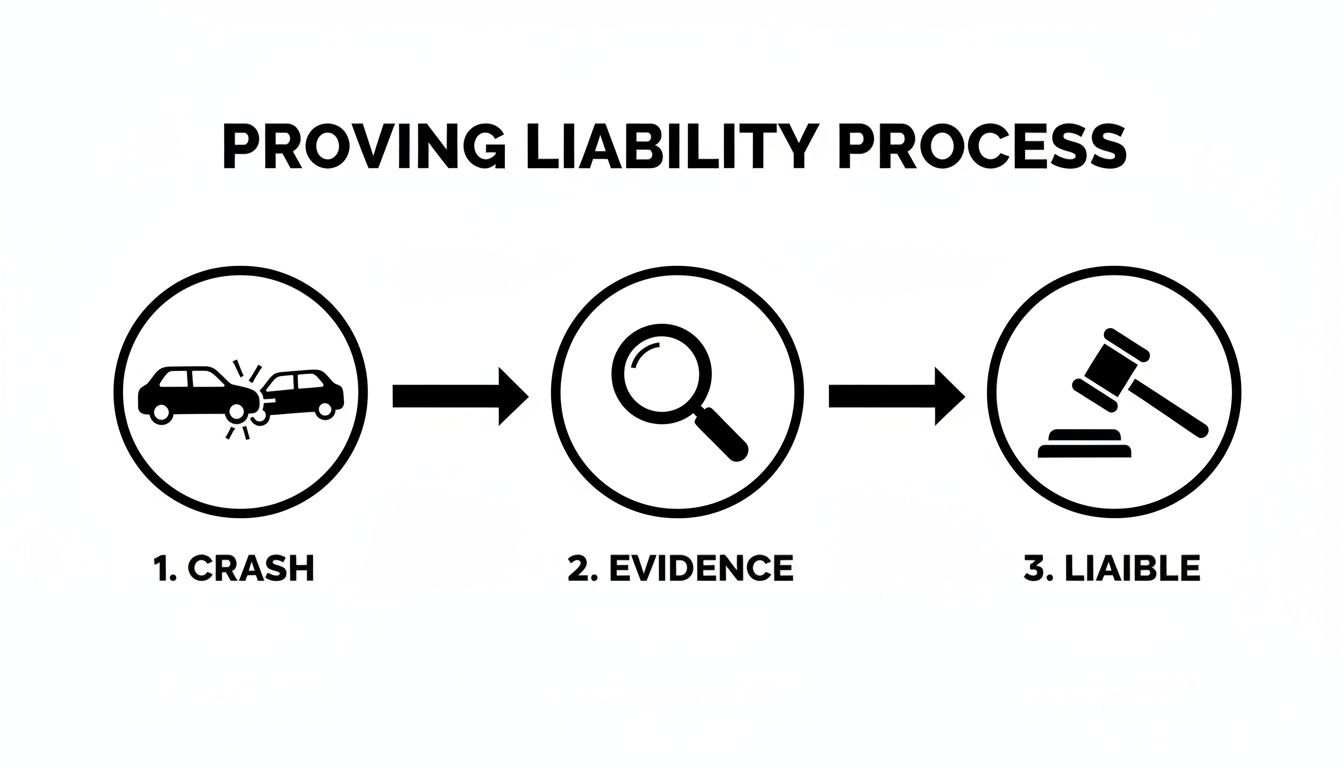
As you can see, proving fault isn't a single event. It starts with the accident, moves into collecting solid evidence, and ends with a formal decision about who is legally responsible.
Your Initial Steps After the Accident
The right moves right after a crash can make or break your claim. Your focus should be on clear communication with the insurer and meticulous documentation of everything.
Here’s a practical, step-by-step checklist to get you started:
- Notify the At-Fault Driver’s Insurer: Your first call should be to the other driver's insurance company to open a claim. You’ll need to provide the basics: your name, their policyholder's name, and the date and location of the crash. Stick to the facts. Do not volunteer opinions about fault or discuss your injuries yet.
- Provide Your Evidence: The insurer will assign an adjuster to investigate. Your job is to provide them with a compelling evidence packet. This should include the official police report, photos from the scene, and the names and contact information of any witnesses.
- Document Every Interaction: This is non-negotiable. Keep a detailed log of every phone call, email, and letter you exchange with the insurance company. Write down the date, time, who you spoke to, and what was said. This record can be a lifesaver if a dispute arises later.
Crucial Advice: Never give a recorded statement to the other driver’s insurance company without first speaking with a Houston car accident lawyer. Insurance adjusters are trained professionals whose job is to minimize payouts. They will ask leading questions designed to trick you into admitting partial fault or downplaying how hurt you really are.
Your Step-by-Step Guide to Filing a Third-Party Claim
Follow these key actions to effectively manage your third-party auto insurance claim in Texas.
| Step | Action to Take | Why This Step Matters |
|---|---|---|
| 1. Open the Claim | Contact the at-fault driver’s insurance company promptly. Provide basic accident details: date, time, location, and their policyholder's name. | This establishes an official record of the incident and starts the process. Delays can be used against you. |
| 2. Submit Evidence | Provide the adjuster with your police report, photos, witness information, and a clear description of the events. | This is your first opportunity to present a fact-based case that their driver was at fault. |
| 3. Document Damages | Systematically collect all medical bills, proof of lost wages, and at least two vehicle repair estimates. Keep everything organized. | You must prove every dollar you're claiming. Strong documentation is the foundation of a fair settlement offer. |
| 4. Avoid Pitfalls | Do not give a recorded statement without legal advice. Do not sign any documents or accept an early, lowball offer. | This protects you from the insurer's tactics to devalue your claim and preserves your right to full compensation. |
| 5. Consult an Attorney | If you have significant injuries or the insurer is being difficult, speak with an experienced Texas injury attorney. | An attorney can handle all communication, build a stronger case, and fight for a settlement that truly covers all your losses. |
This structured approach helps ensure you don't miss any critical details that could impact your financial recovery.
Gathering Proof of Your Damages
It’s not enough to tell the insurance company you were hurt and your car is wrecked. You have to prove it with hard evidence. The final value of your settlement is directly linked to the quality and thoroughness of your documentation.
Start building a comprehensive claim file that includes:
- All Medical Records: Every single bill from the hospital, your doctors, physical therapy sessions, and prescription medications.
- Proof of Lost Income: Gather recent pay stubs and ask your employer for a letter confirming your rate of pay and the exact amount of time you missed from work.
- Vehicle Repair Estimates: Don’t just get one quote. Obtain at least two written estimates from reputable body shops for the property damage to your car.
Putting together a strong claim takes serious attention to detail. For a deeper dive into what’s involved, check out our guide on how to file a car accident claim. When you handle these steps correctly from the beginning, you put yourself in the best possible position to get the full compensation you deserve.
Recovering All the Damages You Are Owed
After a wreck, a fair settlement should cover far more than just the initial ER visit. When another driver’s negligence turns your life upside down, Texas law gives you the right to seek compensation for every single one of your related losses.
Legally, these losses are called damages. Think of them as the key to making you as whole as possible after a crash. Knowing what you can actually claim is the first step toward getting a settlement that truly reflects what you've been forced to endure.
Damages generally fall into two categories: economic and non-economic. Both are absolutely critical for a complete recovery.
Economic Damages You Can Claim
Economic damages are the most straightforward because they’re tied to tangible, out-of-pocket financial hits. These are the costs you can prove with a stack of receipts, bills, and pay stubs.
Consider these the black-and-white costs of the accident. They typically include:
- Medical Expenses: This covers everything from the ambulance ride and hospital stay to future surgeries, physical therapy, and prescription medications.
- Lost Wages: You deserve compensation for the income you lost while you were physically unable to work during your recovery.
- Loss of Earning Capacity: If your injuries are serious enough to prevent you from returning to your old job or earning the same income as before, you can claim these future lost wages.
- Property Damage: This is the cost to either repair or completely replace your vehicle and any other personal property that was destroyed in the collision.
Solid documentation is the bedrock of a strong economic damages claim. Keep every bill and receipt.
Non-Economic Damages for Your Suffering
Non-economic damages are just as real as medical bills, but they are designed to compensate for the intangible losses that don't come with a price tag. These damages acknowledge the profound human toll of a serious injury.
Under Texas law, you are entitled to compensation for:
- Pain and Suffering: The physical pain, discomfort, and agony caused by your injuries.
- Mental Anguish: The emotional distress, anxiety, depression, and trauma that so often follow a violent accident.
- Physical Impairment: This is compensation for the loss of your ability to enjoy daily activities, hobbies, or the life you once loved.
Because these damages are subjective, insurance companies love to downplay them or pretend they aren't worth much. This is precisely where a skilled Houston personal injury lawyer becomes invaluable—they know how to articulate your suffering in a way that demonstrates its true value.
It’s also important to understand the bigger financial picture. Third-party liability claims in the U.S. are under immense pressure from high litigation costs. This has led to casualty insurance rates in the U.S. jumping by 8% in a single quarter, while rates in other parts of the world saw much smaller increases or even went down. You can read more about these global insurance market trends to see how they highlight the high stakes involved in your third-party claim.
In the most severe cases—think of a drunk driving crash or other instances of extreme negligence—Chapter 41 of the Texas Civil Practice & Remedies Code also allows for exemplary damages (often called punitive damages). These are not meant to compensate you for a loss. Instead, their purpose is to punish the at-fault party and send a clear message to deter others from engaging in similar reckless behavior, potentially leading to a claim for wrongful death compensation.
Why a Lawyer Is Your Best Ally in a Third-Party Claim

Trying to handle a third-party claim by yourself is like stepping into the ring against a professional boxer. You're going up against a team of insurance adjusters whose entire job is to protect their company's bottom line by paying you as little as possible. They are trained negotiators, and this isn't their first fight.
Hiring a Houston car accident lawyer immediately levels the playing field. You get an experienced advocate in your corner who is dedicated to one thing: protecting your rights.
An attorney becomes your shield, taking over all communication with the insurance company. This is more important than it sounds. It stops you from falling into common traps, like giving a recorded statement that they can twist and use against you later. This lets you focus on what really matters—your physical and emotional recovery—while we handle the legal heavy lifting.
Navigating Deadlines and Building Your Case
One of the most critical roles a Texas injury attorney plays is making sure you don't miss the state's strict deadlines. In Texas, you generally have just two years from the date of the accident to file a personal injury lawsuit. This is called the statute of limitations.
If you miss this two-year window, the courthouse doors will likely be closed to you forever. The court will almost certainly refuse to hear your case, and your right to seek any compensation will be gone. An attorney manages these deadlines for you, keeping your legal options open while we build the strongest case possible.
Your lawyer is your strategic partner. We gather evidence, consult with experts, calculate the full extent of your damages, and build a powerful, evidence-based argument for why you deserve maximum compensation.
We meticulously document everything. This includes your medical treatments, lost wages, and the long-term impact the accident has on your quality of life. This comprehensive, detailed approach is the key to successful negotiations.
Fighting for the Settlement You Deserve
An experienced lawyer knows all the tactics insurers use to undervalue or flat-out deny legitimate claims. We know how to counter their lowball offers with compelling proof of your losses and negotiate aggressively for a settlement that truly covers your needs, both now and in the future.
The insurance world is incredibly complex, with a web of regulations and financial pressures. Global reports show that supervisory attention on third-party liability is increasing due to new systemic risks. This environment makes professional guidance essential when you're just one person up against a massive insurance corporation. You can discover more insights from the 2025 Global Insurance Market Report to better understand the forces at play.
With an attorney, you are not just another claim number to be processed as cheaply as possible. We fight to make sure your story is heard and that the final settlement reflects the true cost of your injuries and suffering.
Best of all, most personal injury lawyers, including our team at The Law Office of Bryan Fagan, PLLC, work on a contingency-fee basis. This means you pay us absolutely nothing unless we win your case. You have nothing to lose and everything to gain by getting an expert on your side.
Answering Your Questions About Third-Party Claims
When you're reeling from a serious car accident, the last thing you need is more confusion. The questions can feel overwhelming, and the path forward is rarely clear. Below, we’ve answered some of the most common concerns we hear from injured folks across Texas.
Getting a handle on your rights is the first, most critical step. Knowing what to do—and just as importantly, what not to do—can make all the difference in securing the financial stability you and your family need to heal and move on.
What if the At-Fault Driver Is Uninsured?
It’s a nightmare scenario, but one that happens far too often. The good news is, it doesn't automatically mean you're out of options. If the driver who hit you has no insurance or not enough to cover all your damages, you can often turn to your own auto policy for help.
This is exactly what Uninsured/Underinsured Motorist (UM/UIM) coverage is for. It’s a part of your policy designed to protect you in this specific situation. By filing a UM/UIM claim, you’re asking your own insurance company to step in and cover the losses the at-fault driver should have paid for. An experienced Texas injury lawyer can dig into your policy and manage this claim to make sure you get the benefits you’ve been paying for.
Should I Give a Recorded Statement to Their Insurer?
Absolutely not. Let's be crystal clear: you are under no legal obligation to give a recorded statement to the other driver's insurance company. We strongly advise all our clients to politely decline.
Why? Because insurance adjusters are trained professionals whose job is to minimize payouts. They ask tricky, leading questions designed to trip you up and get you to say something that hurts your claim. They might try to get you to downplay your pain or even unintentionally admit some fault for the crash. Anything you say in that recording can and will be used against you. It's always best to let your lawyer handle all communications.
How Long Do I Have to File My Claim?
Texas law is very strict on this. You have a limited time to file a personal injury lawsuit, which is set by the statute of limitations. For most car accident claims, you have just two years from the date of the crash to get your case filed with the court.
If you miss this two-year window, you will almost certainly lose your right to seek any compensation, forever. The deadline is unforgiving, which is why it’s so critical to talk to a Houston car accident lawyer as soon as possible to protect your legal rights.
Should I Accept a Quick Settlement Offer?
Be extremely careful with any early settlement offer from an insurance company. These quick offers are almost always a lowball tactic. The insurer is hoping you'll take the fast cash before you understand the true extent of your injuries, your future medical needs, and the total value of your claim.
Once you accept that check, it's over. You waive your right to seek any more money for this accident, even if your injuries turn out to be far more serious than you first thought. Never sign anything or agree to a settlement without first talking to a lawyer who can calculate what your case is actually worth and fight for a fair outcome.
The legal system can feel like an impossible maze, but you don't have to navigate it alone. The compassionate attorneys at The Law Office of Bryan Fagan, PLLC are here to listen, answer your questions, and fight for the justice you deserve. Your rights matter, and you deserve a team that will stand up to the insurance companies for you. Contact us today for a free, no-obligation consultation to learn how we can help. https://houstonaccidentlawyers.net