Skip to content
A car crash can change your life in seconds, but you don’t have to face recovery alone.
If you’re reading this after losing a spouse, parent, or child in a Texas accident, you may be trying to do basic things while carrying impossible grief. You’re answering family texts, talking to the funeral home, dealing with bills, and trying to understand what happened. Legal deadlines probably feel far away from what matters most right now.
But one deadline can shape whether your family keeps the right to seek justice. That deadline is the wrongful death statute of limitations texas families need to know about as early as possible. This isn’t about pressure. It’s about protecting your options before an insurance company, missing records, or the passage of time closes the door.
The First Step After an Unthinkable Loss
A Houston family loses a father after a crash on I-45. He survives the wreck, spends time in the hospital, and then passes away later from those injuries. His wife is grieving. His children are in shock. The family knows the other driver caused the crash, but they don’t know what to do first.
That kind of situation is common. Families often know something was wrong, but they don’t know how Texas law turns that harm into a legal claim. They also don’t know that more than one type of claim may exist after a fatal accident.
Why legal timing matters so much
The law gives families a limited window to file a lawsuit. That deadline is called the statute of limitations. In plain English, it means the final date to bring a claim in court.
A wrongful death case usually grows out of negligence, which means a person or company failed to use reasonable care. In a fatal car wreck, that could mean a distracted driver, a drunk driver, a trucking company, or another party whose conduct caused the death.
Liability means legal responsibility. If someone’s negligence caused the death, that person or business may be liable.
Damages means the losses the law may allow a family or estate to recover. In these cases, damages may include financial losses, funeral-related losses, and other harm recognized by law.
Practical rule: Your family doesn’t need to have every answer before speaking with a lawyer. You do need to protect the deadline while evidence is still available.
Texas also uses fault rules that matter in accident cases generally. Under Texas Civil Practice & Remedies Code Chapters 33 and 41, questions can arise about who was at fault, whether more than one party shares blame, and what damages may be available. Chapter 33 covers proportionate responsibility, often called comparative fault. That means the law can look at whether multiple people contributed to the crash. Chapter 41 addresses certain rules tied to damages.
Those rules can feel abstract until they affect a real family. If a fatal crash involved a speeding driver and a rideshare vehicle, or a truck and a road design issue, sorting out fault can take time. That’s one reason early action matters. You’re not just grieving. You’re preserving your family’s rights.
Understanding the Two-Year Deadline for Texas Wrongful Death Claims
A family loses someone after weeks in the hospital. The crash happened in January. The death happened in March. One of the first legal questions is often, “Which date starts the deadline?”
In many Texas wrongful death cases, that answer is the date of death.
Under Texas Civil Practice and Remedies Code Section 16.003(b), the general rule is that a wrongful death lawsuit must be filed within two years of the person’s death. You can read the statute itself in Texas Civil Practice and Remedies Code Section 16.003.

What statute of limitations means in plain English
A statute of limitations is the court’s filing deadline. It works like an expiration date on a legal claim. If the case is filed on time, the court can hear it. If it is filed too late, the defendant can ask the court to dismiss it.
That can happen even when the underlying facts are serious and the loss is real.
Why the date of death matters
Families often assume the clock starts on the day of the crash or other fatal event. For a wrongful death claim, that is usually not the key date. The key date is usually when your loved one died from those injuries.
Here is a simple example. A man is badly hurt in a highway collision, survives for several months, and then dies from those injuries. The wrongful death deadline usually runs from the date of death.
That rule sounds simple. The confusion starts because the family may also have a survival action, and that timeline can raise a different question. A general guide to statutes of limitations in Texas can help with the broader framework, but the practical point is this: families should preserve both claims early, because wrongful death and survival issues do not always line up as neatly as people expect.
Why waiting can still create problems
Two years can sound like plenty of time during grief. In practice, it passes fast.
Security footage may be deleted. Vehicles may be repaired or sold. Electronic data can disappear. Witness memories usually get less reliable, not more reliable, with time. Insurance companies often start evaluating the case long before a family feels ready to talk about a lawsuit.
So even if the filing deadline has not arrived, delay can still weaken the proof.
A common confusion families should catch early
The wrongful death claim belongs to certain surviving family members. The survival action is tied to the claim the deceased person could have brought if they had lived. Those are separate legal tracks, even when they grow out of the same event.
That difference matters here because people sometimes hear “two years” and assume every related claim will be measured the same way in the same way. Texas cases are not always that simple. A family that protects the wrongful death deadline but ignores the survival side can create avoidable problems for the estate. A family that focuses only on the deceased person’s pre-death suffering can also miss the deadline for the relatives’ own wrongful death claim.
The safest approach is to treat the case like it has two clocks until a lawyer confirms otherwise.
Who needs to pay attention to this deadline
This deadline can affect families after many kinds of fatal incidents, including car crashes, truck wrecks, workplace accidents, unsafe property events, and other deaths caused by negligence.
It also matters when fault is disputed. If the other side argues your loved one shared blame, the family may need time to investigate, gather records, and identify every responsible party. That work is easier when it starts early.
Some exceptions can pause or affect limitations periods in limited situations. Those exceptions are fact-specific and should be reviewed carefully, not assumed.
Wrongful Death Claims vs Survival Actions What Families Need to Know
Families often hear “wrongful death claim” and assume that’s the only case that matters. It often isn’t. Texas law can allow a second track called a survival action.
That distinction matters because these claims serve different purposes. One focuses on the family’s losses. The other focuses on the losses the deceased person could have pursued if they had lived.
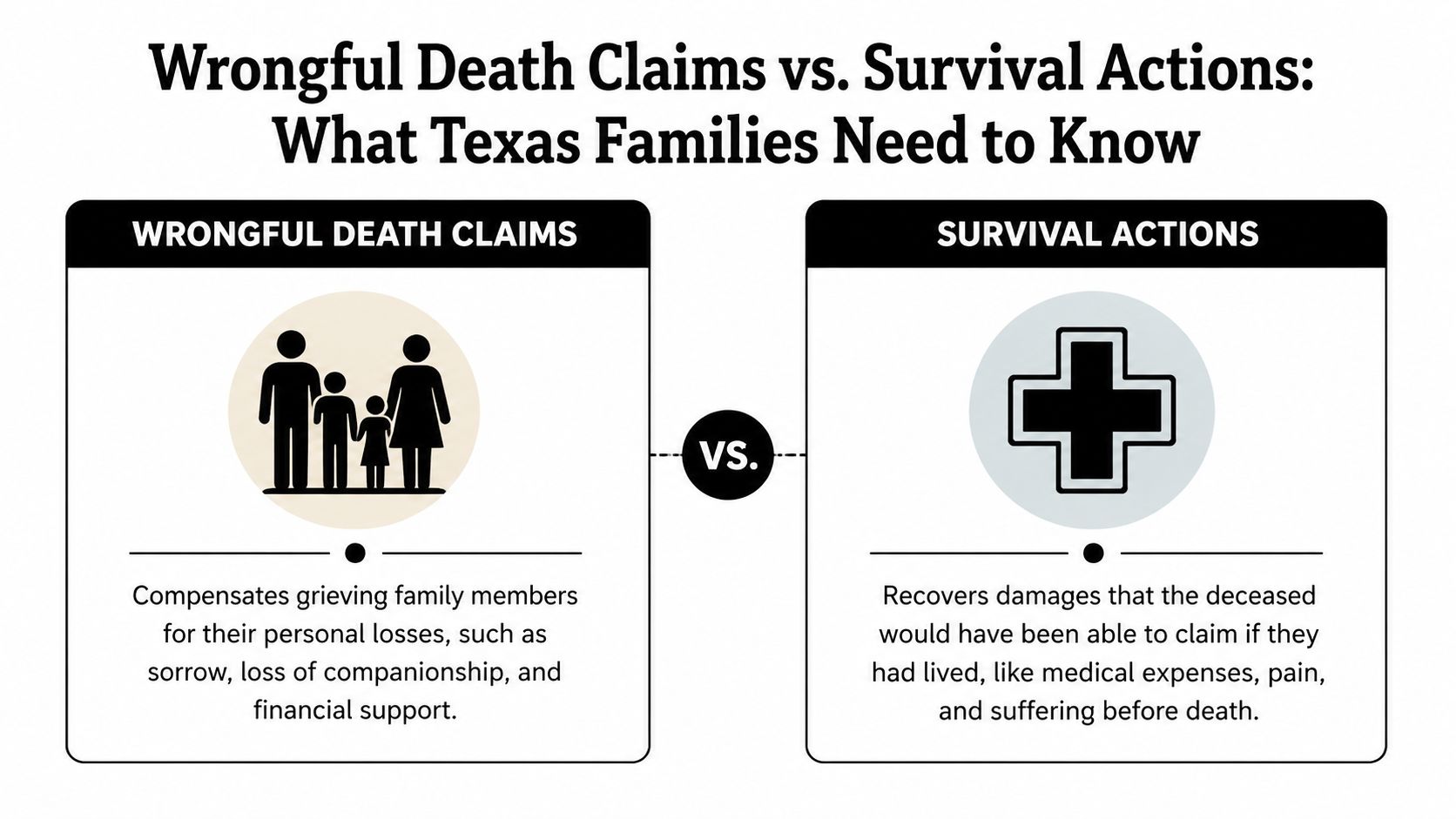
Side by side comparison
| Claim type | Who the claim is for | What it seeks to recover | Key timeline issue |
|---|---|---|---|
| Wrongful death claim | Eligible family members | Their own losses caused by the death | Usually tied to the wrongful death deadline |
| Survival action | The estate of the deceased | Losses the deceased suffered before death | May follow a different timeline issue tied to the estate |
A wrongful death claim is about the harm suffered by surviving family members. In plain terms, it addresses what the death took from them.
A survival action is different. It preserves the claim the deceased person would have had if they had survived. That can include pre-death suffering and medical expenses tied to the fatal injuries.
Why this difference changes strategy
A fatal accident can create both kinds of claims at once. For example, a San Antonio mother is hit by a drunk driver, survives for a period of medical treatment, and then dies. Her family may have a wrongful death claim for their own losses. Her estate may also have a survival action for what she endured before passing.
That’s why families should understand how to prove wrongful death in Texas. The proof can overlap, but the legal purpose of each claim is not the same.
The most common mistake is assuming one lawsuit automatically covers every possible loss. It may not.
The timeline confusion families run into
The wrongful death deadline gets most of the attention, but survival actions can involve a different timing analysis. A critical distinction exists between the two-year wrongful death statute of limitations for family members’ losses and the potentially longer window for survival actions, which can be suspended for up to one year after death until an estate administrator is appointed, as explained in this discussion of Texas wrongful death deadlines and survival claims.
That doesn’t mean families should wait. It means the legal picture may be more complicated than it first appears.
A simple way to remember it
Use this shortcut:
- Wrongful death: What the family lost.
- Survival action: What the deceased suffered before death.
- Estate issue: Someone may need authority to act for the estate.
- Timing issue: The two claims may not line up perfectly.
A Texas injury attorney often adds real value in situations like these. Not by using legal jargon, but by making sure the family doesn’t miss one claim while focusing only on the other. In a fatal car or truck case, that can make a major difference in the full picture of wrongful death compensation.
When the Clock Can Be Paused Tolling Rules and Exceptions
A family may hear that the deadline was “paused” and assume there is more time than they thought. That assumption can be dangerous.
Texas law does allow limited exceptions. Lawyers call this tolling, which means the legal clock may stop for a specific reason for a specific period. The safer way to view tolling is this: it is an exception you prove, not extra time you count on.

Minors and independent filing rights
Minor children can create one of the more confusing timing issues in a fatal case. A child may have additional time to bring that child’s own wrongful death claim after reaching adulthood. But the surviving spouse, parents, or an estate representative should never assume the entire case can wait because a child is still under 18.
That is where families can lose track of the difference between the two claims discussed earlier. The wrongful death claim and the survival action may not pause in the same way for the same people. One child’s extended filing window does not automatically protect every other claimant, and it does not preserve evidence that may disappear long before any lawsuit is filed.
Concealed wrongdoing and delayed discovery
Some cases involve facts the family could not reasonably know right away. A hidden vehicle defect, missing maintenance history, altered records, or another concealed problem can change the limitations analysis.
Courts examine these situations closely. Finding out new information later does not automatically extend the filing deadline. The question is usually more specific. What was hidden, who hid it, when could it reasonably have been discovered, and which claim does that later discovery affect?
That last question matters. Families sometimes focus on whether the wrongful death deadline moved, while overlooking whether the estate still needs to preserve a separate survival claim based on the deceased person’s own injuries before death.
Exceptions exist for narrow reasons. They are not safe assumptions.
Incapacity and estate-related timing problems
Incapacity can also affect the calculation in some cases. If a person who would otherwise act cannot do so because of legal incapacity, the court may treat the deadline differently.
Probate issues add another layer. A survival action belongs to the estate, so someone may need legal authority to act for the estate before that claim can be pursued. That is one reason families should get specific advice early, especially if they are still sorting out who will serve as executor or administrator. If you need a practical overview of the filing process itself, this guide on how to file a wrongful death lawsuit in Texas can help you see where estate authority and filing deadlines often intersect.
Government cases can have earlier notice deadlines
A death involving a city vehicle, county truck, state agency, or public transit system can trigger notice rules that are separate from the ordinary lawsuit deadline. Those notice requirements may come much sooner than two years.
That catches families off guard. They are counting the general statute of limitations while a shorter government notice deadline is already running.
The Texas Tort Claims Act sets special rules for claims against governmental units, including notice requirements that can apply well before a lawsuit is filed, as explained by the Texas Attorney General’s overview of the Texas Tort Claims Act. If a fatal accident involved a public entity, that fact should be reviewed right away.
A simple way to approach possible tolling issues
Treat any possible exception as a reason to act faster.
Start by writing down the key dates you know. Include the incident date, date of death, major medical treatment dates, and the date any hidden fact came to light. Save records that may later explain why an exception applies, such as recall notices, maintenance records, probate filings, medical records, and insurer letters.
Then ask two separate questions. Who can bring the wrongful death claim? Who has authority to bring the survival action for the estate? Those answers are sometimes different, and the timing can be different too.
Texas law also still requires proof on liability, causation, and damages. Tolling can affect when a case must be filed. It does not fix a weak factual record.
Practical Steps to Protect Your Family’s Legal Rights After a Fatal Accident
The first week after a fatal accident often feels like a blur. One family member is talking to the funeral home. Another is answering insurance calls. Someone else is trying to figure out whether the estate needs to be opened.
That confusion matters because two legal paths may need attention at the same time. A wrongful death claim belongs to certain surviving family members. A survival action belongs to the estate. Families are often told about the two-year wrongful death deadline, but no one clearly explains how to protect the estate’s claim while grief is still fresh. That gap causes avoidable problems.

Start by separating the two claims on paper
Use one page for the family’s wrongful death claim and one page for the estate’s survival action.
On the wrongful death page, list the surviving spouse, children, and parents. On the survival action page, write down whether an estate has been opened, whether there is a will, and who may serve as personal representative. This simple step helps families see a common problem early. The people who benefit from a wrongful death case are not always the same person who has authority to act for the survival claim.
If you want a fuller picture of the process, review how to file a wrongful death lawsuit in Texas.
Gather the records you can still control
You do not need to prove the whole case by yourself. You do need to preserve the basic building blocks before they scatter.
Start with these:
Death certificate
This often becomes necessary for insurance, probate, and case review.Incident or crash report
This may identify witnesses, vehicles, employers, and investigating officers.Medical records and bills
These are especially important for the survival action because that claim may include the harm your loved one suffered before death.Photos, video, and phone screenshots
Save scene images, vehicle damage photos, text messages, and voicemail messages in one folder.Names and contact information
Include witnesses, adjusters, tow yards, hospitals, and employers.
A good rule is simple. If it helps explain what happened, who was involved, or what losses followed, save it.
Treat the estate paperwork as part of the deadline problem
Families often focus on the accident and overlook probate issues. That is understandable. It is also risky.
A survival action usually must be brought through the estate. If no one has authority to act, records can sit untouched while the filing deadline keeps getting closer. Opening the estate, identifying the right representative, and collecting medical and billing records can take time. Waiting until the final months creates pressure that no family needs.
This does not mean every family must rush into a full probate fight. It means the estate question should be reviewed early, while there is still room to make decisions carefully.
Be cautious with insurance adjusters
An adjuster may sound kind and organized. Many are. Their role is still to protect the insurance company’s position.
Recorded statements can freeze details before your family has all the facts. Early releases can also affect more than one claim. A quick payment may sound like help with funeral costs, but the paperwork attached to it can create serious problems if it is signed without legal review.
One careful sentence can protect you: “We are still gathering information and would like any request in writing.”
Build one family file with two purposes
A single folder can support both claims if it is organized well.
Include:
- Out-of-pocket expenses, such as funeral costs, travel, and related bills
- Medical expenses before death, which may relate to the survival action
- Lost financial support at home, such as income, benefits, or services your loved one provided
- A communication log, with dates of calls, letters, and emails
- Short notes about changes in daily life, including childcare, caregiving, and household responsibilities
Families sometimes wonder whether writing these details down is worth the effort. It is. Memory fades quickly under stress. Notes made close in time are usually more useful than trying to reconstruct everything a year later.
Here’s a helpful video that gives more context on legal guidance after a serious loss:
Ask one practical question right away
Who is handling the family’s claim, and who is handling the estate’s claim?
Sometimes the answer is the same person. Sometimes it is not. For example, a surviving spouse may be a wrongful death beneficiary, while a different person is named executor under a will. If no one spots that split early, the family may move forward on one track and neglect the other.
That is why early legal review matters so much after a death that followed medical treatment, a truck crash, a workplace incident, or any event where your loved one lived for a period of time before passing away. In those cases, the survival action is not a side issue. It may represent a significant part of the case.
A common real-life problem
A man is badly hurt in a commercial vehicle crash and dies weeks later. His wife speaks with the insurer and gathers funeral records. His adult son starts looking for the police report. No one realizes the estate may need a representative to pursue the claim for the father’s pre-death medical expenses, pain, and other losses tied to the survival action.
By the time the family asks that question, valuable records may be harder to collect and the deadline may feel much closer than expected.
The safest first move is usually the simplest one. Preserve documents, identify who can act for the family and the estate, and get legal advice before an insurer defines the case for you.
The Unforgiving Consequences of Missing the Wrongful Death Deadline
Missing the deadline usually means the court dismisses the case, and the family loses the right to recover through that lawsuit. That result can happen even when fault seems obvious.
This is one of the hardest truths in wrongful death law. The statute of limitations is not a suggestion. It is a filing barrier.
What delay often looks like in real life
A family in Austin loses a mother in a crash caused by an inattentive driver. The insurer keeps saying it wants to “work things out.” The family sends records, answers questions, and waits for a fair offer. Months pass.
That delay can feel reasonable during grief. It often isn’t. Insurance negotiations do not guarantee your rights are protected in court.
Why insurance companies benefit from waiting
Insurance carriers often exploit the two-year wrongful death deadline by making low settlement offers and using the pressure of time to their advantage. One source reports that 70 to 80% of wrongful death auto claims settle before trial if legal action begins within the first 6 to 12 months, which shows the practical advantage of moving early, according to this discussion of settlement timing and insurer tactics in Texas wrongful death claims.
That doesn’t mean every early case settles. It means action creates an advantage. Delay usually helps the other side more than it helps your family.
A pending insurance claim is not the same thing as a protected legal claim.
Why waiting hurts even strong cases
Even before the deadline arrives, delay can weaken proof:
- Witness memory fades: People forget speeds, statements, and traffic details.
- Records become harder to obtain: Some evidence takes time and persistence to secure.
- Defense stories harden: Once the insurer frames the case its way, correcting the record gets harder.
- Families feel rushed later: Decisions made close to a deadline are rarely the calmest or strongest ones.
Texas negligence law still requires proof of fault, causation, and damages. If an insurer argues comparative fault under Chapter 33, your family may need a detailed response backed by evidence. If that evidence has gone stale, the case becomes harder to build.
The painful part is that families often delay for understandable reasons. They’re grieving, exhausted, and trying to trust the process. But the law doesn’t pause merely because life has been shattered. That’s why the best protection is early legal advice, even if you aren’t ready to decide every next step.
How a Texas Wrongful Death Attorney Can Help Your Family
A lawyer’s job in a wrongful death case isn’t just to file papers. It’s to take a confusing, painful situation and turn it into a clear legal plan before deadlines and evidence problems take control.
That starts with identifying the right claim or claims. Some families have only a wrongful death claim. Others may have both a wrongful death claim and a survival action. A lawyer can also review who has standing to file, whether probate issues need attention, and whether tolling questions might matter.
What legal help often includes
An attorney can help your family by:
- Investigating liability: Determining who caused the fatal crash and whether more than one party may be responsible
- Addressing comparative fault arguments: Responding when the defense tries to blame the person who died
- Calculating damages: Looking at the full picture of losses, including possible wrongful death compensation and estate-related damages
- Handling insurers: Managing communication so your family doesn’t get trapped by low offers or harmful statements
- Meeting deadlines: Protecting the filing date while building a case carefully
A fatal crash can involve private drivers, trucking companies, rideshare coverage, employer liability, uninsured motorist issues, and estate administration all at once. Families shouldn’t have to decode all of that alone while mourning.
If you’re searching for a Houston car accident lawyer or Texas injury attorney after a fatal wreck, focus on getting clear answers fast. You deserve to know what deadline applies, what claims may exist, what evidence should be preserved, and what your family’s options are from here.
If your family has lost a loved one in a fatal Texas crash, The Law Office of Bryan Fagan, PLLC is here to help you understand your rights with compassion and clarity. Our team can review the facts, explain the wrongful death statute of limitations texas families face, identify whether a survival action may also apply, and deal with the insurance company while you focus on your family. We offer a free consultation, and there’s no obligation to move forward. When you’re ready for answers, support is available.