Skip to content
A car crash can change your life in seconds, but you don’t have to face recovery alone.
If you’re reading this after a wreck with a suspected drunk driver in Dallas, you may be hurting, angry, and unsure what comes next. You may also be trying to manage hospital visits, car repairs, missed work, and calls from insurance adjusters while the criminal DWI case starts moving in the background. That’s a lot for anyone.
A dallas drunk driving accident lawyer helps with something many people don’t realize at first. The criminal case against the drunk driver and your civil injury claim are connected, but they are not the same. The State may prosecute the driver for breaking the law. Your civil claim focuses on your losses, your medical care, your income, your pain, and your future.
That distinction matters. A criminal prosecutor is not your personal attorney. Even when police arrest the impaired driver, you still need to protect your own claim.
Your Life Changed in an Instant You Are Not Alone
A normal Dallas day can turn upside down in one red light, one wrong lane change, or one late-night impact from a driver who should never have been behind the wheel. Many people remember small details after a drunk driving crash. A phone sliding across the floorboard. The smell of alcohol. The sound of a child crying in the back seat. Then everything becomes paperwork, appointments, and fear about what life will look like next.

This isn’t a rare problem in our community. In the city of Dallas alone, there were 3,727 DUI alcohol-related accidents, resulting in 148 deaths and 287 serious injuries, according to Dallas drunk driving crash statistics. Behind every one of those cases is a family trying to put life back together.
What most victims feel in the first days
You might be asking yourself questions like these:
- Was the other driver arrested? If so, what does that mean for your case?
- Should you talk to the insurance company? Usually, not alone.
- Do you need a doctor even if you feel "okay"? Often, yes.
- Can you still recover if the criminal case takes months? Yes, potentially.
A drunk driving case often feels more personal than an ordinary wreck because the collision was preventable. Someone made a choice. That can leave victims with a deep sense of shock.
You’re not overreacting if you feel unsettled, exhausted, or unable to focus after the crash. That response is common after a violent collision.
Hope starts with clarity
The good news is that drunk driving claims often come with important evidence that doesn’t exist in other crash cases. Police reports, officer observations, chemical tests, dash camera footage, and witness statements can become powerful building blocks in a civil injury claim.
Your job right now is not to know every law. Your job is to get medical care, preserve evidence, and avoid mistakes that could weaken your rights.
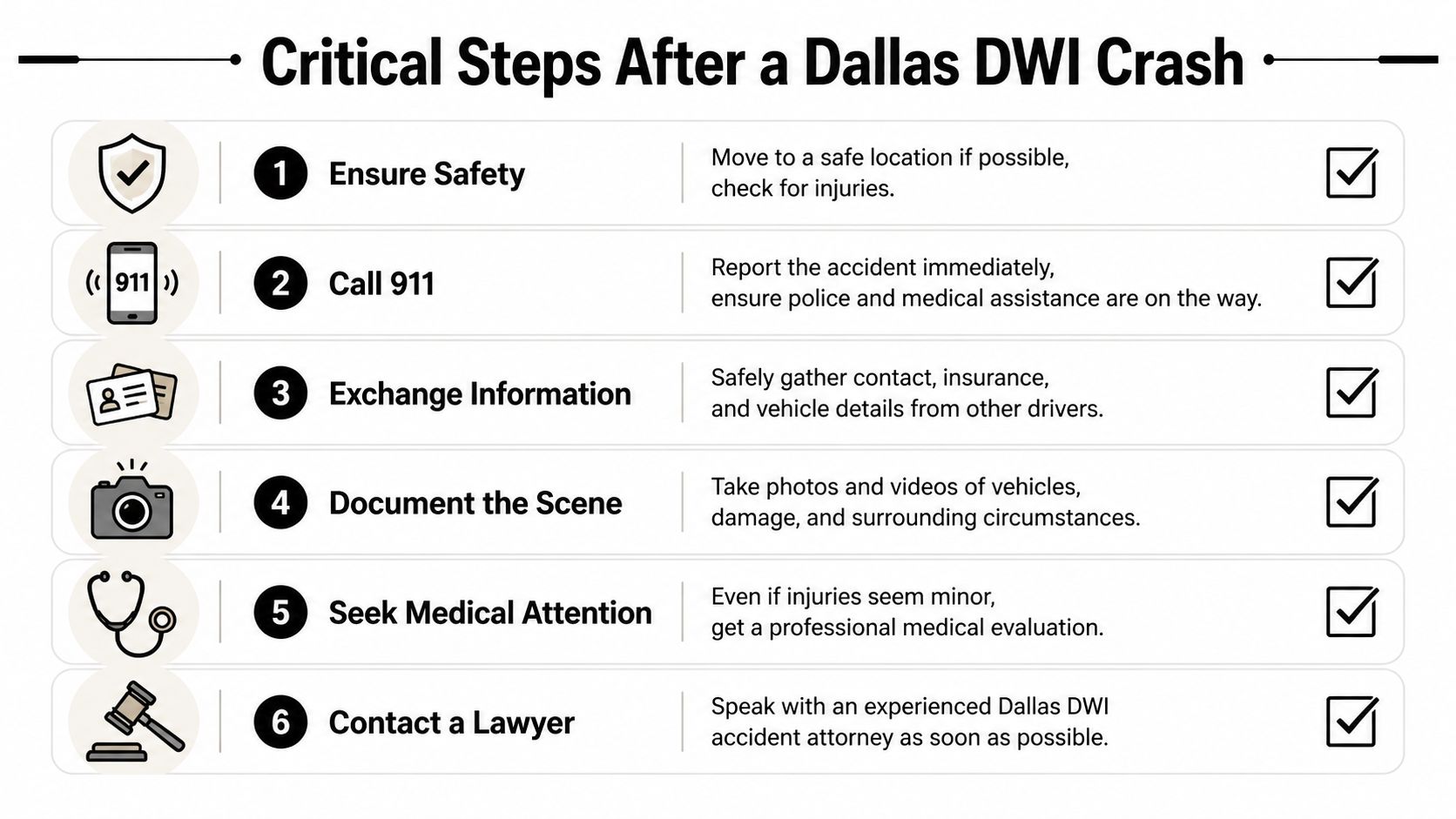
Critical Steps to Take Immediately After a Dallas DWI Crash
The hours after a wreck matter. What you do can affect both your health and your claim. If you’re physically able, move through the situation in order and keep it simple.
First protect people, then protect proof
Start with safety. If the vehicles can move and the scene is dangerous, get to a safer location nearby. Call 911 and report the crash. Tell the dispatcher if you think the other driver may be intoxicated, and describe what you observed without exaggerating.
Then focus on preserving what may disappear quickly.
Call law enforcement and request medical help.
A DWI collision needs an official response. Officers may document slurred speech, the smell of alcohol, open containers, balance problems, and statements made by the other driver.Accept medical evaluation.
Adrenaline can hide injuries. Head injuries, neck strain, and internal pain often show up later. If you’re unsure where to go, this guide on when to visit urgent care or ER can help you think through the level of treatment you may need.Photograph everything you can.
Take pictures of vehicle damage, debris, skid marks, injuries, road conditions, lane positions, and any visible containers or cups inside the other vehicle if they can be seen safely and lawfully from where you stand.
Gather the right information
You don’t need to conduct your own investigation, but you should collect the basics if you can do it safely.
- Driver details: Name, contact information, insurance, license plate, and vehicle description.
- Witness details: Names and phone numbers of anyone who saw the crash or the other driver’s behavior.
- Police details: Officer names, agency, and report number if available.
- Scene clues: Nearby businesses, homes, parking lots, or intersections with cameras.
If you later need help understanding the officer’s paperwork, this guide on how to read a police accident report can make the report easier to follow.
Practical rule: If you think something might matter later, document it now. Crash scenes change fast, and memory gets less reliable with time.
What not to do
People often harm good claims by trying to be polite or by talking too much.
Avoid these common mistakes:
- Don’t admit fault: Even saying “I didn’t see them” can be twisted later.
- Don’t downplay injuries: If you say you’re fine, insurers may use that against you.
- Don’t give a recorded statement to the other insurer right away: You’re usually better off getting advice first.
- Don’t post about the crash on social media: Photos and comments can be taken out of context.
Build a simple recovery file
When you get home, start one folder, digital or paper, for everything tied to the wreck:
| Keep this item | Why it matters |
|---|---|
| Medical records | Show diagnosis, treatment, and timing |
| Bills and receipts | Support out-of-pocket losses |
| Repair estimates | Document property damage |
| Work records | Help prove missed income |
| Notes about symptoms | Show how the injury affects daily life |
A simple notebook can help. Write down pain levels, sleep problems, headaches, missed activities, and follow-up appointments. Those details may become important when you seek compensation.
Proving Fault How Intoxication Establishes Liability in Texas
When people hear the word liability, they usually mean one basic question. Who is legally responsible for the crash?
In Texas, many injury claims are based on negligence. In plain English, negligence means someone failed to use reasonable care and caused harm. A sober driver who runs a red light may be negligent. A distracted driver who rear-ends another car may be negligent. In a drunk driving case, the evidence is often even stronger because the conduct is not only careless but also illegal.
Why DWI evidence matters so much in a civil claim
Texas law allows injured people to bring a civil case for damages caused by another person’s negligence. In many drunk driving wrecks, the same evidence that supports the criminal DWI prosecution can also support your injury claim.
That may include:
- Police reports
- Officer body cam or dash cam footage
- Field sobriety testing observations
- Breath or blood test results
- Witness testimony
- Crash reconstruction
- Admissions made by the driver
A key concept here is negligence per se. That phrase sounds technical, but the idea is simple. When a driver violates a safety law designed to protect the public, that legal violation can strongly support a finding of fault in a civil case. In drunk driving claims, unlawful intoxication can become a central piece of that argument.
The science behind impairment helps prove causation
Intoxication isn’t just a bad label. It affects how a person drives. According to Texas accident analysis on alcohol-impaired driving, alcohol-impaired drivers experience a documented cascade of neurobiological impairments involving compromised reaction times, poor judgment, and decreased motor coordination, which significantly impairs their ability to respond to dynamic road conditions and directly strengthens negligence claims.
That matters because a civil case has to connect misconduct to harm. If a driver had delayed reactions, poor lane control, and bad judgment because of alcohol, those facts help explain why the crash happened and why the impact may have been so severe.
Criminal case versus civil case
Many clients get confused here, and that’s understandable. The criminal case and civil case move on separate tracks.
| Criminal DWI case | Civil injury claim |
|---|---|
| Brought by the State | Brought by the injured person or family |
| Focuses on punishment | Focuses on compensation |
| Must prove guilt under a criminal standard | Must prove liability under a civil standard |
| May lead to fines, probation, or jail | May lead to payment for losses |
A criminal conviction can help your civil case, but you don’t always need one to win compensation. Sometimes the criminal process is delayed. Sometimes charges are reduced. Sometimes a prosecutor decides not to proceed. Your civil rights may still exist.
Here’s a helpful overview of the legal issues many injured families ask about:
Comparative fault in Texas
Texas also uses a comparative fault system under Texas Civil Practice & Remedies Code Chapter 33. This rule looks at whether more than one person contributed to the crash.
In plain language:
- Comparative fault means fault can be shared.
- If you were partly responsible, your recovery may be reduced by your percentage of fault.
- If you were more than half responsible, you generally can’t recover damages.
That worries some people unnecessarily. In a drunk driving crash, insurers may still try to shift blame by saying you braked suddenly, changed lanes, or could have avoided the collision. Those arguments should be tested against the evidence, not accepted at face value.
Even when intoxication is clear, insurance companies still look for ways to reduce what they pay. Strong proof doesn’t mean they’ll be fair on their own.
Plain-English legal terms that matter
A few definitions can make the whole process less intimidating:
- Liability: Legal responsibility for the crash and resulting harm.
- Damages: The losses the law allows you to recover, such as medical bills, lost wages, and pain and suffering.
- Comparative fault: A rule that can reduce recovery if the injured person was partly at fault.
- Statute of limitations: The legal deadline to file suit. If you miss it, your claim may be barred.
Those rules apply whether you’re looking for help from a dallas drunk driving accident lawyer, a Houston car accident lawyer, or another Texas injury attorney handling a serious collision claim.
Identifying All Responsible Parties Beyond Just the Driver
A drunk driver may be the obvious defendant, but not always the only one. In some cases, the strongest recovery strategy is to look beyond the person behind the wheel and ask a harder question. Who helped create the danger?
That’s where third-party liability becomes important. A crash may involve a bar, restaurant, event host, employer, rideshare issue, or another person or business that played a meaningful role in what happened.

Dram Shop claims in Texas
Texas recognizes claims against alcohol providers in some situations. These are often called Dram Shop claims. The basic idea is that a bar, restaurant, or similar provider may face liability if it served alcohol when it should have recognized the danger.
Many families never hear about this option. According to Texas Dram Shop claim information, Texas Dram Shop claims succeed in approximately 20-30% of filed cases, yet only 15% of DWI crash lawsuits include a third-party claim, even though alcohol outlets contribute to 25% of severe Dallas crashes.
For a plain-language overview of how this area of law works, see this guide to Texas Dram Shop laws.
What a third-party case may involve
A claim against an alcohol provider usually requires more than suspicion. Lawyers often look for:
- Receipts and tabs showing how much alcohol was sold
- Surveillance footage from the business
- Employee statements about the customer’s condition
- Witness accounts describing visible intoxication
- Timing evidence linking service to the crash
These cases can be valuable because they may open another source of insurance coverage. That matters when catastrophic injuries lead to major medical needs or when the drunk driver carries limited coverage.
Drug-impaired crashes add another layer
Not every impaired driving case involves alcohol alone. Some involve marijuana, fentanyl, prescription medication, or a combination of substances. Those cases can be harder because there may not be one simple number that works like an alcohol test.
Drug cases often turn on behavior, toxicology, driving pattern, and expert explanation. The legal question becomes whether the substance impaired the driver, not just whether it was present.
A real-world example helps. Suppose a Dallas driver leaves work and gets hit by someone who drifts across the center line. The at-fault driver later tests positive for multiple substances. The insurer may argue the test doesn’t prove impairment at the time of the wreck. A careful civil case would then focus on officer observations, medical records, crash mechanics, and toxicology interpretation to connect impairment to the collision.
Third-party liability can change the value and direction of a case. If no one investigates those leads early, important evidence may disappear.
Other possible defendants
Depending on the facts, responsibility may also extend to:
| Possible party | Example issue |
|---|---|
| Employer | Driver was working at the time of the crash |
| Vehicle owner | Negligent entrustment or permission issues |
| Rideshare-related entity | Coverage disputes involving app status |
| Another motorist | Multi-vehicle chain reaction caused by impaired driving |
This broader view can be the difference between a thin insurance claim and a fully investigated case that reflects the true scope of your losses.
What Is Your Claim Worth? Understanding Compensation
After a drunk driving wreck, people often ask one question first. What is my case worth? The honest answer is that value depends on the facts, the injuries, the available coverage, and how clearly the evidence ties the crash to your losses.
What matters most at the start is understanding the categories of damages Texas law may allow. In plain English, damages are the money you seek for the harm you suffered.
Texas drunk driving crashes often involve severe harm. According to Texas DUI crash fatality data, DUI crashes make up 2.77% of all wrecks but cause 16% of the state’s total traffic deaths, with one person dying every nine hours and six minutes in such incidents. That imbalance helps explain why these claims often involve major medical treatment, lasting pain, and long-term disruption.
Economic damages
Economic damages are the financial losses you can point to on paper.
These may include:
- Medical bills from the ER, hospital, imaging, surgery, and follow-up care
- Lost wages if you missed work during recovery
- Reduced earning ability if you can’t return to the same job
- Rehabilitation costs such as mobility training or therapy
- Property damage to your vehicle and personal items
If you’re in rehab or trying to understand the role physical recovery plays after a crash, resources like Highbar Physical Therapy accident care can help you think through the treatment side of the process.
Non-economic damages
Not every loss comes with a receipt. Non-economic damages address the human side of injury.
That may include:
- Pain and suffering
- Emotional distress
- Physical impairment
- Loss of enjoyment of life
- Disfigurement
Consider a simple example. A Dallas parent gets rear-ended by an intoxicated driver while taking a child home from school. The parent has a fractured wrist, ongoing neck pain, and anxiety about driving at night. The bills are one part of the claim. The inability to lift groceries, sleep comfortably, or enjoy normal routines is another part.
For a fuller breakdown of how lawyers evaluate losses, see this guide on how to calculate damages.
Punitive damages and Chapter 41
Texas also recognizes exemplary damages, sometimes called punitive damages, under Texas Civil Practice & Remedies Code Chapter 41. These are not awarded in every case. Their purpose is different from ordinary damages.
They are meant to punish especially wrongful conduct and discourage similar behavior in the future. Drunk driving may support that kind of claim when the facts show gross negligence, which means more than ordinary carelessness. It refers to extreme risk coupled with conscious indifference to the safety of others.
Wrongful death and survival claims
When a drunk driving crash takes a life, surviving family members may have additional claims. A wrongful death compensation case can seek recovery for the losses suffered by close family members because of the death. A related survival claim may address the losses the injured person sustained before passing away.
These are emotionally difficult cases, but they are also important. They can provide financial stability, accountability, and a formal way to pursue justice through the civil system.
The value of a claim is not just about the crash day. It’s about how the crash changed your body, your work, your family life, and your future.
How Our Dallas Accident Lawyers Will Fight for You
Once you’ve reported the wreck and started medical care, the legal process becomes a question of execution. Evidence has to be preserved. Insurance coverage has to be identified. Deadlines must be tracked. The criminal DWI case may also generate records that can strengthen your civil claim if someone knows when and how to obtain them.
That is where a law firm earns its place. A strong team doesn’t just file paperwork. It builds the case in a way that protects your position from the beginning.
What legal help looks like in practice
A careful dallas drunk driving accident lawyer typically starts by doing four things quickly:
Securing records
This can include crash reports, body cam footage, 911 audio, tow records, medical records, and available criminal court information.Protecting you from insurance tactics
Adjusters often want a fast statement and a cheap settlement. Your lawyer can handle communication tied to the auto insurance claim so you don’t get pushed into harmful answers.Investigating all defendants
If the facts suggest a Dram Shop issue, a rideshare issue, or another source of coverage, that investigation should begin early.Documenting damages thoroughly
The claim should show not just that you were hurt, but how those injuries affect daily life, work, and future care.
The criminal case can help, but only if used correctly
The unique feature of a drunk driving case is the overlap between the criminal and civil tracks. A lawyer may monitor the criminal file for evidence such as:
- Charging documents
- Officer testimony
- Chemical testing records
- Plea paperwork
- Video evidence
- Court dates that affect access to records
That doesn’t mean you wait passively for the criminal case to finish. Civil claims often need immediate action. Witness memories fade. Video gets deleted. Businesses overwrite surveillance. Delay can weaken even a strong case.
Insurance disputes are often tougher in drug-impaired cases
Not every impaired driving case is alcohol-only. According to Dallas-Fort Worth drug-impaired driving trend reporting, THC and fentanyl detections were up 45% in DWI crashes from 2024-2025, and these cases often face insurance denials 2x higher than alcohol-only cases. That’s one reason legal strategy matters so much when impairment evidence is more contested.
In those cases, the work may involve toxicology experts, crash reconstruction, and a closer review of medical and law-enforcement records. A general approach may miss what a focused strategy would catch.
The path from claim to lawsuit
Clients often want to know what happens next. While every case is different, the process often looks like this:
| Stage | What happens |
|---|---|
| Initial consultation | Facts, injuries, insurance, and immediate concerns are reviewed |
| Investigation | Evidence is gathered and preserved |
| Treatment period | Medical condition and prognosis become clearer |
| Demand phase | The insurer receives a package explaining liability and damages |
| Negotiation | Settlement talks begin |
| Lawsuit if needed | Discovery, depositions, motions, and trial preparation follow |
Many cases settle. Some should. Some shouldn’t. If the insurer refuses to act reasonably, filing suit may be the right move.
Paying for a lawyer
Most injury firms handling these cases work on a contingency fee. That means you don’t pay upfront attorney’s fees, and the firm gets paid from a recovery if the case succeeds. This arrangement lets injured people get legal help without adding another immediate bill during a difficult time.
A Texas injury attorney should also explain the process clearly, return calls, and make sure you understand what is happening with your case. Good legal work is not only aggressive. It is also organized, responsive, and steady.
Frequently Asked Questions About Dallas DWI Accident Claims
What if the drunk driver is found not guilty in criminal court
You may still have a civil case. Criminal and civil cases use different legal standards and serve different purposes. A not-guilty result in the criminal case does not automatically erase your right to seek damages in civil court.
That’s one reason the evidence matters so much. The police investigation, witness statements, medical proof, and crash facts may still support your claim even if the criminal case doesn’t end the way you expected.
How long do I have to file a lawsuit in Texas
The statute of limitations matters. In plain English, the statute of limitations is the deadline for filing suit. If you miss it, you may lose the right to pursue the claim.
In many Texas personal injury cases, that deadline is generally two years, but exceptions and case-specific issues can affect timing. That’s why it’s smart to talk with a lawyer early rather than assume you have plenty of time.
What if the drunk driver has no insurance or not enough insurance
That happens more often than people think. If the at-fault driver has no coverage or too little coverage, your own uninsured or underinsured motorist benefits may become important. Other possible sources may include third-party defendants, commercial policies, or other applicable coverage depending on the facts.
This is also why a complete investigation matters. A crash may look like a simple one-driver case at first, but insurance layers can change once records are reviewed.
Do I have to talk to the other driver’s insurance company
Usually, you should be careful. The adjuster may sound friendly, but their job is to protect the company. They may ask questions in a way that minimizes injuries or shifts blame.
You generally don’t want to guess, speculate, or give a recorded statement without understanding the stakes. A lawyer can handle those communications and help you avoid accidental damage to the claim.
Can I recover if I was partly at fault
Possibly, yes. Texas follows comparative fault rules under Chapter 33, which means partial fault does not always bar recovery. It may reduce recovery, depending on your share of responsibility.
That issue should be evaluated carefully with the actual evidence, not just the insurer’s version of events.
If a drunk driving crash has disrupted your life or taken someone you love, contact The Law Office of Bryan Fagan, PLLC for a free consultation. You can talk with a lawyer about your injuries, your auto insurance claim, the criminal DWI case, and your options for pursuing compensation. Whether you need guidance after a Dallas wreck, help from a Houston car accident lawyer, or support in a wrongful death compensation case, the firm is here to protect your rights with clear answers, compassionate counsel, and contingency-fee representation.