A car crash can change your life in seconds—but you don’t have to face recovery alone. The roadmap to filing a successful car accident claim starts the moment the collision happens. How you handle those first few chaotic minutes—prioritizing safety, gathering the right evidence, and knowing what to say (and what not to say)—can protect both your health and your legal rights down the road.
What to Do Immediately After a Texas Car Accident
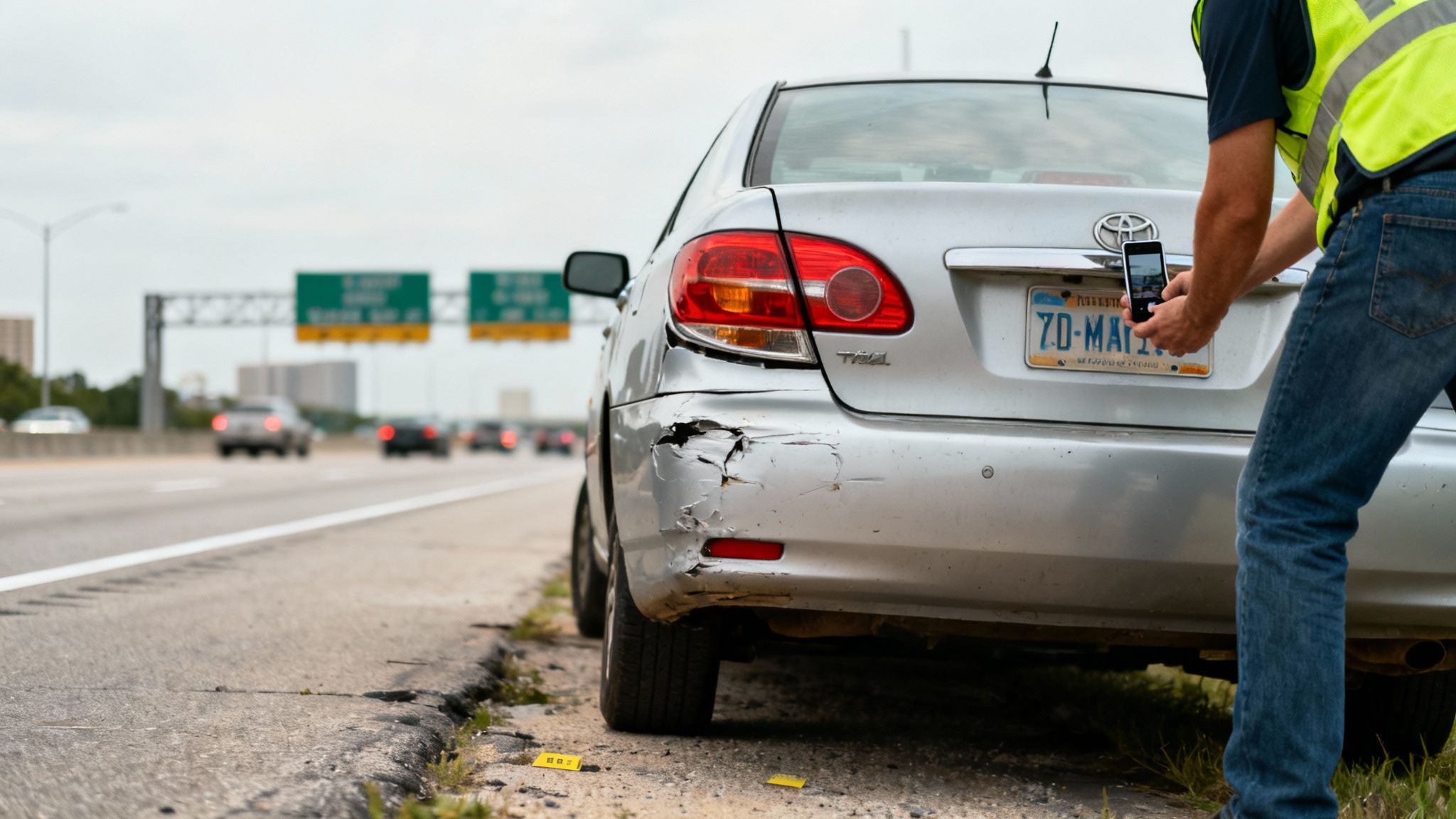
The moments right after a crash are a blur. Especially on a packed Houston freeway like I-10 or the 610 Loop, it’s disorienting and stressful. Your mind is racing, and the adrenaline coursing through your veins can easily mask serious injuries.
But what you do next builds the entire foundation for your auto insurance claim. Staying as calm as possible and taking deliberate, smart actions can make all the difference in your physical and financial recovery.
Your absolute first priority is safety. If it’s possible, move your vehicle out of the flow of traffic and onto a shoulder or into a nearby lot. Flip on your hazard lights immediately to warn other drivers. Before you even think about opening your door, check your mirrors and blind spots for oncoming traffic.
Get Medical and Police Assistance
Once you're in a safer spot, call 911. Don't hesitate. This is non-negotiable for two critical reasons.
First, you need a medical evaluation, even if you feel perfectly fine. Injuries like whiplash, concussions, or internal trauma often don't show symptoms for hours or even days. Second, a police officer will create an official Texas Peace Officer's Crash Report. This document is a vital piece of evidence for your auto insurance claim.
When the police show up, just give them the facts of what happened. Stick to what you know for sure and avoid guessing or, most importantly, admitting any fault. Simple, direct statements like, “The light was green, and I proceeded through the intersection,” are far better than an automatic, “I’m so sorry.” An insurance company will twist that apology into an admission of guilt every time.
To help you stay on track during a high-stress moment, here’s a quick-reference checklist of what to do at the scene.
Essential Post-Accident Checklist
| Immediate Action | Why It Matters for Your Claim |
|---|---|
| Call 911 Immediately | Establishes an official record of the incident and ensures you get a medical check. |
| Take Photos & Videos | Creates an unbiased, visual record of vehicle damage, road conditions, and injuries. |
| Exchange Information | Gathers the essential contact and insurance details needed to file the claim. |
| Get Witness Contacts | Provides third-party accounts that can support your version of events if disputes arise. |
| Do Not Admit Fault | Prevents the other party's insurer from using your words against you to deny or reduce your claim. |
Following these practical, step-by-step pieces of advice provides the concrete evidence needed to build a strong foundation for your claim from the very beginning.
Document Everything at the Scene
The evidence you gather yourself right there at the scene is priceless. Before any vehicles are towed away, pull out your smartphone and become a detective. Take pictures and videos from every possible angle.
Make sure you capture:
- Damage to all vehicles involved, from wide shots to close-ups.
- The other driver's license plate, driver's license, and insurance card.
- Road conditions, traffic signs, skid marks, and any debris.
- Any visible injuries you or your passengers have.
A picture is worth a thousand words, especially to an insurance adjuster. Your photos create a powerful, unbiased record of the accident's immediate aftermath, making it much harder for the other driver to change their story later.
Finally, exchange all the necessary information with the other driver. You need their full name, address, phone number, driver's license number, and their auto insurance policy details. If any bystanders saw what happened, politely ask for their names and phone numbers. Their testimony could be the key to your case if the other driver tries to dispute fault.
For a deeper dive, you can explore our full breakdown of the essential steps to take after a car accident.
Who Is Liable in a Texas Car Accident?
Before you can file a car accident claim, it’s essential to understand who is legally at fault. In Texas, the entire process hinges on a legal principle called negligence.
In plain English, negligence means a driver failed to act with reasonable care, and that failure caused harm to someone else. Every person on the road owes this duty of care to others. When they text and drive, speed, or run a red light, they've breached that duty. For you to have a solid claim, you must prove the other driver's negligence is the direct cause of your injuries and damages. This is known as establishing liability.
How Texas Law Handles Shared Blame
Of course, a crash isn't always one person's fault. Sometimes, both drivers’ actions contribute to the accident. This is where a critical Texas rule called proportionate responsibility, or comparative fault, comes into play. You can find this law in Chapter 33 of the Texas Civil Practice & Remedies Code.
This rule assigns blame as a percentage. For example, imagine a Houston driver rear-ended on I-45. It seems clear the other driver is at fault. But what if an investigation reveals your brake lights weren’t working? A jury might find the other driver was 80% at fault for following too closely, but decide you were 20% at fault for the faulty equipment.
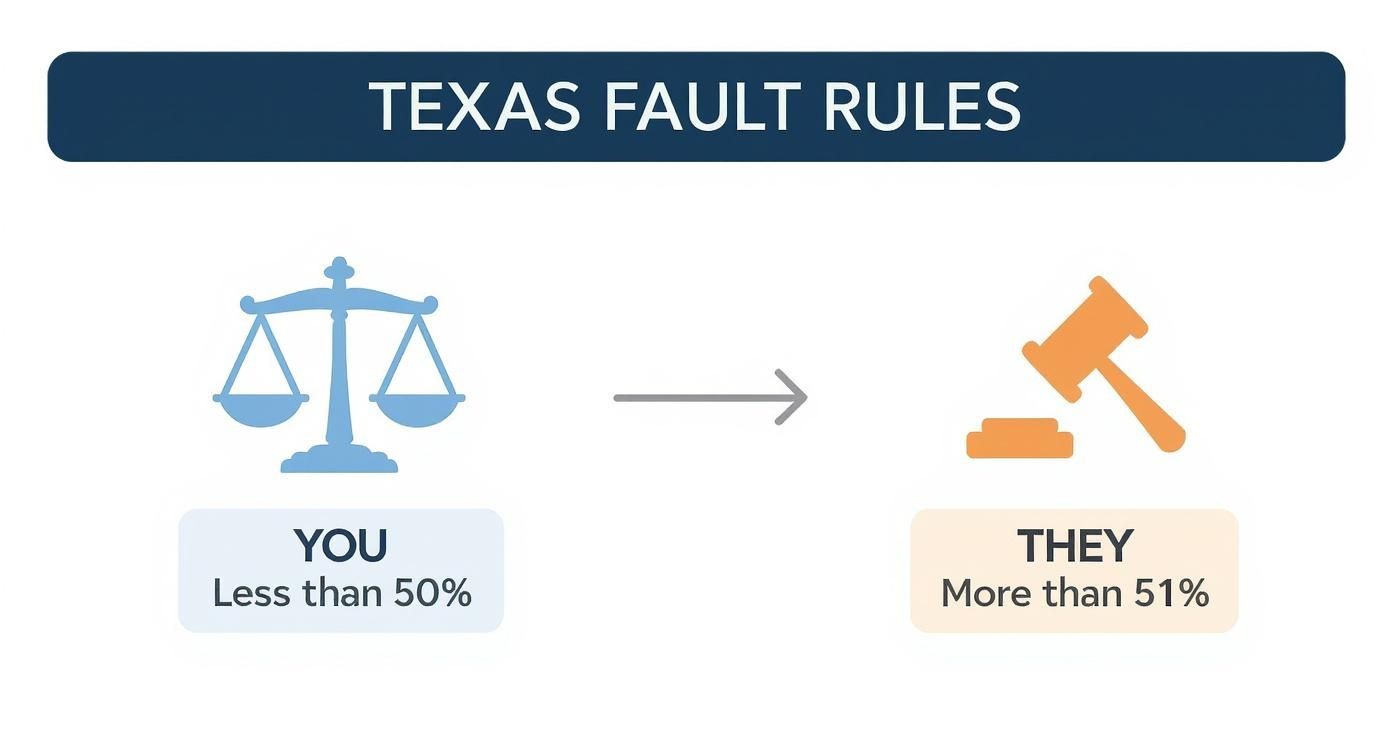
The 51% Bar Rule: A Game-Changer for Your Claim
That percentage of fault directly impacts how much money you can recover for your damages (the total physical, emotional, and financial harm you've suffered). Under Texas law, your total compensation is reduced by your percentage of fault.
Using the I-45 example, if your total damages were $50,000, that amount is reduced by your 20% of fault. You would only be able to recover $40,000.
This brings us to the most crucial part of the rule, known as the 51% Bar:
If you are found to be 51% or more at fault for the accident, Texas law bars you from recovering any compensation.
This is exactly why insurance adjusters work so hard to shift even a small amount of blame onto you. If they can convince a jury that you were slightly more than half responsible, their duty to pay you disappears completely. A Houston car accident lawyer’s job is to build a rock-solid case that protects you from unfair blame and proves the other driver’s liability.
Steps to File an Insurance Claim
After the dust settles, your next step is navigating the insurance claim process. Knowing how to handle this is crucial for protecting your rights and getting the compensation you deserve.
Your first move is to notify your own insurance company. Do this promptly, regardless of who was at fault. After that, you'll need to open a claim with the other driver's insurance company. This officially puts them on notice and gets the process started.
Your First Call with an Insurance Adjuster
Soon after, an insurance adjuster will call you. It’s important to understand their role: their job is to protect their company’s profits by minimizing your payout. They are trained negotiators looking for any information that could weaken your claim.
Be polite, but be guarded. Stick to the basic facts—your name, contact information, and the time and place of the crash. You are not required to give a recorded statement, and we almost always advise our clients to politely decline. Anything you say in a recording can be taken out of context and used against you later.
The adjuster’s primary goal is to close your case quickly and for the lowest amount possible. Never, ever accept their first offer. You likely don’t even know the full extent of your injuries yet.
For a deeper dive into handling these critical conversations, our guide on how to deal with insurance adjusters is a must-read.
Gathering Your Essential Documents
A strong claim is a well-documented one. From day one, start a file and save every piece of paper related to the accident. Your records are your most powerful evidence.
Here’s what you need to collect:
- The Texas Peace Officer's Crash Report: This is the official police report and a foundational piece of evidence.
- Medical Records and Bills: Every single one. This includes the ambulance ride, ER visit, follow-up appointments, physical therapy sessions, and prescription receipts.
- Proof of Lost Wages: Ask your employer for a letter on company letterhead that details your normal pay rate, your job title, and the exact hours or days you missed because of your injuries.
- Repair Estimates: Get at least two quotes for your vehicle damage from reputable body shops.
A powerful tool in this process is the demand letter you'll eventually send to the insurer. Looking at some Effective Sample Personal Injury Demand Letters can give you a solid idea of how to structure your argument and present your evidence compellingly.
Calculating the True Value of Your Claim
One of the biggest mistakes you can make is underestimating what your claim is truly worth. Insurance adjusters often hope you’ll only focus on the obvious costs, like the mechanic’s bill and the first emergency room visit.
Your actual losses, however, run much deeper.
Under Texas law, you have the right to seek compensation for all of your damages—the legal term for the total harm you’ve suffered due to someone else's negligence. Understanding what those damages include is the only way to ensure you don’t accept a lowball offer that leaves you paying for someone else's mistake years from now.
Economic Damages: The Tangible Costs
This is the most straightforward category. Economic damages are the direct, verifiable financial losses you can prove with receipts, invoices, and pay stubs.
These include:
- All Medical Expenses: This isn’t just the ambulance ride. It’s the hospital stay, follow-up appointments, future physical therapy, necessary surgeries, prescriptions, and any medical equipment you might need.
- Lost Income and Earning Capacity: If you missed work, you can claim those lost wages. But if your injuries prevent you from returning to your old job or earning what you used to, you can also seek compensation for this loss of future earning capacity.
- Property Damage: This covers the cost to repair or replace your vehicle and any other personal property destroyed in the crash, like a laptop or a child's car seat.
Your claim should account for every single dollar the accident has cost you, both now and in the future. Meticulous records are your most powerful tool in proving these losses.
Non-Economic and Punitive Damages
Next are non-economic damages. These are just as real, but they compensate you for the intangible, personal suffering the crash caused.
This includes compensation for:
- Pain and Suffering
- Mental Anguish
- Physical Impairment or Disfigurement
- Loss of Enjoyment of Life
Finally, in rare cases of extreme negligence, Texas law allows for punitive damages. As outlined in Chapter 41 of the Texas Civil Practice & Remedies Code, these are not meant to compensate you for a loss. They are designed to punish the at-fault driver for truly reckless behavior—like drunk driving—and to deter others from similar conduct. If your family is seeking wrongful death compensation, these damages may also be a factor.
When you're dealing with all this, it's also critical to understand insurance policy limits in Texas, as they can dramatically affect the total amount you are actually able to recover.
Globally, road safety is a massive issue. In 2021, road accidents were responsible for about 1.2 million deaths worldwide. These staggering numbers underscore why robust legal and insurance systems are essential for covering the true, full costs of an accident. You can find more insights about global road safety statistics on developmentaid.org.
When to Contact a Houston Car Accident Lawyer

Many people wonder if they truly need an attorney after a car wreck. For a minor fender-bender with no injuries, you may be able to handle the insurance claim yourself. But when the stakes are higher, trying to face a large insurance company alone can be a costly mistake.
Knowing when to ask for help is a powerful step toward protecting your rights. If you find yourself in any of the following situations, it’s a clear sign you need an experienced Texas injury attorney in your corner.
Red Flags That Signal You Need Legal Help
Think of these as warning signs that the insurance company is not on your side and you need a professional advocate to level the playing field.
- You Suffered Serious Injuries: If the crash resulted in hospitalization, surgery, or long-term physical therapy, your costs will quickly add up. An attorney ensures your claim accounts for all future medical needs, not just today's bills.
- The Insurance Company is Disputing Fault: Is the adjuster using Texas's comparative fault rules to blame you? An attorney’s job is to fight back with evidence that proves the other driver’s negligence.
- You've Received a Lowball Settlement Offer: Insurers often make a quick, low offer, hoping you'll accept it before you realize what your claim is truly worth. An attorney will fight for the full and fair compensation you deserve.
- The Other Driver was Uninsured or Underinsured: Navigating an uninsured/underinsured motorist (UM/UIM) claim with your own insurer can be surprisingly difficult. A skilled lawyer helps you get the coverage you've been paying for.
An experienced Houston car accident lawyer takes over all communication with the insurance companies. They launch a thorough investigation into the crash and bring in experts to calculate the true value of your damages.
Protecting Your Future Recovery
Hiring a lawyer isn’t about being confrontational; it’s about being proactive. While road safety initiatives are making a difference—there was a reported 8.2% decline in traffic fatalities in the first half of 2025—accidents still happen every day. You can read more about these encouraging safety trends on NHTSA.gov.
When a crash happens to you, the economic and personal toll can be devastating.
If your case proceeds to a lawsuit, your attorney will guide you through every step. For instance, they will show you how to prepare for deposition, a critical phase where the other side's lawyers will question you under oath.
You don't have to face these challenges by yourself. If you've been seriously injured or are fighting with an uncooperative insurance company, it's time to get legal help.
Common Questions About Texas Accident Claims
When you're trying to recover, the last thing you need is more confusion. The legal process can feel overwhelming, but getting clear answers is the first step toward reclaiming your life. Here are a few of the most common concerns we hear from accident victims.
How Long Do I Have to File a Claim in Texas?
This is one of the most critical questions. The statute of limitations is a legal deadline for filing a lawsuit. In Texas, you generally have two years from the date of the car accident to file a personal injury lawsuit.
If you miss that two-year window, you will likely lose your right to seek compensation through the courts forever. While two years sounds like a long time, it passes quickly. Evidence disappears, witnesses' memories fade, and building a strong case takes time. It is always best to speak with an attorney as soon as you are medically able.
What if the At-Fault Driver is Uninsured?
It’s a nightmare scenario, but it’s all too common on Texas roads. If the driver who hit you has no insurance—or not enough to cover your damages—you are not out of options. You can turn to your own insurance policy, provided you have Uninsured/Underinsured Motorist (UM/UIM) coverage. This is an optional but highly recommended coverage that protects you when the at-fault driver cannot pay for the harm they caused.
Should I Talk to the Other Driver's Insurance Adjuster?
While you must report the crash to your own insurer, you are under no obligation to give a recorded statement to the other driver’s insurance adjuster. This is a crucial distinction.
Their adjuster's only job is to save their company money. You can—and should—politely decline to give a recorded statement until you've spoken with a car accident lawyer.
Remember, anything you say can be used against you. An innocent comment like "I'm feeling a little better" can be twisted to argue your injuries aren't severe. Stick to the basic facts and let your attorney handle the complex communications.
When you’re facing a pile of questions and an insurance company that won’t cooperate, you don’t have to go it alone. The team at The Law Office of Bryan Fagan, PLLC is here to give you the answers you need and fight for the full compensation you deserve.
Your rights and recovery are our priority. Contact us today for a free, no-pressure consultation to discuss your case and learn how we can help you move forward with confidence.