Skip to content
A car crash can change your life in seconds, but you don't have to face recovery alone.
If you're reading this after a bicycle wreck in Houston, you may be hurting, angry, and unsure what to do first. One moment you were riding through an intersection, along a neighborhood street, or near a busy corridor. The next, you were on the pavement, your bike was twisted, and a driver or insurance adjuster was already starting to shape the story.
Early mistakes matter. What you say at the scene, whether you get medical care right away, and how you handle the first insurance call can affect your case from the start. That's especially true in bicycle cases, where insurers often look for a reason to blame the rider.
Your Life Can Change in an Instant But You Are Not Alone
A peaceful ride can turn into a legal and medical crisis fast. You may be dealing with road rash, broken bones, a head injury, bike damage, missed work, and a flood of calls you never asked for. Family members are often trying to help while also worrying about bills, treatment, and whether the driver will be held responsible.
That reaction is normal. After a serious crash, individuals don't need legal jargon. They need clear next steps, honest answers, and a way to protect their rights before the insurance company gets ahead of them.
You don't have to figure this out in one day. You do need to protect the facts from day one.
Houston bicycle cases can become complicated quickly because liability is often disputed. A driver may say you came out of nowhere. An adjuster may suggest you weren't visible, were riding too far into traffic, or should have avoided the collision. The law gives you rights, but rights only help when they're backed by evidence.
This guide is meant to help you act calmly and strategically. If you need a Houston bicycle accident lawyer, the goal is simple. Protect your health, preserve proof, and put yourself in the strongest position to recover compensation under Texas law.
What to Do Immediately After a Houston Bicycle Crash
The first few hours after a bicycle crash can shape your injury claim. In Houston, the danger is real: in 2023, over half of all bicycle crashes were caused by motor vehicles, with 670 total crashes and 561 injuries reported, driven primarily by speeding, driver distractions, and failure to yield the right of way, according to Houston bicycle crash reporting discussed by McDonald Worley.
Start with a simple rule. Your body and your evidence both need protection.
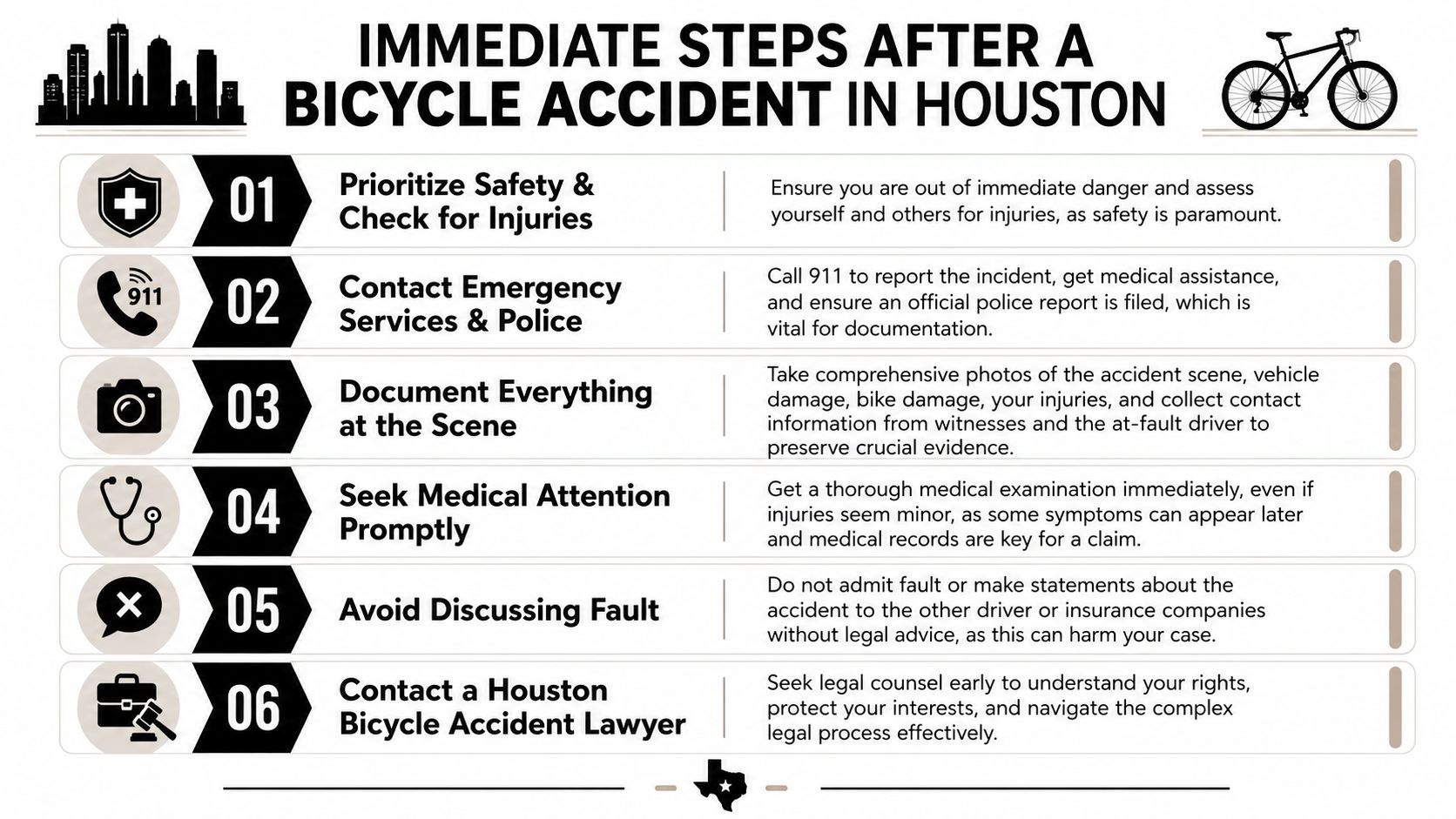
Get safe and get medical help
If you can move without making the injury worse, get out of traffic. Call 911. Ask for both police and medical help.
Don't brush off pain just because adrenaline is masking it. Cyclists often suffer injuries that look minor at first but become much more serious later. A same-day medical record connects the injury to the crash, and that matters when an insurer later claims something else caused your symptoms.
Make sure a report is created
A police report isn't the whole case, but it often becomes the starting point. Tell the officer what happened in plain language. Stick to facts. If you don't know something, say that you don't know.
If you get the report number, keep it. Later, you'll want to review it carefully. This guide on how to read a police accident report can help you understand what officers recorded and whether anything needs to be corrected.
Document the scene before it disappears
If you're physically able, gather evidence while it's still there:
- Photograph the roadway: include the bike, the vehicle, skid marks, debris, lane position, traffic signs, and any visible injuries.
- Collect names and contact details: get the driver's information, insurance details, and witness contact information.
- Preserve damaged items: keep your helmet, clothing, lights, bags, and the bicycle itself in the post-crash condition.
Practical rule: Don't repair the bike, throw away the helmet, or wash blood off clothing until your lawyer has advised you.
Video can also help explain these first steps in a more visual way.
Watch what you say
You should be polite, but careful. Don't apologize. Don't guess about speed, distance, or fault. Don't tell the driver, "I'm fine," if you really don't know yet.
A simple example shows why. If a Houston driver rear-ended a cyclist near a stop sign and the rider says, "I probably should have seen you sooner," the insurer may later twist that into an admission of fault. The same thing happens in car and motorcycle cases. In Houston Motorcycle Accident Lawyer matters, riders face many of the same arguments about visibility and lane position.
Don't speak to the other driver's insurer first
The other insurance company is not calling to help you value your claim. The adjuster is looking for recorded statements, gaps in treatment, prior injuries, and anything that shifts blame onto you.
This is where a specialized bicycle lawyer matters. A general personal injury practice may know injury law in broad terms. A bicycle case often turns on scene reconstruction, rider visibility arguments, bike-lane positioning, road design, and the insurer's effort to frame ordinary cycling behavior as careless. A lawyer who handles these cases knows what gets attacked first and how to respond before those early mistakes harden into the defense story.
Why You Need a Houston Bicycle Accident Lawyer
Bicycle cases look simple from a distance. A car hit a cyclist. The cyclist got hurt. But claims rarely stay that clean once the insurance company gets involved.
Houston's roads see an average of 2.8 bicycle collisions daily, with settlements in Texas ranging from $15,000 to $250,000, heavily dependent on the documented evidence of driver negligence and the long-term impact of the crash, as described by Atlas Firm's discussion of Houston bicycle accident claims.

A bicycle lawyer focuses on fault before the insurer does
A key legal word is liability. It means legal responsibility for causing the crash. In a bicycle case, liability often gets contested immediately.
Insurers may argue that you were outside the lane, hard to see, moving too fast, or failed to avoid the collision. A Houston bicycle accident lawyer looks at the road layout, the report, photos, witness statements, vehicle damage, and medical records to test those claims against actual evidence.
That work overlaps with what a Houston Car Accident Lawyer does in representing car accident victims in Houston and Harris County, but bicycle cases add a layer of bias and vulnerability that often makes the factual fight sharper.
Comparative fault can make or break your recovery
Another term you need to know is comparative fault. That means more than one person can share blame. Texas doesn't treat fault as all-or-nothing in every case, but the percentages matter a lot.
A simple example helps. Suppose a driver turns left in front of you, but the insurer claims you were riding unpredictably near the intersection. If they can push your share of fault high enough, your compensation may be reduced or even blocked. That is why evidence from the first day matters so much.
Insurance companies don't need to prove you caused everything. They only need enough blame assigned to you to reduce what they pay.
Your lawyer values the whole claim, not just the first bill
Another important term is damages. In plain English, damages are the losses the law allows you to recover. That can include medical care, lost income, bicycle damage, pain, and the ways the injury changed daily life.
What doesn't work is treating the case like a stack of receipts. Serious bicycle injuries often involve future treatment, limited mobility, missed work opportunities, and lasting pain. A strong claim tells the full story, not just the emergency room visit.
A good lawyer also handles communication, preserves evidence, pushes back on blame-shifting, and prepares the case for suit if the insurer won't deal fairly. That changes the conversation. When the defense sees an organized file instead of an injured rider trying to negotiate alone, the case tends to move on more serious terms.
Understanding Your Rights Under Texas Law
Texas law gives you a path to recover when someone else's carelessness causes a bicycle crash, but it also sets rules that can limit or reduce your claim. If you understand those rules early, the process feels less intimidating and a lot more manageable.
Negligence and liability in plain English
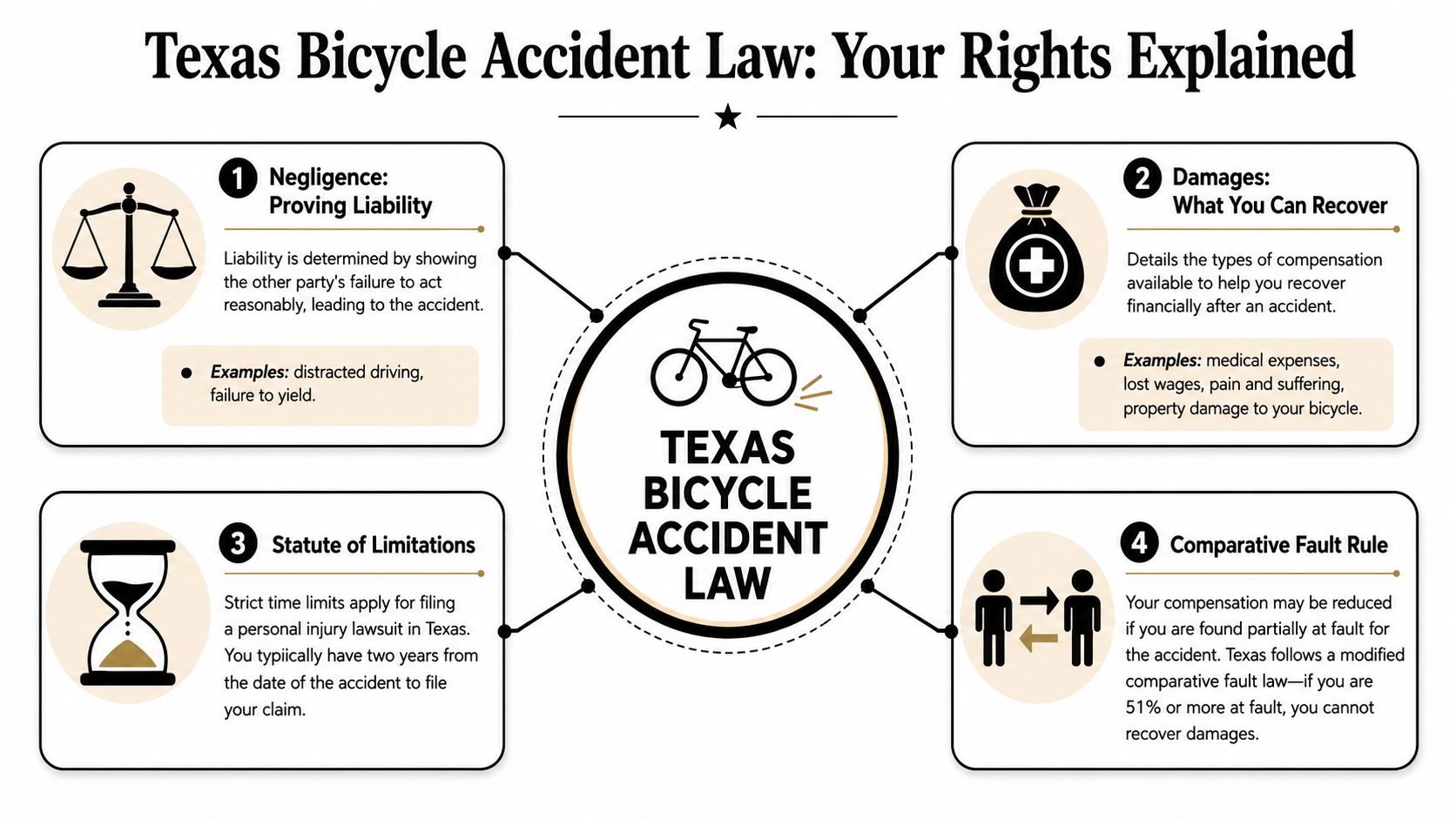
The foundation of most bicycle injury claims is negligence. That means a person failed to act with reasonable care and caused harm. In everyday terms, a driver who speeds through a turn, looks down at a phone, or fails to yield may be negligent.
When negligence causes the crash, that helps establish liability, which is legal responsibility. Your lawyer's job is to prove what happened with documents, witness accounts, photos, medical records, and other evidence.
A common real-world example looks like this. A Houston driver rear-ended a cyclist while approaching a red light on I-45 frontage traffic. The rider goes to the hospital, misses work, and later gets a call from the insurer saying the cyclist "stopped suddenly." The legal case then becomes a question of proof. What does the scene show? What did witnesses say? What does the damage pattern suggest? That's how liability gets built.
Comparative fault under Chapter 33
Texas Civil Practice & Remedies Code Chapter 33 controls comparative fault, sometimes called proportionate responsibility. This rule matters in almost every contested crash case.
Under Texas Civil Practice and Remedies Code Section 33.001, an injury victim cannot recover any compensation if their percentage of responsibility exceeds 50 percent, meaning a bicyclist found 51% at fault receives nothing under Texas law, as explained in this discussion of Texas negligence law.
That rule is often called the 51 percent bar. If you're 50 percent responsible or less, you may still recover. If you're over that line, the claim is barred.
If you'd like a simpler breakdown of how fault percentages affect cases, this page on comparative fault definition is a useful companion.
A bicycle claim can be strong on injuries and still fail if fault isn't handled correctly.
What damages may be available
Texas law also allows injured people to seek damages, which means compensation for losses caused by the crash. In plain terms, damages usually fall into two broad categories.
| Type of damages | What it means |
|---|---|
| Economic damages | Financial losses such as medical bills, lost wages, rehabilitation costs, and bicycle or gear damage |
| Non-economic damages | Human losses such as pain, suffering, physical impairment, disfigurement, and emotional distress |
Texas Civil Practice & Remedies Code Chapter 41 deals with certain damages issues in civil cases, including exemplary damages in limited circumstances. Most bicycle injury claims, though, are built first on proving ordinary negligence and fully documenting the actual impact of the injury.
What the claim process often looks like
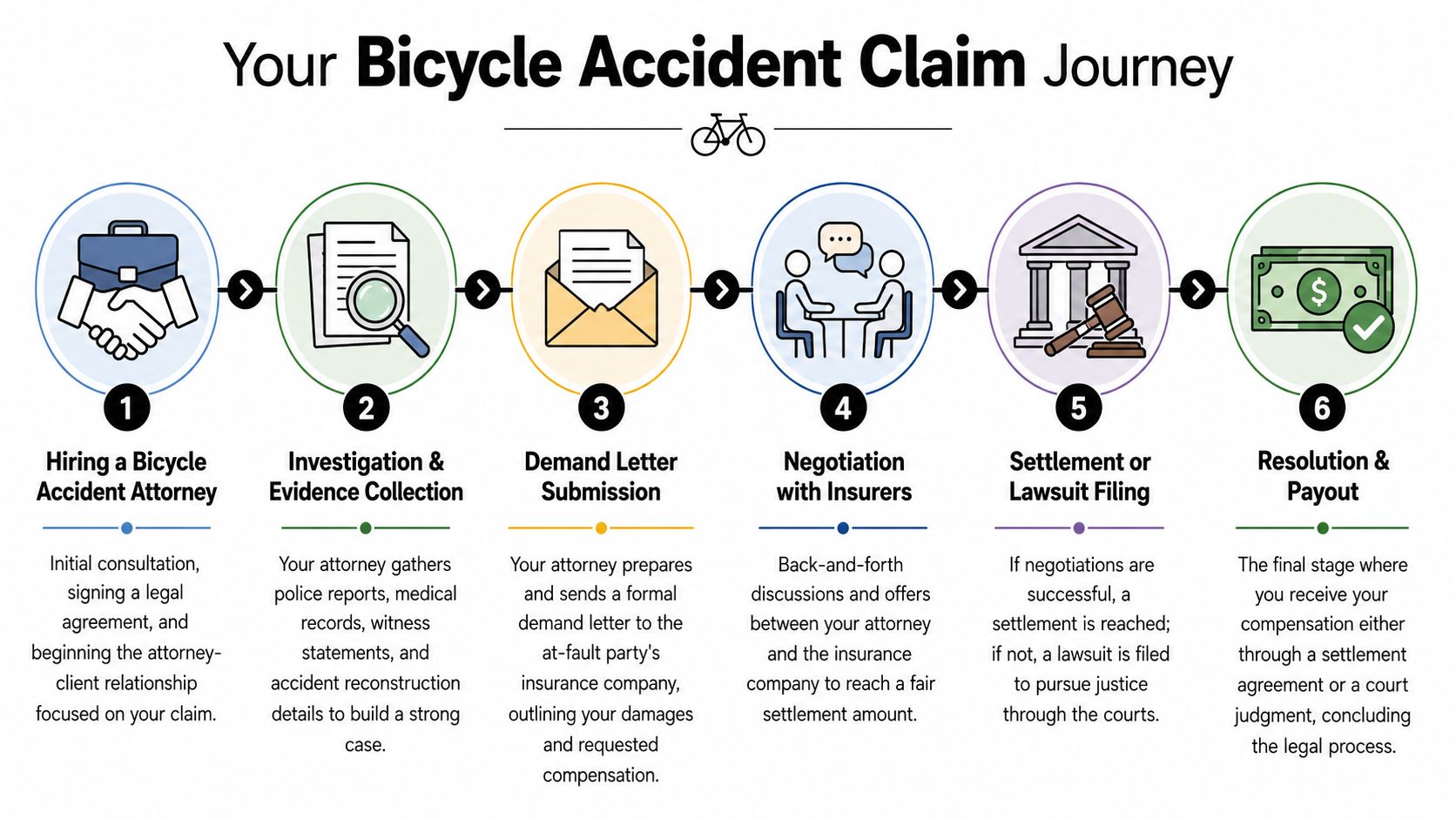
For many riders, the legal path starts ordinarily. You hire counsel. Medical records are gathered. Photos are organized. Witnesses are contacted while memories are still fresh. The police report is reviewed for mistakes or missing details.
Then a demand is sent to the insurer. That package usually explains why the driver was at fault, what your injuries are, how treatment has affected your work and home life, and what compensation is being sought. Negotiations follow. Sometimes the insurer responds reasonably. Sometimes it disputes fault, questions treatment, or offers much less than the case is worth.
If no fair resolution happens, filing suit may be the next step. The important point is that the process follows a structure. It isn't chaos. It only feels that way when you're trying to handle it while recovering.
The Bicycle Accident Claim Process Step by Step
The legal process feels more manageable when you can see it as a sequence instead of one giant problem. Most bicycle cases move through a series of stages, and each one has a purpose.
Step one and step two
The case usually begins with hiring counsel and opening the file. Your lawyer gets the crash report, requests medical records, preserves photographs, talks to witnesses, and identifies all possible insurance coverage.
That early investigation is where many cases are won or lost. A driver may have been working at the time. A roadway defect may have contributed. A nearby business may have video. If no one asks quickly, those facts may disappear.
Two practical concerns come up here for many clients:
- Time pressure: waiting too long can mean lost evidence, faded memories, and harder negotiations.
- Money pressure: injured riders often worry they can't afford a lawyer while medical bills are already piling up.
If you're also sorting through your own coverage questions, a practical outside resource is this guide for a smooth auto insurance claim, which explains how policyholders can approach the insurance side in an organized way.
Step three and step four
Once the evidence is developed, your lawyer prepares a demand package. This is more than a letter asking for money. It is the case story, backed by records, photos, bills, treatment history, and legal analysis.
Then negotiations begin. Under Chapter 33 of the Texas Civil Practice and Remedies Code, a claimant's damages recovery is reduced by their percentage of responsibility plus any settlement credit from settling parties, a complex calculation your attorney manages during negotiations, as discussed in the Texas Tech Law Review analysis of Chapter 33.
That matters because negotiation is not just haggling over a number. It is often a fight over blame allocation. If the insurer can push fault onto you, the math changes in its favor.
Settlement talks are really two arguments at once. What is the case worth, and who can pin what share of fault on whom?
Step five and step six
If the insurer won't make a fair offer, the next step may be a lawsuit. Filing suit doesn't mean the case will definitely go to trial. It means the dispute moves into a formal court process with deadlines, written discovery, depositions, motion practice, and potential mediation.
From there, one of two things usually happens:
- The case resolves before trial: after more evidence is exchanged, the defense may increase its position.
- The case goes to court: a judge or jury decides fault and damages.
Either way, the final stage is resolution and payout. Liens, case expenses, and attorney's fees are addressed, and the client receives the net recovery.
A bicycle case can share features with other complex injury claims, including commercial vehicle cases, where fault and coverage are heavily contested. The point isn't that every case becomes a lawsuit. It's that your claim should be prepared as if it might. Cases built carefully tend to negotiate from a stronger position.
Timelines and Costs for Your Bicycle Accident Case
Most injured cyclists ask two questions early. How long do I have, and what will it cost to hire a lawyer? Both are fair questions, and both affect whether people act quickly enough to protect their rights.
The filing deadline is real
The Texas Civil Practice and Remedies Code § 16.003 establishes a strict two-year statute of limitations for filing bicycle accident suits, while most Houston lawyers operate on a contingency fee, typically 33% to 40% of the recovered compensation, ensuring no upfront costs for clients, according to Ramsey Law's discussion of Houston bike accident claims.
A statute of limitations is the legal deadline to file suit. If you miss it, the court can dismiss the case even if the driver was clearly at fault. That's why waiting is risky. Evidence rarely gets better with time.
The practical problem isn't just the calendar. Surveillance footage gets erased. Witnesses move. A damaged bike gets repaired or discarded. Medical treatment gaps appear in the record. All of that gives the insurer room to argue.
How contingency fees work
A contingency fee means you don't pay attorney's fees up front. The lawyer is paid from the recovery if the case succeeds. If there is no recovery, there is generally no attorney's fee.
That fee model matters because it lets injured people hire a Texas injury attorney without paying out of pocket while they are already dealing with treatment and lost wages. It also means you should ask clear questions at the start:
- What percentage applies: make sure you understand whether the fee changes if suit is filed.
- How are costs handled: ask about filing fees, records costs, and other case expenses.
- Who handles insurer contact: you want that answer to be "your legal team" as early as possible.
What to look for in the lawyer you hire
Not every personal injury practice handles bicycle cases the same way. If you're choosing counsel, look for someone who can explain fault rules in plain English, move quickly to preserve evidence, and prepare the case for negotiation or litigation without overpromising results.
The Law Office of Bryan Fagan, PLLC handles Texas personal injury and motor vehicle claims on a contingency-fee basis and offers free consultations for injured people who need to understand liability, damages, coverage, and next steps after a serious crash.
The right lawyer won't promise miracles. They will explain the trade-offs, tell you what documents matter, warn you about insurer tactics, and start protecting the case before the defense shapes the narrative for you.
Choose Your Advocate and Begin Your Recovery Today
After a bicycle crash, the right next step is rarely complicated. You need medical care, you need the facts preserved, and you need an advocate who knows how Texas injury claims really work in practice.
What to look for in your advocate
A strong lawyer for a bicycle case should offer more than broad injury experience. You want someone who understands disputed visibility claims, rider-blame defenses, insurance pressure tactics, and the way comparative fault can change the outcome of a case.
You also want communication. If you call with a question about treatment records, bike damage, or an adjuster asking for a statement, you should get a clear answer. You shouldn't be left guessing what happens next.
What doesn't work
What usually hurts these claims is delay, loose talk with insurers, and hiring someone who treats the case like a routine fender-bender. Bicycle injuries are often more serious than they first appear, and the defense often challenges both fault and the extent of harm.
For local searches, this page on finding a bicycle accident lawyer near me may help you think through what to ask before you hire anyone.
The goal isn't just to open a claim. It's to build a case that can withstand pressure.
Recovery starts with one informed decision
If your injuries are severe, your claim may involve more than a basic insurance dispute. It may include future care, time away from work, an uninsured driver issue, or even a fatality claim involving wrongful death compensation for a surviving family. In those situations, clear legal guidance matters even more.
Even if your case seems straightforward, don't assume the insurer sees it that way. The first recorded statement, the first treatment gap, and the first careless comment about fault can all be used against you later. Acting early gives you more control.
If you need help with a bicycle case, an auto insurance claim, or related injury issues involving a Houston car accident lawyer or Texas injury attorney, the important thing is to speak with someone who can evaluate the facts and give you practical next steps suited to your needs.
If you were hurt in a Houston bicycle crash, contact The Law Office of Bryan Fagan, PLLC for a free consultation. You can get clear answers about your rights, how Texas negligence law applies to your case, what compensation may be available, and how to deal with the insurance company without risking avoidable mistakes. You don't have to handle this alone, and you don't have to pay anything up front to get experienced legal guidance.