A car crash can change your life in seconds, but you don't have to face recovery alone.
You may be reading this from a hospital room, your couch, or a family member's home because walking hurts, sleeping is hard, and nothing feels normal. One moment you were crossing a Houston street, walking through a parking lot, or heading to work. The next, a driver hit you, and now you're dealing with pain, bills, calls from insurance companies, and a flood of questions you never expected to ask.
If that's where you are, take a breath. You don't need to know everything today. You just need clear information, steady guidance, and a path forward. That's what this guide is for. It explains what a Houston pedestrian accident lawyer does, how Texas law handles fault, what steps matter most after a crash, and how to protect your right to seek compensation while you focus on healing.
A Pedestrian Accident Can Change Your Life in Seconds
A pedestrian crash often begins in an ordinary place. You're crossing near a neighborhood store. You're walking back to your car after work. You're moving through a marked crosswalk while traffic waits at a light. Then a driver turns without looking, backs up too fast, or glances down at a phone instead of the road.
For many people, the first hours after the collision feel blurry. Your body hurts, but adrenaline can hide part of the pain. You may remember the sound of brakes, voices around you, or the shock of lying on the ground wondering what just happened. Then the practical worries arrive. Who pays the medical bills? What if you miss work? What if the insurance company says you caused it?
What many injured pedestrians feel right away
A Houston driver rear-ended on I-45 may have damage to a vehicle and a clear place to start. A pedestrian usually has something far more personal at stake. Your body took the impact.
Common concerns often include:
- Pain that changes over time: You may feel soreness, headaches, dizziness, or stiffness that gets worse after the initial shock fades.
- Fear about recovery: It's hard to know whether you'll be back to normal soon or whether treatment will last longer than you hoped.
- Stress about money: Missed work, medical appointments, and prescription costs can pile up quickly.
- Confusion about fault: Drivers and insurers sometimes try to blame the person on foot, even when the driver failed to yield.
If you hit your head, feel foggy, or have symptoms that don't make sense, it helps to learn more about understanding concussion recovery. That kind of information can help you ask better questions and follow your treatment plan.
Practical rule: Get medical care first, even if you think your injuries are minor. Pedestrian injuries often look smaller on day one than they feel on day three.
Hope matters just as much as the next legal step
You don't have to figure this out alone. Texas law gives injured people the right to pursue a personal injury claim when someone else's negligence caused harm. In plain English, negligence means a person failed to act with reasonable care and hurt someone as a result.
That legal right matters, but so does your peace of mind. A good lawyer helps you understand the process in plain language, protects you from insurance pressure, and gives you a plan. The goal isn't to turn your life into a lawsuit. The goal is to help you recover physically, financially, and emotionally after a violent interruption to everyday life.
What a Houston Pedestrian Accident Lawyer Does for You
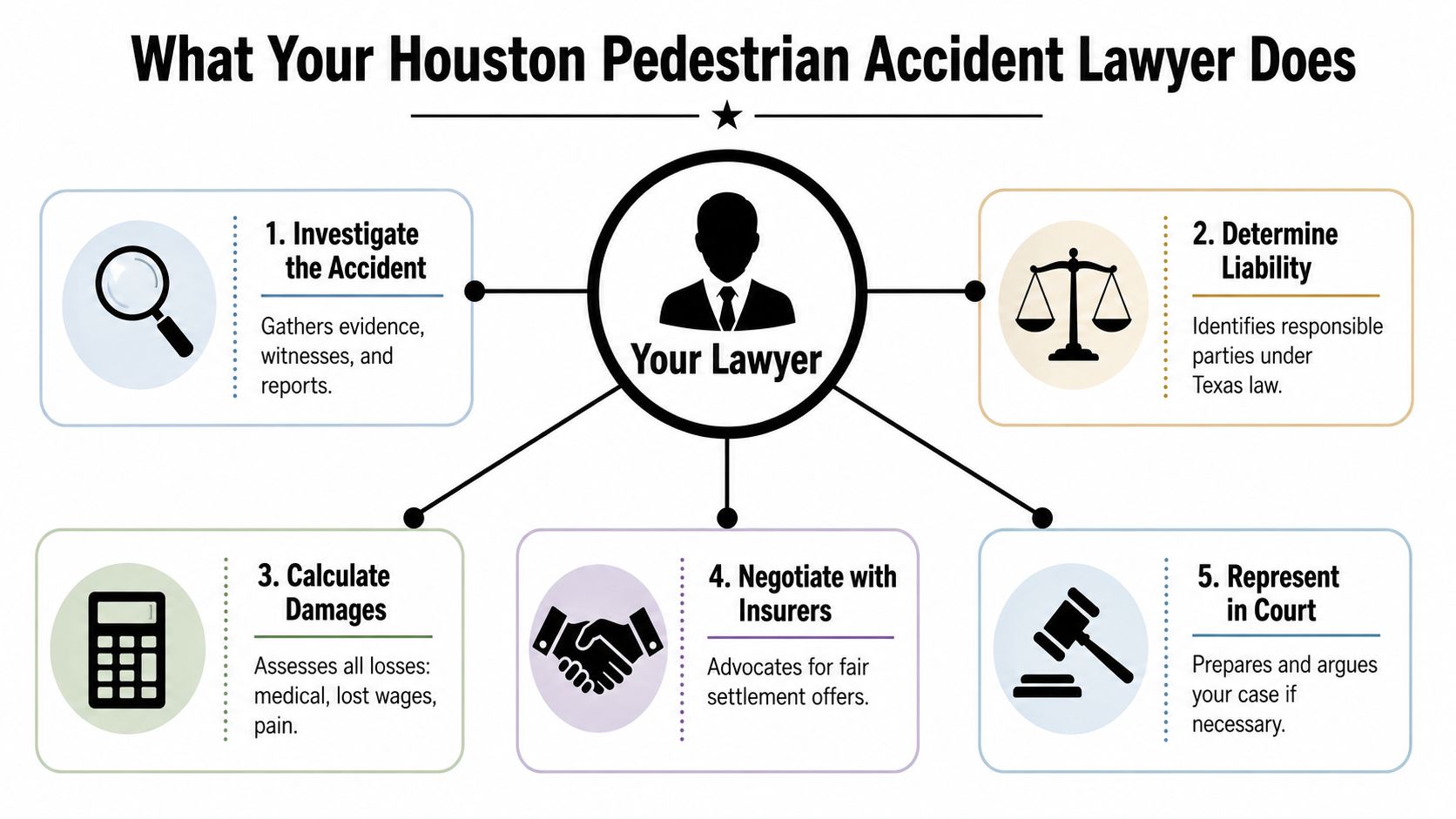
When people hear “lawyer,” they often think of court. In reality, most of the work starts long before a courtroom is involved. A Houston pedestrian accident lawyer steps in early to protect your claim, organize the facts, and deal with the people who may try to minimize what happened to you.
Right near the start of a case, many clients need a simple answer to one question. What will my lawyer do day to day?
Your lawyer becomes your buffer
After a crash, insurance adjusters may sound friendly. They may ask for a recorded statement, request medical records, or push you to describe your injuries before you've finished treatment. That can put you in a weak position.
A lawyer takes over those communications so you don't have to guess what to say. That includes:
- Handling insurance contact: Your attorney can respond to calls, emails, and settlement discussions tied to your auto insurance claim.
- Protecting your words: A simple phrase like “I'm feeling better” can be used out of context later.
- Keeping the timeline straight: Your case moves in an organized way instead of reacting to insurer pressure.
Your lawyer builds the case from the ground up
Personal injury claims depend on evidence. The sooner someone starts gathering it, the better.
That work often includes:
- Collecting the police report and checking whether it matches what happened.
- Talking to witnesses before memories fade.
- Looking for camera footage from traffic lights, nearby businesses, or parking lots.
- Reviewing photos of the scene and damage patterns.
- Documenting your injuries through medical records and provider opinions.
A resource like Houston Pedestrian Accident Lawyer refers to representation for pedestrians struck by vehicles in Houston, which is the type of claim where this investigation work becomes especially important.
The strongest cases are usually the best documented ones, not the loudest ones.
Your lawyer connects the legal and medical sides
You may know you're hurt. The law still requires proof. Your attorney works to show not only that you were injured, but how those injuries changed your daily life.
That can mean tracking:
- medical bills
- follow-up treatment
- time missed from work
- limits on walking, lifting, driving, or caring for family
- pain, stress, and disruption to normal routines
A Texas injury attorney also looks ahead. If your treatment continues, if you need rehabilitation, or if your injuries affect your ability to earn a living, your claim should reflect that full picture, not just the bills already sitting on your kitchen table.
If the insurance company won't offer a fair resolution, your lawyer prepares the case for court. That preparation alone can matter because it shows the insurer your claim is being taken seriously.
Who Is Liable in a Texas Pedestrian Accident
Liability means legal responsibility. In a pedestrian injury case, the main question is who caused the crash and who should pay for the harm that followed. Sometimes the answer is clear. Sometimes the insurance company tries to muddy it.
Under Texas personal injury law, negligence usually comes down to four basic ideas. One person had a duty to act carefully. That person breached that duty. The breach caused the injury. The injury led to damages.
What duty of care means on a Houston street
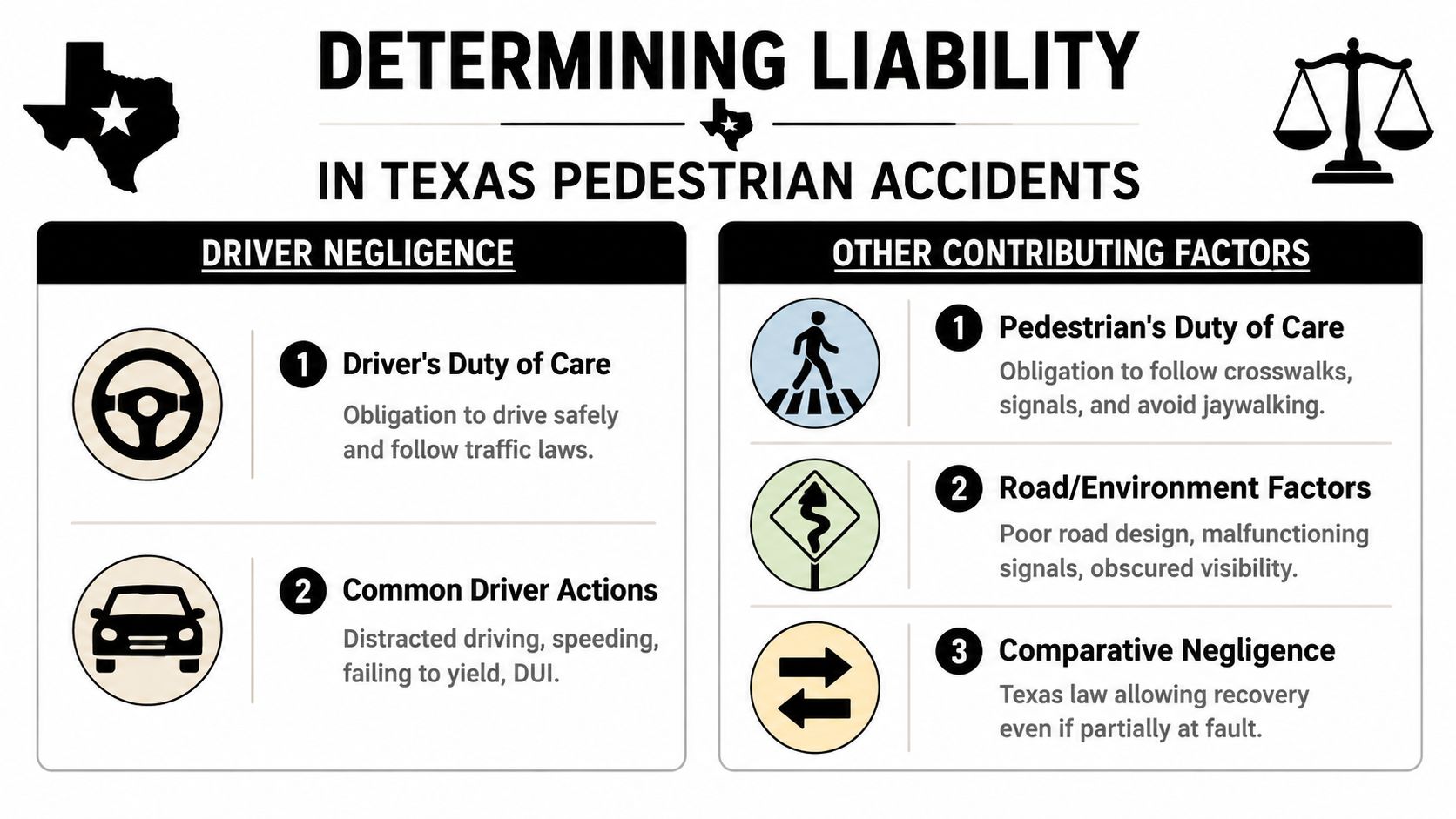
A driver has a duty of care to operate a vehicle safely, watch the road, obey traffic signals, and look for people on foot. A pedestrian also has duties, such as following signals and using reasonable care while crossing.
That's why fault disputes can get complicated. The insurer may argue that the driver wasn't the only one who made a mistake.
This visual shows the common fault issues that come up in these cases:
Comparative fault in plain English
Texas follows a modified comparative fault system under Texas Civil Practice & Remedies Code, Chapter 33. You may also hear this called proportionate responsibility. If an injured person is partly at fault, that person's compensation can be reduced. If the injured person is more responsible than the law allows, recovery can be barred.
A simple way to think about it is this. If two people both contributed to the crash, the law asks how much blame belongs to each one.
For a fuller plain-English explanation, see Texas comparative fault definition.
A real-world example of shared fault
Say a driver is texting while turning right at an intersection in Houston. At the same time, a pedestrian crosses outside the crosswalk. The driver hits the pedestrian.
In that situation, the driver may still carry most of the blame because texting and failing to watch for pedestrians are serious acts of negligence. But the insurance company may argue the pedestrian also contributed by crossing where traffic didn't expect a person to be.
That's where comparative fault matters. In plain language, it means your compensation can be reduced if you share part of the blame. It doesn't automatically end your case.
Insurance companies often use this rule as a strategy. They may say:
- You crossed too late
- You came out too fast
- You weren't visible
- You weren't in the crosswalk
- You should have avoided the driver
A blame argument from an insurer is not the same as a final legal answer.
What damages means under Texas law
Damages are the losses the law allows you to recover in a personal injury case. They can include financial losses, physical pain, emotional distress, and other ways the crash affected your life. Texas Civil Practice & Remedies Code, Chapter 41 also addresses exemplary damages, sometimes called punitive damages, in limited situations involving especially serious misconduct.
A Houston car accident lawyer or pedestrian injury attorney uses evidence to push back when an insurer tries to shift fault unfairly. In many pedestrian cases, proving what the driver did wrong is the heart of the claim.
Your Legal Timeline and the Texas Statute of Limitations
After a pedestrian crash, time feels strange. The days may revolve around doctor visits, pain, transportation problems, and missed work. The legal process still moves forward, and one of the most important rules is the statute of limitations.
A statute of limitations is the legal deadline to file a lawsuit. In Texas, personal injury claims generally must be filed within two years under Texas law. Missing that deadline can mean losing the chance to bring your claim in court. For a closer look at that rule, review Texas statutes of limitations.
This timeline helps show how a case usually develops:
The first phase after the crash
The earliest steps often shape the whole claim.
- Get medical care: Your health comes first, and medical records also connect your injuries to the crash.
- Report the collision: A police report can become an important piece of evidence.
- Preserve what you have: Save photos, discharge papers, receipts, names of witnesses, and any insurer messages.
- Talk to a lawyer early: Prompt legal advice helps protect evidence before it disappears.
What happens after you hire counsel
Once you have representation, the case usually moves through a predictable path.
First comes investigation. Your lawyer gathers records, reviews the scene, studies your treatment, and identifies insurance coverage. Then a formal demand is prepared. This is the document that explains what happened, why the other party is liable, and what compensation you're seeking.
After that, negotiation begins. The insurer may agree, disagree, delay, or make an offer that doesn't reflect the full harm you've suffered. If that happens, filing a lawsuit may be the next step.
If the case turns into a lawsuit
A lawsuit doesn't mean your case will definitely go to trial. It means your attorney is using the court system to keep the claim moving and protect your rights before the deadline expires.
That process can include:
- Filing the petition
- Serving the defendant
- Discovery, where both sides exchange information
- Depositions, where witnesses answer questions under oath
- Settlement talks
- Trial, if no fair agreement is reached
The legal timeline can feel slow, but careful cases often move that way because strong claims need strong proof.
If you're also dealing with a vehicle collision involving family members, broader issues may overlap with help from a Houston car accident lawyer, especially when insurance and liability questions affect several people.
Calculating the Full Value of Your Pedestrian Accident Claim
A common initial question is: Who pays my medical bills? That matters, but it's only part of the claim. A pedestrian injury can affect your income, your routine, your independence, and your mental health. The law groups these losses under damages.
In plain English, damages are the money a person may seek after another party's negligence causes harm. Texas Civil Practice & Remedies Code, Chapter 41 also governs when exemplary damages may be available in cases involving fraud, malice, or gross negligence. In some pedestrian cases, that issue may arise when a driver's conduct goes far beyond ordinary carelessness, such as extreme reckless behavior.
Economic and non-economic damages
Some losses are easier to calculate because they come with bills, invoices, or wage records. Others are real but harder to measure because they affect quality of life.
| Damage Type | Description & Examples |
|---|---|
| Economic Damages | Financial losses you can document, such as emergency care, hospital bills, physical therapy, medication, assistive devices, lost wages, reduced earning ability, and other out-of-pocket costs tied to the crash. |
| Non-Economic Damages | Human losses that don't come with a receipt, such as pain, emotional distress, physical impairment, scarring, and loss of enjoyment of normal activities. |
| Exemplary Damages | Available only in limited cases under Texas law when the facts support more than ordinary negligence, such as gross negligence or similar serious misconduct. |
For many injured pedestrians, recovery also involves ongoing treatment choices. If your doctors recommend supportive therapies during healing, information about chiropractic care for injuries may help you understand one part of post-accident care. Your legal claim should reflect treatment that is reasonable, related to the crash, and supported by your medical providers.
What lawyers look at when valuing a claim
No honest attorney can tell you your exact case value in the first conversation. The value depends on the proof.
A lawyer usually studies factors like these:
- How serious the injury is: Broken bones, head trauma, soft tissue injuries, and permanent limitations affect claims differently.
- How long treatment lasts: A short recovery and a long rehabilitation path are not valued the same way.
- Whether work was affected: Lost time, reduced hours, or a job change can become part of the claim.
- How daily life changed: Trouble walking, driving, sleeping, or caring for children matters.
- How clear liability is: Strong proof of fault often changes how an insurer evaluates a case.
If you want a closer look at this issue, this guide on how to calculate damages explains the building blocks in more detail.
How contingency fees work
Many people worry they can't afford legal help after a crash. That concern is understandable, especially when paychecks stop and bills keep coming.
In a contingency fee arrangement, your lawyer is paid from the recovery if the case succeeds. You don't pay attorney's fees upfront. If there's no recovery, you don't owe those fees. That model lets injured people pursue justice without having to fund a case out of pocket while trying to heal.
This same approach can matter in related cases too, including wrongful death compensation claims when a family loses a loved one after a fatal pedestrian crash.
Why Trust The Law Office of Bryan Fagan With Your Recovery
After a pedestrian collision, you need more than legal vocabulary. You need people who return calls, explain what's happening, and treat your case like it involves a real human being, not a file number. That's especially important when you're in pain and your family is trying to hold daily life together.
At this stage, trust usually comes down to a few practical questions. Will the firm listen? Will they be clear with you? Will they stand between you and the insurance company when things get difficult?

What injured clients usually need most
People rarely call after a crash because they want a complicated legal lecture. They call because they want relief from uncertainty.
That often means:
- Direct communication: You should know where your case stands and what the next step is.
- Help with insurers: Adjusters may move fast, and you need someone who knows their tactics.
- Respect for your recovery: A firm should understand that your medical care and stability come first.
- Trial readiness: Even if a case settles, preparation matters because insurers pay attention when a lawyer is ready to litigate.
The Law Office of Bryan Fagan, PLLC handles Texas personal injury and car accident matters, including cases involving pedestrians, drivers, passengers, insurance disputes, and wrongful death compensation. That kind of broad accident practice can help when a pedestrian case overlaps with larger insurance or liability issues.
Why approach matters in pedestrian cases
Pedestrian claims are highly personal. Unlike many vehicle-only crashes, your own body took the full force of the impact. Clients often feel exposed, blamed, and overwhelmed all at once.
A compassionate attorney should understand that. A practical attorney should also know how to gather records, document losses, and push back when an insurance company tries to reduce your story to a quick settlement figure.
Good legal help should make your life easier while your case is active, not harder.
A grounded promise, not a sales pitch
No ethical lawyer should promise a specific result. Every case turns on its facts, your injuries, available coverage, and the quality of the evidence. What a firm can promise is effort, communication, and a clear strategy.
That includes the same contingency-fee structure discussed earlier. You don't need to fund the case upfront just to get answers and representation. If you're searching for a Houston pedestrian accident lawyer, that kind of practical access to legal help can make the first step feel possible.
Frequently Asked Questions About Pedestrian Accidents
What if the driver fled or had no insurance
Call the police, get medical care, and preserve any detail you remember about the vehicle, direction of travel, or nearby witnesses. A hit-and-run case may still involve possible recovery through your own policy, including uninsured or underinsured motorist coverage if it applies. A lawyer can also look for surveillance footage and other sources of proof.
Should I give a recorded statement to the other driver's insurance company
Usually, no. You're not required to help the other side build a case against you. Recorded statements can be used to challenge your injuries, your memory, or your version of events. It's safer to speak with an attorney before answering detailed questions from the insurer.
How much is my case worth
There's no honest one-size-fits-all answer. The value depends on your injuries, your treatment, time away from work, long-term effects, pain, available insurance, and how strongly the evidence proves fault. That's why a quick online estimate often misses the full picture.
What should I do right now if I'm injured
Focus on the next few steps:
- Follow medical advice: Keep appointments and tell your doctors about every symptom.
- Save documents: Keep bills, prescriptions, discharge papers, and insurer messages.
- Avoid social media posts: Insurers may use photos or comments out of context.
- Get legal advice early: The sooner you understand your rights, the fewer mistakes you're likely to make.
If you've been hit while walking in Houston, you don't have to sort through this alone. Contact The Law Office of Bryan Fagan, PLLC for a free consultation. We can listen to what happened, explain your options in plain language, and help you decide what to do next so you can protect your rights and focus on healing.