A car crash can change your life in seconds—but you don’t have to face recovery alone. This guide is your first step toward understanding a critical, yet often confusing, part of a pain and suffering car accident settlement in Texas. While your medical bills and car repairs are tangible costs, Texas law recognizes that the physical pain and emotional trauma you're going through have real value, too.
Understanding Your Rights in a Pain and Suffering Settlement

After a crash, your main focus should be on healing. The problem is, the financial and emotional burdens can quickly become overwhelming. A fair settlement needs to cover more than just your immediate hospital bills; it has to account for the profound, personal toll the accident has taken on your life.
This is where the concept of "pain and suffering" comes in. It’s the legal system's way of putting a value on the human cost of a collision—the sleepless nights, the chronic pain, the anxiety you feel just getting back behind the wheel, and the simple joys you can no longer take for granted.
Why Your Story Matters in a Texas Claim
Insurance companies often try to boil your experience down to a set of numbers on a claim form. They’ll focus on the vehicle damage or the cost of your first ER visit. But your story is so much bigger than that.
For example, imagine a Houston driver rear-ended on I-45. Her medical bills for whiplash treatment might add up to $10,000. But what about the constant neck pain that keeps her from picking up her toddler? Or the panic attacks that make her avoid highways altogether? These are the real, human damages that a pain and suffering claim is designed to address.
In Texas, pain and suffering is a legitimate category of damages. It is meant to provide financial compensation for the physical discomfort and emotional distress you've been forced to endure because of someone else's negligence.
This guide will walk you through how to document what you've been through, what insurance adjusters are looking for, and how to build a strong case. We'll cover the key Texas laws that can impact your claim and share practical, step-by-step advice you can take to protect your rights. Our goal is to empower you with the knowledge needed to fight for a settlement that truly reflects the full impact of the accident. You can learn more about the initial steps by reviewing our guide on the car accident injury claim process.
Defining Pain and Suffering in Plain English
When you're trying to pick up the pieces after a car wreck in Texas, you'll hear the term "pain and suffering" a lot. It’s not just a vague legal phrase—it’s a very real and specific type of compensation you're entitled to. Simply put, "pain and suffering" falls into a legal category called non-economic damages. These are meant to compensate you for all the ways an accident has turned your life upside down—the harm that doesn't come with a neat price tag.
Think about it this way: your total compensation is made up of two different buckets. The first bucket holds your economic damages. These are the straightforward, black-and-white costs. We’re talking about things you can prove with a receipt or a pay stub, like:
- Hospital bills and ambulance rides
- Prescription medication costs
- Lost wages from being unable to work
- Future physical therapy sessions
The second bucket, for non-economic damages, is where a pain and suffering car accident settlement comes in. It’s designed to provide financial relief for all the invisible wounds—the physical agony and emotional turmoil that have a massive impact on your quality of life but don’t generate an invoice.
The Two Sides of Pain and Suffering
To really get a handle on what you can claim, it helps to break "pain and suffering" down into its two core parts: the physical and the mental. Both are crucial for building a strong case.
-
Physical Pain and Suffering: This is the immediate, raw pain from your injuries. Imagine the searing back pain from a herniated disc after getting T-boned at a Dallas intersection. But it doesn't stop there. It also covers the chronic, nagging discomfort you endure during recovery—the aches from physical therapy or the persistent headaches that just won't go away.
-
Mental Anguish and Emotional Distress: The psychological fallout from a serious crash can be just as crippling as any physical injury. It's the anxiety that grips you every time you get behind the wheel. It’s the depression that keeps you from enjoying the hobbies you once loved. In severe cases, it can even be Post-Traumatic Stress Disorder (PTSD), complete with flashbacks that force you to relive the collision over and over.
Texas law gets it: your well-being is about more than just not having a broken bone. It's about being able to live your life without fear, to enjoy time with your family, and to do the things that make you, you.
A core principle of Texas law is that liability—or legal responsibility—for your pain and suffering falls squarely on the person who caused the crash. If another driver’s negligence left you injured, they are on the hook for compensating you for all of it, both the economic and the non-economic harm.
Economic vs. Non-Economic Damages in a Texas Auto Insurance Claim
It’s absolutely vital to understand the difference between these two types of damages. Getting this right ensures your settlement demand covers the full, true scope of what you've lost. Below is a simple table to help you see the difference at a glance.
| Type of Damage | What It Covers | Examples |
|---|---|---|
| Economic Damages | Direct, calculable financial losses resulting from the accident. | Medical bills, lost wages, vehicle repair costs, future medical expenses. |
| Non-Economic Damages | Intangible, personal losses that affect your quality of life. | Physical pain, emotional distress, mental anguish, loss of enjoyment of life. |
Ultimately, a fair settlement has to account for every single aspect of your ordeal. While no amount of money can turn back the clock and erase what happened, a comprehensive pain and suffering car accident settlement delivers the financial resources you need to manage the burdens—physical and emotional—and start moving forward. This is where an experienced Texas injury attorney becomes your greatest asset; they know how to prove the full extent of these damages to an insurance company that would rather ignore them.
How Insurance Companies Calculate Your Settlement Value
After a serious car accident, it’s only natural to wonder how an insurance company could possibly put a price on your pain. Frankly, you should be skeptical. An adjuster sitting in a cubicle can't feel your physical agony or the emotional trauma you're going through. So, they turn to formulas to translate your very real, very personal suffering into a number for their pain and suffering car accident settlement offer.
Getting a handle on their methods is your first line of defense. These formulas are just a starting point for negotiations—they are not the final word. An adjuster’s job is to close your auto insurance claim for as little as possible. Our job is to fight for a value that truly reflects what you’ve been forced to endure.
This infographic breaks down the basic journey from the moment of a crash to the final settlement.
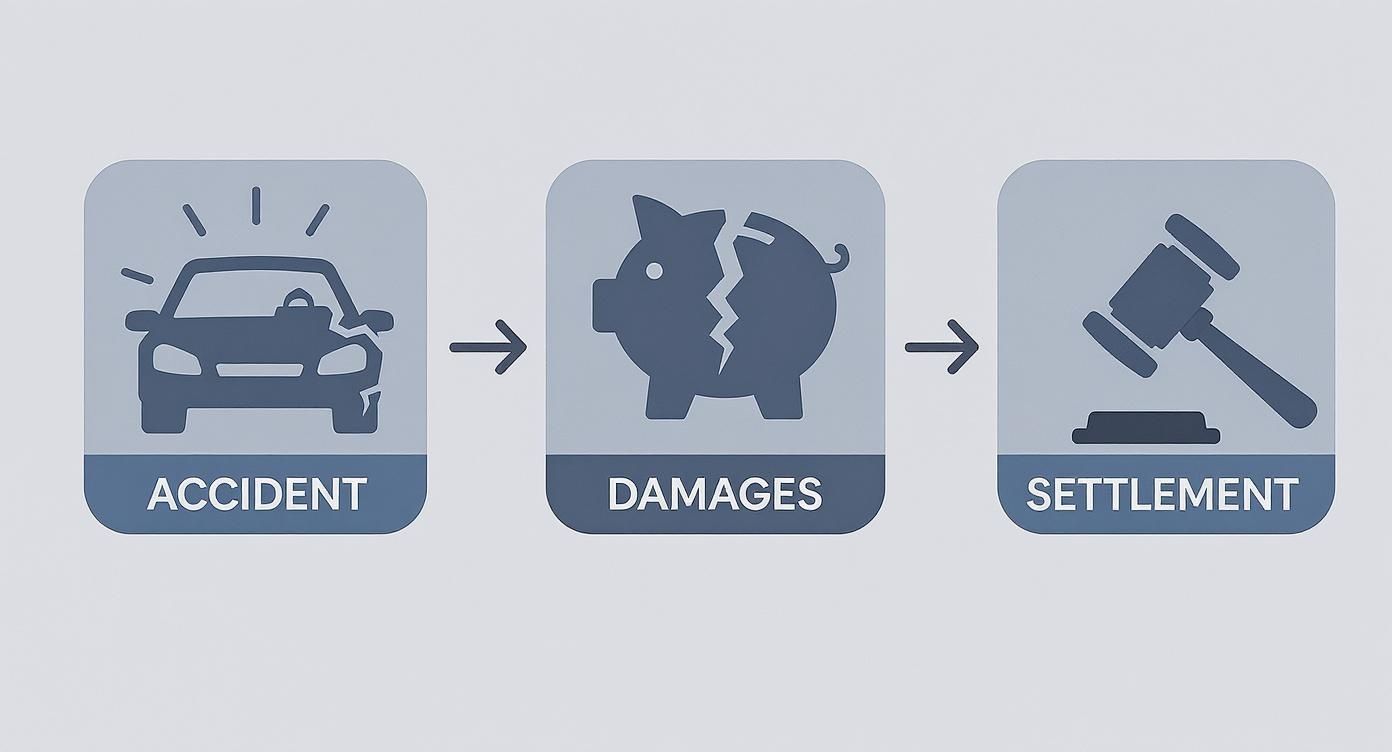
As you can see, the settlement is the last step. The amount you get is tied directly to the damages you suffered—both the ones with receipts and the ones that are much harder to quantify.
The Multiplier Method
The most common tool in an adjuster's kit is the Multiplier Method. It’s a pretty straightforward formula: they add up your economic damages—things like medical bills and lost wages—and multiply that total by a number, usually between 1.5 and 5.
That multiplier is where the fight really begins. It’s supposed to reflect how severe your injuries are and the impact the crash has had on your life.
- Low Multiplier (1.5 to 2): Adjusters reserve this for minor injuries. Think strains, bruises, or anything with a quick and complete recovery.
- High Multiplier (3 to 5): This is for the devastating, life-changing injuries. We're talking traumatic brain injuries, spinal cord damage, or permanent disfigurement that comes with long-term pain and significant emotional distress.
Let's say a driver in Dallas gets T-boned. They end up with a broken leg and a concussion, racking up $20,000 in medical bills and lost income. The adjuster might decide to apply a multiplier of 3, calculating the pain and suffering portion at $60,000 ($20,000 x 3). That number isn't a final offer; it's just their opening bid in the negotiation.
The Per Diem Method
Another approach, though less common, is the Per Diem Method. "Per diem" is just Latin for "per day." Using this method, the insurance company assigns a daily dollar amount to your pain and suffering.
They then multiply that daily rate by the number of days you were in pain—from the accident date until you reach what doctors call "maximum medical improvement." That’s the point where your condition isn’t expected to get any better. The daily rate is often tied to your daily earnings, based on the idea that enduring pain is at least as hard as going to work every day.
It is absolutely critical to remember that these formulas are just tools for the insurance company. They do not—and cannot—fully capture the human cost of a devastating car accident. A Texas injury attorney’s job is to build a case that tells your story beyond the numbers.
These calculations almost always lead to initial offers that are far too low. Insurance companies are known for starting with lowball offers that don't come close to fairly compensating victims for their pain and suffering. This is precisely why having strong legal counsel is so important.
Your unique experience is what truly defines the value of your claim. The physical therapy you pushed through, the family events you missed, the hobbies you had to give up—that's the real story. An experienced Houston car accident lawyer knows how to gather the right evidence to argue for a settlement that reflects the true scope of your suffering, not just some adjuster's formula. To get a better idea of how these factors come together, you can learn more about typical car accident settlement amounts and what to expect here in Texas.
Steps to Build a Compelling Case for Your Pain and Suffering

To get a fair pain and suffering car accident settlement, your word alone isn't enough. You need to show the insurance adjuster—and maybe a jury—exactly how the accident turned your life upside down. This means building a case with undeniable proof that tells the story of your new reality.
Of course, your personal account is important. But it’s the hard evidence that forces an insurance company to sit up and take your claim seriously. This goes way beyond just collecting medical bills. It’s about creating a detailed record of your physical agony, your emotional turmoil, and all the ways your life has been limited since the crash.
Your Personal Pain Journal: The Story in Your Own Words
One of the most powerful tools you have is a simple journal. Think of it as your daily logbook of what you're actually going through. It’s your chance to translate your suffering into a language an adjuster can’t ignore.
For instance, a Houston driver with a severe back injury might write, "Tried to lift a small bag of groceries today and felt a sharp, shooting pain down my left leg. Had to sit down for an hour with an ice pack. Missed my son's soccer practice because of it." That one entry says more about your struggle than just stating "my back hurts."
Your journal should capture the details:
- Daily Pain Levels: Rate your pain on a scale of 1 to 10. What did it feel like? Was it a dull ache, a sharp stab, or a burning sensation?
- Emotional State: Note feelings of anxiety, depression, or frustration. Did you have a panic attack? Nightmares? Trouble sleeping? Write it down.
- Life Impacts: What couldn't you do today? Simple things matter—playing with your kids, walking the dog, or even just doing the dishes.
- Medication Side Effects: Are your prescriptions making you drowsy, nauseous, or foggy? Document it.
Gathering Essential Medical Evidence
Your medical records are the foundation of your entire claim. They provide the official, professional proof of your injuries. It’s critical, however, that these records paint the complete picture of both your physical and mental health.
Don't hold back when talking to your doctor. If you're having trouble sleeping or feel a wave of anxiety every time you get behind the wheel, you need to say so. A formal diagnosis of post-traumatic stress disorder (PTSD), depression, or an anxiety disorder is a vital piece of evidence. This documentation creates a direct, medical link between your emotional distress and the accident itself, making it a legitimate part of your claim.
Under Texas law, your medical records serve as the primary evidence to establish the nature and severity of your injuries. A strong, consistent medical history is vital for proving both your physical pain and your mental anguish.
The Power of Visual and Witness Accounts
Evidence isn't just about paperwork. What you can show people, and what others can say about your situation, can be incredibly persuasive. You're trying to build a file that leaves no doubt about how this accident has affected you.
Make sure you collect these other forms of proof:
- Photographs and Videos: Take photos of your injuries as they heal. Pictures of you using crutches, wearing a neck brace, or sitting through a physical therapy session are powerful.
- Statements from Loved Ones: Ask your spouse, close friends, or family to write down what they’ve seen. A letter from a spouse describing how you can no longer enjoy gardening together or how your personality has changed because of chronic pain offers a credible, deeply personal perspective.
- Prescription Records: Keep a dedicated file of every medication you've been prescribed, for both physical pain and mental health conditions like anxiety or depression.
At the end of the day, a strong claim is a well-documented one. Every journal entry, photo, and medical report adds another layer of proof to your story. By carefully gathering this evidence, you give your Houston car accident lawyer the ammunition they need to fight for the maximum compensation you deserve.
How Is Liability Determined in a Texas Car Accident?
Getting a fair pain and suffering car accident settlement isn't just about adding up your medical bills. You also have to navigate a few critical Texas laws that can dramatically change the outcome of your case. Think of them as the rules of the game—and not knowing them can cost you everything.
Two laws, in particular, stand out: comparative fault and the statute of limitations. These aren't just technical legal terms; they are powerful rules that insurance companies love to use to slash your payout, sometimes down to zero. A lawyer who knows the Texas playbook can help you steer clear of these traps.
Who's Really at Fault? Understanding Comparative Fault in Texas
Texas uses a rule called modified comparative fault, also known as proportionate responsibility (Texas Civil Practice & Remedies Code § 33.001). It’s the state’s way of handling accidents where more than one person shares the blame. This law directly slices into your final settlement by assigning a percentage of fault to everyone involved.
It works like this:
- Your total compensation gets reduced by whatever percentage of fault is assigned to you.
- Let's say a jury determines your total damages are $100,000, but they decide you were 10% at fault for the crash. Your final award is cut by 10%, meaning you walk away with $90,000.
Sounds straightforward enough, right? But here’s the catch. Texas draws a hard line in the sand.
Under the Texas 51% Bar Rule, you are completely blocked from recovering a single penny if you are found to be 51% or more responsible for the accident. If your fault is 50% or less, you can still get paid, but your award will be reduced.
Insurance adjusters are masters at exploiting this rule. They will dig for any tiny reason—maybe you were going just a few miles over the speed limit or glanced at your radio for a second—to pin more blame on you. Their goal is to push your fault percentage up to reduce their payout or, better yet for them, get it over the 51% threshold to avoid paying you anything at all.
Don't Miss This Deadline—The Statute of Limitations is Non-Negotiable
The other big one is the statute of limitations. This is a legal stopwatch that starts ticking the moment your accident happens, giving you a limited time to file a lawsuit. In Texas, you generally have just two years from the date of the crash to take legal action.
If you let that two-year clock run out, you forfeit your right to ever seek compensation in court. It’s a permanent bar. Once that happens, the insurance company has all the leverage because they know you can no longer sue them. They’ll have zero incentive to offer you a fair settlement. You can get the full rundown by reading our deep dive into the statute of limitations for a car accident in Texas.
Pain and suffering damages can be the largest part of a settlement, especially when injuries are life-altering. Proving these non-economic losses is crucial, and it's why you need to understand the laws that protect your right to them. In some catastrophic injury or wrongful death cases, there may also be a claim for exemplary damages (punitive damages) under Texas Civil Practice & Remedies Code, Chapter 41, though this is rare and requires proving gross negligence.
Why a Lawyer Is Your Strongest Ally in a Settlement
After a serious car accident, your only job should be focusing on your recovery. The last thing you need is to be fielding calls from aggressive insurance adjusters or drowning in complex legal paperwork. This is exactly where a dedicated Houston car accident lawyer steps in, becoming your strongest ally to manage every detail of your pain and suffering car accident settlement.
An experienced attorney does so much more than just fill out forms. We act as your shield and your advocate, taking over all communication with the insurance companies. Insurance adjusters are trained to ask tricky, leading questions designed to get you to say something that undermines your claim. Once you hire us, you can just tell them to talk to your lawyer. We put a stop to their tactics.
Taking Control of Your Claim
From the moment you hire our firm, we launch our own independent investigation into the crash. We never just take the police report at face value. Instead, we dig deep to gather the crucial evidence that tells the whole story—what happened, who was at fault, and how severely it has impacted your life.
This process is thorough and often includes:
- Collecting Evidence: We track down and secure witness statements, traffic camera footage, and even cell phone records to build an undeniable case for liability.
- Consulting Experts: Our team works with trusted medical specialists and financial planners to calculate the true, long-term costs of your injuries, including future surgeries and lost earning potential.
- Building Your Case: We meticulously compile every piece of documentation, from your pain journal to expert testimony, into a powerful demand package that leaves no doubt about the extent of your suffering.
The primary role of your Texas injury attorney is to level the playing field. Insurance companies have teams of lawyers working to protect their profits; you deserve an expert fighter in your corner dedicated solely to protecting your rights.
A key part of having a lawyer on your side is getting accessible legal support right when you need it most. By letting a professional legal team manage your claim, you get the peace of mind to focus on what truly matters: healing. We handle the fight for fair compensation so you can concentrate on rebuilding your life.
Answering Your Top Questions About Texas Settlement Claims
After a car wreck, your head is probably spinning with questions. It’s completely normal. Let’s clear up some of the most common concerns we hear from clients about pain and suffering car accident settlements in Texas.
Is There a Cap on Pain and Suffering Damages in Texas Car Accidents?
For most car accident claims between private citizens in Texas, the answer is a firm no—there is no legal cap on pain and suffering damages. This is fantastic news for injury victims because it means the compensation you can recover is tied directly to the real-world impact the accident had on your life.
Caps usually only come into play in very specific situations, like when you’re filing a claim against a government agency or in a medical malpractice case. A good Texas injury lawyer can quickly confirm whether any of these rare exceptions apply to your situation.
Do I Have to Pay Taxes on My Pain and Suffering Settlement?
Generally, you don't. The IRS typically does not treat compensation for physical injuries or sickness as taxable income. This protection includes the pain and suffering part of your settlement, as long as it’s directly connected to those physical injuries.
There's a small catch, though. If a settlement includes money for emotional distress that is not tied to a physical injury, that portion might be taxable. It’s always smart to run the final settlement agreement by both your attorney and a financial advisor to be sure.
The fact that most personal injury settlements are tax-free is a huge benefit. It ensures the money you fought for goes toward your recovery, not Uncle Sam. It’s a key reason to pursue every dollar you’re owed.
How Long Do I Have to File a Pain and Suffering Claim in Texas?
This one is critical. Texas has a strict statute of limitations for personal injury cases, giving you just two years from the date of the accident to file a lawsuit. This isn't a suggestion; it's a hard deadline.
If you miss that two-year window, you will almost certainly lose your right to seek compensation forever. This deadline is precisely why you need to contact a car accident lawyer as soon as possible after a crash. Protecting your rights starts with acting quickly, and when navigating the complexities of a claim, understanding how to go about finding the right car accident law firm is a critical first step.
If you or someone you love has been hurt in a car accident, you don’t have to figure all this out on your own. At The Law Office of Bryan Fagan, PLLC, our compassionate Houston car accident lawyers are ready to answer your questions and fight for the full and fair compensation you deserve. Contact us today for a free, no-strings-attached consultation to discuss your case and learn how we can help you get back on your feet.