A car crash can change your life in seconds—but you don’t have to face recovery alone. When you're dealing with injuries, medical bills, and uncertainty, understanding your legal rights is the first step toward regaining control. While no two accidents are the same, many victims find financial relief through a settlement, which is an agreement to resolve your claim without stepping into a courtroom. There's no magic number for an "average" settlement, because the final amount hinges entirely on the unique details of your case.
What a Car Accident Settlement Really Means for You

After the trauma of a crash, the word “settlement” can feel a little abstract. Think of it this way: a car accident settlement is a financial agreement between you (the injured party) and the at-fault driver's insurance company. It’s designed to provide you with the money you need to cover all the losses you suffered because of their negligence. In plain English, it's compensation for your physical, emotional, and financial recovery.
In exchange for that compensation, you agree to release the other driver from any future legal claims related to the accident. This closes the chapter for good, giving you finality so you can focus on healing without a drawn-out court battle.
Understanding the Goal of a Settlement
The main goal here is to make you "whole" again, at least financially. A fair settlement is meant to reimburse you for every single loss, big and small, that came from the other driver's mistake. It’s about much more than just the obvious stuff.
A fair settlement should cover:
- Economic Damages: These are the clear, out-of-pocket costs. Think medical bills piling up, wages you lost from being unable to work, and the cost of fixing or replacing your car. These are your tangible financial losses.
- Non-Economic Damages: These are the personal, human costs. This includes your physical pain and suffering, emotional distress, and the ways your injuries have disrupted your daily life. These damages acknowledge the non-financial impact on your well-being.
Because everyone's experience is different, car accident settlement amounts can swing wildly. A Houston driver who gets minor whiplash in a fender-bender on I-45 will have a completely different settlement than a family grappling with a catastrophic injury from a truck wreck.
Setting Realistic Expectations
It’s completely normal to wonder what an "average" settlement looks like. You might see reports claiming the national average for injury claims is around $30,416, but that figure can be very misleading.
Averages don’t tell the whole story. They can't account for the severity of your injuries, how clear the fault is, or the limits of the available insurance coverage.
Your story, your injuries, and your recovery journey are unique. A fair settlement isn't about hitting some generic average; it's about securing compensation that reflects the true and total impact the accident has had on your life.
For anyone feeling the financial pinch during the often-long legal process, options like litigation settlement loans and pre-settlement funding can offer a crucial lifeline. An experienced Texas injury attorney is your best resource for understanding what your claim is truly worth and fighting to get you every dollar you deserve.
Who Is Liable in a Texas Car Accident?
Before anyone can even start talking about settlement amounts, we have to answer the most important question first: Who was at fault?
In Texas, proving liability—a plain-English legal term for responsibility—is the absolute foundation of your personal injury claim. This single step decides who has to pay for the damage and, just as crucially, how much money you can actually get.
It All Comes Down to Negligence
The whole idea of fault really boils down to one simple concept: negligence. In plain English, this means someone else didn't act with reasonable care, and their carelessness directly caused you to get hurt. A driver texting, running a red light, or tailgating isn't just being a bad driver—they're being negligent.
To have any shot at a successful claim, your Houston car accident lawyer has to prove the other driver's negligence was the reason the crash happened. This isn't a "he said, she said" situation. It requires hard, solid evidence.
How We Prove Liability After a Wreck
Strong evidence is the backbone of your claim. It’s what tells the true story of the accident and leaves no doubt about who was responsible.
Here are the key pieces of evidence we go after immediately:
- Police Accident Reports: This is the official first take on the crash. It often includes the officer's opinion on what happened, notes on traffic violations, and other critical details.
- Witness Statements: An independent witness who saw everything unfold can be a game-changer. Their unbiased account can completely validate your side of the story.
- Photos and Videos: Nothing tells a story like a picture. We look for photos of the vehicle damage, skid marks on the road, the weather conditions, and anything else that paints a clear picture of the scene.
- Traffic Camera or Dashcam Footage: Video is the gold standard. It’s objective, compelling, and leaves very little room for the other side to argue.
A good attorney knows that time is of the essence. We work fast to gather this evidence and build a rock-solid case that clearly establishes the other driver's liability.
How Texas’s "Comparative Fault" Rule Can Change Everything
Texas operates under a rule called modified comparative fault, sometimes known as proportionate responsibility. Imagine the blame for the accident is a pie, and the insurance adjuster or a jury has to decide how big of a slice each driver gets. This rule, found in the Chapter 33 of the Texas Civil Practice and Remedies Code, is critical to your claim.
Here's the part you really need to understand: your final settlement is reduced by whatever percentage of fault you're assigned. Let's use a real-world example: say a jury decides your total damages from being rear-ended on I-10 are $100,000. But, they also find that you were 20% to blame because you had a broken taillight.
Under Texas law, that $100,000 award would be cut by your 20% share of the fault. You would only be able to recover $80,000. It's a perfect example of how even a little bit of blame can cost you thousands.
This system is designed to make sure compensation is awarded fairly, but it also gives insurance companies an opening to point the finger at you.
The 51% Bar Rule: A Hard Cutoff
Texas law has one more critical piece to this puzzle: the 51% bar rule. The rule itself is simple, but its impact is massive.
If you are found to be 51% or more responsible for the accident, you get nothing. Zero. You are completely barred from recovering any compensation.
This is exactly why insurance companies fight so hard to shift blame onto you. If they can convince a jury that you were mostly at fault, they walk away without paying a dime. This is where having a skilled Texas injury attorney from The Law Office of Bryan Fagan, PLLC, becomes essential. We fight to protect you from unfair blame, prove the other party's negligence, and make sure fault is assigned where it truly belongs.
Calculating the Full Value of Your Claim
A fair settlement is about so much more than just covering your immediate medical bills. It’s about securing a financial future that accounts for every single loss you've suffered because someone else was careless. Getting a handle on the full scope of what you're owed is the first step toward making sure your car accident settlement amount is what it should be.
In Texas, the compensation you can claim, known as damages, is broken down into two main categories: economic damages and non-economic damages. Think of them as two different but equally important pieces of the puzzle, both designed to help you put your life back together.
Tallying the Tangible Costs: Economic Damages
Economic damages are the straightforward, calculable financial losses you’ve racked up. These are the bills, receipts, and pay stubs you can physically hold and add up. They represent the direct financial hit your family has taken because of the crash.
A complete claim will always account for:
- Past and Future Medical Expenses: This covers everything. From the ambulance ride and ER visit to surgeries, physical therapy, prescription drugs, and any long-term care you might need down the road.
- Lost Wages: If your injuries kept you out of work—even for a few days—you are entitled to the income you lost during your recovery.
- Diminished Earning Capacity: This is a big one. If your injuries are permanent and prevent you from returning to your old job or earning what you used to, you can be compensated for this future loss of income.
- Property Damage: This covers the cost to repair or replace your vehicle and any other personal items that were damaged in the wreck, like a laptop or phone.
These costs form the concrete foundation of your claim. It’s absolutely critical to keep meticulous records of every single expense to build a strong case.
Valuing the Human Impact: Non-Economic Damages
While bills are easy to count, the deepest wounds from a car crash are often invisible. Non-economic damages are meant to compensate you for the profound, personal suffering that doesn't come with a price tag. These losses are just as real and can be even more devastating than the financial ones.
This category includes compensation for:
- Physical Pain and Suffering: The chronic pain, discomfort, and physical limitations you have to live with every single day.
- Emotional Distress and Mental Anguish: The anxiety, depression, PTSD, and trauma that so often follow a serious accident.
- Permanent Disfigurement or Scarring: Compensation for visible scars or physical changes that impact your confidence and quality of life.
- Loss of Enjoyment of Life: This is about the inability to do the things that once brought you joy, whether it’s playing with your kids, gardening, or going for a run.
Putting a dollar amount on this kind of suffering is incredibly challenging, which is why having an experienced Houston car accident lawyer is so crucial. Our job is to tell your story in a way that helps insurance companies and juries understand the true human cost of what happened.
A settlement isn't just a number; it's a recognition of everything you have been through. It acknowledges both the financial burden and the personal pain, ensuring your recovery is as complete as possible.
The infographic below shows how fault—which we talked about earlier—can directly impact the settlement you ultimately walk away with.
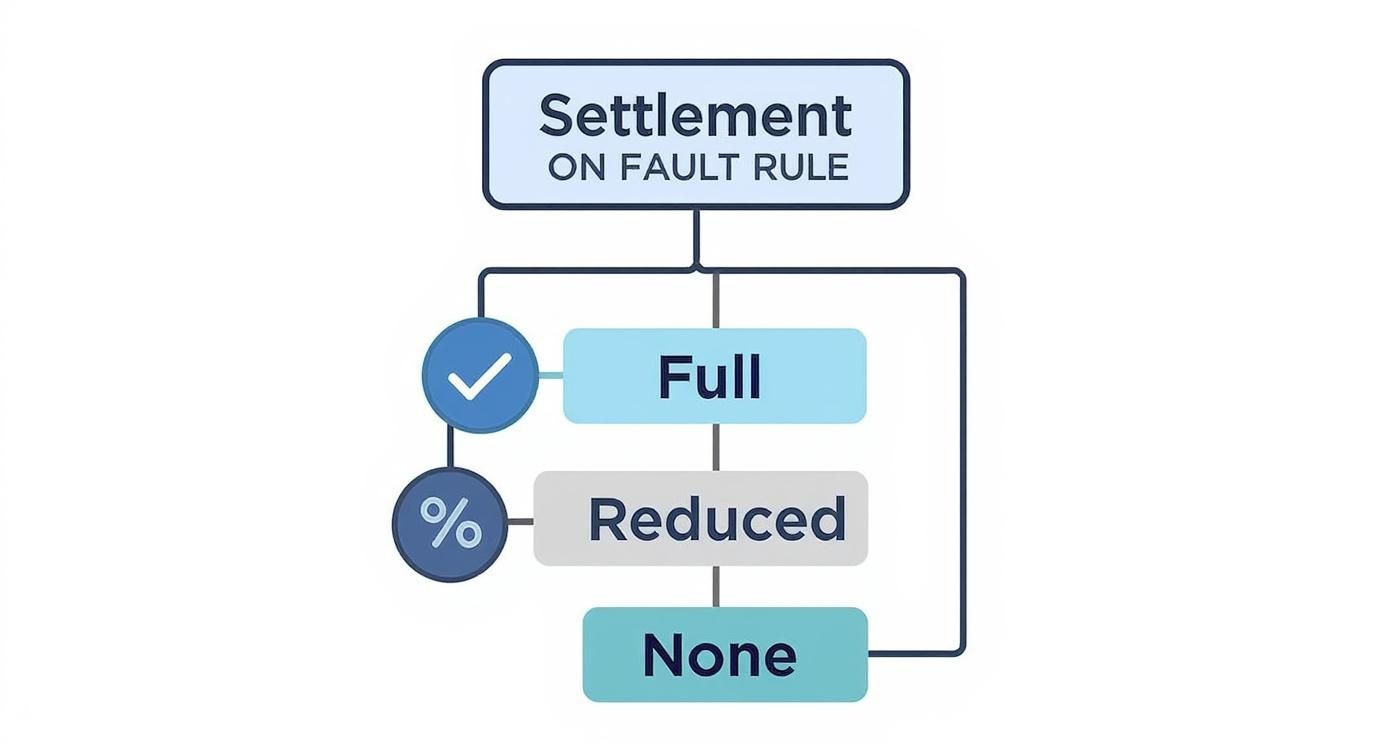
This visual really drives home how Texas's comparative fault rule can lead to a full, reduced, or completely denied settlement based on your assigned percentage of responsibility.
When Are Punitive Damages Awarded?
In some rare and extreme cases, another type of compensation might come into play: punitive damages. As laid out in Chapter 41 of the Texas Civil Practice & Remedies Code, these aren't meant to compensate you for your losses. Instead, their sole purpose is to punish the at-fault party for truly awful negligence or malice and to stop others from doing the same thing.
A classic example is a crash caused by a drunk driver whose actions showed a conscious disregard for the safety of others. Because these are reserved for the most severe cases, they aren't a factor in most auto insurance claim negotiations.
Settlements are shaped by many things, including insurance coverage and the specifics of the accident. For a bit of perspective, the Insurance Information Institute reports that the average auto liability claim for bodily injury in 2022 was $26,501. This number shows just how significant the financial fallout from these incidents can be. To dig deeper into these statistics, you can read the full personal injury data insights on Casepeer.com.
Navigating Insurance Company Tactics
Going toe-to-toe with an insurance company after a car accident can feel like an uphill battle, especially when you’re supposed to be focused on healing. It's easy to forget that insurance companies are businesses first. Their main goal is protecting their bottom line, which means paying out as little as possible on claims—including yours.
This doesn't make them evil, but it does create a direct conflict of interest. The insurance adjuster assigned to your case might sound friendly and concerned, but they are a highly trained negotiator working for the other side. Knowing their playbook is the first step toward protecting your right to a fair settlement.
Common Tactics Insurance Adjusters Use
You can bet the at-fault driver's insurance adjuster will call you quickly after a crash. They want to connect before you’ve had a chance to talk to a lawyer or even fully grasp how serious your injuries are. Be ready for these common strategies.
- The Quick, Lowball Offer: They might dangle a fast settlement in front of you, sometimes within days. It’s tempting, but this is a classic move to close your case for a fraction of its real value before you know the true cost of your medical bills and lost wages.
- Requesting a Recorded Statement: The adjuster will almost always ask for a recorded statement about the accident. They’ll frame it as a routine step, but it’s a trap. Anything you say can be used to poke holes in your claim. They are experts at asking leading questions designed to get you to accidentally admit partial fault or downplay your pain.
- Twisting Your Words: A simple, polite "I'm doing okay" can be twisted to mean your injuries are minor. They will analyze every word, looking for anything they can use against you.
- Delaying and Denying: Some adjusters will intentionally drag out the process. They hope you’ll get so frustrated that you'll accept a low offer just to be done with it. They might ask for endless paperwork or just stop returning your calls, all to wear you down.
Remember, you are under no obligation to give a recorded statement without your attorney present. You have the right to control the flow of information and shield yourself from these tactics.
What to Say and What Not to Say
When an adjuster calls, every word matters. The best approach is to be polite but firm, sticking to the absolute basics.
Never admit fault or apologize for the accident. Even a simple "I'm so sorry that happened" can be spun as an admission of guilt. Stick to the facts and let the evidence do the talking.
Avoid getting into the details of your injuries. You can simply state that you are getting medical care and won’t be discussing your condition. Downplaying your pain ("It's just a little sore") can seriously hurt your ability to get fair compensation for your suffering later on.
The smartest move is to let an experienced Houston car accident lawyer handle these conversations for you. An attorney knows how to manage communication and protect your rights at every turn. You can learn more by checking out our guide on how to deal with insurance adjusters.
It's also a good idea to familiarize yourself with the common reasons for insurance claim refusal. Understanding why claims get denied can help you avoid the pitfalls and build a stronger case from the start.
How Different Scenarios Affect Settlement Outcomes
Knowing the theory behind settlement calculations is one thing, but seeing how it all comes together in the real world is where it really clicks. Every accident is different, so the final car accident settlement amounts can vary wildly depending on the specifics.
Let's walk through a few common scenarios. While these examples are hypothetical, they’re based on the kinds of cases we handle every single day here at The Law Office of Bryan Fagan, PLLC.
Scenario 1: A Rear-End Crash on I-45
Imagine a Houston driver is rear-ended on I-45 by someone who was texting. The impact leaves you with whiplash and a herniated disc. Your medical bills, physical therapy, and lost time from work add up to $25,000.
In a case like this, fault isn't up for debate—the other driver is 100% responsible. Your settlement needs to cover your hard costs (medical bills, lost wages) plus compensation for your pain and suffering. With moderate injuries and clear liability, a fair settlement would likely land somewhere in the $60,000 to $90,000 range, depending on the long-term prognosis for your injuries.
Scenario 2: A Devastating Truck Accident on the 610 Loop
Now let's ramp up the severity. Picture a family driving on the 610 Loop when an exhausted commercial truck driver blows through a red light, causing a catastrophic T-bone collision. One person suffers a traumatic brain injury requiring lifelong medical attention, and another has multiple bone fractures.
The damages here are enormous. Medical bills could easily soar into the seven-figure range, and the victims are left with permanent disabilities. A crucial factor is that a commercial truck was involved, meaning a much larger insurance policy is almost certainly in play.
When injuries are catastrophic, the settlement must account for a lifetime of needs—future medical treatments, lost earning potential, and the profound emotional and physical pain that follows.
These settlements can reach millions of dollars. For example, some high-profile cases have ended with massive verdicts, like the $36.4 million awarded to a woman who suffered severe, permanent injuries in a crash. You can discover more insights about major personal injury payouts on ExpertInstitute.com to see how these cases are valued.
Scenario 3: A Wrongful Death Claim
Tragically, not everyone survives a serious accident. When a loved one is killed by a drunk driver, the surviving family has the right to file a wrongful death claim. This type of legal action seeks compensation not only for the victim's final medical bills but also for the family's devastating, lifelong losses.
This includes compensation for:
- The future income and financial support the deceased would have provided.
- The loss of companionship, guidance, and emotional connection.
- The family’s own mental and emotional anguish.
These are the most heartbreaking cases we see, and the settlements are calculated to reflect the immense scale of the family’s loss. The final value is also heavily tied to the available insurance coverage. That’s why it’s so critical to understand how to navigate policy limits and explore every possible source of recovery, which makes understanding insurance policy limits after a car accident in Texas an absolute must.
Steps to File an Insurance Claim

The moments after a car crash are a blur of shock and adrenaline. It's tough to think clearly, but the actions you take right then—and in the days that follow—are absolutely critical. They don’t just protect your physical well-being; they build the foundation for a fair insurance settlement.
Practical, Step-by-Step Advice
- Seek Medical Attention Immediately. Your health is the top priority. Go to the ER or an urgent care clinic, even if you feel okay. Some serious injuries may not have immediate symptoms. A medical record is crucial evidence linking your injuries to the crash.
- Report the Accident. Always call 911 to get police and medical personnel on the scene. A formal police report creates an objective record of the crash that is invaluable for your claim.
- Document Everything. Use your phone to take photos and videos of the scene. Capture damage to all vehicles, skid marks, road conditions, and traffic signs. Get pictures of the other driver’s license, insurance card, and license plate.
- Gather Witness Information. If anyone saw the accident, politely ask for their name and phone number. An independent witness statement can powerfully support your claim.
- Notify Your Insurance Company. Report the accident to your own insurer soon after it happens, but stick to the basic facts. Do not give a recorded statement to the other driver's insurance company without speaking to an attorney first.
- Keep Meticulous Records. Start a file for everything related to the accident: medical bills, receipts for prescriptions, repair estimates, and a journal detailing your pain levels and how the injuries affect your daily life.
- Consult a Texas Injury Attorney. Before you accept any offer, speak with a lawyer. An experienced Houston car accident lawyer can handle communications with insurers, calculate the true value of your claim, and fight for the compensation you deserve.
Following these steps creates a clear, undeniable record of the incident. It makes it much more difficult for an insurance adjuster to argue the facts. For a more detailed breakdown, check out our guide on the complete car accident injury claim process.
Understanding Texas’s Critical Deadline
There's one rule you absolutely cannot ignore: the statute of limitations. In plain English, this is a strict legal deadline for filing a personal injury lawsuit.
In Texas, you generally have only two years from the date of the accident to file a lawsuit. If you miss this deadline, your right to seek compensation is gone forever, no matter how strong your case is.
This two-year clock is ticking and unforgiving. It’s exactly why you shouldn't wait to talk to a lawyer. An experienced Texas injury attorney will make sure every deadline is met, preserving your right to pursue the full compensation you are owed.
Common Questions We Hear About Car Accident Settlements
When you're trying to heal after a car crash, the last thing you need is more uncertainty. We get it. Having clear, honest answers helps you feel back in control. Here are some of the most frequent questions we tackle for our clients when it comes to car accident settlement amounts in Texas.
How Long Will It Take to Settle My Case?
This is usually the first question on everyone's mind, but the honest answer is: it depends. A simple case with minor injuries and no question about who was at fault might wrap up in just a few months. But if you're dealing with serious injuries, a fight over liability, or the need for future medical care, it could easily take a year or more.
The most important thing is not to rush it. If you settle too early—before you and your doctors truly understand the full extent of your injuries—you could be leaving money on the table that you'll desperately need down the road. Patience and a smart strategy are key to making sure we're fighting for every penny you deserve.
Will I Have to Go to Court to Get a Settlement?
Probably not. The vast majority of car accident claims—well over 95%—never see the inside of a courtroom. We're usually able to negotiate a fair settlement without a full-blown trial, which saves you time, stress, and money.
That said, we prepare every case as if it is going to trial. If an insurance company digs in its heels and refuses to make a reasonable offer, we're always ready to stand before a jury. Sometimes, just showing the other side you have a trial-tested Houston car accident lawyer in your corner is all it takes to bring them back to the table with a serious offer.
Can I Still Get a Settlement if I Was Partially at Fault?
Yes, in many situations, you can. Texas operates under a "comparative fault" rule. This means you can still recover money for your injuries as long as you aren't found to be 51% or more responsible for the accident. Your final settlement amount is just reduced by whatever percentage of fault is assigned to you. For instance, if you were found 10% at fault, your total damages would be cut by 10%.
This is exactly why you should never, ever admit fault at the scene or to an insurance adjuster. They are experts at twisting your words and will use any admission, no matter how small, to pin more blame on you and slash the amount they have to pay.
Do I Really Need a Lawyer to Handle My Claim?
Legally, no. But practically, trying to handle a claim on your own puts you at a massive disadvantage. Insurance adjusters are professional negotiators whose entire job is to pay out as little as possible. They know the system, they know the law, and they know how to use your own words against you.
Hiring an experienced Texas injury attorney completely levels the playing field. We take over all the communications with the insurance company, gather the evidence needed to build a rock-solid case, and fight to get you the maximum settlement possible. That leaves you free to focus on the one thing that truly matters: your recovery.
The aftermath of a car accident is overwhelming. You don’t have to go through it alone. The insurance company has a team of professionals working to protect their bottom line—you deserve an advocate who is fighting just as hard for you. The compassionate team at The Law Office of Bryan Fagan, PLLC is here to help you navigate this difficult time.
Contact us today for a free, no-obligation consultation. We will listen to your story, explain your legal rights, and help you map out the best path forward for your health and your financial future. Visit us online at https://houstonaccidentlawyers.net to get started.