A car crash can change your life in seconds, but you don't have to face recovery alone.
You may have started the day like any other. Then traffic stopped. Someone drifted into your lane. You braked too late. A Houston driver rear-ended on I-45 might walk away shaken, sore, and overwhelmed, only to hear an officer start asking about drinking. If police order a blood draw after the crash, fear sets in fast.
Now you're dealing with two problems at once. There's the accident itself, with vehicle damage, medical concerns, and an auto insurance claim. Then there's the DWI case, which can threaten your license, job, and reputation. If you're staring at a blood test result that doesn't seem right, you're probably asking one question over and over: can blood test results be wrong in DWI cases in Texas?
They can.
A blood result may look final on paper, but it still has to be collected, stored, tracked, and tested the right way. People handle every part of that process. People make mistakes. Texas law also requires the State to prove that the sample is reliable and properly connected to you.
If a crash injured you or someone you love, the civil side of the case matters too. In Texas injury cases, liability means legal responsibility for causing harm. Comparative fault means more than one person can share blame. Damages means the money sought for losses like medical bills, lost income, and pain and suffering. Texas Civil Practice & Remedies Code Chapters 33 and 41 shape how fault and damages are handled in many personal injury cases. The statute of limitations is the legal deadline to file a claim.
That overlap matters in real life. A DWI allegation can affect settlement talks, insurance decisions, and how the other side argues about fault after a wreck. A Texas injury attorney or Houston car accident lawyer handling crash claims involving alleged intoxication needs to look closely at the blood evidence, not just accept the lab report at face value.
Your Life Changed After an Accident Now a DWI Charge
The hours after a wreck are often a blur. You may be hurt, sitting in an ambulance, or answering questions while your car is being towed. In that moment, you're not thinking about preservatives in a vial or lab paperwork. You're trying to understand what just happened.
Then the investigation shifts. An officer says they smell alcohol. Maybe you had a drink earlier. Maybe you didn't. Maybe your speech sounded off because you were injured, scared, or had just been in a collision. Then comes the blood draw, and suddenly a traffic crash has become a criminal case.
A number on a lab report is not the whole story. It's one piece of evidence, and that evidence can be challenged.
Many people feel trapped at this stage. They assume blood evidence is unbeatable because it sounds scientific. That's a common misunderstanding. Blood testing may be more technical than roadside observations, but technical evidence still depends on rules, training, and documentation.
Take a familiar example. A driver is involved in a late-night crash on a Houston freeway. He's taken for medical evaluation. Hours later, a blood sample is drawn. Later still, a report comes back showing alcohol above the legal line. He believes the result can't be right because of what he drank, when he drank, and how much time passed. That concern isn't irrational. Timing, handling, and identity issues can all matter.
If you're in that position, protect both sides of your situation. On the injury side, keep records of treatment, photos, bills, and time missed from work. On the criminal side, preserve every detail you remember about the stop, the crash, the hospital, and the draw. Those facts can become critical when a lawyer examines whether the State's blood evidence is dependable.
How Texas Law Views DWI Blood Evidence
Texas allows prosecutors to use blood evidence in DWI cases, but that doesn't mean the result gets a free pass in court. The State still has to show the sample was taken and handled under proper safeguards.

What BAC means in plain English
BAC means blood alcohol concentration. In Texas DWI cases, 0.08% BAC is the legal per se intoxication threshold for adults, according to this discussion of Texas blood testing in DWI cases. When a reported result is close to that line, even a small handling or analytical problem can matter.
That same Texas source also notes that blood tests are generally more accurate than breath tests, but they're still vulnerable to mistakes in collection, storage, transport, and lab analysis that can create inaccurate results. That's why a lawyer doesn't just ask, “What was the number?” A better question is, “How did the State get that number?”
If you want a broader picture of how the State builds these cases, this guide on how prosecutors prove DWI in Texas can help.
Implied consent and warrants
Texas drivers often hear the phrase implied consent. In simple terms, by driving on Texas roads, you're subject to laws that allow chemical testing procedures after a lawful DWI arrest. In some situations, officers seek a warrant for a blood draw. In serious crash cases, blood testing becomes common even if a driver refused breath testing.
That doesn't erase your rights. The draw still must follow legal and medical standards. If police, medical staff, or the lab cut corners, a judge can decide the result should be suppressed or given less weight.
Burden of proof and reliability
The State carries the burden of proof in a criminal case. That means prosecutors must do more than wave around a lab report. They must show the blood came from you, that it was properly preserved, and that the testing process was reliable.
Practical rule: Blood evidence sounds powerful because it comes from a lab. In court, it still has to be proven step by step.
That same basic idea matters after a crash on the civil side too. In an injury claim, insurers may try to use a DWI accusation to argue you caused the wreck or should recover less under comparative fault rules. A Houston car accident lawyer reviewing the blood evidence may uncover weaknesses that affect both the criminal charge and the liability fight.
Common Reasons DWI Blood Tests Are Wrong
A blood test can go wrong long before anyone pushes a button in a lab. In many Texas cases, the most important weaknesses happen before the analysis begins.
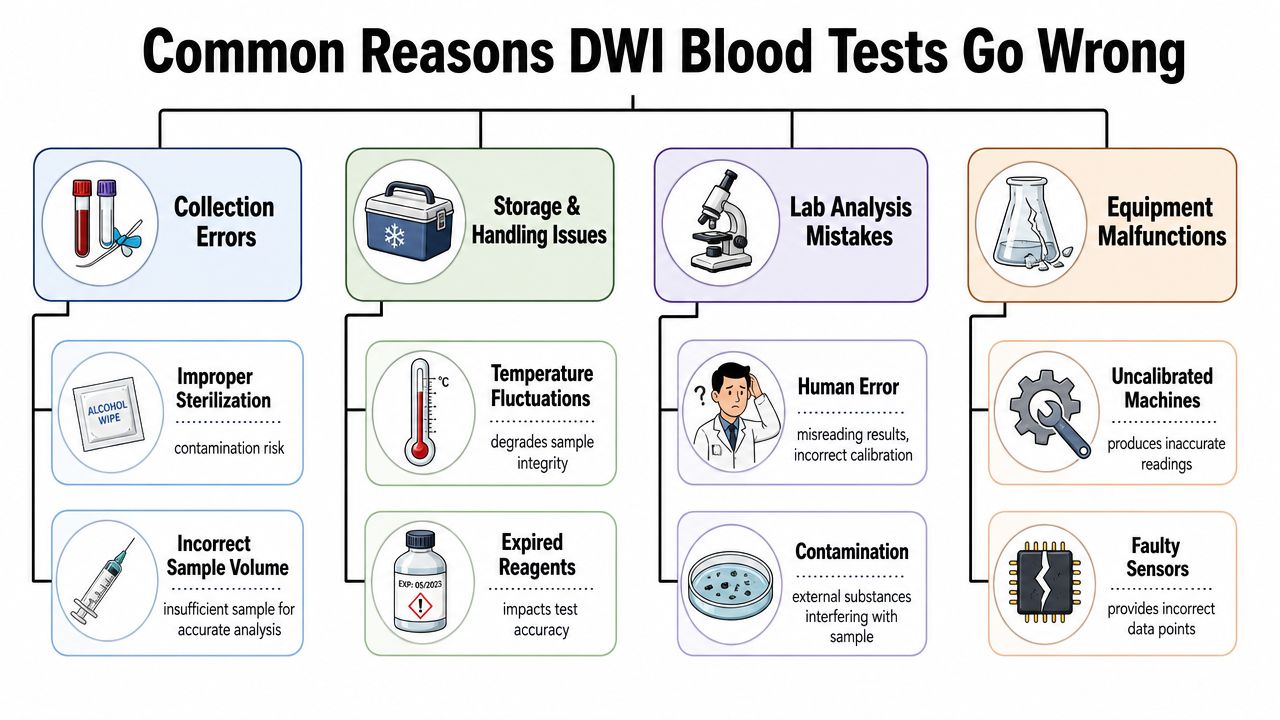
According to this Texas DWI blood test discussion, pre-analytical errors are a major reason a DWI blood result can be wrong. Improper collection, contamination, storage failures, or chain-of-custody gaps can change the measured alcohol concentration before analysis even starts.
Collection problems at the draw
A sample is only as good as the way it was taken.
Some issues begin in the room where blood is drawn:
- Wrong collection method: If staff don't follow proper procedure, the sample may be contaminated before it ever reaches the lab.
- Unauthorized or poorly trained personnel: Defense lawyers often check whether the draw was done by someone legally authorized and properly trained.
- Problems with preservatives or sealing: If the tube isn't prepared or closed correctly, the sample may not stay stable.
Readers often assume that if a hospital or clinic drew the blood, the process must have been flawless. That isn't always true. A medical setting can still have documentation errors, mix-ups, or handling mistakes.
Storage and transport issues
Blood is biological evidence. It changes if people don't protect it.
A tube may sit too long. It may not be refrigerated as expected. Labels can smear or fall off. Transfers can be poorly documented. In some cases, defense attorneys look for signs of fermentation, contamination, or sample mix-ups because those problems can produce a false or inflated BAC reading.
Here's a quick way to think about it. The machine may measure the sample accurately, but the sample itself may no longer reflect what was in your bloodstream at the time of driving.
A short overview can help if you're also comparing chemical tests generally. This article on how accurate breathalyzers are in Texas court explains why “scientific” evidence still depends on procedure.
The blood testing process is easier to follow when you can see it laid out visually.
Lab and equipment mistakes
Even after the sample reaches the lab, problems can continue.
Some concerns involve human work. A technician may mislabel a sample, enter data incorrectly, or fail to follow protocol. Other concerns involve equipment. If a machine wasn't maintained or checked correctly, the final reading may be open to challenge.
The point isn't that every lab makes the same mistake. The point is that every stage creates another chance for error, and every chance for error gives the defense another place to investigate.
Why chain of custody matters so much
Chain of custody means the paper trail showing who had the sample, when they had it, and what they did with it. If there's an unexplained gap, the State may struggle to prove that the tested blood is the same blood drawn from you and that it stayed intact.
That may sound technical, but juries understand it quickly. If no one can clearly account for the sample's path, confidence in the result drops.
| Stage of Process | Potential Error | What It Means for Your Case |
|---|---|---|
| Blood draw | Contamination or improper collection | The result may not reflect your true BAC |
| Packaging and storage | Poor sealing, temperature problems, preservation failures | The sample may change before testing |
| Transport | Missing records or undocumented transfers | The State may struggle to prove reliability |
| Lab intake | Mislabeling or sample mix-up | The reported result may not be tied to you |
| Analysis | Protocol mistakes or equipment concerns | The final number may be challenged |
| Evidence tracking | Chain-of-custody gaps | A judge may question admissibility or weight |
Medical Conditions That Can Affect Your BAC Result
Not every bad blood result comes from a sloppy draw or weak paperwork. Sometimes the confusion starts with the body itself.
After a crash, your system may be under stress. You may not have eaten. You may have been injured, dehydrated, or taking medication. In some cases, a lawyer and defense expert look beyond the lab and ask whether a health issue could have affected the testing or the interpretation.
Your body doesn't process alcohol on a fixed schedule
People often think alcohol moves through everyone's system the same way. It doesn't. Absorption and elimination can vary based on food, body chemistry, timing, and individual physiology.
That matters when blood is drawn long after the crash. The number on the report may not match your condition at the time of driving. If alcohol was still being absorbed, the test can look worse later than it would have looked earlier.
The key question is not only what the sample showed. It's whether that sample fairly represented your condition when you were actually behind the wheel.
Medical explanations deserve attention
Some medical conditions and diets can create confusion in alcohol-related testing discussions. A careful lawyer may explore whether a health condition, medication issue, or metabolic problem affected the interpretation of the result.
This is also where readers often hear the term retrograde extrapolation. In plain English, that means an attempt to work backward from a later test result to estimate what your BAC may have been while driving. It is not a time machine. It's an opinion built on assumptions, and those assumptions can be wrong.
If you were in an accident and also pursuing an injury claim, these details may matter outside the criminal courtroom. Insurance adjusters may rely on a single BAC number to argue liability. But civil responsibility in Texas still depends on evidence, and under comparative fault principles in Chapter 33, blame can be disputed and divided based on the facts.
For example, if a distracted driver ran a red light and hit your vehicle, the insurer may still raise your DWI arrest to reduce payment. That doesn't automatically settle liability. A Texas injury attorney may challenge both the crash narrative and the chemical evidence.
How a Lawyer Challenges Blood Evidence in Court
A strong challenge to blood evidence is rarely about one dramatic mistake. More often, it's about exposing several smaller failures that add up to reasonable doubt.

The legal attack usually starts with the records
Your lawyer may request police reports, warrant materials, medical records, lab notes, and chain-of-custody documents. The goal is simple. Compare what should have happened with what happened.
A lawyer may file a motion to suppress, which asks the judge to exclude the blood result because your rights were violated or the evidence is too unreliable to use. That motion can focus on the draw itself, the handling of the sample, or the State's inability to prove the sample's identity.
Texas appellate guidance discussed by the Texas District and County Attorneys Association in its DWI blood test case law resource notes that hospital blood-test records may be admitted, but the State still must show the blood tested was the same blood drawn from the defendant, and medical records alone are not enough. That's a powerful point. Suppression isn't limited to chemistry disputes. Identity and documentation problems can matter just as much.
Witnesses can make or break the State's case
The State may call the person who drew the blood, the custodian of records, or the lab analyst. A careful cross-examination can reveal missing training, missing recollection, or missing paperwork.
If you want to understand the mechanics of challenging witness testimony, that guide gives a useful general look at how cross-examination can uncover inconsistency and weak foundations. In a Texas DWI case, those same principles often apply to nurses, officers, and forensic staff.
Here are common pressure points:
- Identity of the sample: Can the witness clearly connect the tested blood to you?
- Handling steps: Can anyone explain where the vial was, who touched it, and how it was stored?
- Protocol compliance: Did the lab follow its own written procedures?
- Memory problems: Does the witness remember your case, or are they relying only on routine habit?
Experts and the civil-criminal overlap
In some cases, lawyers bring in an independent forensic expert to review the State's work. That expert may examine whether the sample was preserved correctly, whether the reported result fits the timeline, and whether the testing method was applied properly.
This is also where a firm with accident-case experience may provide added perspective. The Law Office of Bryan Fagan, PLLC handles crash claims involving intoxication allegations, which can require close review of liability, damages, and insurance disputes alongside the blood evidence itself.
That overlap matters because the same blood report may be used in more than one fight. Prosecutors may use it to argue intoxication. An insurer may use it to resist an auto insurance claim. In a fatal crash case, it may affect arguments over wrongful death compensation. One weak piece of blood evidence can ripple through every part of the case if no one challenges it.
What to Do Immediately After a Texas DWI Arrest
The first days after an arrest matter. What you do now can protect your license, your defense, and your injury claim.

Focus on these steps first
Use your right to remain silent
Be polite, but don't try to explain away the situation. Casual statements often become evidence.Ask for a lawyer
Say clearly that you want legal counsel. Then stop answering investigative questions.Write everything down
Record what you ate, drank, when you slept, what medications you took, what happened in the crash, when blood was drawn, and what officers and medical staff said.Get medical care if you need it
Your health comes first. Medical records may also help document injuries and conditions that affected your presentation after the crash.Review your release conditions carefully
Missing a court date or violating bond terms creates new problems fast.Act quickly on your license issue
In Texas, you have 15 days to request an Administrative License Revocation hearing after certain DWI-related license actions. Missing that deadline can hurt your ability to fight for your driving privileges.
Keep a folder with discharge papers, bond documents, tow records, prescriptions, and insurance letters. Small details often become major evidence later.
If police asked you to perform roadside tests, this article on whether you can refuse roadside sobriety tests in Texas may answer some immediate questions.
If your arrest followed a commercial vehicle wreck, it can also help to understand post-crash evidence preservation from the trucking side. This overview of critical steps for trucking companies after a truck accident shows how quickly records, inspections, and incident documentation become important.
Don't forget the injury side of the case
After a crash, you may have a personal injury claim even if a DWI charge is pending. That's where legal terms matter:
- Liability means who caused the crash.
- Damages means losses like medical expenses, lost wages, and pain and suffering.
- Comparative fault means each side may argue the other was partly responsible.
- Statute of limitations means the deadline to file suit.
Insurance companies may move fast. Don't give recorded statements without legal advice if fault or intoxication is being disputed.
You Do Not Have to Face This Alone
A Texas DWI case tied to a car accident can feel crushing. You may be worried about criminal penalties, license loss, medical bills, missed work, and what your family will think. Those fears are real, but they do not mean the State's blood evidence is untouchable.
Texas law has long allowed prosecutors to use blood evidence in DWI cases, but the reliability of that evidence depends on whether the sample was drawn and handled under strict safeguards. In practice, a Texas DWI blood result must be proven reliable step by step, not merely accepted because it came from a lab, as explained in this Texas blood test overview.
That step-by-step focus helps on the civil side too. If you were hurt in the crash, fault still has to be proven. Under Texas Civil Practice & Remedies Code Chapter 33, comparative fault can affect what damages are recoverable. Chapter 41 can affect certain damage issues in serious misconduct cases. Those rules don't erase your rights. They frame the fight.
A careful lawyer can examine whether the blood was drawn lawfully, whether the records match, whether the sample was preserved, and whether the State can accurately connect the result to your driving. At the same time, your lawyer can protect your injury case, push back on unfair insurance positions, and explain your options in plain English.
If you're searching for a Houston car accident lawyer or Texas injury attorney after a wreck involving a DWI allegation, you deserve clear answers. You also deserve to know that a lab report is not the end of the story.
If your accident led to a DWI charge, questions about liability, or problems with an auto insurance claim, contact The Law Office of Bryan Fagan, PLLC for a free consultation. We can help you understand your rights, evaluate the blood evidence, explain how comparative fault and damages may affect your case, and discuss options involving injury claims or wrongful death compensation after a serious Texas crash.