Skip to content
A car crash can change your life in seconds — but you don’t have to face recovery alone. The shock and confusion that follow are completely normal. What you do in those first few moments, however, is critical for your safety, your health, and any future legal claim you might have.
Taking the right actions right away can protect your well-being and preserve your rights from the very start.
Your First Moves After a Texas Car Crash
The moments after a collision are a blur. Your absolute top priority has to be safety.
If you can, get your vehicle to the side of the road and out of the flow of traffic. Flip on your hazard lights. This simple action can help prevent a devastating secondary collision, something we see far too often on busy Houston highways like I-45 or the 610 Loop.
Next, check on yourself and your passengers. Are you hurt? Even if you feel okay, adrenaline is a powerful painkiller. It can easily mask serious injuries.
This is why you must call 911 immediately. Report the crash and let them know if anyone needs medical assistance. When the police arrive, they’ll create an official report—an unbiased record of the incident that is invaluable for your auto insurance claim.
Stay Safe and Report the Accident
Your actions at the scene can make or break your ability to get fair compensation later on. Road traffic accidents are a leading cause of injury and death worldwide, which underscores how vital a prompt, proper response is. The World Health Organization provides detailed findings on the global impact of these incidents, reinforcing the need for caution.
This infographic breaks down the essential steps to take right after a collision.
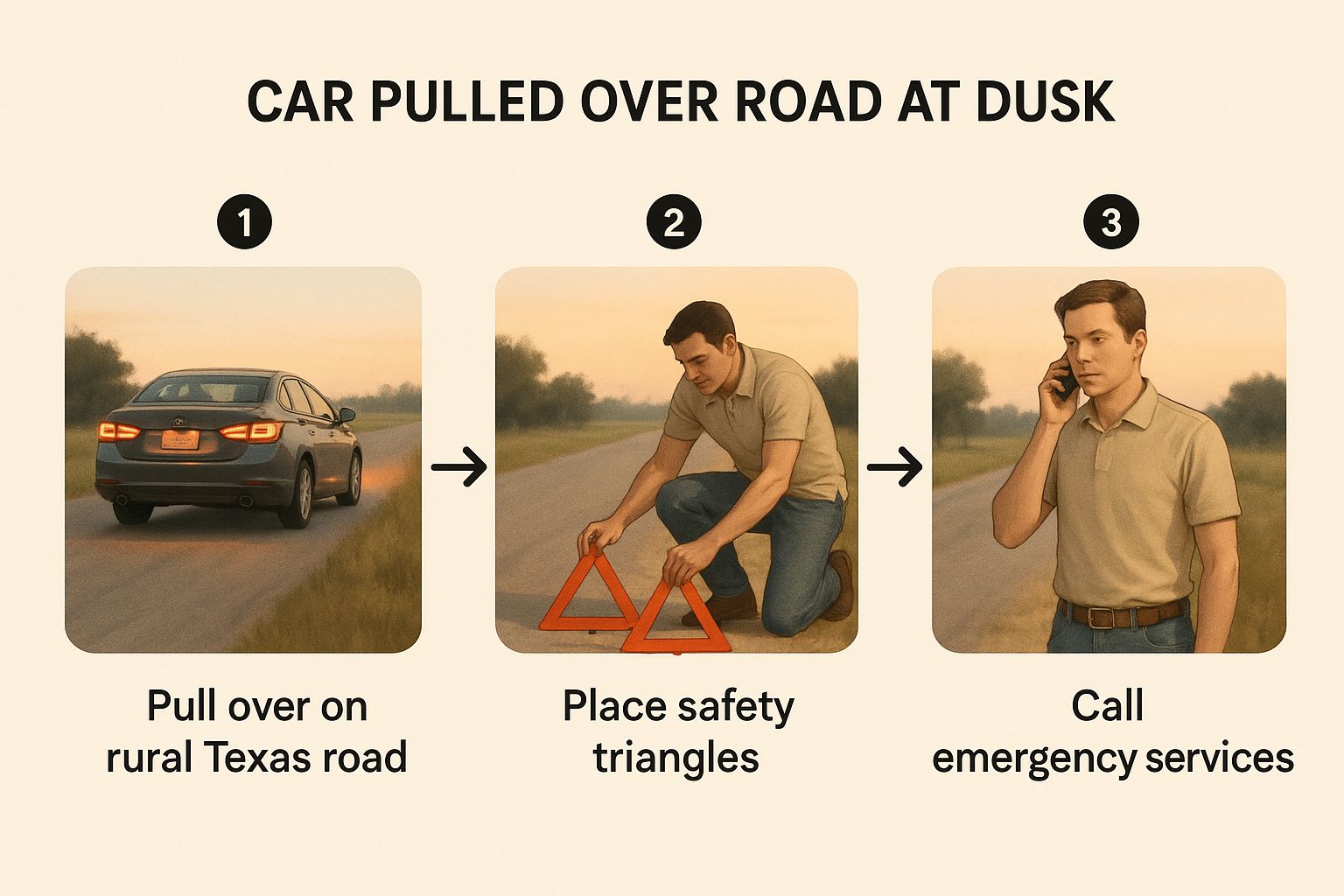
It highlights a clear, calm process. Even in a stressful situation, methodical steps like securing the scene and making the right calls are achievable and absolutely essential.
For quick reference, here's a checklist of what you should be doing at the scene.
Immediate Post-Accident Checklist
This table is a quick reference for the crucial actions to take at the scene of a car accident to ensure safety and protect your rights.
| Action | Why It's Critical |
|---|---|
| Move to Safety | Prevents secondary accidents and further injury. |
| Call 911 | Summons medical help and creates an official police report. |
| Check for Injuries | Adrenaline can mask pain; immediate assessment is crucial. |
| Exchange Information | Gather names, contact info, insurance, and license plates. |
| Document Everything | Take photos/videos of damage, the scene, and injuries. |
| Avoid Admitting Fault | Simple apologies can be used against you by insurers. |
| Get Medical Attention | Creates a medical record linking injuries to the crash. |
Following these steps methodically will provide a strong foundation for any claim you may need to file.
One of the biggest mistakes I see people make is admitting fault. A simple "I'm so sorry" can be twisted by an insurance adjuster into a full admission of guilt, which can seriously damage your case. Stick to the facts when you talk to the other driver and the police.
Protecting your claim starts the moment the crash happens. It's just as important to know what not to do. You can learn more by reading about the common mistakes that could ruin your injury claim.
Documenting Everything at the Accident Scene

The moments after a crash are chaotic, but what you do while waiting for the police can make or break your future claim. Your smartphone is the most powerful tool you have right now. Think of yourself as an investigator, because the evidence you gather will tell the true story of what happened.
Every photo and note helps establish liability—the legal term for who’s at fault. This evidence is what a Houston car accident lawyer will use to prove the other driver’s negligence caused the accident and your injuries.
Pull out your phone and start taking photos. Then take some more. You can never have too much documentation. Get pictures of the damage to every vehicle involved from all angles. I'm talking wide shots to show the scene, and close-ups to show the details of the impact. Be sure to capture where the cars came to rest before anyone moves them.
What to Capture Beyond Vehicle Damage
Bent metal only tells part of the story. You need to create a complete picture of the crash scene with your photos. For example, if you were rear-ended on I-10, a picture showing the other car’s crumpled front end is good, but a picture showing the long skid marks leading up to your vehicle is even better.
Don’t forget to document these other critical details:
- Skid marks on the road that show how the cars moved.
- Debris from the crash, like shattered glass or broken car parts.
- Traffic signs and signals nearby to help establish who had the right-of-way.
- Weather and road conditions—was the pavement wet from rain? Was there a construction zone?
- Any visible injuries you or your passengers have, like cuts or bruises.
These details provide crucial context that an expert can use to reconstruct the accident and prove exactly what happened.
Exchanging Information and Finding Witnesses
When it’s time to talk to the other driver, stay calm and stick to the facts. The one thing you should never do is apologize or get into a debate about who was at fault. Insurance companies love to twist a simple "I'm sorry" into an admission of guilt.
Make sure you get this essential information:
- Full name and contact information
- Insurance company and policy number
- Driver’s license number and license plate number
- The make, model, and color of their car
If anyone stopped to help or saw the accident, their account could be a huge asset to your case. Ask for their name and phone number. A neutral, third-party witness statement can shut down any false stories the other driver might try to tell their insurance company later.
Finally, before you leave, get the responding officer's name, badge number, and information on how to get a copy of the official police report. The Texas Peace Officer’s Crash Report is often the cornerstone of an auto insurance claim, and you’ll absolutely need it.
Why You Must See a Doctor Immediately
In the moments after a car crash, your body goes into survival mode. It pumps you full of adrenaline, a powerful hormone that can completely mask pain and make you think you’ve walked away without a scratch. This is a dangerous illusion. You might feel fine, even a little shaky, but days later, you could wake up with debilitating pain.
Getting a medical evaluation right away is one of the most important things you can do after an accident. It’s not just about your health; it’s about protecting your rights. Without a doctor’s report created soon after the crash, proving your injuries came from the other driver's negligence becomes incredibly difficult.
Protecting Your Health and Your Claim
Insurance adjusters are paid to find reasons to deny or minimize what they pay out. If you wait a week to see a doctor for that new back pain after a collision on a San Antonio freeway, the adjuster will jump on it. They'll argue you could have hurt yourself anywhere else in that time.
Any delay in seeking treatment is a weapon they will use against you.
A prompt medical exam is your best defense. It helps identify common injuries that don't show up right away, such as:
- Whiplash: That tell-tale neck pain, stiffness, and headache often don't kick in for 24-48 hours.
- Concussions and TBIs: Symptoms like dizziness, memory fog, or confusion might not be obvious at the chaotic accident scene.
- Internal Bleeding: A life-threatening emergency that can start with very subtle signs.
- Soft Tissue Injuries: Damage to your muscles and ligaments can cause serious pain and swelling that worsens over time.
An immediate doctor's visit creates an undeniable link between the accident and your injuries. This medical record becomes the foundation of your personal injury claim, making it difficult for the insurance company to dispute the cause of your suffering.
Document Every Symptom, Follow Every Instruction
When you finally see a doctor, be painfully detailed. Tell them about every single ache, pain, or weird feeling you have, no matter how small it seems. Explain exactly how the crash happened and the jolt your body took. This helps your doctor give an accurate diagnosis and builds a rock-solid medical record.
Following through is just as crucial. If your doctor recommends physical therapy, medication, or follow-up appointments, you have to do it. Skipping therapy or deciding you feel "good enough" to stop treatment is a red flag for the insurance company. They’ll see it as proof your injuries weren't that serious, and they’ll slash the value of your claim for damages.
Taking these steps also plays a part in keeping everyone safer. When accidents and injuries are properly reported, it helps authorities spot dangerous trends. National data shows that prompt emergency response is a key factor in reducing traffic fatalities, which saw a 3.3% drop in the first half of 2023. You can read more about these national safety findings from NHTSA. Protecting yourself helps protect the community, too.
How to Handle Your Auto Insurance Claim

Talking to an insurance adjuster after a crash can feel like walking through a minefield. You have to remember: their job isn't to be your friend. It's to protect their company's bottom line. Once you understand their goal, you can better protect your rights and your claim.
First things first, you do need to report the accident to your own insurance company as soon as you can. When you call, stick to the absolute basics: where and when the accident happened, the other vehicles involved, and the police report number if you have it. Don't guess about who was at fault or how badly you're hurt.
Now, when the other driver’s insurance adjuster calls—and they will, often quickly—you need to be even more careful. Their primary goal is to get you to say something, anything, that minimizes their driver’s responsibility.
What to Say and What to Avoid
Your words carry incredible weight in these conversations. An adjuster might sound friendly and compassionate, but every question they ask is designed to gather information that can be used against you later. It’s a game, and they know the rules better than you do. The key is to be polite but firm, and keep your answers brief and factual.
Here are a few tips I give all my clients for that first call:
- Stick to basic info. Confirm your name, address, and the type of vehicle you drive. That’s it.
- Politely decline a recorded statement. You are under no legal obligation to provide a recorded statement to the at-fault driver's insurer. A simple, "I am not comfortable giving a recorded statement at this time," is a complete answer.
- Don't talk about your injuries. If they ask how you're feeling, the only safe answer is something like, “I’m still under a doctor's care.” Never, ever say you feel "fine" or "okay." They will twist that to mean you weren't seriously hurt.
The single most dangerous request an adjuster will make is for a recorded statement. They are trained professionals who ask leading questions designed to corner you into admitting partial fault or downplaying your injuries. I tell everyone: never agree to this without speaking with a Texas injury attorney first.
Understanding Key Insurance Terms
To get through this process, you need to speak the language. Insurance companies use a lot of jargon, and knowing a few key terms is critical to understanding what's happening with your claim.
- Liability: This is just the legal word for fault. Proving the other driver’s liability means showing their carelessness or negligence is what caused the wreck.
- Damages: This refers to the money you can recover for your losses. It covers everything from economic damages like medical bills and lost wages to non-economic damages for your physical pain and mental suffering.
- Policy Limits: Every insurance policy has a maximum dollar amount it will pay for a single claim. These limits can have a huge impact on your recovery, especially if your injuries are severe. To get a better handle on this, you can learn more about understanding insurance policy limits after a car accident in Texas.
An experienced attorney can take over all communications with the insurance company for you. This lifts a massive weight off your shoulders, removing the stress and the risk of saying the wrong thing. It allows a professional to fight for the maximum compensation you're owed while you focus on what really matters: healing.
Who Is Liable in a Texas Car Accident?
When you’re trying to recover from a car wreck, the last thing you want to do is get tangled up in legal jargon. But here’s the thing: understanding a few key Texas laws is absolutely crucial. It’s the difference between protecting your right to compensation and accidentally tanking your own case.
The path to getting paid for your injuries and damages isn't a free-for-all. It's governed by specific rules that can make or break your claim. Knowing what they are puts you in the driver's seat.
How Texas Decides Who’s at Fault
One of the biggest concepts you’ll hear about is “comparative fault.” It sounds complicated, but it’s really just the way Texas assigns blame when more than one person might have caused an accident.
Here's how it works in the real world: a judge or jury looks at what happened and assigns a percentage of fault to everyone involved. Your final compensation, or damages, gets reduced by whatever percentage of fault is yours.
- For example: Imagine a Houston driver is rear-ended on I-45. It seems clear who's at fault. But the insurance company argues the driver’s brake lights were out, contributing to the crash. A jury decides the rear-ended driver was 10% at fault. If their total damages—medical bills, lost wages, pain and suffering—add up to $50,000, that award is cut by 10%. They walk away with $45,000.
But there’s a massive catch. Texas has what’s called the 51% bar rule.
Under Chapter 33 of the Texas Civil Practice & Remedies Code, if you are found to be 51% or more at fault for the accident, you get nothing. Zero. You are completely barred from recovering any money from the other driver.
You can bet the other driver's insurance company knows this rule inside and out. Their main goal will be to pile as much blame onto you as possible to get over that 51% threshold and avoid paying a dime.
To help you get a better handle on these concepts, here’s a quick breakdown of the legal terms you're likely to encounter.
Key Texas Legal Concepts Explained
Navigating a claim means understanding the language. This table cuts through the jargon to explain what these terms really mean for you.
| Legal Term | Plain-English Meaning | Why It Matters for Your Claim |
|---|---|---|
| Comparative Fault | A system where your compensation is reduced by your percentage of blame for the accident. | If you're even partially at fault, your settlement will be smaller. It's a key reason insurers try to shift blame. |
| 51% Bar Rule | If you are found to be 51% or more at fault, you cannot recover any money from the other party. | This is the make-or-break rule. Crossing this threshold means your entire claim is denied, no matter how badly you were hurt. |
| Statute of Limitations | A strict deadline for filing a lawsuit. In Texas, it's typically two years for personal injury. | Miss this deadline, and you lose your right to sue forever. It’s a hard stop that the courts rarely make exceptions for. |
| Damages | The money awarded to compensate you for your losses (medical bills, lost income, pain, etc.). | This is what your claim is all about. Properly calculating all your damages is vital for getting a fair settlement. |
These aren't just technicalities; they are the rules of the game. Understanding them is your first line of defense.
The Clock Is Ticking on Your Claim
There's another critical law that trips up a lot of people: the statute of limitations. Think of it as a countdown timer on your right to file a lawsuit.
In Texas, you generally have just two years from the date of the car accident to file.
If you let that two-year deadline pass without filing a lawsuit, your case is almost certainly dead in the water. You will be legally barred from seeking compensation—forever. It doesn’t matter how clear the other driver’s fault was or how severe your injuries are.
Two years might sound like plenty of time, but it flies by when you’re dealing with doctor's appointments, physical therapy, and just trying to get your life back on track. Evidence gets lost, witnesses move or their memories fade, and building a strong case takes time. Waiting too long is one of the biggest mistakes you can make.
The legal system can feel like a maze, but you don't have to navigate it alone. To help you get started, we've put together a guide on what to do if you're injured in a car wreck in Texas and want to know your legal rights. Knowing where you stand is the first step to protecting your future.
When It’s Time to Call a Car Accident Lawyer
Figuring out if you need a lawyer after a wreck can be a tough call. You're already juggling doctor’s appointments, getting your car fixed, and fielding endless calls from insurance adjusters. But some situations are crystal clear signs that you need to get professional legal help on your side.
If you’ve been seriously hurt, the other driver is trying to flip the script and blame you, or the insurance company is dangling a quick, lowball settlement offer in your face, it’s time to lawyer up. Trying to navigate these minefields alone can, unfortunately, end with you accepting far less than you need and deserve.
Leveling the Playing Field
Hiring a Houston car accident lawyer isn't about being aggressive; it's about making things fair. The insurance company has an entire team of adjusters and lawyers working around the clock to protect their bottom line. Their primary goal is simple: pay you as little as legally possible. Your goal is to get the full and fair compensation you need to actually recover.
An experienced Texas injury attorney knows the playbook. They understand the tactics insurers use to minimize payouts and know exactly how to push back. They can take over all communications, launch a real investigation into the crash to prove who was at fault, and accurately calculate the full value of your damages—something an adjuster will never, ever do for you.
You've been through a traumatic experience. Let a professional handle the legal complexities so you can focus on what really matters: your physical and emotional recovery.
Think of these as bright red flags telling you it's time to at least talk to an attorney:
- Significant Injuries: If you're dealing with broken bones, a head injury, or anything requiring surgery, the value of your claim is substantial. An attorney is essential to make sure you’re compensated for all your medical needs, both now and in the future.
- Disputed Fault: Is the other driver denying they caused the crash? Are they trying to use Texas’s comparative fault rules to pin some of the blame on you? Legal representation is critical to protecting your right to compensation.
- Low Settlement Offers: A fast offer is almost always a bad offer. It’s a classic tactic insurers use when they know your claim is worth much more, and they want to close it out before you figure that out.
- Fatal Accidents: If you've tragically lost a loved one, navigating a claim for wrongful death compensation is an overwhelming burden. It requires compassionate and skilled legal guidance to secure justice for your family.
You have been through enough. You don’t have to fight this battle on your own. The steps you take after a car accident are vital, and making sure your rights are protected by a professional who is 100% on your side should be the final one.
You've been through a traumatic experience, and you don’t have to navigate the legal aftermath by yourself. At The Law Office of Bryan Fagan, PLLC, we are here to fight for your rights, your recovery, and your future. We are ready to listen to your story and explain your legal options. Contact us today for a free, no-obligation consultation to understand your options and start the path to recovery. Visit us at https://houstonaccidentlawyers.net to learn more.