A car crash can change your life in seconds, but you don't have to face recovery alone.
If you're standing in a Houston parking lot right now, looking at a dented bumper, a scraped fender, or a door that won't close right, don't talk yourself out of taking it seriously. Low speed doesn't mean low stakes. Parking-lot crashes still lead to real injuries, disputed fault, and insurance fights, and a calm Houston parking lot accident lawyer can step in before the adjuster turns your side of the story into theirs.
The first thing I tell people is simple. Protect the evidence first, argue later. A quick call for legal help can keep a witness from disappearing, a camera recording from being erased, or a rushed settlement from landing in your inbox before you've even seen a doctor.
What a Houston Parking Lot Accident Lawyer Does for You
You might be sitting in your car in a Galleria-area lot, feeling that tight pull in your neck and wondering whether this counts as a real crash. It does. Insurance companies know parking-lot claims can turn into injury cases with real value, so they treat them seriously even when the impact looked minor.
A Houston parking lot accident lawyer starts by locking down the facts while they still exist. That means identifying who hit whom, whether the other driver was backing out, whether a pedestrian was in the lane, and whether security footage is still available. In a low-speed crash, the evidence is often the whole case.
Practical rule: If the other driver or an adjuster wants a quick statement, slow down. The first version of the story is the one insurers try to keep forever.
Low-speed impact also does not mean low-force on the body. In a parking lot, the sudden stop, twisting motion, and seatbelt restraint can still leave you with neck pain and soft-tissue injuries. If you wait too long, the insurer will say your injuries came from something else, or that they were never serious in the first place.
Early legal help matters because Texas negligence law still applies, and the insurance company will look for ways to cut the claim down. A lawyer can also help you sort out the related pieces that often follow a parking-lot crash, including the auto insurance claim, rental car questions, and, in severe cases, wrongful death compensation.
If the crash happened on property with a large retail or apartment footprint, the claim may also involve premises issues. Poor lighting, bad striping, broken pavement, or weak lot maintenance can change the evidence and the strategy. In that kind of case, the Houston Slip and Fall / Premises Liability Lawyer page is relevant because unsafe property conditions can affect who is responsible and how the case gets built.
The point is to act while the case is still clean.
Understanding Parking Lot Accidents in Texas
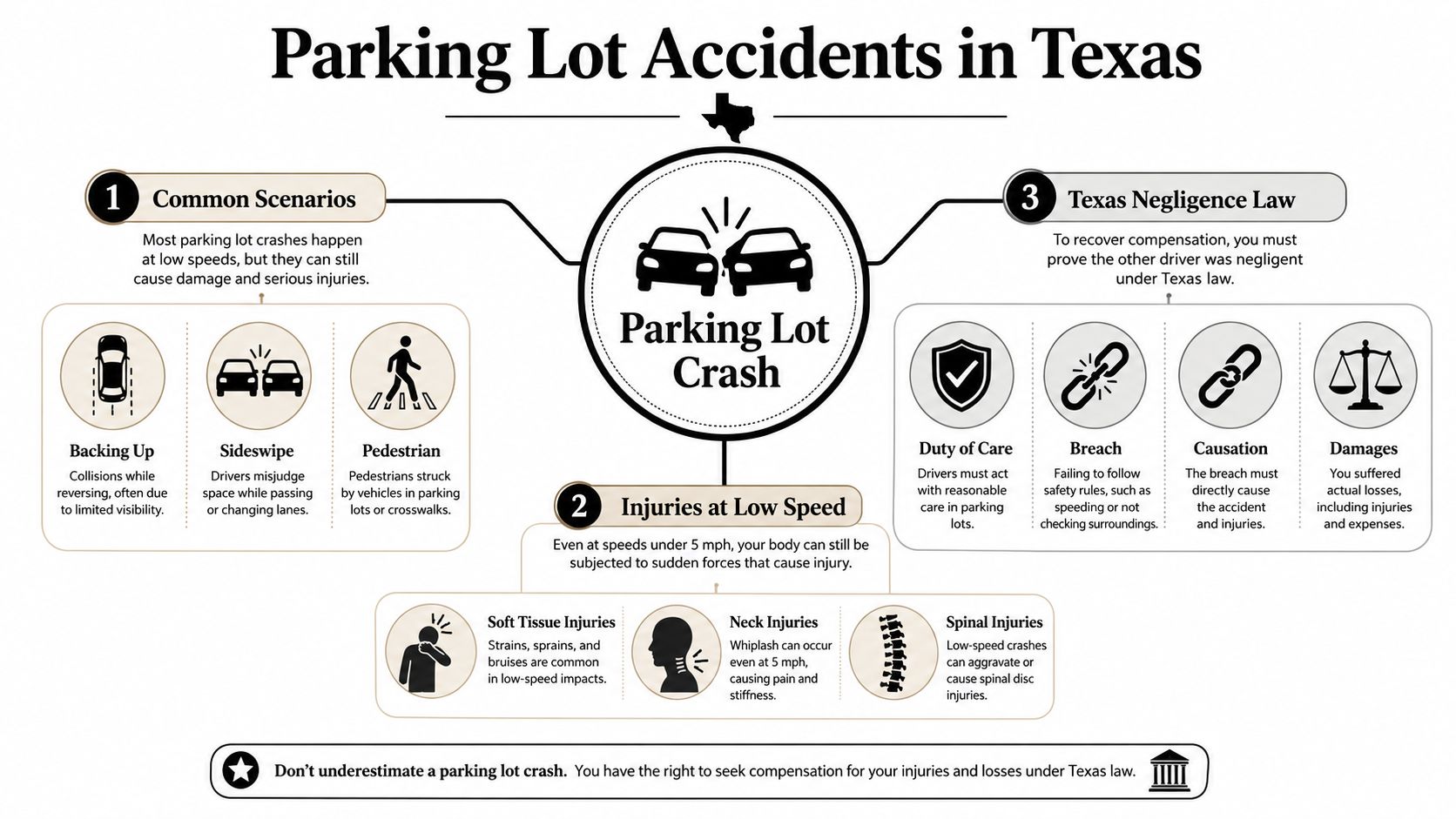
A parking-lot crash happens in a lot, garage, loading zone, or any other private traffic area where drivers, pedestrians, and parked cars are forced into close quarters. These cases usually involve backing out of spaces, cutting across lanes, sudden stops, and sight lines that disappear fast. They happen so often because parking lots are crowded and drivers are watching for spots, carts, phones, and people crossing behind them.
Why low speed still causes real injury
A slow impact can still hurt you. The force comes from the sudden stop and twist your body takes, not just how fast the cars were moving. Neck pain, headaches, back strain, and shoulder pain often show up after what the driver thought was a minor bump.
The evidence in these cases is usually rebuilt from camera footage, lot lighting, vehicle positions, skid marks, and witness statements. Parking-lot cases rarely turn on perfect lane lines or highway-style traffic control. They turn on what each driver did in a tight, shared space.
Texas negligence claims require proof of duty, breach, causation, and damages. In plain English, the other driver had a duty to act safely, failed to do that, caused the crash, and left you with real harm. That harm can include medical bills, missed work, pain, and other losses tied to the collision.
How fault gets proved
The main question is who had the right to move first, who backed out without checking, and who should have yielded. A Houston car accident lawyer looks closely at surveillance footage, lighting, vehicle angles, and the layout of the lot. One careless move in a cramped parking area can decide the case.
Alcohol and drug use can also matter in these crashes, especially when a driver makes a bad decision in a lot or garage. For a closer look at that issue, read Can You Get a DWI in a Parking Lot in Texas?.
Parking lots also create confusion that turns into dangerous conduct fast. A driver who treats a pedestrian crossing like a shortcut, or drives through a lane as if it were open road, changes the liability picture right away. A knowledgeable Texas injury attorney knows how to turn those facts into a clear fault story.
Most Common Causes and Liability Scenarios
Most Houston parking-lot claims come down to a short list of mistakes. A driver backs out without checking the lane. Someone cuts across traffic without yielding. A vehicle moves through the lot as if it had the right of way everywhere. A parked car gets hit because the driver never checked the blind side.
The four patterns that show up again and again
| Crash Pattern | Typical At-Fault Driver | Strongest Evidence |
|---|---|---|
| Backing out of a space | Driver reversing without clearing the lane | Camera footage, witness account, vehicle position |
| Failure to yield in a lane or feeder area | Driver entering traffic without waiting | Right-of-way layout, surveillance, photos |
| Distracted impact with a parked car or pedestrian | Driver looking at a phone or at a spot instead of the path | Phone records, video, witness statements |
| Striking a legally parked car | Moving driver who drifted, turned too tight, or failed to observe the parked vehicle | Damage patterns, lot layout, nearby footage |
Those patterns matter because they point to the duty that was breached. A driver backing out owes a duty to check the space behind the vehicle. A driver crossing the lot owes a duty to yield where the lane design or traffic flow requires it. A driver who is looking at a phone instead of the path can be blamed for not seeing what a careful driver would have seen.
The fight usually centers on small facts. Who was already moving? Who had the cleaner line? Was the lot crowded, poorly marked, or blocked by parked cars that forced a slow, careful turn? In Houston, I also look at whether a commercial truck, delivery van, or rideshare vehicle was involved, because that changes the evidence, the insurance layers, and the claim strategy in retail and mixed-use lots.
The evidence that wins these cases is usually plain, not flashy. It is camera footage, a clean timeline, and a careful reading of who had the safer path. If alcohol or drug use is part of the crash, the stakes rise fast in a parking lot, and the facts around location matter less than the driver's conduct. A separate issue like that is addressed in Can You Get a DWI in a Parking Lot in Texas?.
If the crash happened near a storefront, walkway, or broken pavement, property conditions can also shape the claim. The same set of facts often overlaps with premises evidence, including issues discussed in Houston Slip and Fall / Premises Liability Lawyer. That is why I do not treat a parking-lot crash like a simple fender bender.
The fastest way to protect the claim is to preserve the footage, identify every vehicle involved, and pin down who had the better right to move first. When the insurer gets an early, one-sided version, it starts building a fault story around it. If you are trying to lower your risk on the road from now on, the same careful habits that help in a lot also matter for how to save on Texas car insurance.
How Texas Comparative Fault Affects Your Compensation
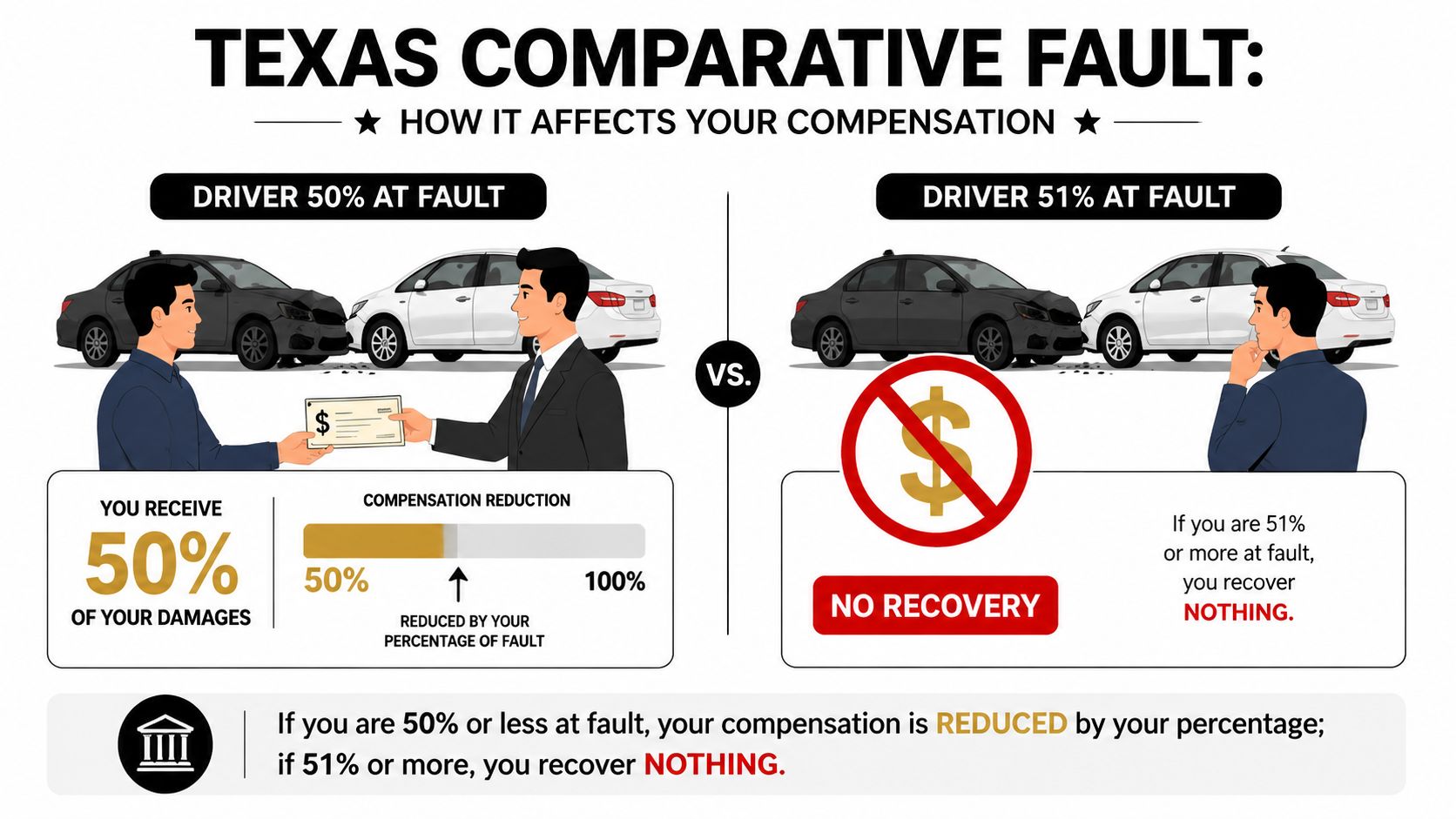
Texas uses modified comparative fault. In plain English, if you are 50% or less at fault, your compensation is reduced by your percentage of fault. If you are 51% or more at fault, you recover nothing. That rule is why insurers push hard to blame the injured person, even in a parking lot where their driver clearly moved wrong.
The math changes fast
If a jury finds you 20% at fault, your recovery drops by 20%. So a claim worth $10,000 becomes $8,000 before any other issues like policy limits come into play. If the fault finding rises to 51%, the recovery is wiped out under Texas law. At 60%, it's the same result, no recovery at all.
That's why fault letters matter. A rushed statement like “I didn't see him either” can get twisted into a fault argument later. Once that wording is in the claim file, the adjuster will lean on it.
Bottom line: Don't volunteer blame to sound polite. Give facts, not admissions.
A clear explanation of this rule is also available in the internal guide on comparative fault definition, which helps you understand why the insurer cares so much about percentages.
Why insurers act early
Parking-lot claims are often settled from the first report, not from the full file. If the insurance company gets to frame the crash before you document your injuries, it gains an advantage. That's also why shopping for cheaper coverage after a wreck is the wrong focus. If you're trying to stay protected going forward, how to save on Texas car insurance is a separate resource, but your first priority after a crash is not a discount. It's evidence and coverage.
A lawyer's job is to keep the fault percentage from being inflated by sloppy adjuster assumptions. That's especially important in mixed-use parking lots where delivery trucks, rideshare cars, and pedestrians all move through the same space. If the other side starts with blame, your case needs a sharper response.
What to Do After a Parking Lot Crash in Houston
Start with safety, then build proof. Don't stand around hoping the other driver will “just handle it.” That's how good evidence gets lost and bad stories get repeated.
Immediate steps that protect you
First, check for injury and move out of traffic if you can. If anyone hurts badly, call 911. If the crash is serious enough to involve police, get the responding officer's information and ask how the CR-3 police crash report will be filed.
Second, photograph everything. Take pictures of both vehicles, the parking spaces, the lane markings, the lighting, any skid marks, and any visible injury. If a surveillance camera is visible, photograph that too.
Third, exchange basic information only. Get the other driver's name, plate number, insurance, and phone number. Keep the conversation short. Don't argue fault at the scene.
The first day matters
Get medical care the same day if you can. Some symptoms show up later, and that delay gives insurers room to argue. Headaches, neck pain, sleep problems, and back stiffness often show up after the adrenaline wears off. That's one reason Houston victims are smart to document the injury early, even when the hit felt minor.
If you need to compare coverage options while the claim is moving, the Select Insurance Group auto quotes page is a useful reference for general insurance shopping. It doesn't replace a claim, and it doesn't help prove fault, but it can help you think ahead once the immediate crash response is handled.
What not to do
Don't give the insurer a recorded statement in the first 48 hours just because they ask. Don't guess about your injuries. Don't say you're “fine” if you're not. And don't sign a release until you know what your medical care really costs.
For a detailed look at what Texas crash reporting looks like after the fact, the internal guide on accident report Houston TX is a good companion piece. It helps you understand why the report matters even when the property damage looks minor.
The rule is plain. Treat the crash like it matters, because it does.
Damages and Compensation You Can Recover
A lot of people undercount their losses because they stop at the ER bill. That's a mistake. In a parking-lot crash, the cost often shows up later, in follow-up care, missed shifts, and the strain the injury puts on your daily life.
The main damage categories
Economic damages are the money losses you can document. That includes past and future medical treatment, lost wages, reduced earning ability, and property damage. If you had to miss work for appointments or recover at home, that belongs in the claim file.
Non-economic damages cover the human side of the injury. That includes pain and suffering, mental anguish, and loss of enjoyment of life. If you stopped sleeping well, can't lift your child, or still tense up every time you back out of a parking space, those facts matter.
Texas Civil Practice & Remedies Code Chapter 41 is often discussed in connection with damage limits in certain cases. For ordinary car-crash injuries, your lawyer should still look closely at the available recovery, because the limit is often the insurance policy and the proof in the file, not just a headline about caps.
Why policy limits matter
The at-fault driver may not have enough coverage to pay the full claim. That's why a Houston car accident lawyer reads the policy as carefully as the police report. The policy language, exclusions, and available coverage can change the value of the case.
A good claim file doesn't just list bills. It connects the pain to the crash, the medical care to the injury, and the loss to the law. That's how you turn a damaged bumper into a full personal injury claim instead of a lowball settlement.
How the Right Houston Parking Lot Accident Lawyer Builds Your Case
A lawyer earns their fee by doing the work you can't do while you're hurt. That starts with evidence preservation. Retailers, apartment managers, and commercial property owners often control the cameras, so a lawyer sends preservation letters fast before footage is overwritten.
If the facts suggest distracted driving, the next step can be sharper. Phone records, witness statements, and vehicle position can all help show what the driver was doing in the seconds before impact. Medical records and discharge summaries then connect the crash to the symptoms you're dealing with.
One piece of the job is also strategic. If a delivery van, rideshare vehicle, rental truck, or company-labeled car was involved, the insurer question gets more complicated. That's where a Houston parking lot accident lawyer who spots the commercial overlay early can look at more than one policy and avoid settling for the first number on the table. The commercial-vehicle issue can be especially important in retail and mixed-use lots where business traffic and pedestrians collide.
The right tools matter too. If a property owner has cameras, a side-by-side review of system placement and footage retention can help. For background on how businesses think about camera coverage, the resource on compare business CCTV systems is useful because it shows why some lots capture a crash clearly while others don't.
That's also why consultation matters early, not after the first offer. A lawyer can decide whether the case belongs in negotiation, whether more records need to be gathered, or whether suit should be filed. The Law Office of Bryan Fagan, PLLC handles that kind of claim work for injured drivers and passengers in Texas, including coordination with insurers and trial preparation when needed.
Houston Parking Lot Crash FAQs and Free Consultation
How long do I have to file a claim?
Most Texas personal injury claims have a two-year statute of limitations. If you wait too long, you can lose the right to file. Don't put this off while you hope the insurer will do the right thing.
What if the other driver left?
A hit-and-run in a parking lot still deserves immediate reporting and documentation. Get the plate number if you can, ask nearby businesses for footage quickly, and tell your insurer what happened. Uninsured or underinsured motorist coverage may matter here, depending on your policy.
How much does a lawyer cost?
Most personal injury firms handle these cases on a contingency fee. That means you don't pay upfront legal fees for the case itself. The point is to let you get help without adding financial pressure while you're trying to recover.
What if my symptoms showed up later?
That happens more often than people think. Delayed neck pain, headaches, and back pain can still connect to the crash if your medical records and timeline support it. Don't dismiss symptoms just because they didn't start at the scene.
If you were hurt in a Houston parking lot, talk to a lawyer before you sign anything or give the insurer a recorded statement. The Law Office of Bryan Fagan, PLLC offers free consultations and contingency-fee representation, and the firm serves clients across Houston and other Texas communities.
If you were injured in a parking lot crash, The Law Office of Bryan Fagan, PLLC can review the report, gather the footage, and deal with the insurer while you focus on healing. Visit The Law Office of Bryan Fagan, PLLC to set up your free consultation and get straight answers about your Houston parking lot accident claim.