You can get a Houston crash report three ways: order it online through the Texas statewide crash report purchase system, mail the H.B. 2633 form to HPD Records with a $6.00 check or money order and a self-addressed stamped envelope, or request it in person at 1200 Travis St. In most cases, the online route is the fastest once the report has been posted.
A car crash can change your life in seconds, but you don't have to face recovery alone. If you were just hit on I-45, sideswiped on Beltway 8, or rear-ended at a Westheimer light, you're probably dealing with pain, car damage, calls from insurance, and a lot of confusion. One of the first documents you should secure is the Texas Peace Officer's Crash Report, usually called the CR-3.
This isn't paperwork for paperwork's sake. The CR-3 often becomes the starting point for your auto insurance claim, your injury case, and any fight over who caused the crash. If you're trying to figure out Houston Police Department CR-3 crash report how to obtain, the process is manageable, but mistakes can slow you down. I'll walk you through what works, what causes delays, and why this report matters to your compensation.
Why the CR-3 Matters Right After a Houston Crash
A wreck scene changes fast.
Right after a Houston collision, people move vehicles, tow trucks clear lanes, witnesses leave, and drivers start telling different versions of what happened. If an officer responds, the CR-3 becomes the closest thing to a neutral snapshot of the scene. That matters more than many drivers realize.
What disappears in the first few days
Take a simple example. A Houston driver gets rear-ended on I-45 during rush hour. At the scene, the cars are angled across a lane, one witness says the trailing driver never braked, and the officer notes damage concentrated at the back of one vehicle and the front of the other. A day later, the roadway is clear. A week later, the witness can't be found. After that, the insurance adjuster may start pushing a different story.
The CR-3 can preserve details like:
- Vehicle positions that show how the collision unfolded
- Point of impact that supports or undermines a liability argument
- Witness names that your lawyer may later contact
- The officer's narrative that frames the incident before insurance creates its own version
Practical rule: Get the report before the adjuster's interpretation becomes the default story.
That's especially important in Texas because fault is rarely argued in a vacuum. Under Texas Civil Practice & Remedies Code Chapter 33, liability can be split between drivers through comparative fault, which means each side may argue the other person shares blame. If the insurer can pin enough fault on you, your recovery drops. If they push it too far, they may argue you shouldn't recover at all.
Why it matters for your claim value
In plain English, liability means legal responsibility for causing the crash. Damages means the losses the crash caused, such as medical bills, lost income, car damage, pain, and other harm. The CR-3 doesn't prove every part of your case by itself, but it helps anchor both.
A Houston Car Accident Lawyer handles representation for car accident victims in Houston and Harris County. One of the first uses of the CR-3 is to identify the parties, insurers, and scene facts before evidence goes stale.
If your crash caused serious injuries or a death, the stakes rise fast. Chapter 41 of the Texas Civil Practice & Remedies Code can affect how certain damages are argued in higher-value injury cases. That's one reason families pursuing wrongful death compensation or major injury damages shouldn't treat the CR-3 like a minor admin task.
What a Texas CR-3 Crash Report Actually Contains
The CR-3 is the officer's formal crash record. Before you request it, gather the basic facts that help locate it correctly. Texas crash-report access is governed by Texas Transportation Code Section 550.065, and Houston's process reflects that rule by directing requesters to provide identifying details such as the accident date, location, and involved parties so the report can be matched correctly, as explained in this overview of requesting a Houston car accident report.
The fields that matter most
Reading the whole report is essential. Opening the document and only looking for a box that says who was at fault is too narrow.
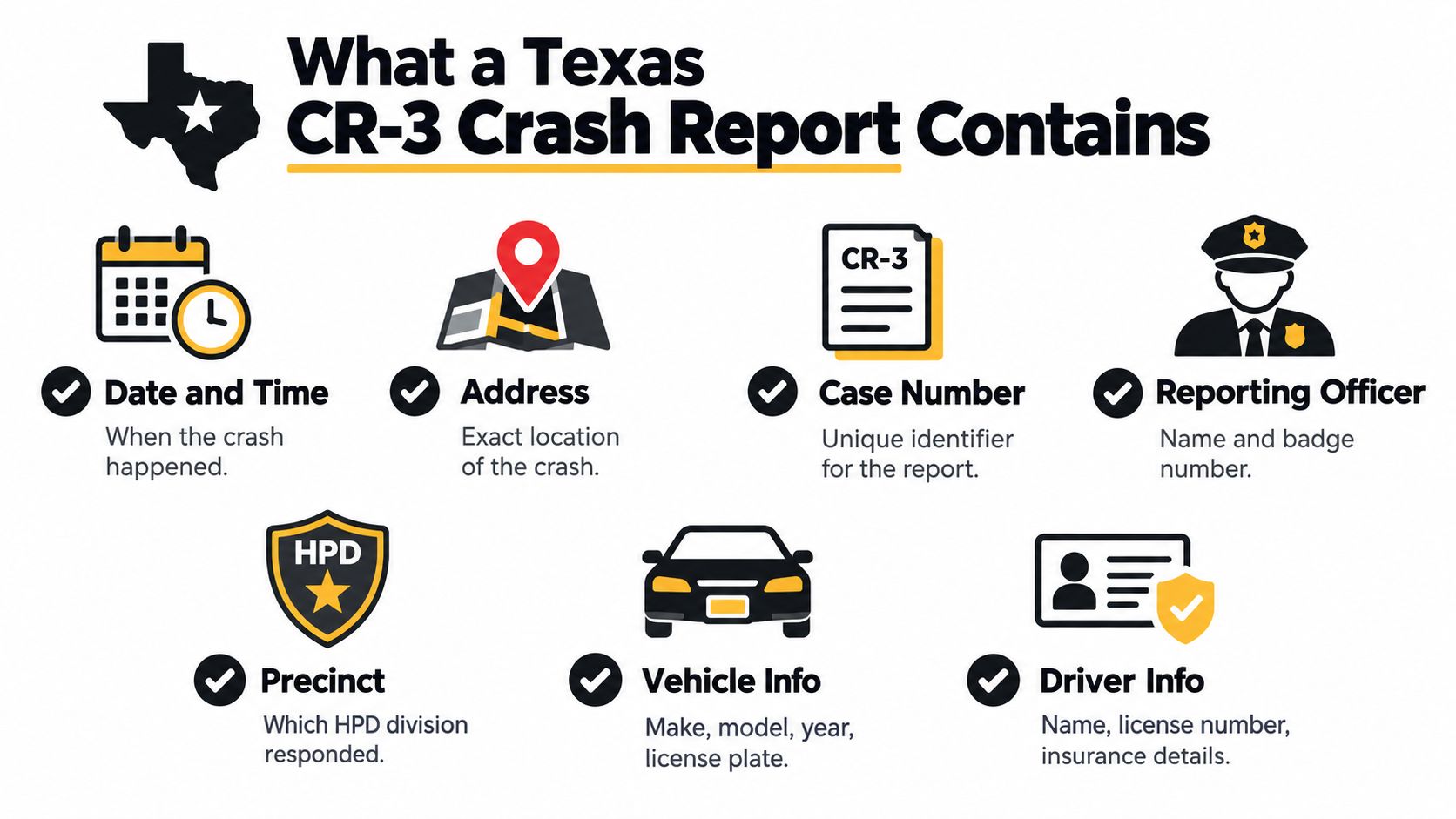
A CR-3 commonly includes:
- Date and time of the crash
- Location or street address
- Case number or report identifier
- Reporting officer and agency information
- Vehicle details for each involved vehicle
- Driver details and insurance information
- Witness information
- Contributing factors
- A diagram and narrative describing the collision
If you want a deeper walkthrough of the boxes and codes, this guide on how to read a police accident report helps you make sense of what you're seeing.
What to review closely before you use it
Some entries carry more weight in a personal injury claim than others.
Focus on these first:
Driver and vehicle identification
Here you confirm you have the right people, the right car, and the right insurer.Contributing factors
These can shape negotiations over negligence. In a lane-change crash on Beltway 8, for example, this part may become central to the blame fight.Narrative and diagram
These often reveal whether the officer saw a straightforward rear-end wreck or a more disputed sequence.Witness listing
Independent witnesses can break a deadlock when insurers claim there's “no clear liability.”
The report is not the final word. It is the starting record everyone reacts to.
Some personal information may be redacted before release. That doesn't make the report useless. It just means you need to know which fields still support your claim and which details you may need to obtain another way.
Ordering Your HPD Crash Report Online Through the Statewide System
You get hit on I-45, the other driver changes their story two days later, and the adjuster asks for the crash report before they will seriously discuss fault. That is why I tell clients to order the HPD CR-3 online first. The faster you get the report, the faster you can catch errors, confirm the investigating agency, and stop an insurance company from filling gaps with its own version of events.
The Texas Department of Transportation makes CR-3 reports available through its online crash report purchase system. If HPD worked the wreck, this statewide portal is usually the fastest way to get the report once it has been uploaded.
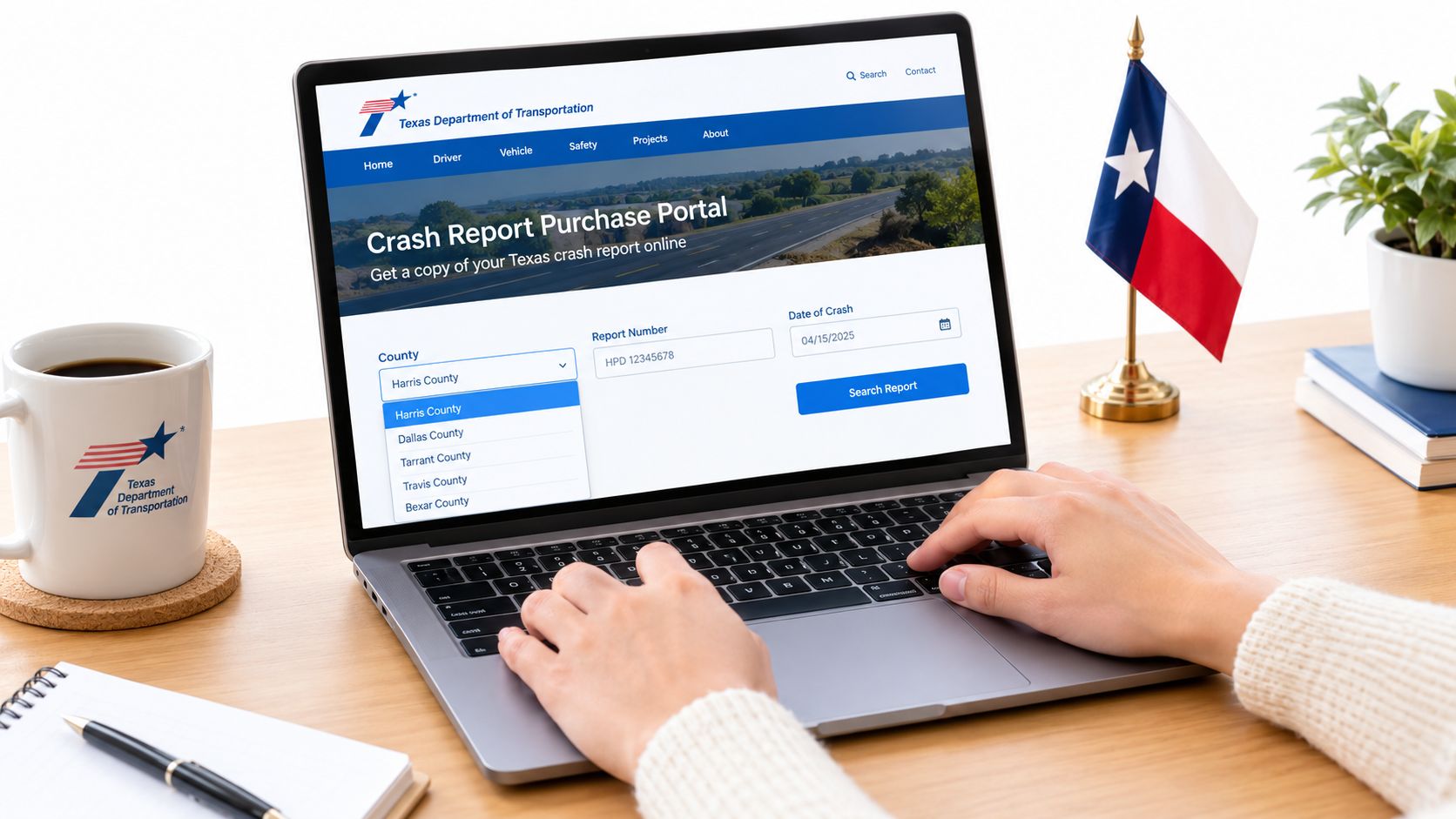
Online ordering saves time, but accuracy matters more than speed. A bad search can send you in circles and cost you days you do not need to lose.
How to place the online order without causing delays
Use the details exactly as they would appear on the officer's report, not how you remember them from a stressful night on Beltway 8.
Follow this order:
- Confirm the investigating agency first. If HPD handled the scene, search for that report in the statewide system. If a sheriff's deputy or a smaller local agency worked the crash, you may be looking in the wrong place.
- Enter the crash date carefully. A one-day mistake is common when a wreck happens late at night or after midnight.
- Match names and location details closely. Use the spelling from your exchange information if you have it.
- Save the confirmation page and receipt. If the report is wrong, delayed, or missing, you want proof of what you requested and when.
If you want another local guide to the process, review this page on getting an accident report in Houston, TX.
Why the online route is usually the right first move
Mail adds delay. In-person requests still depend on whether the report has been processed and indexed. The statewide portal cuts out both problems.
More important, getting the CR-3 early gives you a chance to protect the value of your injury claim. If the report lists the wrong street, leaves out a witness, or misstates who was in which lane, that mistake can affect liability arguments, medical claim handling, and settlement talks. I would rather catch that problem early than fight over it after the insurer has built its file around a bad report.
A failed search does not always mean the report is unavailable. HPD may have finished the investigation, but the report may still be working its way into the system.
If the portal shows nothing a day or two after the wreck, do not assume the case disappeared. Check your details, wait a short time, and try again.
Later in the process, this walkthrough may help you see the portal before you start:
Choose the right copy before you pay
Before you order, decide whether you need a regular copy or a certified copy. For many insurance claims, a regular copy is enough to get the adjuster, your attorney, and the carrier for the other driver working from the same document. If the case turns into a lawsuit or a formal dispute over authenticity, a certified copy may matter later.
Do not pay twice because you guessed wrong the first time. Order the version that fits the immediate job, then review the CR-3 for accuracy as soon as you receive it. That is the point where a simple records request starts becoming evidence.
Requesting Your HPD Crash Report by Mail or in Person
If the statewide portal doesn't show your report yet, don't stall out. Move to the local request options.
The Houston Police Department says crash reports can be obtained three ways: online through the Texas crash report purchase system, by mail to HPD Records Division at 1200 Travis, Houston, TX 77002 with a $6.00 check or money order payable to the City of Houston and a self-addressed stamped envelope, or in person at the Edward A. Thomas Building on the 1st floor at 1200 Travis St. Houston also requires the H.B. 2633 form in English or Spanish with mailed requests, according to the HPD public information page.
Mail requests when you need a paper trail
Mail works best when you want a clean written request and you don't mind waiting. It also helps if you prefer sending documents instead of navigating a portal.
Here's the practical checklist:
- Get the H.B. 2633 form and complete it carefully.
- Include the key crash details such as date, location, city, and the names of involved drivers if you have them.
- Add your payment correctly with a $6.00 check or money order payable to the City of Houston.
- Include a self-addressed stamped envelope so Records can return the report.
- Mail it to HPD Records Division at 1200 Travis, Houston, TX 77002.
If you're dealing with records issues more broadly, this guide on how to obtain police records adds useful context.
In-person requests when time matters
Going in person makes sense when you need answers faster or when online access still isn't showing the file. You'll go to the Edward A. Thomas Building at 1200 Travis St., 1st floor.
Bring more information than you think you'll need. Bring the crash date, location, names, report number if you have it, and identification. The more precise you are, the less likely the counter staff will struggle to locate the file.
A realistic in-person approach looks like this:
- Go during a time when you can wait. Downtown records counters can be busy.
- Bring exact crash identifiers. “Near downtown” isn't enough.
- Ask whether the report has been indexed if it can't be found immediately.
- Keep your receipt and copy request details in case you need follow-up.
If the report hasn't been entered yet, showing up twice won't speed up the officer's filing process.
Which method I recommend
If the online system has the report, use that first. If it doesn't, I usually tell people to choose between mail and in-person based on urgency. Mail is fine when your injuries are minor and the insurance claim hasn't become contested. In-person is better when fault is disputed, medical treatment is underway, or you need the report to move a claim forward.
That matters because your report is not just a record. It's often the first document an adjuster looks at when deciding how to handle your claim.
Texas Law, FOIA Rights, and Privacy on a Crash Report
People often ask whether they need to explain why they want the report. Usually, the better question is which law governs access.
In Texas, crash-report access comes from Texas Transportation Code Section 550.065. That's the legal rule behind these requests. In practical terms, it means crash reports are handled under Texas law, not under the federal FOIA system people hear about in other contexts.
What this means for your rights
You don't need to overcomplicate the request. What matters is giving enough identifying information so the report can be matched and released properly.
That legal framework matters to injury cases because fault and compensation disputes often turn on details captured early. Under Texas Civil Practice & Remedies Code Chapter 33, comparative fault means more than one person can share legal blame. In plain English, if you were partly responsible, your compensation may be reduced. If you were more responsible than the other side can legally tolerate under Texas law, recovery becomes a major fight.
The other term people need to know is statute of limitations. That's the legal deadline to file a lawsuit. If you miss it, you can lose your right to pursue compensation even if the facts are on your side.
What you'll likely see and what may be hidden
Some personal identifiers are commonly removed before release. That's normal.
| Visible on Released CR-3 | Redacted Before Release |
|---|---|
| Names of involved parties | Social Security numbers |
| Insurance carrier information | Phone numbers |
| Vehicle plate information | Home addresses |
| Contributing factors | Some personal identifiers |
| Witness list | Certain private contact details |
| Officer narrative and diagram | Sensitive personal data |
The practical takeaway is simple. The report usually gives you the other driver's identifying and insurance information that you need to open a claim, while some private details may be masked. Protect your own privacy accordingly, especially if your address was part of the underlying record.
Delays, Denials, and Picking the Right Investigating Agency
You can lose a week on a simple agency mistake.
A driver gets hit on Beltway 8, orders an HPD report the next morning, and hears nothing useful back. The problem is not the request. The problem is jurisdiction. If Harris County Precinct officers, a constable, or another city department worked the crash, HPD will not have the report, and that delay can stall your insurance claim before it even starts.
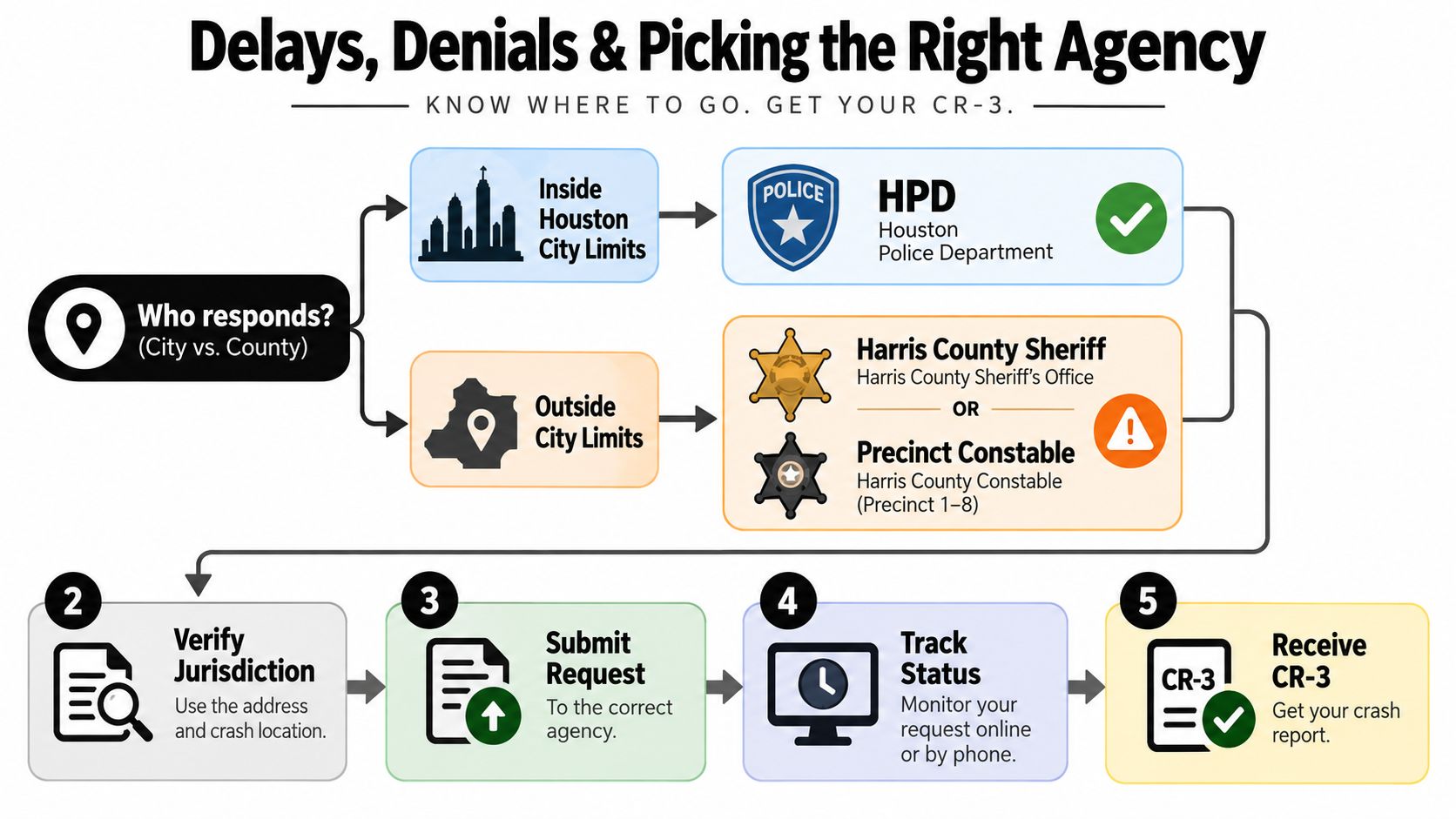
Why jurisdiction trips people up
Houston is full of boundary problems. A wreck can happen near a Houston mailing address and still fall outside HPD's control. That is common around city edges, smaller incorporated cities, and county patrol areas.
The right agency depends on who investigated the crash scene, not what the area feels like on a map.
Use this sorting rule:
- HPD usually handles crashes inside Houston city limits.
- Harris County Sheriff or a constable may handle crashes in unincorporated parts of the county.
- Other local police departments control reports in cities such as Bellaire or West University Place.
That distinction matters for more than convenience. If you send your request to the wrong office, you lose time getting the CR-3, and the CR-3 is often the first document an adjuster uses to identify carriers, review fault allegations, and start pushing back on your version of events.
What to do when the report is delayed or denied
A missing report does not always mean a real denial. Often the report has not been uploaded yet, the case number is off by a digit, or the request went to the wrong records unit.
Do this instead:
- Check the investigating officer's agency on your exchange sheet, citation paperwork, or any scene receipt.
- Verify your identifiers before you submit again. Use the correct crash date, location, driver name, and report or case number.
- Give it a little time if the crash just happened. Posting delays are common after serious or multi-vehicle wrecks.
- Contact the correct records office directly and ask whether the report exists, is pending, or was assigned to another agency.
- Get any denial in writing so you know whether the issue is privacy, timing, or a plain agency mismatch.
A repeated blind request does not fix any of those problems. It just burns more time.
How to pick the right agency fast
Start with the officer's name and department on any paper you received at the scene. If you do not have that, use the location. A crash on I-45 or Beltway 8 may involve different agencies depending on the exact stretch of road and where the stop occurred after the impact.
If the crash involved injuries, a commercial vehicle, or multiple cars, expect a longer reporting timeline. Those are also the cases where the CR-3 carries more weight. The report can lock in early witness names, road conditions, vehicle positions, and contributing-factor codes before memories shift and insurers start shaping the story.
Treat a delay like a problem to solve, not a dead end. Get the right agency, get the right report, and get it early enough to protect your claim.
How an Attorney Uses the CR-3 to Strengthen Your Texas Claim
A good lawyer doesn't stop at the CR-3. But a good lawyer absolutely starts there.
The report gives your Houston car accident lawyer or Texas injury attorney a working map of the case. It identifies drivers, vehicles, insurers, witnesses, and the officer's scene-level observations. From there, the legal work becomes much more targeted.
Turning the report into a negligence case
Texas injury claims are built around negligence. In plain English, that means showing the other driver had a duty to act reasonably, breached that duty, and caused your damages.
A CR-3 helps organize those elements:
- Liability evidence may come from the officer's diagram, impact location, and contributing factors.
- Comparative fault disputes may grow out of conflicting statements or coded driver actions.
- Damages support begins with the fact of the crash itself and extends into treatment records, wage loss records, and repair evidence.
If a Houston driver is rear-ended on I-45 and the report reflects rear impact, witness support, and a straightforward narrative, that can help frame a cleaner demand. If the same driver was in a multi-car Beltway 8 collision with disputed lane changes, the report becomes the first draft of a more contested liability analysis.
Why the timing matters
Insurance companies don't wait for you to feel ready. They start evaluating the claim early, sometimes before you've seen the report yourself.
That's one reason I tell people not to give broad recorded statements to the other driver's insurer before they know what the CR-3 says and before they understand their injuries. Once a version of events gets locked into the file, it can be hard to unwind.
This is also where legal help can become practical instead of theoretical. The Law Office of Bryan Fagan, PLLC represents Texas accident victims in injury matters, including car wreck cases, and can review the CR-3 alongside medical records, insurance communications, and liability issues to evaluate the claim.
Filing the claim and protecting your recovery
After you have the report, the next steps usually include:
- Opening the auto insurance claim with the correct carrier
- Documenting treatment so your injuries are tied to the crash
- Tracking losses such as medical bills, missed work, and vehicle damage
- Pushing back on blame shifting if the insurer tries to overstate your share of fault
In severe cases, the CR-3 may also support a broader investigation involving witness outreach, vehicle records, or scene reconstruction. In fatal cases, it can become part of the foundation for a wrongful death compensation claim by the surviving family.
A crash report won't win the case by itself. But not getting it, not reading it closely, or not using it correctly can absolutely hurt the value of your claim.
If you were hurt in a Houston wreck and you need help getting or using the CR-3, The Law Office of Bryan Fagan, PLLC can help you connect the report to the bigger injury picture, including liability, insurance, and compensation. You can visit The Law Office of Bryan Fagan, PLLC to schedule a free consultation and talk through what your crash report means for your rights and your next steps.