Yes. In Texas, a drunk driver can be arrested for DWI in a parking lot if that lot is a public place and the facts show the driver was operating or in actual control of the vehicle, even if the car was parked.
A car crash can change your life in seconds, but you don't have to face recovery alone. If you were hit in a grocery store lot, outside your apartment, or in a shopping center garage, it's common to feel thrown off twice. First by the collision itself, then by the fear that the other driver might escape responsibility because it happened on “private property.”
That fear is understandable, and in many cases, it's misplaced. Texas law does not give drunk drivers a free pass just because a crash happened in a parking lot. For injured victims, that matters for two reasons. The driver may face criminal consequences, and the same facts that support a DWI arrest can also strengthen your civil injury claim for compensation.
A Parking Lot Crash Can Change Everything
A low-speed parking lot crash can still leave you with a real injury, real expenses, and real disruption. Maybe you were backing out at a supermarket when another driver cut across the lane and hit your door. Maybe you were walking to your car at your apartment complex when someone lurched over a curb. Maybe you were loading groceries when a driver slammed into your parked vehicle.
Then you smell alcohol. You notice slurred speech. The driver can't keep a straight story.

Why this matters to you as the victim
When the at-fault driver was intoxicated, your case is no longer just about a dented bumper or a confusing insurance exchange. It becomes a case about accountability.
A parking lot crash often creates a false sense that the incident was minor or legally murky. Insurance companies sometimes lean into that confusion. They may act like everyone shares blame in a tight parking area, or suggest the location makes liability harder to prove. That is not always true.
Practical rule: If a drunk driver hit you in a parking lot, the location alone does not erase their responsibility.
A familiar example
Take a common Houston scenario. You're leaving a shopping center. Another driver swings too wide, strikes your vehicle, then stops a few spaces away. Officers arrive and start asking questions. The driver claims they were “just sitting there” or says it's private property so it isn't really a DWI case.
For an injured person, those statements can be unsettling. But Texas law looks at access and control, not just labels. If the lot is open to the public and the evidence shows the person operated the vehicle while intoxicated, the criminal side of the case may move forward. That can become important evidence in your auto insurance claim and any lawsuit that follows.
What you need to know early
After a parking lot drunk driving crash, your priorities should be simple:
- Get medical care: Some injuries show up hours later, especially neck, back, and head injuries.
- Protect the evidence: Parking lot cases often rely on photos, witness names, surveillance footage, and the police report.
- Avoid assumptions: A private lot is not the same thing as a legally private event.
- Get legal guidance: A Houston car accident lawyer can evaluate both the crash facts and the intoxication evidence.
If a loved one died after this kind of collision, the same principles may support a claim for wrongful death compensation. The setting does not reduce the seriousness of the loss.
Why a Parking Lot is a Public Place Under Texas Law
Many people ask the same question in different words. Can you get a DWI in a parking lot in Texas if the lot belongs to a store, apartment complex, or private business?
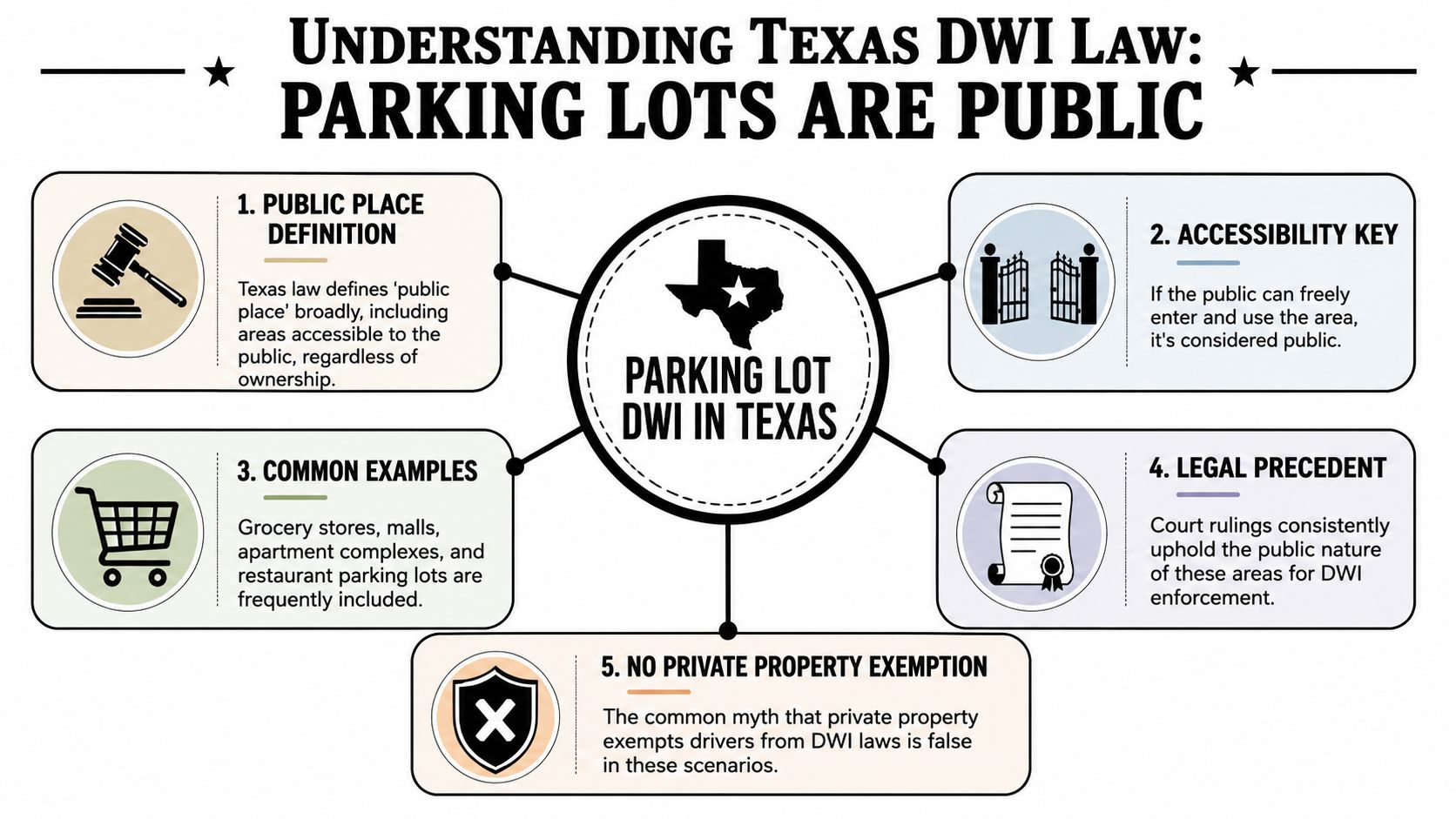
Often, yes. Texas focuses on whether the area is a public place, not just who owns the land. Texas defense materials discussing parking lot DWI law and Texas Penal Code § 1.07(a)(40) explain that a parking lot can qualify when it is accessible to the public, including shopping-center lots, apartment common areas, and other open-access private lots.
Public place in plain English
Public place means an area that people can generally enter or use. It does not have to be owned by the city or state.
Think about these locations:
- Retail lots: Grocery stores, pharmacies, strip malls, and big-box stores
- Residential common areas: Apartment complex lanes and shared parking sections
- Commercial garages: Hospital decks, office parking areas, and restaurant lots
- Mixed-use access areas: Places used by customers, residents, guests, or delivery drivers
If motorists can come and go there in the ordinary course, Texas law may treat that area as public for DWI purposes.
Ownership is not the deciding issue
This point often confuses people. “Private property” sounds like it should end the discussion. It usually doesn't.
A business can own the lot and still invite the public onto it. An apartment complex can be privately owned and still have shared driving lanes used by residents and guests. In both situations, the law may treat the space as public because of access.
The question is usually whether people could use the area, not whose name is on the deed.
Why that helps your injury case
For victims, this point matters because it undercuts a common defense theme. If the drunk driver or insurer argues that the crash happened somewhere outside normal traffic rules, that argument may fail when the lot is open to public use.
That can help establish liability, which means legal responsibility for the harm caused. In a civil claim, liability is the foundation of recovery. If the other driver caused the crash while intoxicated in a legally recognized public place, your claim stands on stronger ground.
A Texas injury attorney looks at the lot layout, entry points, signs, traffic flow, witness accounts, and any available video. Those details can matter when proving the driver does not get a loophole because the crash happened off the main road.
Proving Operation of a Vehicle Even When Parked
A DWI case does not always require an officer to see the vehicle moving. In Texas, prosecutors may rely on evidence that the person was operating the vehicle or had actual control of it, even when the car is parked. Texas DWI commentary discussing parked-car DWI charges and actual control explains that police may pursue a case if the person is in the driver's seat, has the keys nearby, the engine is running, the car is in gear, or circumstantial evidence suggests recent operation.
What operation means in real life
For victims, this issue often comes up after the crash. The drunk driver hits your car, then pulls into a space. By the time police arrive, the vehicle isn't moving anymore.
That does not automatically protect the driver.
Officers and prosecutors may look at the full scene to piece together what happened. They do not have to ignore common sense just because the person stopped moving before the police walked up.
Evidence that can support a parked-car DWI case
These details often matter:
- Driver position: The person is in the driver's seat rather than a passenger seat.
- Keys and controls: Keys are in hand, in the ignition, or within reach.
- Vehicle condition: The engine is running, the car is in gear, or the hood and engine are warm.
- Scene evidence: Fresh damage, skid marks, witness statements, or video suggest the person had just driven.
- Timeline facts: The person was seen arriving moments before officers made contact.
A related question comes up often in Texas DWI cases involving someone sitting in a car. The core issue is not whether the wheels were rolling at the exact moment police arrived. The issue is whether the evidence supports operation or actual control.
Why this matters after your crash
This can directly affect your personal injury case. If the drunk driver claims, “I wasn't driving,” but the circumstances show they had just hit you and then stopped, that story may not hold up.
A parked vehicle can still be part of an active DWI investigation when the surrounding facts point to recent operation.
That matters because your civil case often depends on the same building blocks. The police report, witness interviews, security video, and scene photos can help show what the driver was doing before officers arrived.
How the DWI Arrest Impacts Your Personal Injury Claim
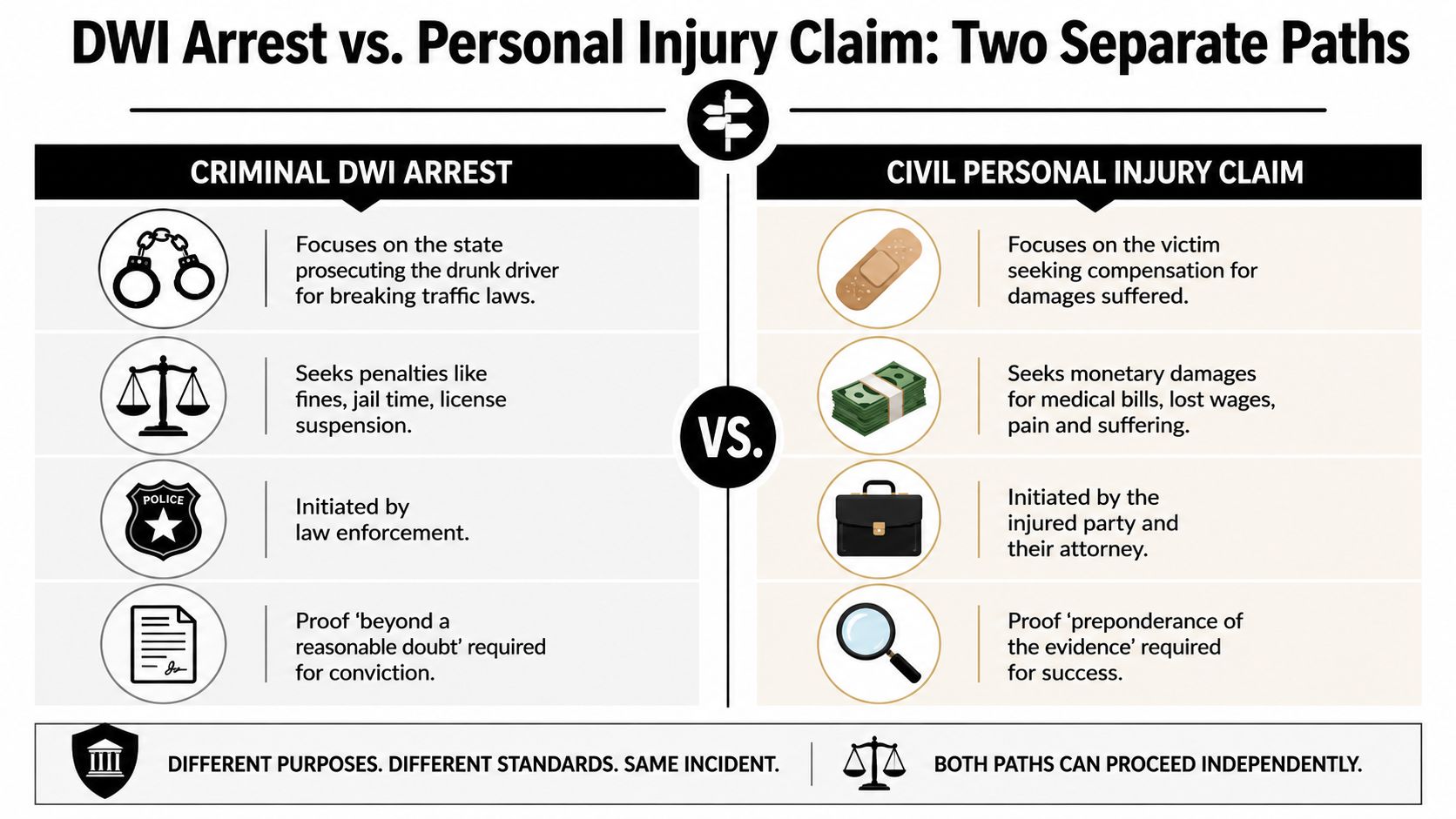
The criminal case and your injury claim are separate. The State handles the DWI prosecution. You handle the civil claim for compensation. But the same event can power both cases.
If the drunk driver is arrested after hitting you in a parking lot, that arrest may support your effort to prove fault in a personal injury case. It doesn't guarantee recovery by itself, but it can be powerful evidence.
Criminal case and civil case are not the same
Here is the key difference:
| Case type | Main purpose | Who brings it |
|---|---|---|
| Criminal DWI case | Punish unlawful conduct | The government |
| Civil injury claim | Recover compensation for your losses | You, the injured person or family |
In the civil case, you are seeking damages. Damages means the money the law may allow for losses caused by the crash, such as medical bills, lost income, pain and suffering, property damage, and in fatal cases, wrongful death damages.
Why the arrest can help prove liability
A DWI arrest may generate useful evidence, including:
- Police observations: Signs of intoxication, field observations, and scene descriptions
- Witness statements: What bystanders, store employees, or passengers saw
- Physical evidence: Vehicle position, damage patterns, and surveillance footage
- Case developments: Charges, plea decisions, or other admissions
That evidence can strengthen your proof of liability, meaning who is legally responsible for causing the crash.
Negligence and negligence per se
Texas personal injury law is rooted in negligence. Negligence means a person failed to use reasonable care and caused harm.
In some drunk driving cases, the facts may also support what lawyers call negligence per se. In plain English, that means a driver violated a safety law designed to protect the public, and that violation helps establish fault in the civil case. When a drunk driver breaks DWI laws and injures someone, that legal violation can become an important part of the claim.
If a driver chose to operate a vehicle while intoxicated and then hit you, that conduct may do more than look careless. It may violate a safety law meant to prevent exactly this kind of injury.
What insurers do with this issue
Insurance companies do not automatically pay fairly because a DWI arrest happened. They may still argue about injuries, medical treatment, or whether the crash caused all of your symptoms.
But intoxication alters the dynamic. A driver arrested for DWI in connection with the collision may have a harder time presenting the crash as an innocent mistake. That can affect settlement talks and trial strategy.
This is also where related claims may arise. If alcohol was overserved before the crash, a lawyer may evaluate Texas dram shop law and third-party alcohol liability in addition to the case against the driver.
What to Do After a Drunk Driver Hits You in a Parking Lot
The hours after a parking lot crash matter. Evidence can disappear fast. Security video can be overwritten. Witnesses leave. Injuries get worse after the adrenaline fades.
The safest approach is to act quickly and methodically.
Start with safety and law enforcement
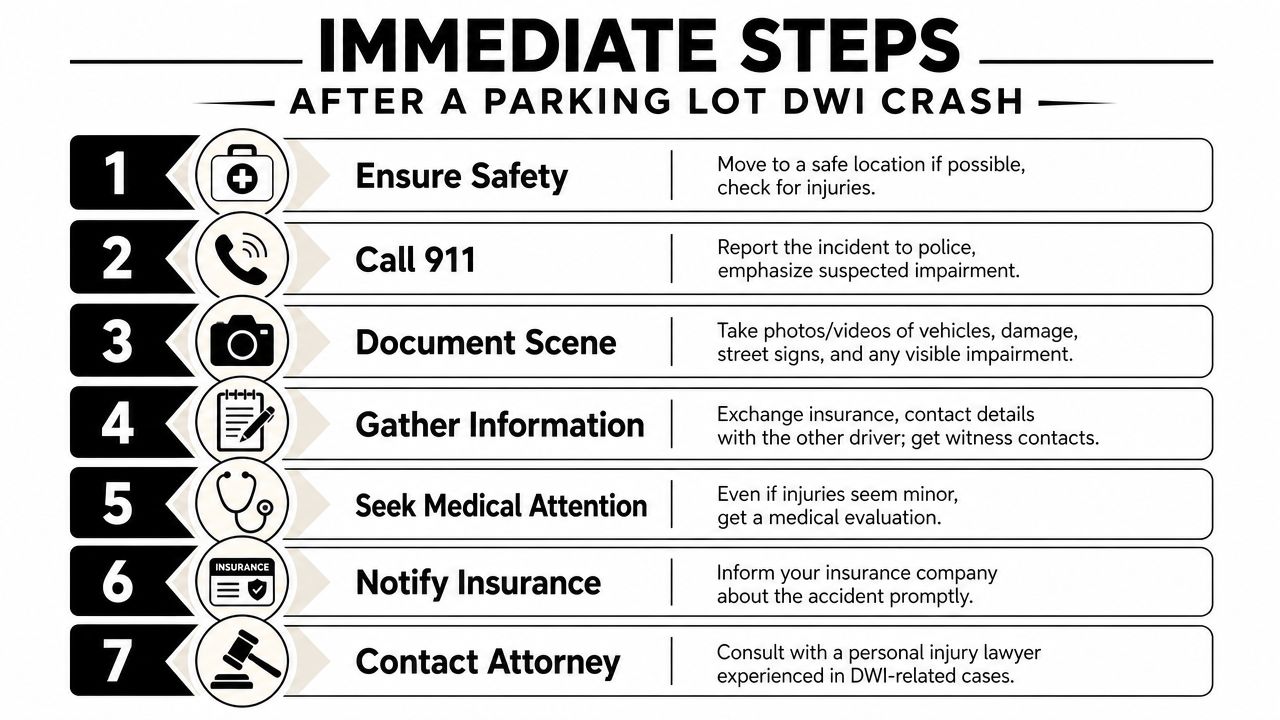
Get to a safe spot if you can. If the vehicles can move and staying put creates danger, move carefully to a safer area nearby.
Call 911 right away. Tell the dispatcher there has been a crash and explain why you suspect impairment. Police presence creates a record. Medical responders can evaluate injuries on scene.
Cooperate, but stay factual. Give officers clear facts. Avoid guessing about speed, fault, or injuries you haven't had checked yet.
A fuller guide to what to do after a drunk driving accident in Texas can help if you're dealing with the aftermath now.
Preserve proof before it disappears
Parking lot cases often depend on details that look small at first.
- Take photos: Capture both vehicles, the surrounding lot, lane markings, debris, and any visible injuries.
- Record conditions: Note lighting, weather, security cameras, and business names nearby.
- Get names: Witnesses, store managers, security staff, and responding officers may all matter later.
- Save your notes: Write down what the driver said, especially anything about drinking or where they came from.
Here's a practical resource that explains common post-crash issues:
Protect your health and your claim
Even if you feel “mostly okay,” get checked by a medical professional. Soft tissue injuries, concussions, and back injuries often present later.
Then be careful with insurance communications.
- Report the crash to your insurer: Give basic facts and follow your policy requirements.
- Don't give a recorded statement to the other driver's insurer without advice: Adjusters often ask questions that limit the value of your claim.
- Keep records: Bills, prescriptions, work absences, repair estimates, and photos all support your case.
Important: The best time to protect a case is at the beginning, before the insurer has framed the story for you.
If you need legal help sorting out evidence, liability, or a stubborn insurer, firms such as The Law Office of Bryan Fagan, PLLC handle Texas auto injury cases involving intoxicated drivers.
Seeking Full Compensation for Your Losses
After a drunk driving crash, the goal is not just proving what happened. The goal is recovering for what the crash has cost you and your family.
That may include emergency care, follow-up treatment, missed work, pain, physical limitations, property damage, and the disruption that follows you home long after the tow truck leaves.
What compensation may cover
In a civil case, damages may include:
- Medical expenses: Hospital bills, imaging, therapy, medication, and future care tied to the crash
- Lost income: Missed paychecks, reduced work capacity, or time away from self-employment
- Pain and suffering: Physical pain, emotional distress, and loss of normal daily life
- Property losses: Vehicle repair or replacement and damaged personal items
If a family member died, a wrongful death case may seek wrongful death compensation for the losses surviving family members suffer.
Comparative fault under Texas law
Texas Civil Practice and Remedies Code Chapter 33 uses a modified comparative fault system. In plain English, that means fault can be divided between people involved in the crash. Your recovery can be reduced if you were partly at fault, and if your share of fault is too high, recovery may be barred.
Comparative fault means the law asks how much responsibility each person carries.
In a drunk driving parking lot case, the intoxicated driver often bears the central blame. Still, insurers may try to argue that you were backing up carelessly, speeding through the lot, or not paying attention. That is one reason evidence matters so much.
Punitive damages and gross misconduct
Texas Civil Practice and Remedies Code Chapter 41 addresses exemplary damages, often called punitive damages. These are not meant to repay a bill. They are meant to punish especially dangerous conduct and deter similar behavior.
A drunk driving crash may raise that issue because driving while intoxicated is not ordinary carelessness. It can reflect extreme disregard for the safety of others.
The filing deadline matters
Texas personal injury claims are also controlled by a statute of limitations. That term means the deadline for filing suit. In many Texas injury cases, that deadline is two years. Missing it can destroy an otherwise strong claim.
A Texas injury attorney helps gather records, evaluate insurance coverage, calculate damages, and push back when the insurer tries to minimize your losses. That matters whether the crash happened on I-45, in a grocery lot, or outside your apartment building.
A Houston DWI Accident Lawyer Is Ready to Help
If you've been asking can you get a DWI in a parking lot in Texas, the answer can shape everything that comes next. A drunk driver does not become less dangerous because the crash happened near a storefront instead of on a highway. And your rights do not shrink because the collision happened in a parking lot.
You may be dealing with pain, repairs, missed work, and constant calls from insurance. You may also be carrying anger that this happened at all. Those reactions are normal.
A Houston car accident lawyer can help you understand the police report, preserve evidence, value your damages, and deal with the insurance company from a position of strength. If the crash caused a fatal injury, your family may also have the right to pursue wrongful death compensation and hold the driver fully accountable.
The law gives you a path forward. You do not need to sort through it alone, and you do not need to accept an insurer's first version of the story.
If a drunk driver hit you or someone you love in a Texas parking lot, contact The Law Office of Bryan Fagan, PLLC for a free consultation. Our team helps accident victims understand liability, comparative fault, damages, insurance issues, and filing deadlines under Texas law. We can review what happened, explain your options, and help you pursue the compensation the law allows.