A car crash can change your life in seconds, but you don't have to face recovery alone. When an Amazon van or FedEx truck hits you in Houston, the shock isn't just the impact. It's the phone calls, the medical bills, the missed work, and the immediate question nobody answers clearly, who pays?
If you're sitting at home with a sore neck, a damaged car, and an insurance adjuster already calling, you're in the right place. Delivery truck crashes in Houston are rarely simple because the logo on the side of the vehicle doesn't always match the company that owns the policy, employs the driver, or controls the route. That's why a Houston delivery truck accident lawyer (Amazon/FedEx) has to look past the branding and straight into the business structure behind the crash.
When a Delivery Truck Changes Your Day in Houston
A Houston driver gets rear-ended on I-45 by a branded Amazon van, pulls onto the shoulder, and feels “fine” for a few minutes. Then the headache starts. The neck tightens. The car is drivable, but work isn't going to happen tomorrow, and nobody on the scene can say whether the driver was an Amazon employee, a contractor, or something in between.
That confusion matters. Houston-area reporting says the Texas Department of Transportation recorded about 450 delivery-vehicle accidents in Harris County during 2023, with Amazon-affiliated vehicles involved in roughly 18% of those crashes, which would suggest about 81 Amazon-related incidents if applied directly. The same source says Houston was seeing approximately 6,200 delivery-truck accidents annually by early 2024. Those numbers show why these cases aren't rare, they're part of everyday traffic danger in a big city with heavy package volume and crowded roadways. See the Houston delivery-truck crash discussion in this Houston-area accident resource for that local context.
A family in the Heights can face the same confusion after a FedEx Ground truck T-bones them in an intersection. The driver may sound apologetic. The adjuster may sound calm. Neither one is there to protect your claim.
Practical rule: the first question is not “What brand was on the truck?” It's “Who controlled the driver, who insured the route, and who has the money to pay the claim?”
The legal job is simple to say and hard to do. Identify the defendant, preserve the proof, and force the insurer to deal with the full impact of the crash, not just the damage that's visible on day one. That's the path a seasoned Texas injury attorney takes from the start.
How Texas Decides Who Is at Fault
Texas law uses plain ideas, even if the paperwork doesn't. Liability means legal responsibility for the harm. Negligence means someone failed to use reasonable care. Damages means the losses you suffered, like medical bills, lost income, pain, and other harm. Comparative fault means the court can divide responsibility between you and the other driver.

The 51% bar in plain English
Texas Civil Practice & Remedies Code, Chapter 33, is the law that controls comparative fault in many injury cases. If you're found 51% or more at fault, you generally recover nothing. If you're 50% or less at fault, you can still recover, but your compensation is reduced by your share of fault. That's the rule insurance companies lean on when they try to push blame onto you.
Here's how it plays out in a Houston crash. A delivery-truck driver runs a red light at Westheimer, and you brake hard but still make contact. The insurer may argue you were speeding, following too closely, or not paying attention. Your lawyer's job is to push back with the evidence, the signal timing, witness statements, the vehicle damage, and the crash report so the fault percentage is based on facts, not pressure.
Why adjusters push blame so hard
Adjusters know that fault percentages change the value of a claim. If they can move you closer to the 51% line, they can cut down or wipe out payment. That's why they move fast, ask leading questions, and often try to get a recorded statement before you understand your injuries.
A good Houston car accident lawyer doesn't argue with the adjuster on instinct. The lawyer builds a record that shows what really happened and why the delivery driver, contractor, or carrier should be paying. That's where police reports, scene photos, route data, and repair records matter.
Who Actually Pays When an Amazon or FedEx Truck Hits You
The biggest mistake people make is assuming the parent logo means the parent company automatically pays. It doesn't work that way. Amazon and FedEx both use layered business models, and those layers can change the target of the claim, the available insurance, and the value of the case.
The business structure matters more than the logo
Amazon Flex drivers usually use personal vehicles, which can shift the starting point of the claim to the individual driver and whatever policy applies to that vehicle. Amazon Delivery Service Partners are separate businesses that operate branded vans, so the claim may point first to the DSP, not straight to Amazon. FedEx Ground often uses contractors holding specific routes, while FedEx Express is more likely to involve employees. The difference is huge because an employee case, a contractor case, and a third-party business case don't sit on the same insurance footing.
A delivery driver saying, “I'm an independent contractor,” is a red flag, not an answer. It tells you the carrier may try to distance itself from liability. It does not tell you who controlled the route, who trained the driver, or who set the schedule.
The question is not whether the truck had a famous name on it. The question is whether that company controlled enough of the work to be tied to the crash.
What evidence points to the right defendant
At the scene, look for the driver's name, the insurance card, the DOT number, the license plate, and any brand markings on the van or uniform. Keep your own notes if you can. In these cases, the details you collect early can help identify whether the driver was an employee, a contractor, or part of a delivery program that routes the claim somewhere else.
A practical claim against a delivery-company crash often turns on identifying the business relationship behind the vehicle, because the driver may be an employee or an independent contractor, and evidence such as the driver's name, insurance card, DOT number, license plate, Amazon branding, and delivery-company records may be needed to trace the correct liable parties and insurance coverage. That's the work behind a delivery-truck case, and it's why quick assumptions usually help the insurer, not the victim.
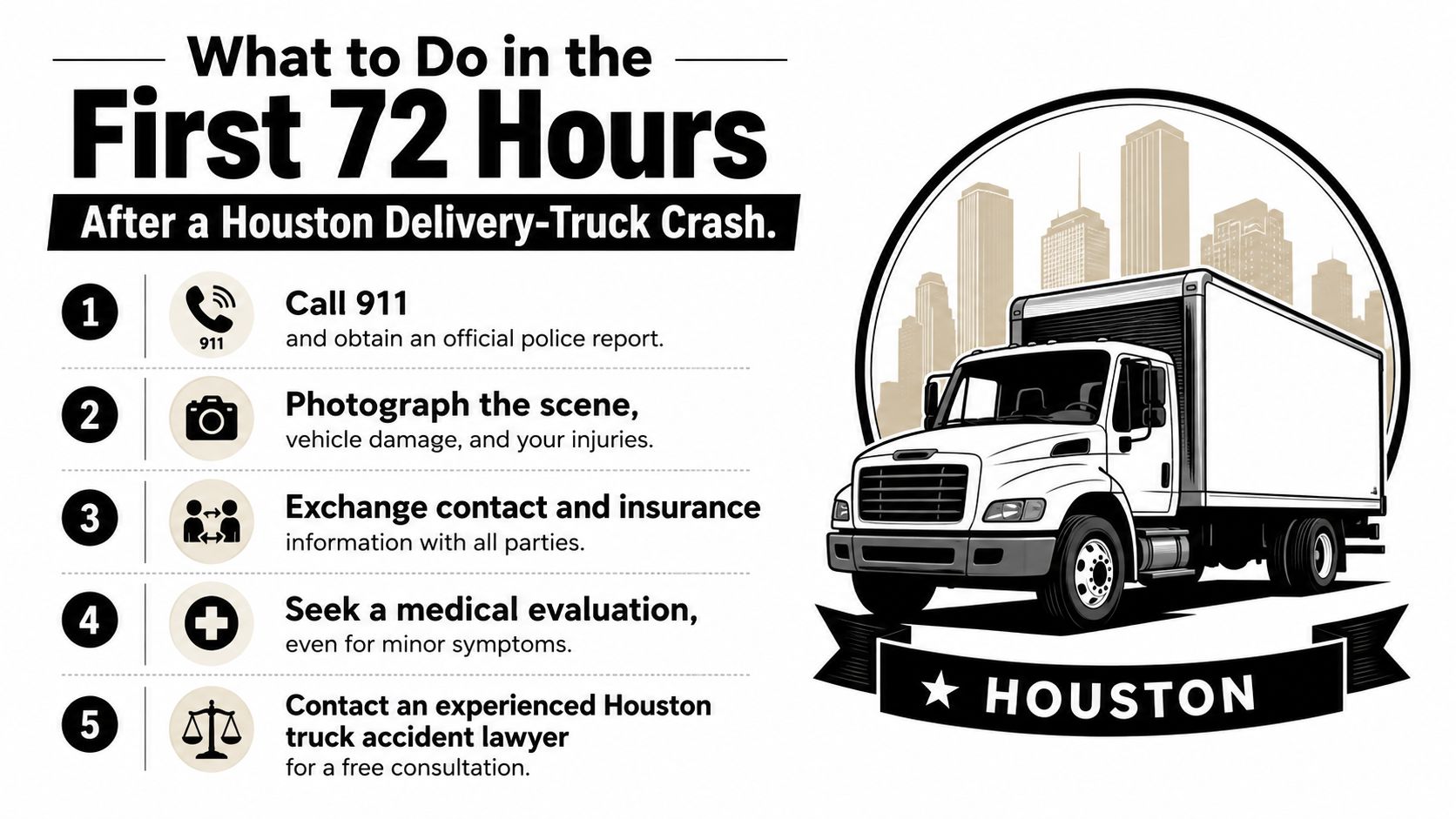
What to Do in the First 72 Hours After a Houston Delivery-Truck Crash
The first three days matter because evidence disappears fast. Dashcam footage gets overwritten. Witnesses get harder to find. The driver's story starts to harden. If you can do only a few things, do the right few things.
First moves at the scene
Call 911 and make sure a police report is created. Photograph the truck, your car, the road, skid marks if they're visible, traffic signals, and any injuries you can see. Get the witness names and phone numbers before people leave.
Ask the driver for the name, employer, DOT number, insurance carrier, and policy number. If they won't give it, write down what you can see from the vehicle, the uniform, and the paperwork. If a driver says they're just a contractor, write that down too.
Medical care and insurance contact
Seek medical care even if the pain seems minor. Some injuries show up later, and Houston families often learn that after the shock wears off. Do not give a recorded statement to the delivery company's insurer before you talk to a lawyer.
If you're dealing with adjusters already, Dealing With Insurers After a Houston Accident is a useful resource on common insurance tactics. It helps you understand why friendly phone calls can turn into claim problems.
What not to post
Don't post photos, jokes, or updates about how “okay” you are. Don't speculate about fault. Don't write that you “might be fine” if you're still hurting. The insurance company will read it, and they'll use it.
A preservation letter can lock down dashcam files, driver logs, and package-route records before they're recycled. That matters because a delivery case is often won or lost on the details the company would rather not keep.
Why Insurance Limits Often Decide What Your Case Is Worth
A strong liability case can still run into a coverage problem. That's the part people don't hear enough. The truck may have caused serious harm, but the policy behind the truck may be thin, layered, or aimed at a contractor instead of the brand everyone recognizes.
Coverage sets the practical ceiling
In a commercial claim, the policy limit often matters as much as fault. Texas commercial vehicles operating in-state must meet state minimums, and interstate trucks can fall into higher federal tiers based on weight and cargo, with limits that range from $300,000 to $5 million depending on the operation. That range explains why a hazmat carrier and a local delivery van do not look the same from a claims standpoint. For a deeper explanation of policy structure, this insurance policy limits guide is a useful reference.
| Coverage Tier | Applies To | Minimum Limit |
|---|---|---|
| Lower commercial tier | Smaller commercial vehicles | $300,000 |
| Middle commercial tiers | Many standard interstate operations | Varies by operation |
| Highest commercial tier | Certain heavier or hazardous cargo operations | $5 million |
The table is the key takeaway. Different trucks mean different insurance realities. A local Amazon DSP truck and a high-risk interstate hauler don't come with the same recovery picture.
Why the correct entity matters
If you name the wrong company, you can spend months fighting a policy that can't fully cover the harm. If you identify the contractor, the employer, the parent relationship, and any additional policy layers, you may find more coverage on the table. That's why the business structure behind the driver matters as much as the crash itself.
A Texas injury attorney has to be practical, not theoretical. You don't just want fault. You want the right defendant with the right policy, or the case may settle far below the actual cost of the injuries.
Texas Deadlines and the Clock on Your Claim
Texas deadlines are unforgiving. For many personal injury and wrongful-death claims, the default deadline under the Texas Civil Practice & Remedies Code is two years, and claims involving a government entity can have shorter notice rules. If you wait, you may lose your chance to file even when the case is strong. For the statutory framework, see Texas statutes of limitations in accident cases and the broader statute of limitations guide for attorneys.

Why time hurts even before the deadline
Waiting is a mistake because evidence starts fading right away. Witnesses move. Security footage gets overwritten. Package-route data can disappear. If the crash involved a delivery schedule, the records that show where the driver was supposed to be can become some of the most important proof in the case.
Insurance notice also matters. The company may have a duty to report the claim quickly, and you should not assume they're protecting your interests while that happens. A lawyer's preservation letter can stop routine deletion and put the company on notice that the evidence has to be kept.
A simple claim timeline
In the first days, you get medical care and gather the scene evidence. In the first weeks, your lawyer investigates the carrier structure, not just the driver. In the first months, the claim is presented, negotiated, and supported with records. If the insurer won't be fair, litigation follows.
If the at-fault driver has no meaningful insurance, Uninsured Driver Accidents in Houston explains how recovery can still be pursued in that situation. That issue comes up more often than people expect after commercial and delivery crashes.
A delivery case loses value fast when nobody acts. The deadline is important, but the evidence clock starts ticking long before it.
What You Can Recover After a Delivery-Truck Crash in Texas
Texas law allows different categories of damages, and each one has to be proved. Economic damages cover the measurable losses, like medical bills, future care, lost wages, and reduced earning ability. Non-economic damages cover the human losses, like pain and suffering, mental anguish, and loss of enjoyment of life. In rare cases, exemplary damages may also come into play.
How those losses get documented
ER records matter because they show the first diagnosis. Orthopedic follow-ups matter because they show whether the injury healed or worsened. Work records, pay stubs, and doctor's restrictions matter because they show missed income. If the crash affects long-term work ability, a vocational or economic analysis can help explain that loss.
A Houston driver hit by a delivery van on US-59 might suffer a herniated disc that needs surgery. The medical treatment is only part of the story. The recovery also includes time off work, follow-up care, physical pain, and whatever the injury takes away from daily life.
Wrongful death cases
If a family lost a loved one, the case can move into wrongful death compensation. That route is about more than bills. It can also involve the loss of companionship, financial support, and the harm that follows when a family's center is gone. A Houston family facing that kind of loss should speak with a lawyer immediately.
For broader perspective on car-crash representation in the city, Houston Car Accident Lawyer is a related firm resource focused on victims in Houston and Harris County.
The point is simple. Compensation should match the full harm, not just the first ER visit. That's why the file has to be built carefully from day one.
Choosing the Right Houston Attorney and What Happens Next
Choose a lawyer who handles commercial-carrier cases, not just ordinary fender-benders. Delivery truck claims turn on route control, policy layers, and insurer tactics. You need someone who understands how those pieces fit together and who's willing to prepare for trial if the carrier won't settle fairly.
If you're comparing options, this how to choose a car accident lawyer in Texas guide is a useful checklist for what to ask and what to expect. If you're also caring for an injured parent or spouse, senior legal support for caregivers can help you think through the practical side of helping an older loved one after a crash.
What a solid consultation should cover
Bring the police report, photos, medical records, and any letters or texts from the insurer. Ask who may be liable, what insurance may apply, and how the firm handles delivery-company investigations. Ask whether they take cases to trial when needed, because that answer tells you a lot.
The Law Office of Bryan Fagan, PLLC handles Houston delivery-truck and car crash claims by investigating liability, dealing with insurers, and preparing each case as if trial may be necessary. That includes Amazon and FedEx crashes where the fight is often over who the employer was and which policy applies.
A free consultation should leave you clearer, not more confused. You should know the next steps, the risks, and the strategy.
If you were hit by an Amazon or FedEx truck in Houston, The Law Office of Bryan Fagan, PLLC can help you sort out liability, deal with the insurer, and protect the evidence before it disappears. Visit The Law Office of Bryan Fagan, PLLC to request a free consultation and get direct guidance from a Texas injury attorney who understands delivery-truck claims.