Skip to content
A car crash can change your life in seconds, but you don't have to face recovery alone. If you've just been rear-ended on I-45, watched your vehicle leave on a tow truck, or taken a family member to the hospital after a collision, the next step can feel confusing. One of the most important steps is identifying the right agency and obtaining the official crash report.
For a Harris County Sheriff crash report request in Houston, the correct path depends on where the wreck happened and which agency investigated it. A report from the wrong department can waste time, delay an auto insurance claim, and create unnecessary frustration. This guide explains how to locate the report, request a standard or certified copy, understand the CR-3 record, and use the report when evaluating liability, damages, and a Texas injury claim.
Why the Crash Report Matters After a Houston Wreck
After the adrenaline fades, the crash report becomes one of the first records an insurance adjuster will ask for. It can help identify the crash location, involved vehicles, parties, witnesses, road conditions, and the investigating officer's observations. It may also contain a diagram and contributing-factor information that gives the carrier an initial framework for deciding who may be responsible.
That report doesn't decide your case by itself. Liability means legal responsibility for causing harm, and insurers, attorneys, and courts may consider the report alongside photographs, medical records, vehicle damage, witness accounts, video, and other evidence. An officer's conclusion can be useful, but it isn't the final word on fault.
Practical rule: Get the report, read every page, and compare it with what you remember and what your evidence shows.
The document that opens the claim
The crash report often gives you the information needed to identify the other driver and begin a property-damage or bodily-injury claim. It can also reveal whether the investigating officer recorded a failure to yield, following too closely, unsafe speed, or another possible contributing factor.
For example, a Houston driver rear-ended on I-45 may have photographs showing rear bumper damage, a witness who saw the other driver looking down, and medical records documenting neck pain. The report can organize those facts into a starting record, while the additional evidence supports the larger claim.
Texas negligence law generally requires proof that another person failed to use reasonable care and that the failure caused your injuries or losses. Damages means the financial and personal harm connected to the crash, such as medical expenses, lost income, vehicle damage, pain, and other legally recognized losses.
Deadlines still matter
Texas personal-injury and wrongful-death claims generally have a two-year limitations period, so a victim or family usually must file suit within two years of the crash or death. That deadline is addressed in Texas Civil Practice and Remedies Code Chapter 33 and related limitations law, and the published Texas crash-law guidance explains why prompt claim evaluation matters (Texas car accident limitations guidance).
Don't wait for an insurance company to decide whether your case is worth pursuing. Request the record, preserve evidence, seek medical care, and speak with a Houston car accident lawyer early if the crash caused significant injury, disputed fault, or a death.
Which Agency Holds Your Harris County Crash Report
The biggest mistake people make is requesting a report from the wrong agency. Houston-area crashes may involve the Houston Police Department, Harris County Sheriff's Office, a constable precinct, a city police department, or another law-enforcement agency.
Start with the location. A crash inside Houston city limits may be handled by HPD, while a sheriff-investigated wreck in unincorporated Harris County may be maintained by HCSO. A collision inside a separate municipality generally goes through that municipality's police department. A constable's office may hold records for incidents it investigated or handled.
Use this quick check before submitting a request:
- Crash location: Was the collision inside Houston city limits, in unincorporated Harris County, or inside another city?
- Road and jurisdiction: Look at the street address, freeway segment, nearby cross streets, and the agency that had authority over the roadway.
- Responding officer: Check the officer's card, exchange paperwork, email, or report number for agency markings.
- Report number: Use the case, incident, or crash number to confirm the custodian before paying a fee.
- State filing: A Texas Peace Officer's Crash Report, or CR-3, is handled through the statewide crash-record system after the investigating agency submits it.
HPD routes its accident-report questions through its Records Division, including the published Records Division option for accident reports. If HPD investigated your wreck, use the Houston Police Department CR-3 crash report process instead of sending the request to HCSO.

The same agency question matters in motorcycle collisions. A Houston Motorcycle Accident Lawyer may need the investigating agency's report, photographs, witness information, and medical records to evaluate the motorcyclist's claim.
How to Request a Harris County Sheriff Crash Report Online and In Person
HCSO provides more than one public-facing access route. The Harris County Sheriff's Office says crash reports can be purchased at five district substations, and its online public-safety portal also allows users to obtain copies of crash reports (Harris County Sheriff's Office public information).
Online access
Use the HCSO public-services portal when you know the investigating agency was HCSO. Have the report or incident number available, along with the crash date and involved-party information. Enter the information carefully, save the confirmation, and keep a copy of the completed request for your records.
The published HCSO fee is $6 for a standard crash report and $8 for a certified copy. A certified copy is often requested for court filings or other legal proceedings, but you shouldn't pay for one automatically. Ask your attorney, court, or insurance carrier whether a certified record is required for your specific purpose.
The public guidance also identifies HCSO's Public Information Act request hours as Monday through Friday, 8:00 a.m. to 5:00 p.m. (HCSO public-services portal). Submit complete information during the agency's operating window when possible, and check whether the record is final rather than pending a supplemental report.
In-person pickup
If online access doesn't work, contact or visit the appropriate HCSO district substation. Bring your identification, the report or incident number, crash date, and names of involved drivers. Before traveling, confirm the substation's current pickup instructions, payment process, and whether the report is available for release.
For a more detailed companion resource, review this guide to the Harris County accident report request process.

If the report isn't available, ask whether the deputy has completed the report and whether records staff have processed it. Don't assume a missing online result means no crash record exists. It may mean the report is still moving through the agency's records workflow, or that another agency is the actual custodian.
Texas law also limits crash-report release to a person directly concerned in the accident or someone with proper interest, who must make a written request and pay the required fee. That eligibility question can matter as much as the location of the report.
Using a Public Information Act Request When the Portal Comes Up Empty
A missing portal result doesn't end the search. A written request under the Texas Public Information Act can create a documented path for asking HCSO to locate responsive records, although release may be limited by confidentiality rules, an open investigation, or another legal restriction.
Write a focused request. Include the crash date, exact location or cross streets, names of involved drivers, and the HCSO case or CAD number if you know it. Identify the specific records you want, such as the crash report, supplements, diagrams, photographs, or related audiovisual records.
Build a complete request
A useful written request should identify you and explain your connection to the collision. A crash party, an authorized attorney, or an insurance carrier with proper authorization may have a stronger basis for seeking records than an unrelated member of the public.
HCSO publishes a business-hours pathway for Public Information Act requests, and the agency's public materials direct people to use its records channels. Send the request through the current HCSO open-records contact listed by the agency, and keep proof of delivery, the request text, and every response.
Keep your request narrow and specific. A records employee can act more efficiently when the date, location, parties, agency number, and requested documents are clear.
The agency may charge permissible copying or labor fees under applicable Texas fee rules. If HCSO withholds a record, ask for the legal basis and consider seeking a ruling from the Texas Attorney General rather than arguing only by telephone.
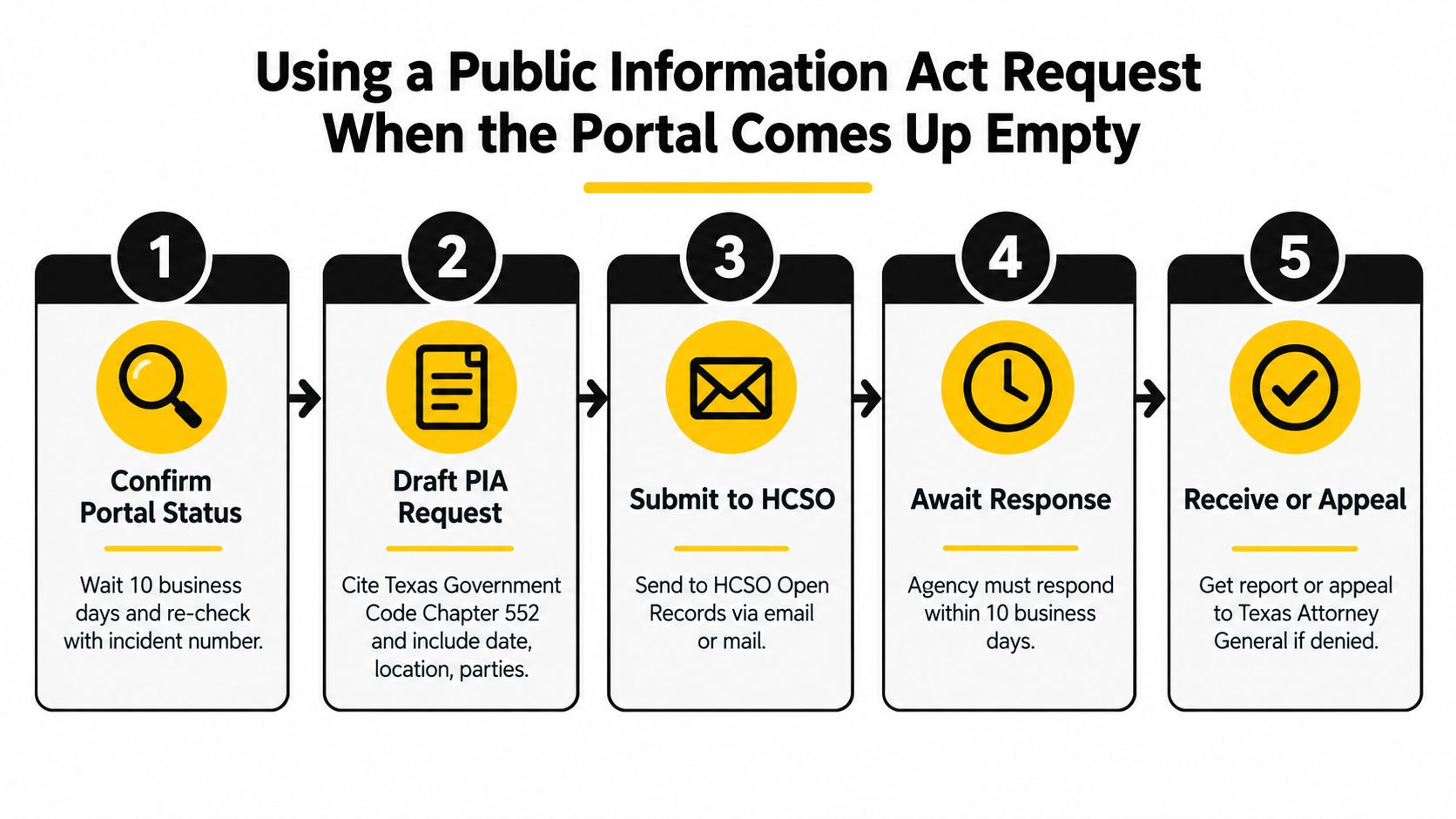
Escalation makes sense when the portal repeatedly returns the wrong incident, the report remains unavailable, or the agency says the file is restricted. Ask whether the matter involves an open investigation, a fatality hold, juvenile information, or a felony-related investigation. Those issues can change what the agency may release and when.
How to Read a Houston Crash Report and Spot the Details That Matter
A CR-3 can look like a page of codes until you know where to focus. Start with the header. Confirm the agency, case number, crash date, location, weather, road surface, and roadway information. A wrong date, address, vehicle description, or party name should be reported to the agency promptly and supported with documents.
Next, study the diagram and contributing-factor entries. They may address issues such as following too closely, failure to control speed, failure to yield, unsafe speed, or distraction. These entries provide leads for an insurance investigation, but they don't replace photographs, witness testimony, vehicle data, or medical proof.
Key fields and claim meaning
| Report Field | What It Means for Your Claim |
|---|---|
| Agency and case number | Identifies the record custodian and helps insurers match the report to the claim |
| Date, location, and road conditions | Helps verify where and how the collision occurred |
| Diagram | Shows vehicle positions, travel paths, impact points, and the officer's scene interpretation |
| Contributing factors | Provides possible evidence about conduct that contributed to the wreck |
| Vehicle and occupant information | Connects drivers, vehicles, plates, restraints, injuries, and insurance information |
| Injury classification | Helps compare the scene report with later medical records |
| Witness information | Gives the claim team people who may confirm the sequence of events |
| Narrative | Explains the officer's observations and may contain the clearest fault discussion |
The form may include vehicle identification, plate information, insurance information on file, restraint use, airbag deployment, and injury classifications. Compare those entries with your own records. If the report says no injury but symptoms appeared later, medical documentation can explain the difference.
For a plain-English walkthrough, see how to read a police accident report. Pay special attention to the narrative at the back. It may explain what each driver said, what witnesses reported, what physical evidence the officer observed, and why the officer recorded certain contributing factors.
A typo usually doesn't erase a valid claim. Ask the agency whether it will correct a clerical error or attach a supplement. Don't expect an officer to rewrite an opinion just because you disagree. Preserve the original report and build the correction with photographs, video, witness statements, and medical records.
Turning the Report Into an Insurance Settlement or Injury Claim
The report is a starting point, not a settlement. Use it to organize the evidence and open the right claims. The policy information may help you contact the other driver's carrier for property damage and bodily injury issues. If the policy information is incomplete, your lawyer or insurer can investigate coverage through the available claim records.
Comparative fault means responsibility is divided among the people whose conduct contributed to the collision. Texas Civil Practice and Remedies Code Chapter 33 provides that a claimant whose percentage of responsibility is greater than 50 percent cannot recover damages, as reflected in the Texas statutory text (Texas Civil Practice and Remedies Code Chapter 33). The report's contributing factors can affect that analysis, but the final allocation depends on all admissible evidence.
Match each report detail to the next action
- Policy information: Report the crash and open the appropriate property-damage and bodily-injury claims.
- Diagram and narrative: Compare the officer's account with photographs, vehicle damage, traffic signals, video, and witness statements.
- Injury information: Give medical providers a complete history and preserve bills, records, work restrictions, and treatment recommendations.
- Witness entries: Contact witnesses promptly through a safe and appropriate channel, and preserve their contact information.
- Vehicle information: Photograph damage before repairs and retain estimates, invoices, towing records, and rental documentation.
If you're unsure how to handle talking to an insurance adjuster, keep your statements accurate and limited to what you know. Don't guess about speed, fault, future treatment, or the full extent of your injuries. An adjuster's job is to evaluate the claim for the carrier, not to provide legal advice.

A statute of limitations is the legal deadline for filing a lawsuit. Texas personal-injury and wrongful-death claims generally carry a two-year period, so collect the report and evaluate the claim without allowing the insurance process to consume the available time. Different facts can affect deadlines, including the claimant's age, the defendant, and the type of claim.
Chapters 33 and 41 of the Texas Civil Practice and Remedies Code also matter. Chapter 33 addresses proportionate responsibility. Chapter 41 concerns exemplary damages, which are additional damages available only in limited circumstances and require proof beyond ordinary negligence. A Texas injury attorney can determine whether the facts support those theories, while ordinary compensation usually begins with medical expenses, lost income, property damage, pain, and other provable losses.
For a family facing a fatal crash, the report may help establish the initial timeline and involved parties, but wrongful death compensation requires a separate legal evaluation. Preserve death records, financial-loss evidence, and communications with every insurer.
Common Request Problems and How to Solve Them
Most delays have a practical explanation. Fix the process instead of repeatedly submitting the same incomplete request.
- Wrong agency: If HCSO cannot locate the collision, confirm whether HPD, a constable precinct, or a municipal police department investigated it. Request the report from the agency that created or maintains the record.
- After-hours submission: HCSO identifies Public Information Act request hours as Monday through Friday, 8:00 a.m. to 5:00 p.m. A submission outside that window may wait for the next business day, so save your confirmation and follow up through the correct records channel.
- Pending case: A case number may exist before the completed crash report reaches the portal. Ask whether the report is pending, incomplete, or awaiting a supplemental entry.
- Restricted file: A fatality, felony-related investigation, or other legal hold may limit release. Ask what can be released now and what process applies to withheld material.
- Incorrect information: If a driver name, address, vehicle description, or insurance entry is wrong, identify the exact error in writing and attach supporting proof. Request a correction or supplement rather than demanding that the original report disappear.
- Payment problem: If the standard report fee is declined, verify the portal's payment information or use an approved in-person or written request route. Confirm whether you need a standard or certified copy before paying.
- Missing paper copy: Ask the substation to verify the case number and records status. If the substation cannot locate it, escalate to HCSO records staff and then use a written Public Information Act request.
If the crash caused serious injuries, disputed liability, permanent impairment, or a death, don't let a records problem become a claim problem. The Law Office of Bryan Fagan, PLLC can help you pursue the report, protect evidence, evaluate your auto insurance claim, and assess whether you may seek injury or wrongful death compensation.
The Law Office of Bryan Fagan, PLLC offers free consultations for people dealing with Houston crash reports, insurance disputes, serious injuries, and wrongful-death claims. Visit The Law Office of Bryan Fagan, PLLC to connect with a Texas personal-injury team that can help you understand the next step and protect your rights.