A car crash can change your life in seconds, but you don't have to face recovery alone.
You may be reading this with your phone in your hand, your car in a tow lot, and a headache that won't go away. Maybe you were driving on I-45 through Houston in stop-and-go traffic when the car behind you never slowed down. One second you were headed home. The next, you were talking to police, calling family, and wondering how you'll pay for medical care, car repairs, and time off work.
That confusion is normal. So is the fear that one wrong step could hurt your case.
If you're searching for a Houston car accident lawyer after a wreck on I-45, it helps to slow the situation down and handle it one piece at a time. Your health comes first. Then your evidence. Then your insurance claim. Then the legal questions that often get harder on I-45 because crashes can involve different cities, counties, police agencies, and court venues.
Introduction and What You Face After an I-45 Crash
A rear-end crash on I-45 often looks simple at first. It usually isn't.
A Houston driver may leave the scene thinking they're just sore, then wake up the next day with neck pain, missed work, a totaled vehicle, and calls from insurance adjusters asking for recorded statements. If the wreck happened near an interchange, construction area, or county line, even basic details like where the report was filed and which court may handle a lawsuit can become more complicated than one might expect.
What usually hits first
After a crash, people often face several problems at once:
- Medical stress: You may need emergency care, follow-up visits, imaging, medication, or physical therapy.
- Financial pressure: Bills keep coming even when you can't work.
- Insurance confusion: Adjusters may sound helpful while also looking for ways to reduce what they pay.
- Legal uncertainty: You may not know who's liable, what evidence matters, or how long you have to act.
In plain English, liability means legal responsibility for the crash. Damages means the losses you suffered, such as medical bills, lost income, property damage, pain, and other harm recognized by law. The statute of limitations is the legal deadline to file a lawsuit. Waiting too long can block your claim entirely.
Practical rule: The first days after an I-45 wreck often shape the whole case. Medical records, crash scene photos, witness names, and the right report can matter later when fault is disputed.
Understanding Risk and Texas Liability on I-45
I-45 isn't just another Houston freeway. It has a documented record of severe crashes. Interstate 45 holds the title of the deadliest road in the U.S., averaging 56.5 fatal crashes per 100 miles; 73 people died on the Houston stretch in 2019 alone, and 45 fatal crashes occurred between 2018 and 2020, more than any other Harris County road, according to reporting on I-45's crash data.
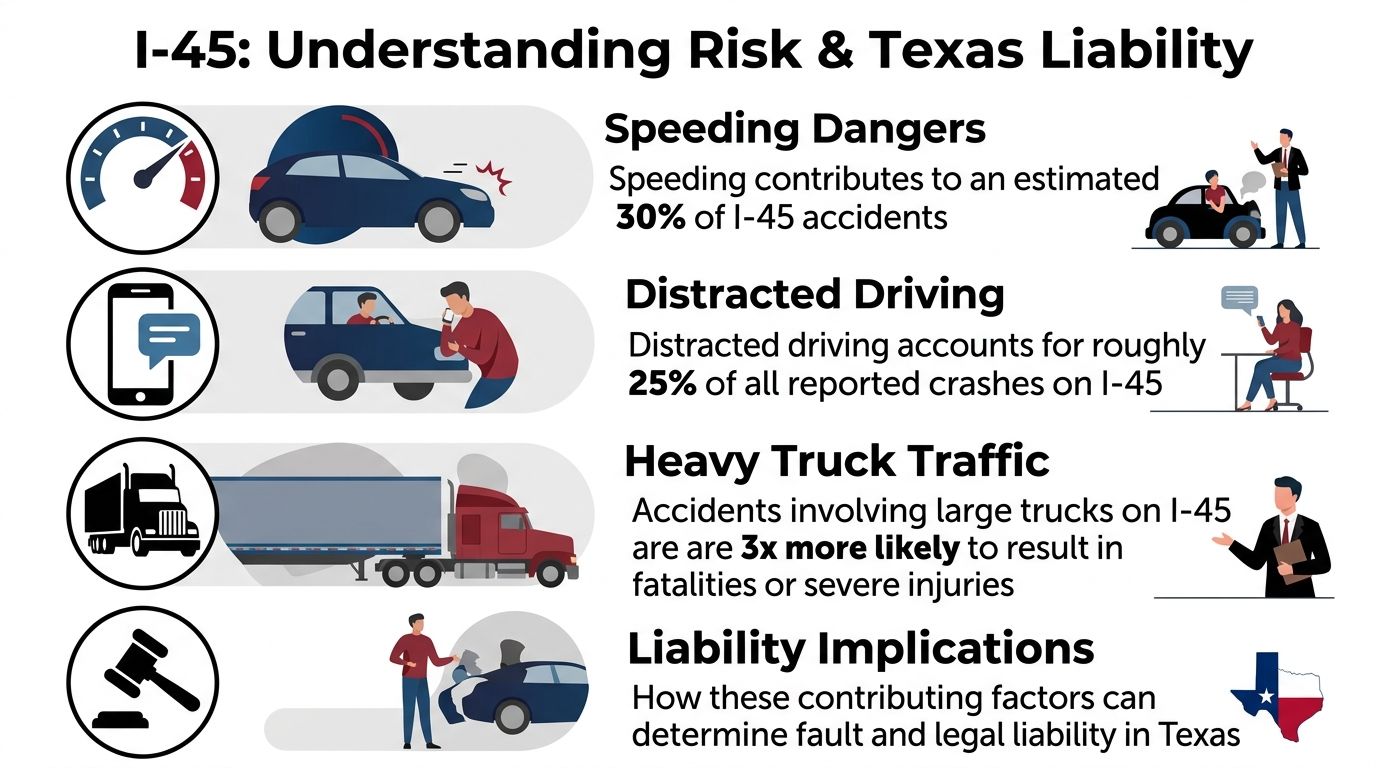
That matters because the road itself creates conditions where many forms of negligence overlap. Congestion, sudden braking, lane changes, commercial traffic, poor weather, and distracted driving can all feed into the same collision.
What negligence means in Texas
Under Texas personal injury law, a crash claim usually turns on negligence. That means one party failed to use reasonable care and caused harm.
A driver's duty of care is the basic legal obligation to drive safely, pay attention, follow traffic laws, and avoid creating unreasonable risk for others. If a driver speeds, follows too closely, drifts between lanes, drives impaired, or looks down at a phone, that conduct may support a negligence claim.
How Chapters 33 and 41 fit in
Texas Civil Practice & Remedies Code Chapter 33 governs proportionate responsibility in tort cases, including car wrecks. That chapter becomes important when more than one person may share fault. Chapter 41 addresses certain rules tied to damages in civil cases, including how some categories of damages are treated under Texas law.
Here's the plain-English version:
| Term | Meaning |
|---|---|
| Liability | Who is legally responsible |
| Comparative fault | How fault is divided between people involved |
| Damages | The compensation sought for losses and harm |
| Duty of care | The responsibility to act with reasonable safety |
A real I-45 example helps. If a driver brakes suddenly in traffic, the vehicle behind may still be liable for following too closely. But if another driver was also weaving across lanes and triggered the chain reaction, fault may be split.
That's one reason a car accident on I-45 Houston lawyer needs to examine more than the final impact point. The full sequence matters.
Immediate Actions After a Crash
The hours after a crash are messy. You may be shaken, in pain, or trying to get out of traffic safely. Still, a few calm steps can protect both your health and your claim.

What to do first
Call 911
If anyone is hurt, ask for emergency help right away. Even when injuries seem minor, police response can help create an official record.Get medical care
Adrenaline hides pain. Neck injuries, back injuries, concussions, and internal injuries may not fully show up at the scene.Move to safety if possible
If the vehicles can be moved and it's safe, get out of live traffic lanes.
What evidence to gather
If you're physically able, collect basic information before the scene changes.
- Photos and video: Capture vehicle damage, road markings, traffic signs, debris, skid marks, weather, and visible injuries.
- Names and contacts: Get information for drivers, passengers, and witnesses.
- Insurance and vehicle details: Photograph insurance cards, license plates, and commercial markings on trucks or delivery vehicles.
- Digital evidence: Ask whether nearby businesses, dashcams, or traffic cameras may have footage.
For a fuller checklist, see what to do after a car accident.
After a highway crash, the scene changes fast. Cars are moved, debris is cleared, and people leave. If you can document conditions early, you preserve details that may never come back.
What not to say
Don't guess about fault. Don't apologize in a way that sounds like admitting blame. Don't tell the other insurer you're “fine” if you haven't been evaluated yet.
A simple example: if you say, “I didn't see him either,” that sentence may later be used to argue you contributed to the crash, even if the other driver made the dangerous move.
If your injuries happened somewhere other than a roadway, such as a store or apartment complex, a different type of claim may apply. Houston Slip and Fall / Premises Liability Lawyer addresses representation for injuries caused by unsafe property conditions in Houston.
Comparative Fault and Calculating Your Damages
Many people think the other driver is either at fault or not at fault. Texas law is often more nuanced than that.
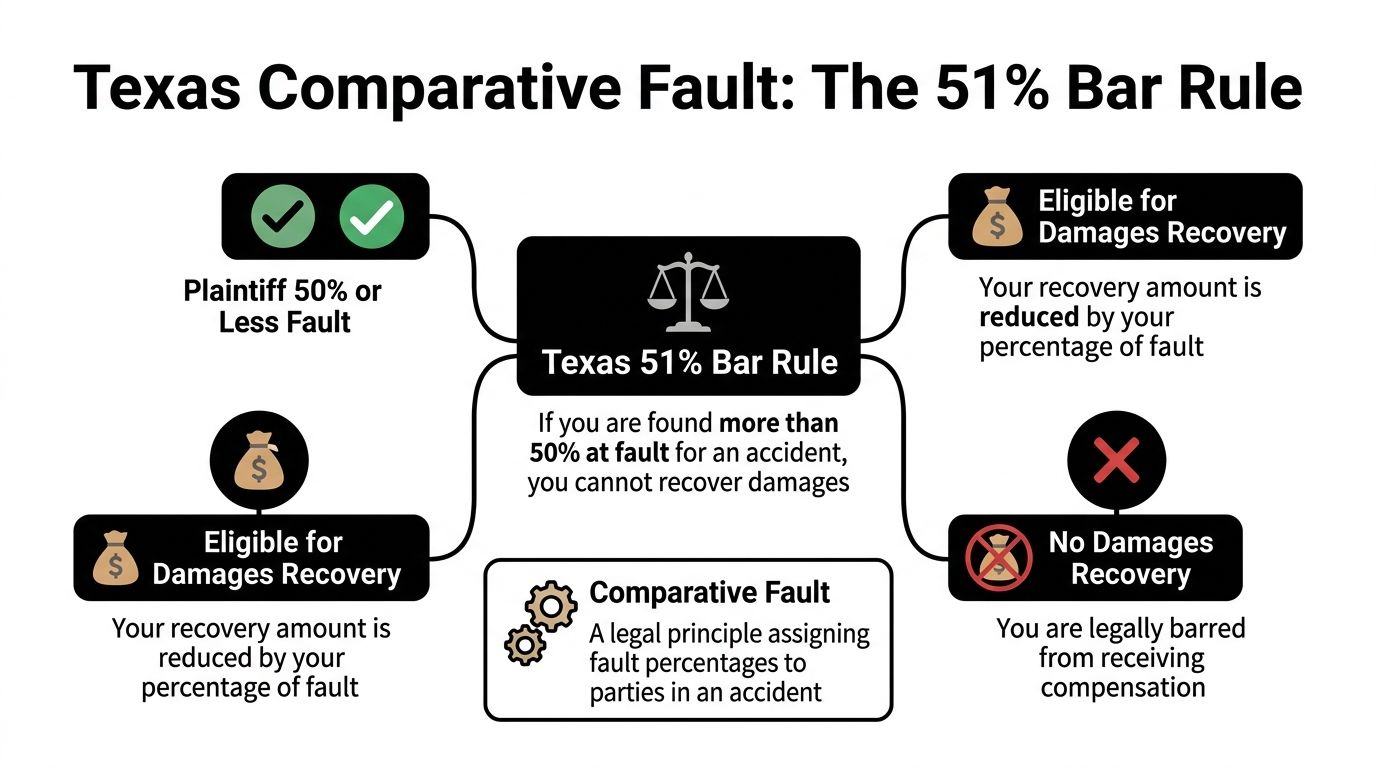
Under Texas Chapter 33, a plaintiff with 51% or greater fault recovers nothing; if your fault is 50% or less, your damages award is reduced by your exact percentage of fault, as explained in this discussion of Texas comparative fault rules.
What comparative fault means
Comparative fault means the law assigns percentages of blame to the people involved in the crash.
A simple example helps. Suppose a Houston driver is rear-ended on I-45, but evidence shows that driver also changed lanes abruptly without signaling just before the impact. A jury could decide the rear driver was mostly at fault, while still assigning some fault to the driver in front.
If the injured driver is found 30% responsible, that driver receives 70% of the full damages award. If the injured driver reaches 51% or more, recovery is barred.
For a more focused explanation, review this guide to comparative fault in Texas accident cases.
What damages can include
In a car wreck claim, damages may include:
- Medical expenses: Emergency care, follow-up treatment, medication, therapy, and future care
- Lost income: Time missed from work and reduced earning ability
- Pain and suffering: Physical pain and the daily limits the injury causes
- Property loss: Vehicle damage and related out-of-pocket costs
If your crash caused lasting neck or back symptoms, good medical documentation matters. Many people benefit from learning more about diagnosing and treating spinal pain so they understand what symptoms to report and what treatment records may support a claim.
Key point: Don't reduce your own case by guessing what it's worth too early. The value often becomes clearer after doctors understand the full injury, restrictions, and likely recovery path.
Special Considerations for Trucking and Rideshare Crashes
A regular two-car wreck and a commercial vehicle wreck may look similar on the road, but the legal work is very different.
Harris County had 3,857 truck crashes in 2024, the highest in Texas, creating complex liability disputes involving federal safety regulations, maintenance failures, and multiple insurance layers, according to this report on Texas trucking crash litigation issues.
Truck crashes often involve deeper investigation
In a trucking case, the driver may not be the only defendant. A claim can involve the trucking company, a maintenance contractor, a vehicle owner, a freight broker, or another business tied to the load or equipment.
Useful evidence may include:
- Driver qualification records
- Inspection and maintenance records
- Hours-of-service logs
- Electronic data from the truck
- Company safety policies
If a truck jackknifes on I-45 and blocks multiple lanes, fault may involve speed, brake condition, driver fatigue, loading issues, or company supervision. That's very different from an ordinary fender-bender.
Rideshare cases raise insurance questions
Uber and Lyft crashes often turn on what the driver was doing in the app at the time of the collision. The available insurance may differ depending on whether the driver was offline, waiting for a ride request, or carrying a passenger.
A rideshare crash also creates practical problems. The driver may use a personal insurer, but the rideshare company's policy may also matter. Sorting that out early can help avoid delay.
If your I-45 wreck involved an app-based driver, this overview of Houston rideshare accident issues may help you understand the claim path.
A Texas injury attorney handling either type of case should identify every possible insurer before key records disappear.
Wrongful Death Claims for Families
When a loved one dies after an I-45 crash, legal questions can feel impossible to face. Families are grieving, planning services, managing bills, and trying to understand what happened.
Texas law allows certain surviving family members to pursue a wrongful death claim. In plain terms, a wrongful death claim is a civil case that seeks compensation when someone's death was caused by another party's wrongful act, neglect, carelessness, or default.
Who may have the right to bring a claim
In many cases, the surviving spouse, children, or parents may have the right to file. A related estate claim may also be relevant depending on the facts and the role of a personal representative.
The details matter. Families often need to gather:
- Death certificate and medical records
- Crash report and witness information
- Funeral and burial expense records
- Proof of financial support the loved one provided
What compensation may cover
A wrongful death case may seek wrongful death compensation for losses connected to the death, such as funeral costs, lost financial support, and the emotional harm suffered by qualifying family members. An estate-related claim may involve losses the deceased person suffered before death.
Chapter 33 can still matter here if the defense argues the person who died shared blame for the crash. Chapter 41 may also affect how some damages issues are handled in civil litigation.
Families often feel pressure to make quick insurance decisions while they're still in shock. It's okay to slow down, gather records, and get legal guidance before signing anything.
Venue matters too. If the fatal crash occurred on a stretch of I-45 connected to one county but involved responders, witnesses, or defendants tied to another, filing in the right place can shape how smoothly the case moves.
Insurance Claims Process and Typical Timelines
Insurance claims don't move in a straight line. They move in stages, and each stage depends on records, treatment progress, liability evidence, and the number of parties involved.

How a typical auto insurance claim starts
Most claims begin when you report the wreck to your own insurer and, if known, the at-fault driver's insurer. This is often called an auto insurance claim.
The insurer then investigates. It may request photos, a recorded statement, vehicle estimates, and medical authorization forms. Be careful here. Some requests are routine. Others may give the insurer broad access to unrelated records.
A common pattern looks like this:
| Claim stage | What usually happens |
|---|---|
| Notice of claim | The crash is reported to the insurer |
| Investigation | Adjusters gather statements, photos, reports, and policy information |
| Treatment period | You receive care and your injuries become clearer |
| Demand phase | A settlement demand is prepared with evidence of fault and damages |
| Negotiation | The parties discuss value and liability |
| Suit if needed | A lawsuit is filed if the claim doesn't resolve fairly |
Why timelines vary on I-45
An I-45 crash can take longer to sort out when multiple vehicles are involved or when the wreck crosses county lines. One police agency may respond while medical records come from another county and witnesses live somewhere else.
Insurance delay also becomes more likely when there are venue disputes, conflicting statements, commercial vehicles, or questions about shared fault.
A multi-vehicle example shows why. If three drivers are involved and one settles before trial, Texas Chapter 33 requires courts to reduce awards by any settlement credits before assigning liability, meaning early settlements by one driver subtract from the total before other defendants pay their share, as reflected in Texas Civil Practice and Remedies Code Chapter 33.
How to deal with the insurance company
Use a disciplined approach.
- Stick to facts: Report when and where the crash happened, who was involved, and where your car is located.
- Avoid medical conclusions: Don't say you're fully recovered if treatment is still ongoing.
- Track every contact: Keep a log of calls, emails, claim numbers, and the adjuster's name.
- Review settlement language carefully: Some releases close the claim completely.
If the insurance company asks for a recorded statement right away, you don't have to treat that request as harmless. The timing often benefits the insurer more than the injured person.
Uninsured and underinsured motorist issues can also appear if the at-fault driver lacks enough coverage. In those cases, your own policy may become part of the recovery process.
How a Houston Lawyer Can Help with I-45 Crashes
I-45 cases often become harder because the road doesn't sit neatly inside one local system. A crash may involve Houston police, county records, outside medical providers, and defendants tied to different parts of the corridor.
That's not a small issue. 42% of highway accident claims in Texas face initial venue disputes due to jurisdictional ambiguity across counties, a problem highlighted in this discussion of venue issues in Interstate 45 accident claims. On I-45, that matters because the highway spans Harris, Galveston, and Jefferson counties.
What a local lawyer actually does
A Houston car accident lawyer helps by identifying the right venue, preserving evidence, and pushing the case forward when insurers or defense lawyers try to stall it.
That work may include:
- Ordering reports from the correct agency
- Securing witness statements before memories fade
- Collecting medical records in a usable format
- Analyzing fault under Texas Chapter 33
- Negotiating with multiple insurers
- Preparing the case for trial if needed
The Law Office of Bryan Fagan, PLLC handles Texas personal injury matters involving car wrecks, trucking crashes, rideshare collisions, insurance disputes, and fatal accident claims.
What to bring to a consultation
You don't need to walk in with a perfect file. Bring what you have.
- Crash paperwork: Exchange sheet, report number, towing info
- Photos and video: Scene images, vehicle damage, visible injuries
- Insurance documents: Your policy, letters, emails, claim numbers
- Medical records you already have: Discharge papers, prescriptions, work notes
A lawyer can often help fill in the missing pieces. That's especially useful when your crash happened on a complicated stretch of I-45 and the paperwork is spread across agencies or counties.
If you've been hurt and need clear answers about your rights, your next step doesn't have to be complicated.
If you were injured in a wreck and need practical guidance from a Houston car accident lawyer, contact The Law Office of Bryan Fagan, PLLC for a free consultation. You can talk through what happened, learn how Texas negligence rules may apply to your case, and get help dealing with insurance companies, venue questions, and the evidence needed to protect your claim. You don't have to sort out an I-45 crash alone. Legal help is available, and your rights matter.