A car crash can change your life in seconds, but you don't have to face recovery alone.
If you were hurt at work in Houston, life may feel split into two parts. Before the accident, you had a routine, a paycheck, and a plan. After the accident, you may be dealing with pain, missed work, pressure from your employer, and a lot of confusion about what comes next.
Many injured workers make the same understandable mistake. They assume every work injury follows the same legal path. In Texas, that isn't true. Your options can change depending on whether your employer carries workers' compensation, whether the company opted out, and whether someone outside your employer also caused the accident.
That difference can affect your medical benefits, lost wages, damages, deadlines, and your right to file a lawsuit. It can also affect how you handle an insurance claim, whether you need a Houston car accident lawyer for a crash that happened while you were working, and whether your family may later need to explore wrongful death compensation if a tragedy becomes fatal.
An Injury at Work Can Change Everything
You may have been lifting materials at a warehouse, driving between job sites, working on a scaffold, or sitting at a desk when equipment failed and injured your hand. At first, many focus on one thing. Getting through the day.
Then the bigger worries show up. How will you pay bills if you can't work? Who pays for treatment? Is your employer helping you, or protecting itself?

Why this happens so often in Texas
Work injuries are not rare here. Texas has ranked either first or second in the United States for the number of annual workplace injuries since 1992, and plaintiffs who hire a lawyer receive an average of $77,600, compared with $52,900 for those without legal representation, according to Houston construction accident data discussed by Sutliff & Stout.
That matters because many workers blame themselves, stay quiet, or think they should just “see how it goes.” In many cases, waiting makes things harder. Evidence disappears. Witnesses forget details. Insurance companies start building their version of events fast.
Practical rule: If your injury happened while you were doing your job, treat it like a legal issue as well as a medical one.
A simple example
A Houston driver rear-ended on I-45 while making deliveries for work may have more than one legal problem at once. There may be a work injury claim, an auto insurance claim, and a personal injury case against the driver who caused the crash. That is why a Texas injury attorney has to identify the right path early.
Legal terms can make this feel harder than it is. In plain English:
- Liability means legal responsibility for causing harm.
- Damages means the losses the law may let you recover, such as medical bills, lost income, and sometimes pain and suffering.
- Statute of limitations means the filing deadline.
- Comparative fault means your compensation can be reduced, or blocked, if you share too much of the blame.
Texas negligence law also matters in work injury cases that become lawsuits. Under Texas Civil Practice & Remedies Code Chapters 33 and 41, fault allocation and damages rules can shape what a case is worth and how it is proved. The hard part is knowing when those rules apply and when a workers' compensation system applies instead.
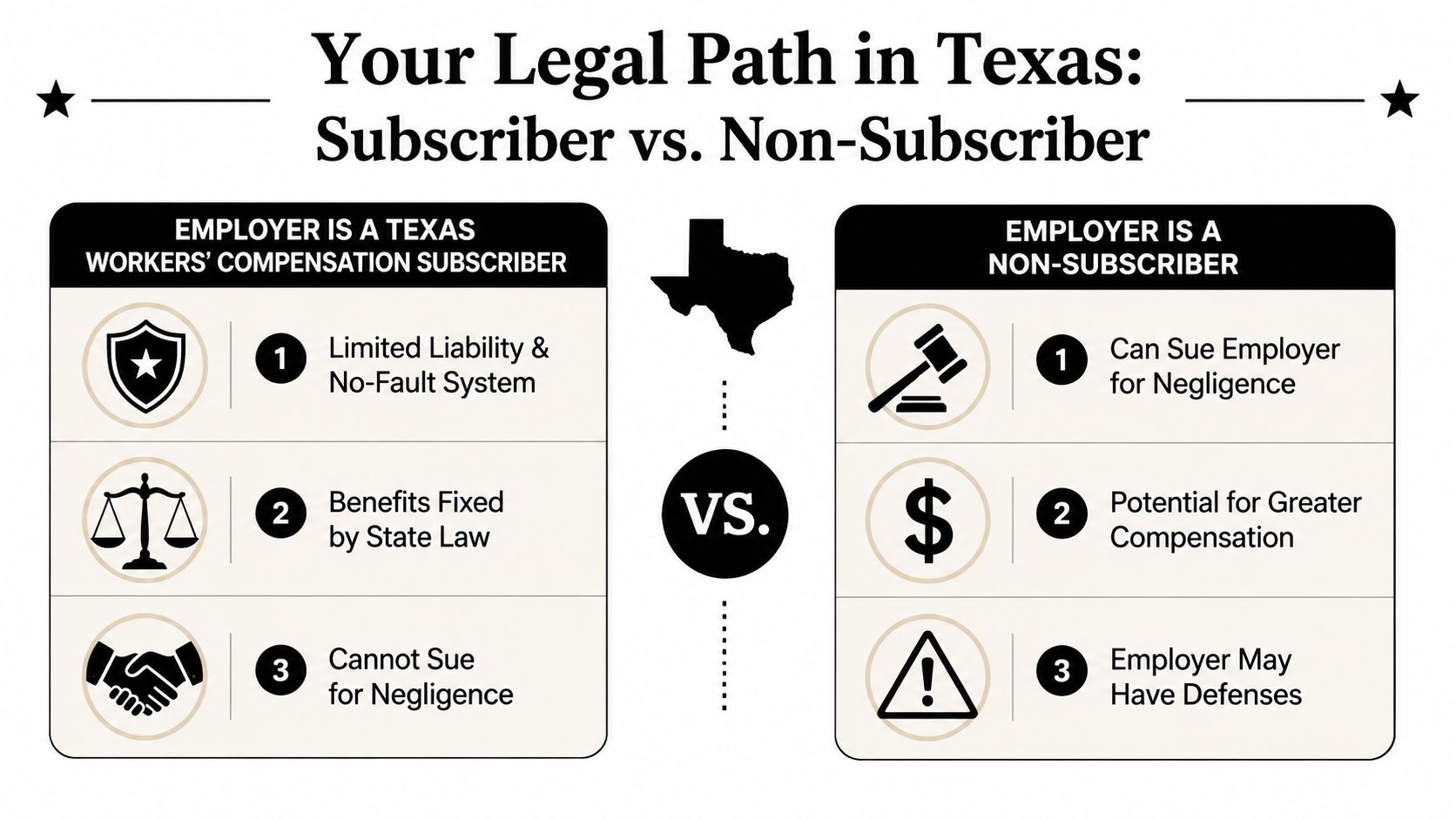
Your Legal Path in Texas Is Your Employer a Subscriber
The first question in most Texas work injury cases is simple.
Is your employer a workers' compensation subscriber or a non-subscriber?
That question creates a fork in the road. One road is an administrative claim. The other may be a negligence lawsuit.
If your employer is a subscriber
If the company carries workers' compensation coverage, your claim usually goes through that system. This is often described as no-fault, which means you may qualify for certain benefits without proving your employer was negligent.
That sounds straightforward, but workers often get confused here. A no-fault system does not mean full compensation for every loss. It usually means a narrower set of benefits, and it generally does not include pain and suffering.
A subscriber claim often focuses on:
- Medical care tied to the injury
- Lost wage benefits in certain situations
- Administrative rules instead of a normal lawsuit
- No negligence suit against the employer in most cases
If your employer is a non-subscriber
Texas is unusual because employers can opt out of workers' compensation. According to the Texas Department of Insurance, over 15% of Texas employers are non-subscribers, which means they opt out of workers' comp. That changes the case from a no-fault administrative process into a personal injury lawsuit where pain and suffering may be recoverable.
When your employer is a non-subscriber, you may be able to bring a negligence claim. That can open the door to a wider range of damages than workers' compensation usually allows.
Here is the practical difference:
| Employer status | What it usually means for you |
|---|---|
| Subscriber | Claim goes through workers' comp, benefits are limited, and suing the employer for negligence is generally restricted |
| Non-subscriber | You may sue the employer for negligence and seek broader damages, including losses workers' comp does not usually cover |
A work injury case in Texas is not one-size-fits-all. The employer's coverage status often decides whether you are filing paperwork, building a lawsuit, or both.
Why workers get tripped up here
Many injured workers hear the phrase “work injury” and assume “workers' comp.” That assumption can cost them. If your employer opted out, the case needs a different strategy from day one.
For example, if a warehouse worker slips because the company ignored a known hazard, a non-subscriber case may focus on unsafe policies, missing training, or poor supervision. If that same worker wrongly assumes workers' comp is the only option, valuable evidence may never be gathered.
If you want a plain-language overview of this issue, this guide on being hurt at work in Texas can help you frame the basic questions. It also helps to see how liability rules evolve in other areas of injury law, such as the impact of Florida tort reform on trucking, because legal structure changes how claims are valued and defended.
What to ask right away
When you report the injury, ask these questions clearly:
- Is my employer a workers' compensation subscriber?
- Who is the insurance carrier or claim administrator?
- Was another company, contractor, driver, or manufacturer involved?
- Do I need to preserve equipment, photos, or witness information right now?
Those answers shape everything that follows.
Beyond Your Employer Identifying Third-Party Liability
Your employer may not be the only party who caused your injury.
That idea is called third-party liability. It means someone outside your employer may also be legally responsible. This is common in Houston because many worksites involve contractors, delivery vehicles, outside vendors, equipment makers, and shared job locations.
Common third-party examples
A few examples make this easier to see:
- A construction worker uses a defective power tool. The employer may be involved, but the tool manufacturer might also face liability.
- A refinery contractor creates a dangerous condition. The injured person may have a claim against that outside contractor.
- A delivery driver gets hit on Loop 610 while making a route. The driver who caused the crash may be a separate defendant in a motor vehicle case.
An overlap can occur between a work injury case and the work of a Houston car accident lawyer. If you were driving for work when another motorist caused the crash, your work status does not erase your traffic injury claim.
Why this matters so much for drivers
A recent study noted a 40% surge in third-party liability cases for delivery and rideshare drivers in Houston over the last year. These claims matter because they may allow recovery for damages like pain and suffering that standard workers' compensation typically does not cover.
That means rideshare and delivery workers should look beyond the employer relationship. Uber, Lyft, DoorDash, Amazon route drivers, and similar workers are often injured in situations involving multiple companies and multiple insurance policies.
If someone other than your employer helped cause the accident, you may have a separate claim even when workers' compensation is part of the picture.
Unsafe property can also create a third-party case. If your injury happened because of a dangerous walkway, broken stairs, poor lighting, or another property hazard at a job site, Houston Slip and Fall / Premises Liability Lawyer information may be relevant because it addresses injuries caused by unsafe property conditions in Houston.
Plain-English legal terms here
Again, Texas negligence law comes into play.
- Negligence means someone failed to use reasonable care.
- Liability means that failure legally caused your injury.
- Damages are the losses you seek from the responsible party.
If a third party caused the harm, your case may look less like a workers' comp file and more like a standard personal injury claim.
Critical Deadlines You Cannot Miss After a Work Injury
A missed deadline can change your case more than the injury itself.
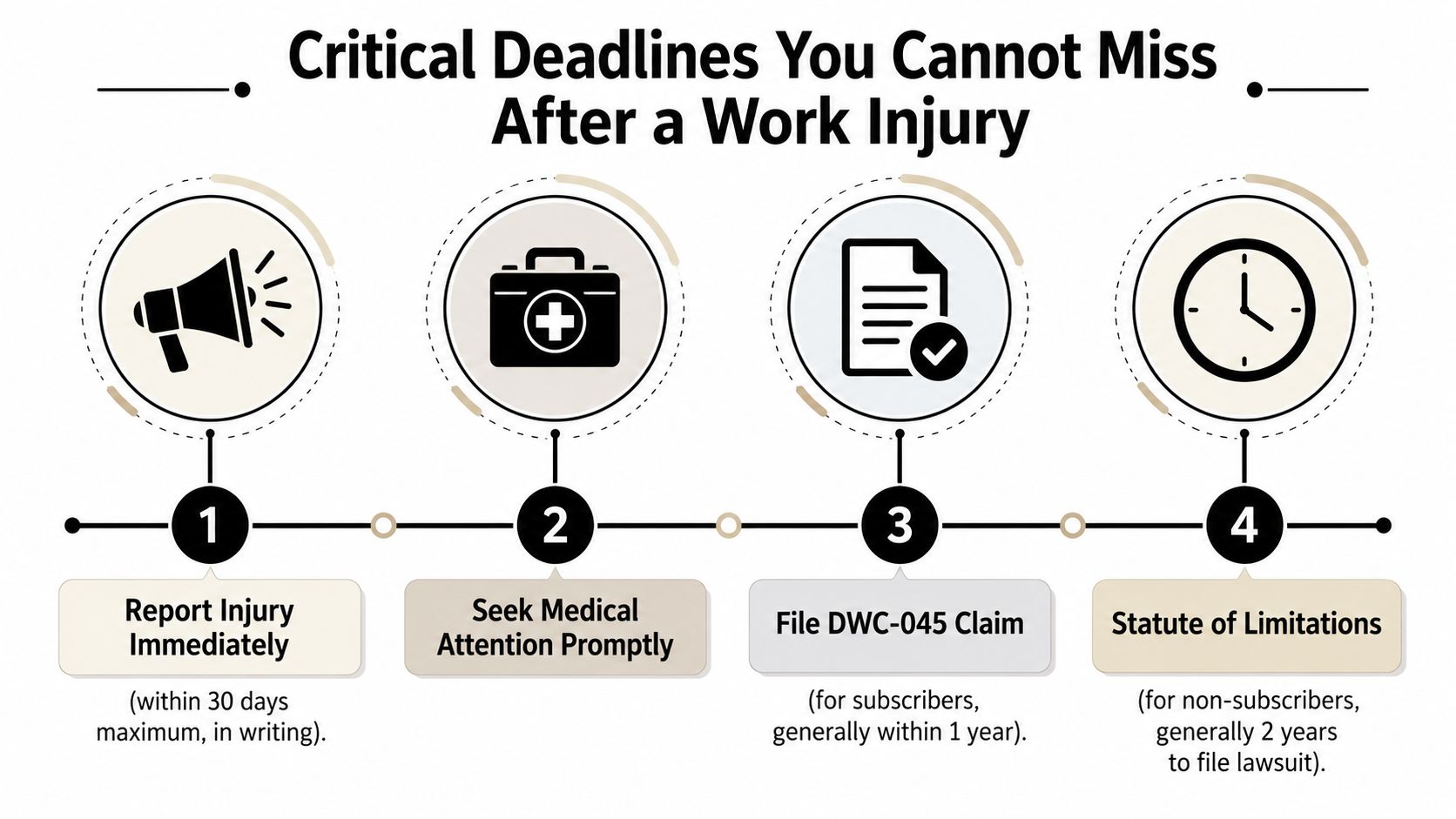
In Texas, the calendar you are dealing with depends on the legal path your injury falls under. A workers' compensation claim has one set of deadlines. A non-subscriber injury lawsuit has another. A third-party case, such as one against a driver, contractor, or property owner, usually follows the lawsuit clock. If you choose the wrong path or wait too long to identify it, you can lose rights that cannot be restored later.
Start with the shortest deadline
If your employer carries Texas workers' compensation coverage, you generally must report the injury to your employer within 30 days. You also generally must file a claim with the Division of Workers' Compensation within one year.
That first deadline arrives fast. A worker may spend the first week hoping the pain fades, the second week trying to keep working, and the third week realizing the injury is worse than expected. By then, valuable time is already gone.
Written notice is safer than verbal notice. An email, text, incident report, or other dated message creates a record that is much harder to dispute later.
Lawsuit deadlines are different
If your employer is a non-subscriber, or if someone other than your employer caused the injury, you may be dealing with a lawsuit instead of a workers' comp claim. In many Texas work injury lawsuits, the filing deadline is two years under Texas Civil Practice and Remedies Code Section 16.003.
That two-year period sounds long, but it shrinks quickly once you factor in medical treatment, missed work, witness turnover, and time spent figuring out who is legally responsible. A broader explanation of these filing limits appears in this guide to Texas statutes of limitations for injury claims.
The hard part for many injured workers is that more than one deadline may apply at the same time. You might have a workers' comp deadline tied to your employer and a separate lawsuit deadline tied to a third party. Those are different tracks, not extensions of each other.
Match the deadline to the claim
A simple way to think about it is this:
- Workers' comp subscriber claim: short notice deadline, then an administrative filing deadline
- Non-subscriber employer claim: lawsuit deadline usually controls
- Third-party negligence claim: lawsuit deadline usually controls, even if a workers' comp claim also exists
This distinction matters because Texas does not treat every work injury the same way. The right deadline depends on who may be legally responsible.
Do not wait for the full picture
Many workers delay action because they do not yet know how serious the injury is, whether surgery will be needed, or whether the employer has workers' comp coverage. That confusion is common. It is also dangerous.
You do not need every answer before protecting your rights. Report the injury promptly. Confirm whether your employer is a subscriber or non-subscriber. Identify any outside company, driver, contractor, or property owner who may have contributed to what happened. Then make sure the deadline for each possible claim is tracked separately.
If the injury later becomes fatal, a wrongful death claim can follow its own two-year filing period measured from the date of death. In severe refinery, construction, and work vehicle cases, that date can matter just as much as the original accident date.
Steps to Take Immediately to Protect Your Claim
The first few hours after a work injury often shape what happens months later. Medical records get created. Supervisors write reports. Insurance representatives start asking questions. If the wrong legal path is assumed at the start, a subscriber claim, non-subscriber case, or third-party lawsuit can become harder to prove.
Start by protecting the facts
After an accident, your body is injured and the evidence is fragile. Treat the situation like a phone battery at one percent. If you do not preserve what matters early, important details can disappear fast.
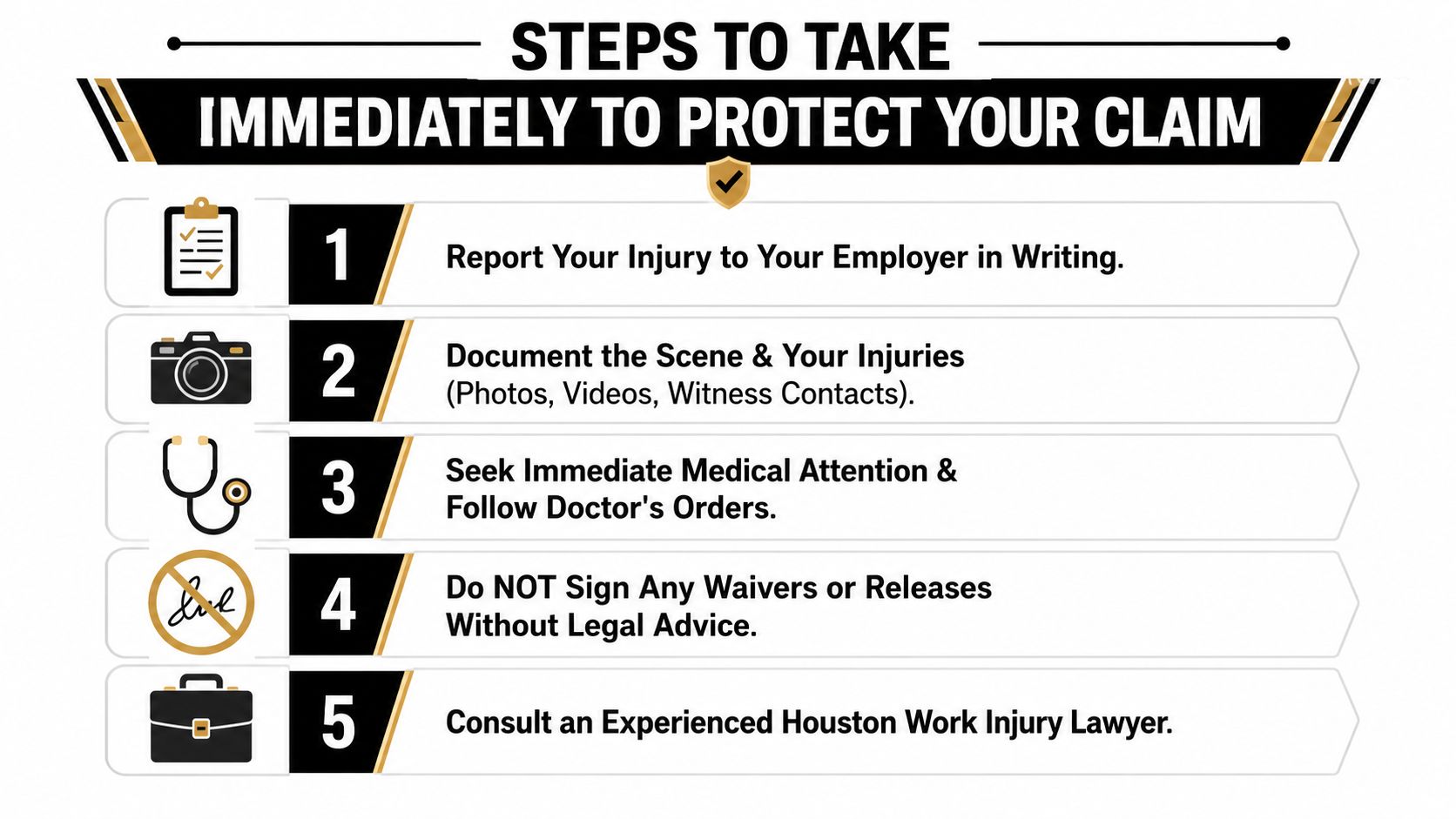
Focus on five practical steps:
- Report the injury in writing. An email, text, or incident report creates a time-stamped record.
- Get medical care promptly. Tell every provider the injury happened at work and explain exactly how it happened.
- Photograph the scene and your injuries. Include tools, machinery, floor conditions, vehicles, safety gear, and anything broken or unsafe.
- Write down witness names and contact information. Co-workers change shifts, quit, or forget details.
- Keep your own file. Save work messages, medical papers, prescriptions, bills, mileage, and any employer forms.
These steps help no matter which Texas claim path applies. They can support a workers' comp file, a non-subscriber negligence case, or a lawsuit against an outside company.
Do not let the paperwork choose your case for you
This point gets missed all the time in Houston work injury cases. The first documents often frame the injury as "just workers' comp" or "just an insurance matter," even when the facts suggest more than one claim.
For example, a warehouse worker hurt by a forklift may have a claim involving the employer, the forklift operator, the maintenance company, or the equipment maker. A rushed incident report that leaves out who controlled the forklift or why the safety system failed can limit what gets investigated later.
Read carefully before signing anything. If you are asked for a recorded statement or broad medical authorization, slow down and understand what is being requested. A short explanation of a lawyer letter of representation can help you see how attorneys step in to control communication early.
Watch for common mistakes
A few choices cause problems again and again:
- Giving a recorded statement too early. You may not yet know the full extent of your injuries.
- Leaving out your work status at the doctor. That gap can create confusion about causation later.
- Assuming your employer is the only possible defendant. On construction sites, refineries, and delivery routes, another company may share fault.
- Signing broad releases without review. Those forms can reach far beyond the injury at issue.
- Relying only on the employer's incident report. Your own photos and notes may tell a fuller story.
If your injury involved a fall, unsafe equipment, or a site hazard, outside safety information can also help you understand what should have happened. Some workers use KODOBI workplace safety expertise as background reading while their case is being evaluated.
Here is a short video that may help you think through your next steps.
The first written version of an accident often carries outsized weight. Make sure it is accurate, specific, and complete.
A real-world example
A Houston driver hit on I-45 while making deliveries may think the auto insurer will handle everything. But the legal path may be wider than that. If the employer is a subscriber, there may be a workers' comp claim. If the employer is a non-subscriber, there may be a negligence claim against the employer. If another driver caused the crash, there may also be a third-party case.
Now add one common mistake. The injured worker tells the emergency room only that a car crash happened, not that it happened during work. Later, the delivery app records are gone, the employer disputes job status, and the insurer points to incomplete medical history. The injury is still real, but proving the right claim becomes harder than it should have been.
How a Houston Work Injury Lawyer Builds Your Case
A strong case is built piece by piece. Most of that work happens behind the scenes.
An attorney starts by identifying the legal path. Is this a subscriber claim, a non-subscriber lawsuit, a third-party case, or a combination? That early decision affects evidence, deadlines, and who should receive notice.
The investigation phase
The first phase usually includes:
- Coverage review: finding out whether the employer subscribed to workers' comp
- Liability analysis: identifying who caused the injury
- Evidence collection: medical records, incident reports, photographs, witness statements, and job records
- Damage evaluation: understanding how the injury changed your work, income, and treatment needs
If the case involves a fall, heavy equipment, or site safety failure, outside safety analysis may help. For broader context on accident prevention and employer responsibility, some workers find KODOBI workplace safety expertise useful as background reading.
You may also hear that a lawyer sends a formal notice to insurers and opposing parties. If you want to understand that part, this explanation of a lawyer letter of representation is a helpful starting point.
Why fault matters under Texas law
Texas uses a proportionate responsibility rule. Under Texas Civil Practice & Remedies Code Chapter 33, if you are found to be more than 50% responsible, you are barred from recovering damages. If you are not barred, your damages are reduced by your percentage of responsibility, as discussed in this Texas Law Review analysis of Chapter 33.
That rule is why comparative fault matters. In plain language, comparative fault means the defense may argue that you caused part of the accident. Your lawyer's job is to push back with facts, records, witness testimony, and a clear timeline.
When a company or insurer says, “You should have seen it,” “You were moving too fast,” or “You knew the risk,” they are often trying to shift fault onto you.
Negotiation and, if needed, litigation
Once the facts are developed, the case usually moves into negotiation. A lawyer organizes the evidence, calculates damages, responds to insurance arguments, and pushes for a fair result.
If settlement talks fail, the case may need to be filed in court. That is where Texas negligence law, Chapter 33 fault rules, and Chapter 41 damages rules can become especially important.
One practical point also matters to many families. The Law Office of Bryan Fagan, PLLC handles injury matters on a contingency-fee basis, which means the client does not pay attorney's fees unless there is a recovery.
Your Next Step Get a Free Consultation Today
If you were injured at work, you do not need to know every legal rule before asking for help. You only need to know that your case may be more complicated, and more valuable, than it first appears.
The biggest mistake many workers make is choosing the wrong path because they didn't know there were multiple paths. In Texas, a work injury might involve workers' compensation, a non-subscriber negligence lawsuit, a third-party claim, a vehicle case, or several of those at once. That is why early legal guidance matters.
What your consultation can clarify
A consultation can help answer questions like:
- Was your employer a subscriber or non-subscriber?
- Do you have a third-party claim in addition to a workplace claim?
- What damages may be available in your situation?
- What deadlines apply right now?
- How should you deal with insurance company contact?
Those are not small details. They shape the entire case.
If your injury involved a vehicle collision
Some workers are injured while driving for work. In those cases, the legal issues can overlap with ordinary motor vehicle law. A Houston car accident lawyer may need to evaluate the crash facts, insurance coverage, and fault issues while a work injury attorney evaluates the employment side.
The same is true in fatal work crash cases. Families may need answers about liability, insurance, and wrongful death compensation while they are still trying to process what happened.
You don't have to figure all of this out alone. You also don't have to wait until the insurance company has already shaped the record.
The earlier you get clear advice, the easier it is to protect evidence, avoid mistakes, and choose the right legal path.
If you're unsure whether you have a workers' comp claim, a lawsuit, or both, asking questions now can protect your rights and reduce stress later.
Contact The Law Office of Bryan Fagan, PLLC for a free consultation if you were hurt at work in Houston. We can help you understand whether your case involves workers' compensation, a non-subscriber claim, a third-party lawsuit, an auto insurance claim, or wrongful death compensation. You'll get clear answers about your rights, your deadlines, and your next steps.