Skip to content
A car crash can change your life in seconds, but you don't have to face recovery alone.
If you're reading this after a wreck with a commercial truck, you may still be replaying the moment in your head. One second you were driving to work, heading home, or taking your kids across town. The next, your car was crushed by a vehicle so large and heavy that the impact changed everything.
Many Texas families come to a Houston car accident lawyer with the same question. How could this happen? In some truck wreck cases, the answer starts with fatigue. Trucking companies and drivers have to follow federal safety rules because tired driving is dangerous. One of the most important of those rules is the new 14 hour rule for truck drivers.
A Crash Can Change Your Life But You Are Not Alone
A Houston driver rear-ended on I-45 by a tractor-trailer may assume the wreck was just bad luck. A family hit by a commercial truck near the Ship Channel may hear the trucking company say the driver “had a long day” or that traffic caused delays. But those details matter. They may show the driver stayed on the road longer than federal law allows.
The rule exists for a simple reason. A truck driver who has been working too long can miss a stopped car, drift across a lane, or react too slowly when traffic changes. For injured people, that rule can become more than a safety guideline. It can become evidence.
Why this rule matters to your case
When a truck driver breaks a federal safety rule, that violation may help prove liability, which means who is legally and financially responsible for the crash. In a Texas injury case, that can affect your medical bills, lost income, pain and suffering, property damage, and in fatal cases, wrongful death compensation.
Texas law also matters here. Under Texas Civil Practice & Remedies Code Chapter 33, Texas uses a modified comparative fault system. In plain English, comparative fault means more than one person can share blame. If you were partly at fault, you may still recover damages as long as your share of responsibility is 50% or less. Chapter 41 addresses certain rules involving damages in civil cases, including limits that can apply in some situations.
Practical rule: Truck cases often turn on records that disappear fast. The sooner you get legal help, the better your chance of preserving logs, dispatch messages, and electronic data.
You don't need to decode trucking law by yourself
You don't have to understand federal regulations overnight to protect your rights. Your job is to get medical care, follow your doctors' advice, and avoid saying too much to the insurance company before you know what happened.
A Texas injury attorney can investigate whether fatigue, bad scheduling, or pressure from the trucking company played a role. That matters because what looks like “just an accident” may indeed be a preventable crash caused by a driver who should not have been behind the wheel.
What Is the FMCSA 14-Hour Rule for Truck Drivers
The Federal Motor Carrier Safety Administration, or FMCSA, sets Hours of Service rules for commercial drivers. For most property-carrying truck drivers, the rule is straightforward: after at least 10 consecutive hours off duty, the driver cannot drive beyond the 14th consecutive hour after coming on duty, and driving within that window is capped at 11 hours total, as explained in this FMCSA 14-hour rule overview.
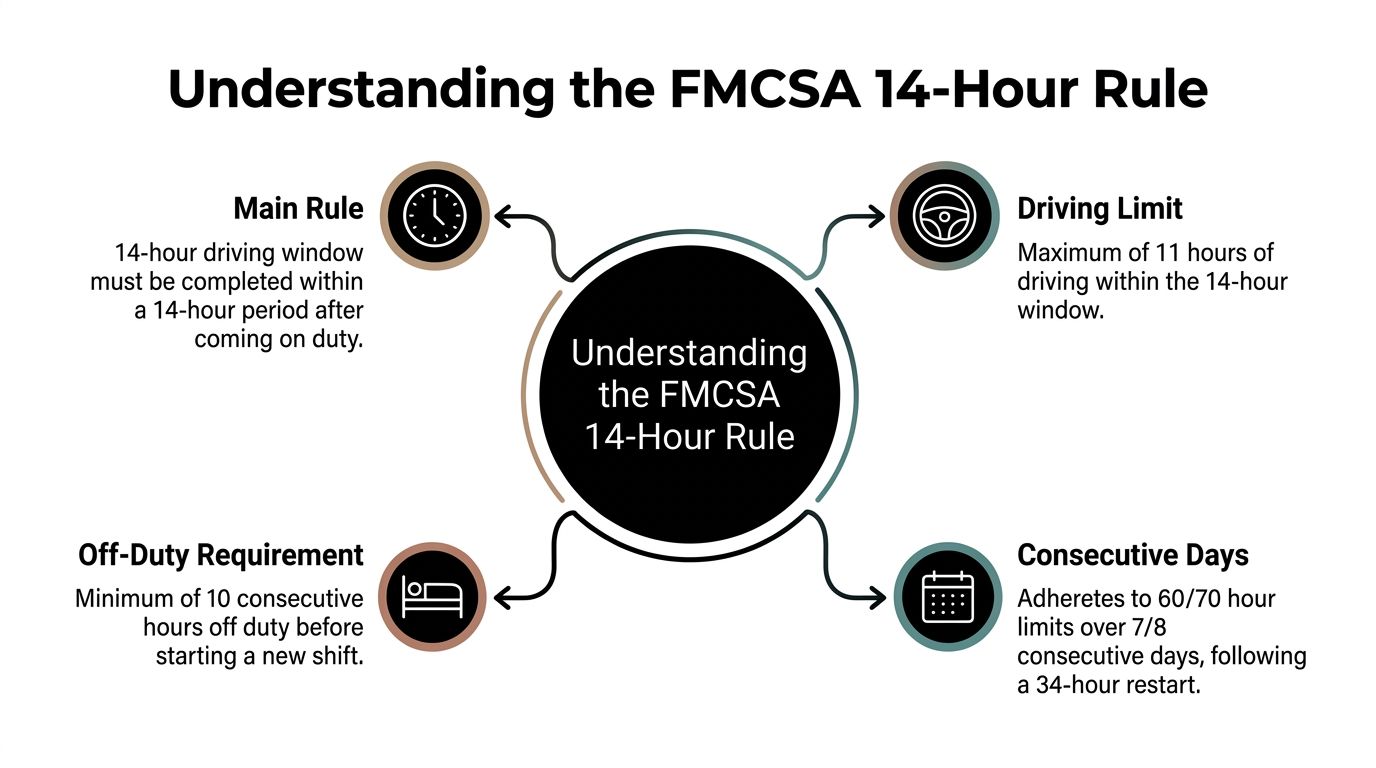
Think of it like a countdown clock
The easiest way to understand the new 14 hour rule for truck drivers is to picture a countdown timer that starts when the driver begins work for the day.
That start time isn't limited to driving. It can begin with a pre-trip inspection, fueling, waiting to load cargo, checking paperwork, or other work duties. Once that clock starts, it keeps moving.
Within that same workday window, the driver can only spend part of the time driving. The rest may be used on work tasks, delays, or breaks. But when the window closes, the driver can't legally keep driving until the required off-duty time is completed.
Why victims should care
For an accident victim, this rule can answer a very practical question. Should that truck have been on the road at all?
If the answer is no, that can become strong evidence in a personal injury claim. It may also point beyond the driver. Dispatchers, safety managers, and the motor carrier may have pushed a schedule that made a violation likely.
If you want broader background on how carriers manage compliance, this guide to DOT regulations for fleets gives useful context on the systems trucking companies are expected to follow.
Common points of confusion
Readers often get tripped up on a few parts of the rule:
- On-duty time is broader than driving: A driver may be “working” even while not moving.
- The 11-hour limit and 14-hour window are different: A driver can run out of legal workday even if some driving time remains.
- Breaks don't always solve the problem: Stopping for food or sitting in traffic doesn't automatically make later driving legal.
That distinction matters in a truck crash case. Insurance companies may focus on how long the truck was moving. A lawyer looking at fatigue will ask a different question. When did the driver's legal workday begin?
How the 14-Hour Clock Actually Works in Practice
A Houston truck driver starts the day at 6:00 a.m. After coming back on duty, federal rules mean the latest legal driving time is 8:00 p.m., regardless of how much actual driving happened during the day, as summarized in the FMCSA hours of service regulations.
That one example clears up a lot of confusion. The clock doesn't wait for the truck to get moving.
A Houston workday example
Say the driver begins with a pre-trip inspection before sunrise. Then comes a wait at a warehouse near the Ship Channel. Then paperwork. Then time in traffic on I-45. Maybe there is a fuel stop. Maybe there is another delay while cargo is checked.
All of that time counts toward the day's legal window.
By late afternoon, the driver may feel pressure to finish the route. If delivery is running behind, that pressure gets worse. A company that wants the load delivered may keep calling. A tired driver may think, “I'm close enough. I'll just finish this run.”
But if the legal window has run out, the truck should no longer be driving.
A delay doesn't excuse a violation. It often explains how the violation happened.
What an ELD can show
Most commercial drivers subject to these rules use an Electronic Logging Device, or ELD. In plain language, an ELD is a digital record of duty status and timing. In many truck wreck cases, it functions like a road map of the driver's day.
An attorney may compare the ELD with:
- Dispatch communications: Did the company push a delivery after the legal window?
- Fuel receipts and toll records: Do outside records match the driver's timeline?
- Bills of lading and shipping records: When was the load picked up and delivered?
- Crash timing: Was the truck still moving after the legal day had expired?
Federal and state rules can overlap. Some crashes involve interstate trucking and some involve trips that may raise different questions about state operation. For background on that distinction, see this discussion of interstate vs intrastate trucking rules.
Why details around the crash scene matter
Sometimes the truck collision isn't the only dangerous condition involved. For example, a victim may also have been hurt after stepping into an unsafe loading area, parking lot, or delivery site. In those situations, a separate premises claim may exist through a Houston Slip and Fall / Premises Liability Lawyer, which involves representation for injuries caused by unsafe property conditions in Houston.
In the truck case itself, though, the key point is simple. Every task in the driver's day can eat away at legal driving time. If the driver kept going anyway, that may be proof of negligence.
Key Exceptions and Recent Changes to the Rule
The rules aren't always as clean as trucking companies make them sound. There are exceptions and updated provisions, and carriers sometimes point to them quickly after a crash. That doesn't mean the exception applies.
In 2020, the FMCSA revised several Hours of Service provisions, including an expansion of the short-haul exception from a 100-air-mile radius to a 150-air-mile radius and a 14-hour on-duty period for certain non-CDL drivers, according to the FMCSA Hours of Service rule update.
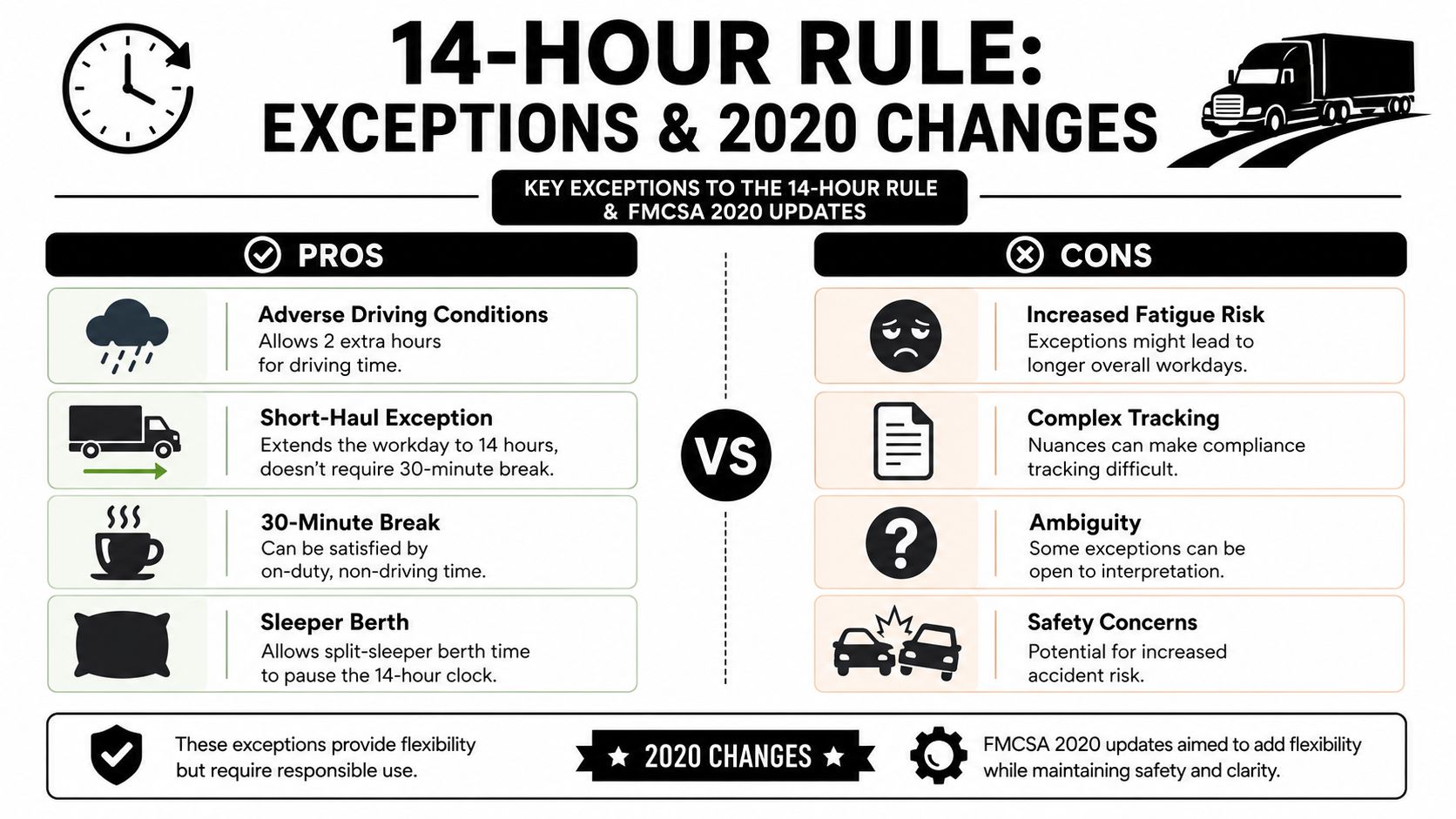
The short-haul exception
This update gave some local and regional operations more flexibility. That may sound harmless, but in litigation, the details matter.
A company may say a driver qualified for short-haul treatment. Your lawyer will want proof. What route was driven? What type of vehicle was involved? Did the driver's work fit that exception, or is the company stretching the facts after the crash?
The split-sleeper issue
Another area of confusion involves split sleeper-berth arrangements. When used properly, those rules can give drivers more flexibility in how they take rest. When used poorly, they can create fragmented sleep and leave a driver on the road tired, irritated, and slow to react.
That matters on long Texas corridors where schedules are tight and traffic can shift fast. A crash on I-35 between Austin and San Antonio may raise questions about whether a company relied on technical scheduling options while ignoring real fatigue.
When trucking companies claim an exception
After a serious wreck, carriers often frame the issue as a paperwork misunderstanding. A better question is whether the records support the story.
Look at how these disputes can play out:
| Company claim | What your lawyer may examine |
|---|---|
| The driver was short-haul | Route records, duty records, and whether the exception truly fit |
| Delays forced the schedule | Dispatch pressure, timing, and whether the company created the problem |
| Rest rules were followed | ELD entries, sleeper use, and signs of fragmented rest |
Exceptions are narrow. They are not a free pass for a tired driver to keep moving.
Why this matters in Texas injury cases
A defense built around exceptions can confuse injured families. That's often the point. Trucking law has enough technical language to make a preventable safety violation sound ordinary.
A Texas injury attorney can slow that down and test each claim against the records. If the exception doesn't fit, the attempted defense may help show that the company knew fatigue would be an issue and tried to explain it away afterward.
Using 14-Hour Rule Violations in Your Texas Accident Claim
In a truck accident case, a logbook or ELD violation isn't just a technical rule problem. It can be powerful evidence that the driver and carrier put schedule ahead of safety.
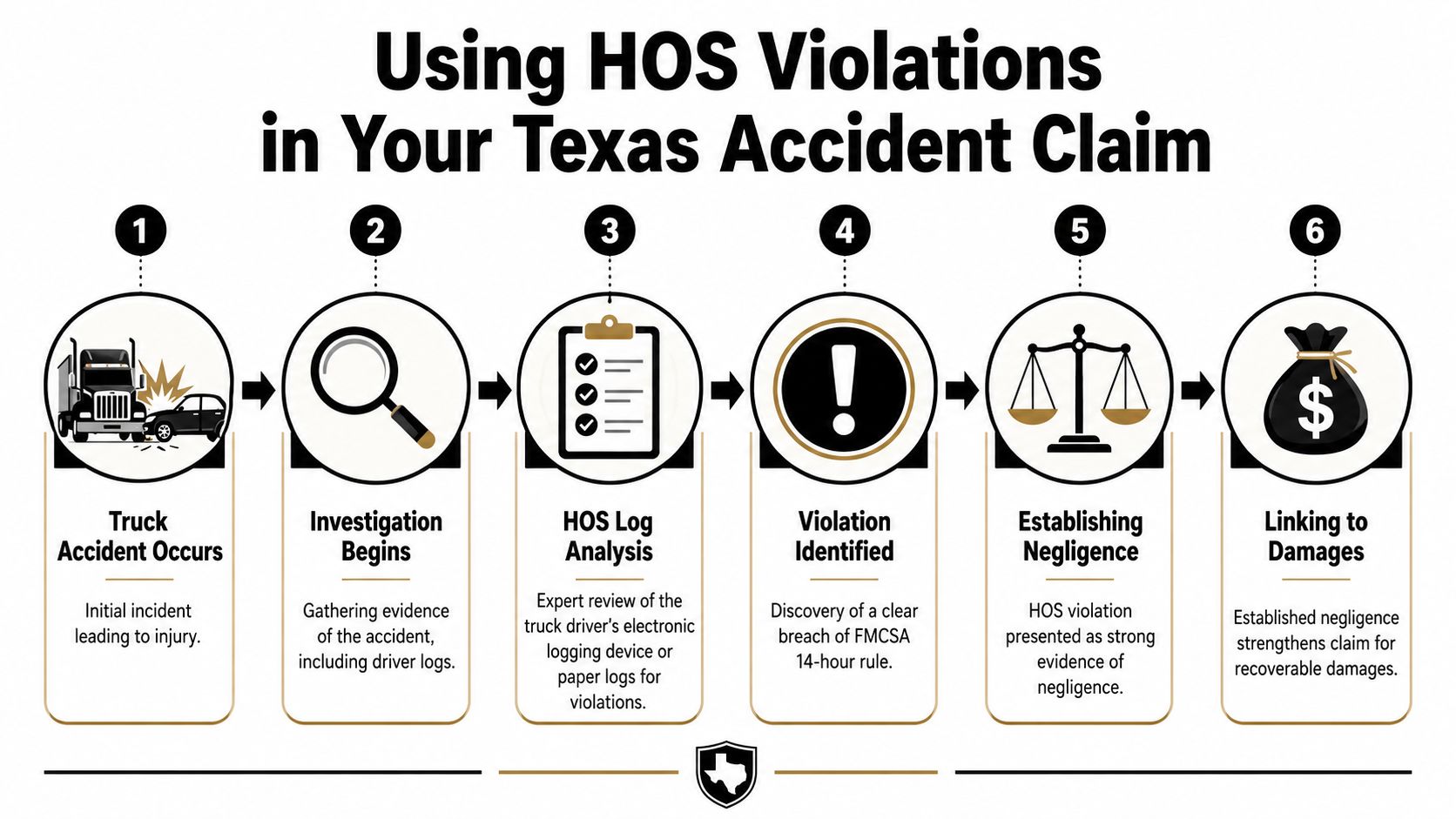
Why a violation matters legally
Texas personal injury law is built around negligence. Negligence means someone failed to use reasonable care and that failure caused injury. In truck cases, violating a safety rule can support the argument that the driver acted negligently and that the carrier bears responsibility too.
That may involve direct fault by the driver, but it can also involve company-level failures such as poor scheduling, weak supervision, or pressure from dispatch.
For readers trying to understand the insurance side of trucking, this overview of comprehensive truck insurance solutions gives general context about the kinds of commercial coverage and risk issues that can surround motor carriers. Coverage questions matter, but proving fault still comes first.
What evidence can prove the violation
An experienced lawyer doesn't rely on one document. A strong investigation usually compares multiple sources to see whether the timeline holds together.
Common evidence includes:
- ELD records: These can show when on-duty time started and whether driving continued too long.
- Driver logs and edits: Changes after the fact can raise serious questions.
- Dispatch messages: A company may have pushed the driver to keep going.
- Shipping records: Pickup and drop-off times may conflict with the driver's version.
- Post-crash testing and investigation materials: These can provide additional context about the driver's condition and company conduct.
For a fuller look at how these cases are built, this page on truck accident claims in Texas explains how liability and evidence often come together after a commercial crash.
A short video can also help you understand how truck cases are investigated:
Fatigue can show up in patterns
One of the most useful insights in these cases is that fatigue often leaves a trail. The 2020 rule introduced a split-sleeper option that lets drivers divide the required off-duty period. When used properly, it can help. But when used poorly, it can fragment sleep and raise microsleep risk, especially on long Texas routes such as I-10, I-35, and I-45, as described in this split sleeper berth explanation.
A lawyer may look for repeated patterns in those records, not just one bad day. If a carrier repeatedly stacked schedules in a way that left the driver worn down, that can strengthen the case that the crash wasn't random. It was the predictable result of unsafe operations.
What you should do after the crash
If you've been hit by a commercial truck, these steps can protect your health and your claim:
- Get medical care right away. Some serious injuries don't fully show up on the day of the crash.
- Preserve what you have. Save photos, discharge papers, repair estimates, and insurance letters.
- Avoid detailed recorded statements early. The insurer may ask questions designed to limit your claim.
- Report facts carefully. Stick to what you know, not guesses about speed, fatigue, or fault.
- Talk to a Texas injury attorney quickly. Trucking evidence can be lost or overwritten if no one demands it be preserved.
The strongest truck cases often begin with fast evidence preservation, not courtroom drama.
Your Rights and Recoverable Damages in Texas
If a tired truck driver caused your crash, you may have the right to recover compensation under Texas law. The legal terms can sound intimidating, but the ideas are simpler than they seem.

Plain-English definitions that matter
Here are the terms to understand first:
- Liability: This means who is legally responsible for paying for the harm caused by the crash.
- Damages: This means the losses you can claim, such as medical bills, lost wages, pain and suffering, property damage, and in fatal cases, wrongful death compensation.
- Comparative fault: This means more than one person may share blame.
- Statute of limitations: This means the legal deadline to file a lawsuit.
In Texas, the statute of limitations for most personal injury cases is generally two years. Missing that deadline can stop your claim, even if your injuries are serious.
How comparative fault works in Texas
Under Texas Civil Practice & Remedies Code Chapter 33, you can still recover damages if you were partly at fault, as long as your share of fault is 50% or less. If your responsibility is higher than that, recovery is barred.
That rule matters in truck cases because insurance companies often try to shift blame onto the injured driver. They may argue you braked suddenly, changed lanes poorly, or failed to react in time.
A simple example helps. A Houston driver is hit by a commercial truck after traffic slows on a freeway. The trucking company claims the car changed lanes too closely. Even if there is some dispute about lane position, the truck driver's fatigue and safety-rule violations may still carry the larger share of fault.
What damages may be available
Every case is different, but recoverable damages often include:
- Medical expenses: Emergency care, hospital bills, surgery, therapy, medication, and follow-up treatment
- Lost income: Pay you missed while recovering and loss of future earning ability in serious injury cases
- Pain and suffering: The physical pain and daily disruption caused by the crash
- Property damage: Repair or replacement of your vehicle and related losses
- Wrongful death losses: Financial and personal losses suffered by surviving family members in fatal truck crashes
For additional context on how compensation issues can develop in these cases, this page about Texas trucking accident settlements discusses common settlement considerations.
Filing a claim and dealing with insurance
After a crash, your auto insurance claim may only be one part of the process. A commercial trucking case can involve multiple insurers and layered defenses.
Keep these steps in mind:
- Report the crash promptly: Give basic facts to your insurer.
- Document everything: Keep receipts, mileage, medical updates, and work-loss records.
- Be careful with trucking insurers: Commercial adjusters often move fast and ask narrow questions.
- Don't guess about injuries: If you don't know, say you are still being evaluated.
- Get legal advice before signing anything: Early releases can close off important rights.
If your family lost someone in a truck wreck, these same issues become even more urgent. Wrongful death claims involve proof, deadlines, and damages that deserve careful handling.
How a Texas Injury Attorney Can Fight for You
Truck wreck cases are different from ordinary car crashes. A regular two-car collision may come down to witness statements and photos. A commercial case may also require ELD analysis, dispatch records, federal safety rules, driver qualification files, and aggressive pushback against company defenses.
That is why many injured people work with a Houston car accident lawyer or Texas injury attorney who handles trucking cases specifically. The legal work includes preserving evidence, identifying every responsible party, dealing with insurance companies, and connecting rule violations to the harm you suffered.
The Law Office of Bryan Fagan, PLLC handles Texas injury cases involving cars, trucks, insurance disputes, and fatal crashes. In a truck case, that means reviewing records, applying Texas negligence law under Chapters 33 and 41, and helping clients pursue damages tied to medical care, lost income, pain and suffering, and wrongful death compensation where appropriate.
If you're hurt, focus on treatment. If you're overwhelmed, that's normal. You don't need to decode the new 14 hour rule for truck drivers, argue with adjusters, or fight a trucking company by yourself. You need clear answers, preserved evidence, and a legal strategy built around your rights.
If you or someone you love was injured in a commercial truck crash, contact The Law Office of Bryan Fagan, PLLC for a free consultation. We can help you understand your rights, investigate possible Hours of Service violations, deal with the insurance company, and take steps toward the compensation you may be owed under Texas law.