A car crash can change your life in seconds, but you don't have to face recovery alone.
If you're reading this, you may be dealing with pain, car repairs, missed work, and calls from an insurance company that seems more interested in closing your claim than hearing what you've been through. You may also have heard a new legal phrase that sounds intimidating: mediation hearing.
For many Texas accident victims, mediation is not a bad sign. It's often a practical chance to resolve a case without the stress of a trial. Instead of sitting in a courtroom while a judge or jury decides your future, you get a structured setting where both sides try to work toward a settlement.
A Houston driver rear-ended on I-45 might spend weeks getting treatment, gathering records, and trying to understand whether the insurer will pay fairly. Early on, simple post-crash steps matter. Resources like MedAmerica Rehab Center's car accident advice can help you think through medical care, documentation, and what to do right after a wreck.
Mediation fits into that larger recovery process. It gives you a chance to speak through counsel, evaluate your case realistically, and push toward closure in a more controlled environment. For many families, that matters just as much as the legal result.
Your Path to Resolution After a Car Accident
After a crash, individuals often want the same basic things. They want treatment. They want their bills covered. They want the insurance company to stop acting like their pain is up for debate. And they want some peace.
Mediation can help create that path. In a car accident case, it is usually a confidential settlement meeting where a neutral person helps both sides negotiate. It is less formal than court, but it is still serious. The goal is to see whether the case can be resolved in a way both sides can accept.
Why mediation matters in real life
Take a simple example. A Houston mother is hit in an intersection by a driver who ran a red light. Her car is totaled, her back injury keeps her from work, and the insurer disputes how badly she was hurt. She files a claim, then a lawsuit. Months later, the court requires mediation before the case can move closer to trial.
That can feel frustrating at first. But mediation often becomes the first moment when everyone with authority has to focus on the issues: who caused the wreck, what treatment was necessary, how much income was lost, and what a fair settlement should look like.
Mediation isn't a side issue. For many injury cases, it's the point where serious settlement talks finally happen.
Where Texas law fits in
Texas injury claims are shaped by negligence law. Under Texas Civil Practice & Remedies Code Chapter 33, fault can be divided between people. This involves comparative fault. In plain English, comparative fault means more than one person may share blame. If you were partly at fault, that can affect what you recover.
You'll also hear the word liability. Liability means legal responsibility. If another driver caused the crash, that driver may be liable for your losses.
And then there are damages. Damages are the losses the law allows you to claim, such as medical bills, lost wages, pain and suffering, and other harm caused by the wreck. Chapter 41 is also part of Texas personal injury law and addresses certain rules involving damages in civil cases.
If you're worried about deadlines, the statute of limitations is the legal time limit for filing a lawsuit. Missing that deadline can put your rights at risk, which is why getting case-specific advice early matters.
What Is a Mediation Hearing in a Texas Injury Case
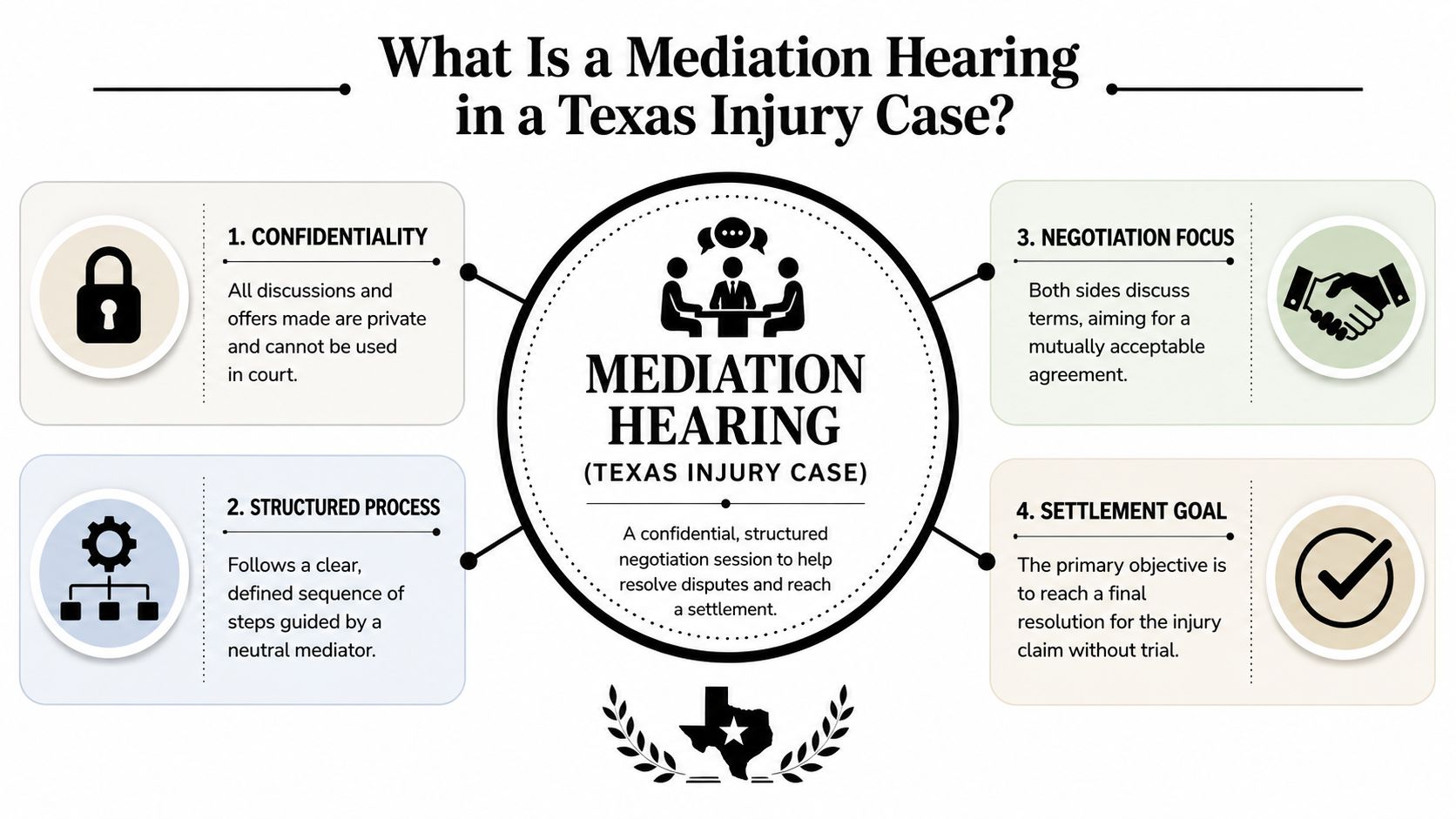
A mediation hearing is best understood as a guided negotiation, not a mini-trial.
A neutral mediator helps both sides talk through the dispute and work toward a voluntary agreement. The mediator does not decide who wins. The mediator does not issue a ruling. The mediator helps people move from fixed positions toward possible settlement terms.
The simplest way to think about it
If a trial is like asking a referee to make the final call, mediation is like sitting down with a skilled go-between who helps both sides see risk, evaluate options, and decide whether they can make a deal.
That matters in Texas because courts often require mediation before a trial can proceed, making it a mandatory step in many personal injury cases rather than just an optional one, as explained in this discussion of Texas mediation in personal injury cases.
Why injured drivers should take it seriously
Mediation isn't just common. It often works.
Verified program data shows settlement rates above 75% across major mediation settings, including an 81% settlement rate in FINRA mediation cases through May 2026 and a 79.50% settlement rate in the Industrial Commission mediation program. In the EEOC mediation program, the settlement rate reached 72.1% in fiscal year 2008. Mediation also tends to move faster, with some sessions lasting about 3 to 4 hours, and one set of program data reporting cases resolved in an average of 97 days compared to over 200 days through traditional investigative processes, according to the verified mediation data summarized from the Industrial Commission reference.
Those numbers don't guarantee a result in your case. They do show why mediation is widely treated as a practical tool rather than a legal formality.
What makes mediation different from court
A few features matter most:
- It is voluntary in outcome: No settlement is final unless the parties agree.
- It is confidential: The discussion is meant to stay inside mediation.
- It is focused on resolution: The point is to solve the claim, not perform for a jury.
- It is flexible: The parties can discuss money, liens, timing, releases, and other terms.
For readers looking into broader injury representation in the area, Houston Personal Injury Lawyer is a local resource focused on representation for injury victims across Houston and Harris County.
Practical rule: If you're asking what is a mediation hearing, the short answer is this. It's a private settlement meeting with structure, strategy, and a real chance to end the case.
Who Attends a Mediation Hearing
One reason mediation feels stressful is that people don't know who will be there. Once you know the cast, the room feels less mysterious.

You and your lawyer
You are there because it is your case, your injuries, and your future. Your lawyer is there to present the facts, protect your rights, answer legal questions, and help you evaluate offers.
You usually won't spend the day arguing directly with the insurance company. In most mediations, your lawyer does the heavy lifting on liability, damages, and negotiation strategy while making sure your voice is still part of the process.
The mediator
The mediator is neutral. That point causes a lot of confusion.
A mediator is not your judge, not your advocate, and not the insurance company's lawyer. The mediator's job is to help both sides communicate, test assumptions, and find possible middle ground. Often, the mediator reframes heated arguments into practical questions like these:
- What would a jury likely believe?
- Which medical records help or hurt the claim?
- What are the costs of continuing toward trial?
- Is there a number or structure that could close the case?
The insurance side
The defense usually includes two key people.
- Insurance adjuster: This person represents the insurer's financial interests and evaluates settlement authority.
- Defense lawyer: This attorney argues the insurer's side, points out disputed facts, and responds to your demand.
A critical point is that decision-makers with appropriate authority must be physically or virtually present so they can participate and approve a resolution if the case settles, as noted in this explanation of how the mediation process works.
Sometimes others attend
Depending on the case, a spouse, family member, interpreter, or lien representative may be involved. In a wrongful death case, several family members may be part of the conversation because settlement can affect more than one claimant seeking wrongful death compensation.
The people in mediation may have different goals, but everyone is there because the case has reached a point where serious resolution is possible.
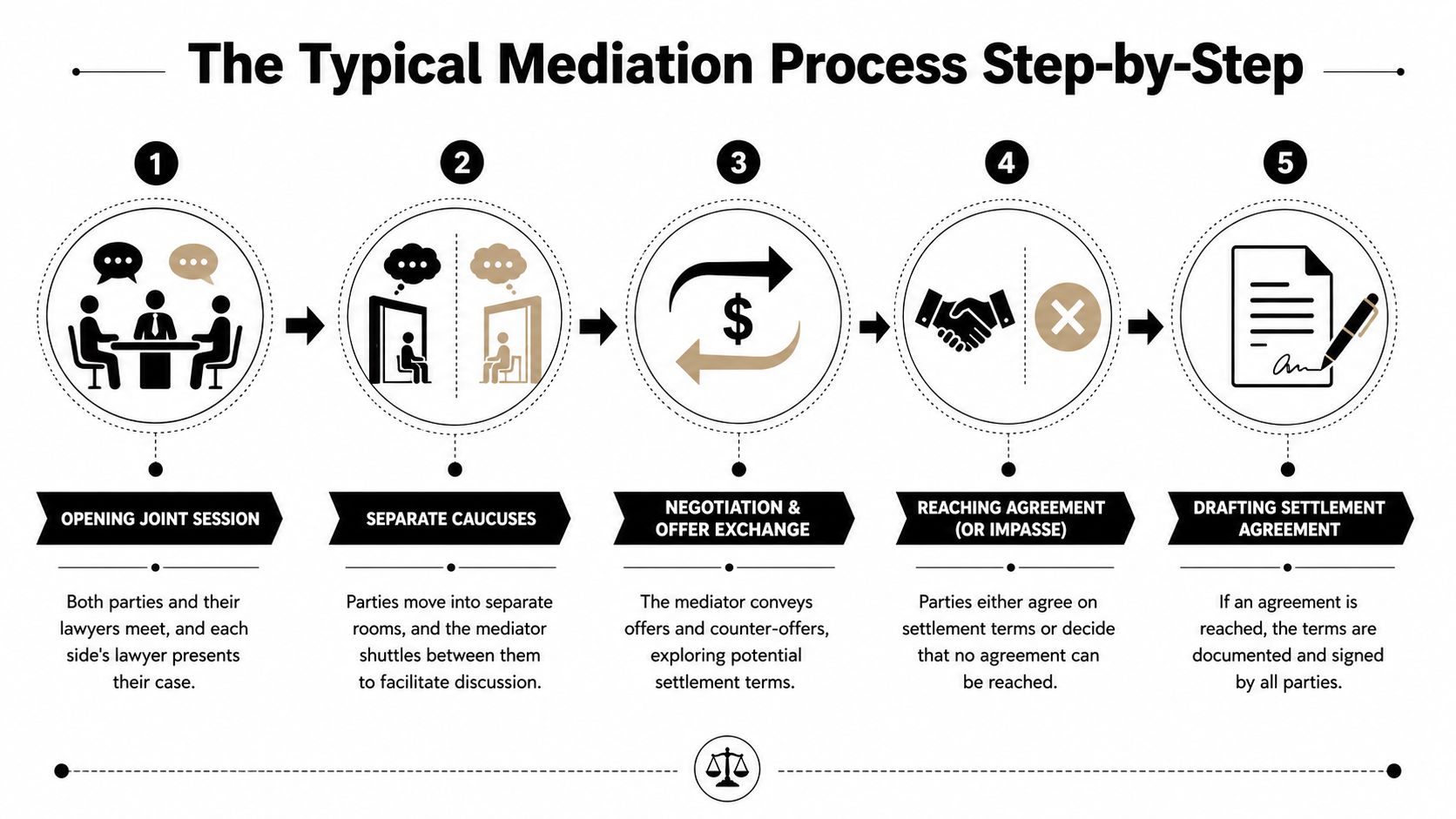
The Typical Mediation Process Step-by-Step
Most mediations are less dramatic than people expect. The day usually moves in stages, and knowing those stages helps.
How the day usually starts
In Texas, a mediation session typically lasts from a few hours to a full day, depending on the complexity of the case and the gap between the parties' positions. It usually begins with an opening joint session, followed by private caucuses where the mediator moves between rooms with offers and counteroffers, according to this overview of Texas personal injury mediation sessions.
That opening session may be brief. Sometimes each lawyer gives a short summary. Sometimes the mediator quickly separates the parties into different rooms to keep emotions down and focus on numbers, risk, and evidence.
The heart of mediation is caucusing
Once the parties split into separate rooms, the mediator starts what lawyers often call shuttle diplomacy.
The mediator goes back and forth carrying information, testing arguments, and helping each side rethink its position. You may spend part of the day waiting. That doesn't mean nothing is happening. Some of the most important movement happens while the mediator is in the other room.
A Houston crash case involving disputed neck treatment is a good example. The insurer may start by saying the treatment was excessive. Your side may respond with records, wage loss evidence, and a demand that reflects pain, disruption, and future care concerns. Through repeated caucuses, the gap may narrow.
For a closer look at timing, this guide on how long mediation takes can help you understand why some sessions move quickly and others take most of the day.
A short video can also help you picture the flow of the process:
How it ends
There are usually two possible endings.
- Settlement is reached. The lawyers draft a short written agreement before anyone leaves.
- No settlement is reached. The case continues toward the next litigation step.
If an agreement is reached, the written document matters. Until the terms are reduced to writing and signed, there can still be disagreement about what was accepted.
Mediation Compared to Arbitration and Trial
People often mix up mediation, arbitration, and trial. They are not the same.
Mediation is built around negotiation. Arbitration is more like a private hearing where another person decides the dispute. Trial is a formal public court process where a judge or jury decides the result.
Mediation vs. Arbitration vs. Trial at a Glance
| Feature | Mediation | Arbitration | Trial |
|---|---|---|---|
| Decision-maker | Neutral mediator helps negotiation | Arbitrator decides outcome | Judge or jury decides outcome |
| Control over result | Parties keep control unless they sign an agreement | Less party control once arbitration begins | Parties give control to court |
| Formality | Informal and flexible | More formal than mediation | Most formal |
| Confidentiality | Generally confidential | Often private, depending on rules | Usually public |
| Binding effect | Non-binding until signed settlement | Often binding | Binding judgment |
| Main goal | Settlement | Decision | Verdict or judgment |
| Tone | Collaborative problem-solving | Adversarial presentation | Fully adversarial |
Why mediation often fits injury claims better
If your priority is resolving an auto insurance claim with less stress and more control, mediation often gives you a better setting to explore options. You can discuss money, treatment disputes, timing, liens, and practical details in a way that a courtroom usually doesn't allow.
Trial still matters. Some cases need it. But trial also means uncertainty. A jury may believe you fully, partly, or not at all. Mediation lets you weigh that risk before handing the decision to strangers.
If you're trying to understand the bigger settlement picture, this explanation of how car accident settlements work connects mediation to the broader life of a Texas injury claim.
Where negligence law affects settlement value
Texas law re-enters the conversation. If the defense argues you were partly at fault, Chapter 33 issues can affect negotiations. In plain terms, comparative fault can reduce what you recover if the facts show shared blame.
That's why mediation is not just about speaking from the heart. It is also about understanding how liability arguments, damages evidence, and legal risk shape settlement value.
How to Prepare for Your Car Accident Mediation
The week before mediation often feels strange. You know your case matters, but you may not know what you are supposed to do besides show up. Good preparation changes that. It gives you a clearer role and helps you walk into the session with steadier expectations.
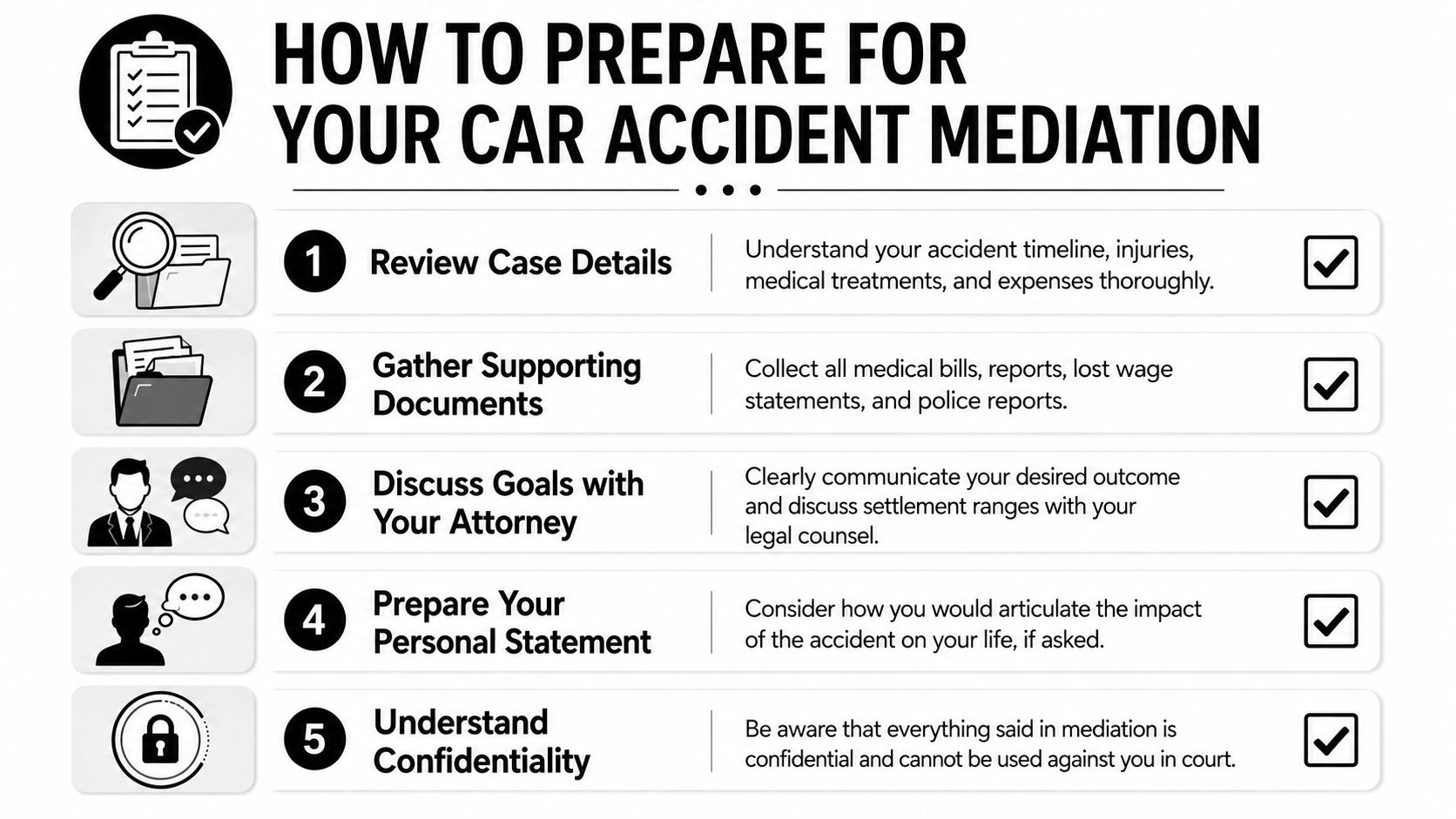
A mediation works a lot like a serious settlement meeting with structure. Your lawyer handles the legal arguments, but your preparation still matters because the value of an injury claim is tied to real-life details. Insurance adjusters and defense lawyers look for proof, consistency, and signs that you understand both your losses and the weak spots the other side may press on.
What to review before the session
Start with the story of the crash and what happened after it. You should be able to explain the timeline in plain language: when the collision happened, where you treated, what symptoms followed, what care you still need, and how the injuries affected work, sleep, driving, parenting, or other routines.
Then review the main parts of your damages, including:
- Medical expenses: Hospital bills, follow-up care, therapy, prescriptions, and future treatment that may still be needed.
- Lost wages: Income you missed, reduced hours, or limits on the kind of work you can do now.
- Pain and suffering: The day-to-day human cost of the injury, including discomfort, stress, and loss of normal activities.
- Property losses and related costs: Vehicle damage, rental expenses, mileage, and other out-of-pocket losses tied to the wreck.
If part of the dispute involves a totaled car, practical guidance on disputing low total loss offers can help you understand the documents and valuation arguments insurers often bring into settlement talks.
What your lawyer needs from you
Your lawyer cannot present a persuasive claim with gaps in the facts. Be ready to review medical records, photographs, wage documents, prior statements, and the settlement demand package. If you want a clearer picture of how that package is built, these examples of personal injury demand letters help show how lawyers frame liability, treatment, and damages.
It also helps to prepare a short personal account of how the crash changed your life. Keep it simple and specific. A person injured on Beltway 8 might explain that shoulder pain made it hard to lift a child into a car seat, attend physical therapy without missing work, or sleep through the night. Details like that give context to records and bills.
The strategic mistake many injured drivers make
Some car accident victims believe they should treat mediation like a performance and act as if the case has no problems. That approach usually hurts more than it helps.
Credibility matters. If there is a treatment gap, a prior injury, or a disputed fact about the collision, your side should be ready to address it calmly and directly. A mediator can work with honest risk assessment. An insurance company is also more likely to move when it sees a prepared claimant who understands both the strengths of the case and the arguments likely to come from the defense.
Your goal is not to sound perfect. Your goal is to sound believable, prepared, and reasonable.
A practical checklist for mediation day
- Review the key facts: Know the crash date, location, treatment sequence, and the records that support your claim.
- Discuss your settlement range with your lawyer: A target helps, but flexibility often matters just as much.
- Be ready for a long day: Mediation often includes waiting, private discussions, and slow movement between offers.
- Watch casual comments: Conversations in hallways or during breaks can still affect the tone of negotiations.
- Ask questions if something is unclear: You should understand any offer, counteroffer, or proposed settlement term before making a decision.
- Stay open to problem-solving: Some successful mediations turn on details like timing of payment, lien issues, or wording in the release, not just the top-line number.
Some families also decide at this stage to get direct guidance from The Law Office of Bryan Fagan, PLLC about liability, damages, and insurance disputes in a Texas auto accident claim.
Common Questions About Mediation and Your Claim
The questions people ask at the end of mediation are usually the ones they worried about all along.
What happens if we settle
If both sides reach an agreement, the lawyers usually put the essential terms into writing before everyone leaves. Once signed, that settlement becomes binding. After that, the remaining steps often include release language, payment processing, lien resolution, and formal dismissal of the lawsuit.
For you, settlement usually means the uncertainty starts to lift. You know the case result. You can make plans.
What happens if we don't settle
No settlement does not mean you lost.
It means the case did not resolve that day. Your lawsuit can continue through the normal court process. That may include more discovery, additional negotiation, motions, or trial preparation. Sometimes a case settles later, even after a failed mediation, because each side learned something useful during the session.
Is mediation really confidential
Yes. A common misunderstanding is the difference between confidential mediation and a formal hearing. Information shared in mediation is protected and cannot be used in a later impartial hearing if mediation fails, creating a legal firewall that many people don't realize exists, as explained by the New York State Education Department's mediation guidance.
That protection matters because it allows honest discussion. You can explore options without worrying that every settlement comment will be repeated in court.
The safest way to approach mediation is to be open with your own lawyer, measured in the room, and focused on resolution rather than pride.
What should you do after a crash and before mediation ever happens
Keep it simple and consistent.
- Get medical care quickly: Your health comes first, and treatment records often become important evidence.
- Report the crash and gather documents: Keep the police report, photos, repair estimates, and bills.
- Be careful with insurance statements: You can report basic facts, but don't guess about injuries or fault.
- Track your losses: Missed work, follow-up care, and everyday limitations all matter.
- Learn your rights early: A Texas injury attorney can explain liability, comparative fault, damages, and filing deadlines in plain English.
If you've been injured and you're trying to understand what comes next, you don't have to figure it out alone.
If you need clear answers about a mediation hearing, a disputed auto insurance claim, or your right to pursue damages after a crash, contact The Law Office of Bryan Fagan, PLLC for a free consultation. Whether you're dealing with a rear-end collision, a trucking case, or a family claim involving wrongful death compensation, you can get straightforward guidance about your options, your timeline, and the next steps to protect your rights.