A car crash can change your life in seconds—but you don’t have to face recovery alone. A car accident settlement is a formal agreement with the at-fault driver's insurance company to compensate you for your losses, all without needing to go to court. But how do car accident settlements work, and how can you ensure you receive a fair outcome?
The process boils down to three critical steps: proving who was at fault, calculating the true value of your damages, and negotiating a fair final payment.
Your Guide to Navigating a Texas Car Accident Settlement
A car crash can turn your world upside down, leaving you with physical pain, a mountain of medical bills, and a deep sense of uncertainty. This guide is here to walk you through the settlement process, step by step, so you can feel empowered to get the financial recovery you deserve. You don’t have to go through this alone.
Imagine you're driving home on I-45 in Houston when a distracted driver slams into you. Your life is immediately thrown off course. This is where a car accident settlement comes into play—it's your path back to financial stability. Sadly, scenarios like this are far too common. In the U.S., over 5.9 million car crashes were reported in 2024 alone, resulting in countless settlements just like the one you may be facing. You can learn more about these national crash statistics and their staggering impact.
Understanding the Settlement Journey
The road to a settlement might seem complicated, but it follows a clear path. The goal is to build a powerful, evidence-backed claim that leaves no doubt in the insurance company’s mind about what you are owed for every single loss—from the initial ER visit to future physical therapy and lost wages.
This infographic breaks down the three core phases you’ll encounter in any car accident settlement.
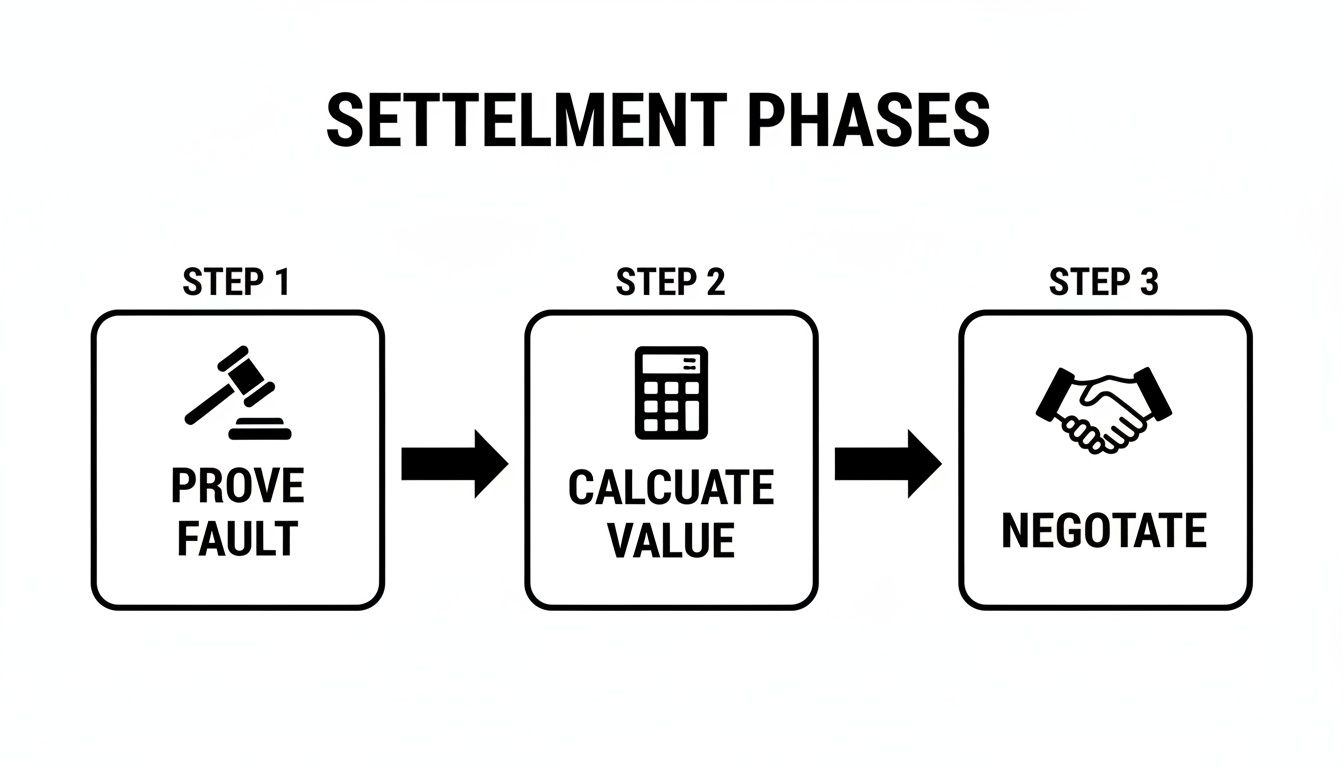
Each phase builds directly on the one before it, creating a solid foundation for your claim long before any negotiation begins.
The Three Phases of a Car Accident Settlement
| Phase | What It Means for You | Key Goal |
|---|---|---|
| 1. Proving Fault | Gathering all the evidence—police reports, witness statements, photos, and expert opinions—to clearly establish that the other driver caused the accident. | To prove liability and show the insurance company their client is responsible for your injuries. |
| 2. Calculating Value | Adding up all your losses. This includes concrete costs like medical bills and lost income, as well as non-economic impacts like pain and suffering. | To determine the full and fair monetary value of your damages, leaving nothing on the table. |
| 3. Negotiating a Fair Payout | Presenting your evidence and damage calculations to the insurance adjuster in a formal demand letter, followed by strategic back-and-forth negotiation. | To secure a settlement offer that accurately reflects the true cost of the accident without having to go to trial. |
Our goal is to explain your rights under Texas law in plain English and show you how to move forward with confidence. We'll cover key legal terms you need to know:
- Liability: In plain English, this is the legal term for who is at fault for the accident.
- Damages: This refers to the total of all your losses—from medical bills and lost wages to your physical pain and emotional suffering.
- Comparative Fault: This is a critical Texas rule (also called "proportionate responsibility") that can reduce your settlement if you are found even partially to blame for the crash.
- Statute of Limitations: Texas law gives you a strict two-year deadline to file a car accident lawsuit. If you miss this deadline, you lose your right to recover anything.
Trying to handle an auto insurance claim on your own is overwhelming, especially when you should be focused on healing. If you've been injured, you don't have to face the insurance companies by yourself. The experienced attorneys at The Law Office of Bryan Fagan are here to fight for you. Contact us for a free, no-obligation consultation to discuss your case and understand your options.
Who Is Liable in a Texas Car Accident?

Before a single dollar can be discussed, we have to answer the most important question: who was responsible for the crash? In Texas, this legal responsibility is called liability, and it is the foundation of every personal injury claim.
Texas is an “at-fault” state. This simply means the person who carelessly caused the accident is legally responsible for paying for the harm they caused. To get a settlement, your Houston car accident lawyer must prove the other driver was negligent.
Proving Negligence Under Texas Law
Negligence is a specific legal standard with four parts. To prove negligence in a Texas car accident claim, we must establish these four elements:
- Duty: The other driver had a legal duty to operate their vehicle with reasonable care. Every person on a Texas road, from I-45 in Houston to a quiet neighborhood street, shares this basic responsibility to follow traffic laws and avoid harming others.
- Breach: The driver broke, or "breached," that duty of care. This is the specific action they took that was careless, like texting while driving, speeding, or running a red light.
- Causation: The driver's mistake directly caused your injuries. It isn’t enough that they were careless; their carelessness must be the reason you got hurt. For example, a driver running a stop sign and T-boning your car is the direct cause of your broken arm and whiplash.
- Damages: You suffered actual losses because of the crash. These are your damages—everything from medical bills and lost paychecks to your physical pain and emotional trauma.
Successfully proving these four points is how we build the case for liability and show that you deserve to be compensated.
Understanding Texas Comparative Fault
What happens if the insurance company claims you were also partly to blame? This is where a critical Texas law called "proportionate responsibility" comes into play, found in Chapter 33 of the Texas Civil Practice and Remedies Code. This rule, often called comparative fault, divides fault in an accident and directly affects how much money you can recover.
Under Texas's 51% Bar Rule, you cannot recover any money for your damages if you are found to be 51% or more at fault for the accident. If your share of fault is 50% or less, your settlement is simply reduced by your percentage of fault.
Let’s walk through a real-world example. Imagine you were T-boned at a Dallas intersection, and your total damages come out to $100,000. The other driver's insurance company argues you were slightly speeding and convinces a jury you were 20% at fault.
- Your Damages: $100,000
- Your Percentage of Fault: 20%
- Reduction Amount: $20,000 (20% of $100,000)
- Your Maximum Recovery: $80,000
Because your share of the fault (20%) is less than the 51% cutoff, you can still recover compensation. But if you were found 51% responsible, your recovery would drop to $0.
This rule is precisely why insurance adjusters work so hard to shift blame onto you. Every percentage point they can assign to you either reduces what they have to pay or eliminates it completely. An experienced Texas injury attorney knows these tactics and will fight back with evidence to protect your right to a full and fair settlement.
Calculating the True Value of Your Claim

Once we've established who is at fault, the next step is to determine what your claim is actually worth. In the legal world, all of your losses—both financial and personal—are called damages.
The insurance company's first offer will almost never cover the full extent of what you've lost. That’s why it’s so important to identify, document, and demand full payment for every loss you have suffered. These damages fall into two main categories: economic and non-economic.
Understanding Your Economic Damages
Economic damages are the straightforward financial losses that come with a paper trail, like receipts, bills, and pay stubs. We gather every piece of documentation to build a detailed accounting of exactly what this accident has cost you.
Common economic damages include:
- Medical Expenses: This covers everything from the ambulance ride and emergency room visit to surgeries, hospital stays, prescriptions, and ongoing physical therapy. It also includes the projected cost of any future medical care you will need.
- Lost Wages: If your injuries prevented you from working, you are entitled to compensation for the income you missed during your recovery.
- Loss of Earning Capacity: For severe injuries that permanently impact your ability to do your job, we can demand damages for the income you will lose over your career. For example, if a Houston construction worker suffers a back injury and can no longer lift heavy materials, we calculate their diminished earning potential for the rest of their working life.
- Property Damage: This covers the cost to repair or replace your vehicle and any personal items that were damaged in the crash, such as a laptop or phone.
Valuing Your Non-Economic Damages
While economic damages cover your financial losses, non-economic damages are meant to compensate you for the immense human cost of the accident. These losses are intangible and deeply personal, but they are just as real and deserving of compensation. They acknowledge that an accident’s impact goes far beyond your bank account.
Economic vs. Non-Economic Damages in a Texas Car Accident
| Type of Damage | What It Covers | Example |
|---|---|---|
| Economic | Tangible financial losses with a clear dollar value. | Hospital bills, car repair invoices, lost paychecks. |
| Non-Economic | Intangible, personal losses without a fixed price tag. | Lasting physical pain, emotional trauma like anxiety or PTSD, or the inability to enjoy hobbies. |
Common examples of non-economic damages include:
- Pain and Suffering: Compensation for the physical pain and discomfort your injuries have caused.
- Mental Anguish: This addresses the emotional and psychological trauma from the crash, such as anxiety, depression, fear, or Post-Traumatic Stress Disorder (PTSD).
- Physical Impairment: If you can no longer participate in hobbies or activities you once loved, like playing with your kids or going for a run, this compensates you for that loss.
- Disfigurement: Compensation for scarring, burns, or other permanent changes to your appearance.
How are these damages calculated? Attorneys and insurance companies often use a "multiplier" method as a starting point. Your total economic damages are multiplied by a number (typically between 1.5 and 5) based on the severity of your injuries and their impact on your life. A catastrophic injury will demand a much higher multiplier than a minor one.
A Note on Exemplary Damages
In rare cases involving extreme recklessness, Texas law allows for a third category of damages. Found in Chapter 41 of the Texas Civil Practice & Remedies Code, exemplary damages (also known as punitive damages) are not meant to compensate you.
Instead, their purpose is to punish the at-fault party and deter others from similar conduct. These are typically reserved for cases where the defendant acted with malice or gross negligence, such as a drunk driver causing a devastating crash. A skilled attorney will always evaluate if the facts of your case warrant pursuing them.
Steps to File an Insurance Claim and Navigate Negotiations

Once we’ve established fault and calculated your damages, it's time to take on the insurance company. This is where a skilled negotiator can make all the difference.
The process begins by notifying the at-fault driver's insurance carrier of your claim. Remember, the insurance adjuster may sound friendly, but their job is to protect their company’s profits by paying you as little as possible. Never give a recorded statement to the other driver's insurer without your lawyer present. They are trained to ask questions designed to devalue your claim or trick you into admitting partial fault.
The Demand Letter and Opening Negotiations
Once you’ve reached maximum medical improvement (MMI)—the point where your doctors confirm your condition has stabilized—your attorney will assemble all your evidence into a powerful demand letter.
This isn't just a letter asking for money. It's a formal legal argument that lays out your entire case and officially starts the negotiation process. It will include:
- A clear summary of the facts proving the other driver was liable.
- Detailed documentation of all your economic damages, including every medical bill and lost paycheck.
- A persuasive case for the value of your non-economic damages, such as pain and suffering.
- A specific dollar amount we are demanding to settle the claim in full.
This demand package signals to the insurer that you have a serious, evidence-backed case and you are prepared to fight. When calculating property damage, understanding the choice between OEM and aftermarket parts is also vital to demanding fair value for repairs.
The Back-and-Forth of Negotiation
After receiving the demand, the insurance adjuster will respond with a counteroffer. It will almost certainly be a lowball offer. This is the beginning of the negotiation process, a strategic back-and-forth where experience is critical.
The initial offer is just a starting point. It's a test to see if you are desperate enough to accept a quick, inadequate payout. A skilled attorney knows not to take this offer seriously and will counter with facts and evidence.
This is also where adjusters use common tactics to wear you down. They might delay for weeks, hoping financial pressure forces you to accept less. Or they’ll question your medical treatments to try and reduce the value of your claim. For instance, a Houston driver rear-ended on I-45 might have their claim stalled for months while the insurer "investigates"—hoping the victim gets desperate enough to accept pennies on the dollar.
Having a seasoned Texas injury lawyer handling these negotiations is your greatest advantage. It tells the insurance company that you know what your claim is worth, you won’t be intimidated, and you are fully prepared to file a lawsuit if they refuse to be reasonable. Often, the threat of a trial is what convinces them to make a fair offer.
How Long Does a Car Accident Settlement Take?
One of the first questions every client asks is, “How long will my settlement take?” The honest answer is: it depends entirely on the unique facts of your case.
A simple, clear-cut case with minor injuries might settle in a few months. On the other hand, a complex claim involving a catastrophic injury or a wrongful death could take a year or more to resolve properly.
Factors That Shape Your Settlement Timeline
Several key variables will drive the timeline of your settlement. The main factors include:
- The Severity of Your Injuries: This is the most important factor. We cannot begin negotiating a fair settlement until you reach Maximum Medical Improvement (MMI)—the point when your doctor determines your condition has stabilized and can predict your future medical needs.
- How Clear Fault Is: If liability is undisputed—for example, if a drunk driver ran a red light and admitted fault—the process can move faster. When fault is disputed, the investigation and negotiations will naturally take longer.
- The Insurance Company's Tactics: Some insurance adjusters negotiate in good faith. Many others, however, will intentionally delay, hoping financial pressure will force you to accept a lowball offer out of desperation.
A longer timeline isn't always a bad thing. Rushing the process almost always means leaving money on the table. It often means your attorney is being thorough—gathering every medical record, hiring the right experts, and building an ironclad case that forces the insurance company to pay what your claim is truly worth.
Texas Two-Year Statute of Limitations
One of the most critical deadlines is the Texas statute of limitations. This law gives you a strict deadline of two years from the date of the accident to file a personal injury lawsuit.
If you miss that two-year window, you lose your right to seek compensation through the courts forever. This deadline is powerful leverage. Your attorney will use it to keep pressure on the insurance company to negotiate fairly and move your claim forward. You can get a more in-depth look at this topic in our article covering how long it takes to settle a car accident claim.
Even as projections show a slight decrease in traffic fatalities, with 2026 fatalities projected at 39,345, victims continue to face an uphill battle. Insurers are notorious for offering pennies on the dollar, even for common crashes. For instance, getting a fair settlement for a simple rear-end collision can still take 12-24 months. You can read the full report on global road safety trends to better understand these industry dynamics.
Why You Need a Lawyer to Secure a Fair Settlement
Trying to take on an insurance company by yourself after a car wreck is not a fair fight. Their adjusters and legal teams are trained professionals whose mission is to protect their company’s profits by paying you as little as possible. Studies have consistently shown that accident victims who have legal representation recover significantly more in their settlements than those who go it alone.
Putting an Expert in Your Corner
A good attorney does more than just file paperwork. We become your advocate, handling every stressful detail of your case so you can focus on what matters most—getting better.
Here’s what a dedicated Houston car accident lawyer does for you:
- We launch our own investigation. We don’t just rely on the police report. We immediately gather crucial evidence, from witness statements and crash scene photos to cell phone records, to build an undeniable case for liability.
- We bring in the right experts. For serious crashes, we work with accident reconstructionists to prove how the collision happened and partner with medical experts to document the true, long-term cost of your injuries.
- We calculate your true losses. We meticulously document every loss you’ve suffered—not just current medical bills, but future treatment needs, lost earning capacity, and the full value of your pain and suffering.
- We handle all communications. Those aggressive calls and emails from the insurance adjuster stop. We take over completely so you never have to speak with them again.
A lawyer can also make sure every piece of evidence is handled correctly, from tracking down surveillance footage to ensuring things like legally admissible text messages from your iPhone are preserved to strengthen your claim.
Insurance companies have teams of lawyers fighting to minimize your payout. A contingency-fee attorney levels the playing field, giving you the same expert representation without any upfront cost.
No Upfront Costs, No Financial Risk
Many people worry about how they can afford a lawyer when they are already facing medical bills and lost wages. At The Law Office of Bryan Fagan, we have eliminated that worry.
We handle all car, truck, and wrongful death compensation cases on a contingency-fee basis. This means you pay nothing out of your own pocket. There are no retainers, no hourly fees, and no upfront costs at all.
Our fee is a percentage of the money we successfully recover for you. If we don’t win your case, you owe us nothing. This aligns our goal with yours: fighting for every penny you need to get your life back on track.
Frequently Asked Questions About Car Accident Settlements
After a crash, it's normal to have a lot of questions. Here are clear answers to some of the most common ones we hear from our Texas clients.
Should I Accept the First Settlement Offer From the Insurance Company?
Almost never. The insurance company's first offer is a starting point, not a final number. It’s a lowball offer designed to close your case as quickly and cheaply as possible. It rarely accounts for future medical needs, lost earning capacity, or the full impact of your pain and suffering. Always speak with an experienced Houston car accident lawyer before accepting any offer.
What if the At-Fault Driver Has No Insurance?
This is a frightening situation, but you still have options. If the driver who hit you is uninsured or underinsured, you can turn to your own auto policy.
Most drivers in Texas carry Uninsured/Underinsured Motorist (UM/UIM) coverage. This protection allows you to file a claim with your own insurance company to cover your damages, from medical bills to lost wages. We can help you navigate that process and fight for the full benefits you have paid for.
Do I Have to Go to Court to Get a Settlement?
It’s highly unlikely. The vast majority of car accident cases—over 95%—are resolved through a negotiated settlement without ever going to trial.
However, filing a lawsuit is often a critical strategic step. It signals to the insurance company that you are serious and gives your attorney the power to gather essential evidence. While a trial is the last resort, preparing for one provides the leverage needed to secure a fair settlement.
A car crash can change your life in seconds — but you don’t have to face recovery alone. The dedicated team at The Law Office of Bryan Fagan, PLLC, is here to fight for the compensation you deserve so you can focus on your health and your family.
If you or a loved one has been injured in a Texas car accident, you have rights. Contact us today for a free, no-obligation consultation to discuss your case with a compassionate and experienced Houston injury attorney. Let us help you take the first step toward justice and recovery.