Skip to content
A car crash can change your life in seconds, but you don't have to face recovery alone.
If a drunk driver hit you in Houston or anywhere in Texas, you're probably dealing with pain, medical appointments, missed work, and nonstop calls from insurance adjusters. At the same time, you may be wondering what happens to the driver who caused the wreck, especially if that person is a nurse, doctor, truck driver, teacher, lawyer, or another licensed professional.
That question matters more than is commonly understood. In a drunk driving injury case, the at-fault driver's professional risk can shape how the claim is handled, how hard the defense pushes back, and how much settlement pressure exists behind the scenes. Understanding how a DWI affects professional licenses in Texas can help you understand your own case better.
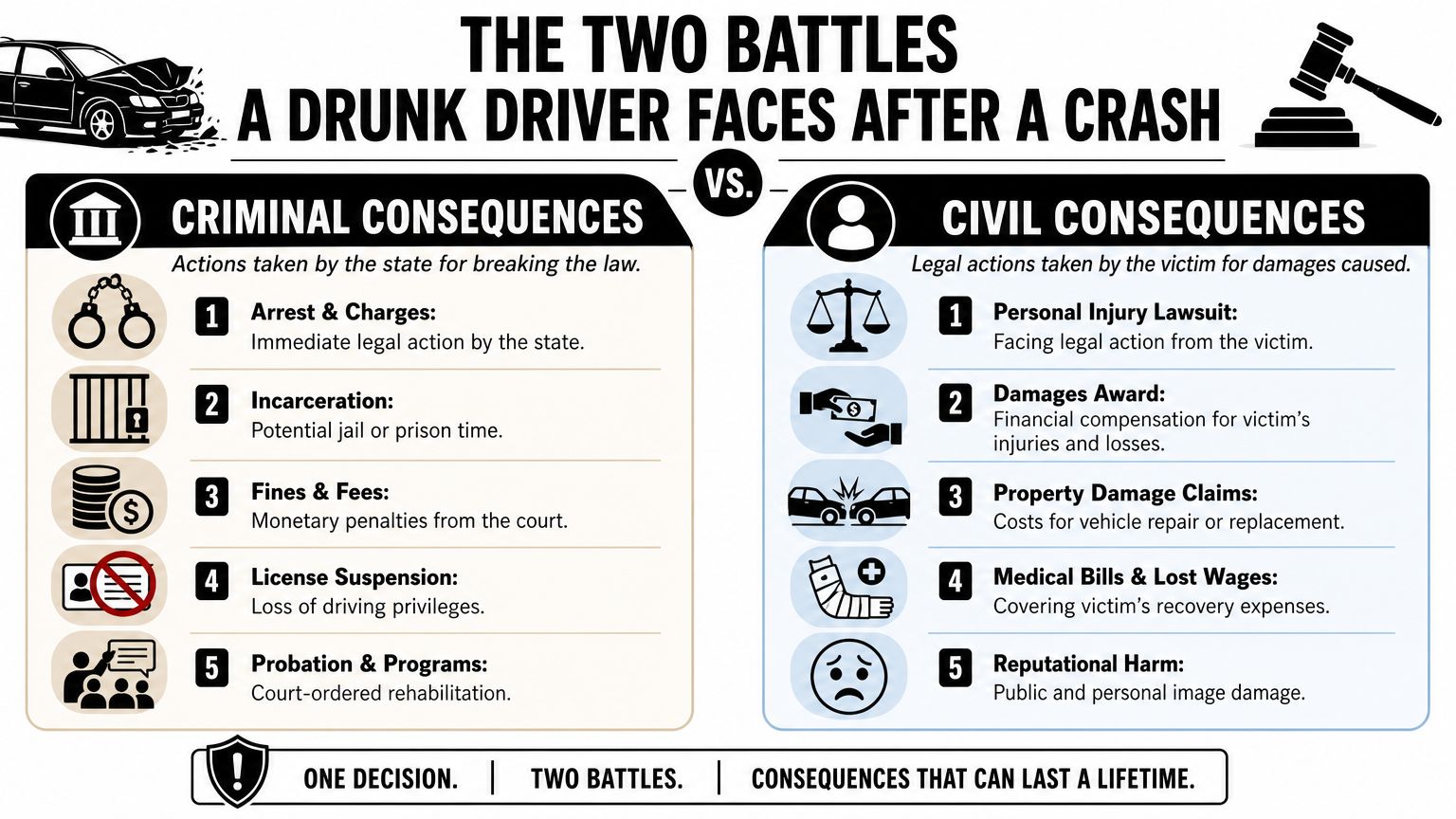
The Two Battles a Drunk Driver Faces After a Crash
After a drunk driving wreck, most victims assume the driver faces one legal problem: the DWI charge. In reality, many licensed professionals face a second fight that can be just as serious. The criminal court handles the DWI case. A separate board, agency, or employer may review whether that person should keep working in their profession.
For you as the injured person, that distinction matters. A driver may be worried about jail, fines, and losing driving privileges. But if that same driver also risks losing the license that pays their bills, the pressure on them changes fast.
Criminal court is only part of the story
The criminal case belongs to the State of Texas. That process deals with punishment for breaking the law. Your injury claim is separate. Your case focuses on liability, which means legal responsibility for causing harm, and damages, which means the money losses and human losses caused by the wreck, such as medical bills, lost wages, pain, and reduced quality of life.
If the drunk driver holds a professional license, there can also be an administrative or licensing review. Under Texas Occupations Code § 53.021 and the related discussion of Texas licensing consequences, boards may consider the nature and seriousness of the offense, how it relates to the profession, the risk of future misconduct, and the person's fitness to practice. That same source notes that sanctions can include suspension, probation, public reprimand, or permanent revocation, and that many boards require disclosure of convictions.
Practical rule: Never assume the drunk driver's only problem is the criminal charge. In many cases, the real fear is professional discipline.
Why this increases pressure after a crash
A licensed professional often has more to lose than a typical driver. A public disciplinary case can affect employment, renewals, hospital access, client trust, and future income. That doesn't replace your civil claim, but it can make the defense more motivated to manage the fallout.
A Houston car accident lawyer will look at both tracks. One track is the criminal case. The other is the threat to the driver's livelihood. If you want background on the driver's own side of that process, this overview of keeping your license after a DWI in Texas shows why professionals often treat the licensing issue as a major crisis.
Where your injury case fits
Your civil case is based on negligence. Under Texas law, negligence means a person failed to use reasonable care and caused injury. Driving while intoxicated can be powerful evidence of negligent conduct. Texas also uses comparative fault under Chapter 33 of the Texas Civil Practice and Remedies Code. That means fault can be divided between people involved in a crash. If the defense tries to blame you for part of what happened, your compensation can be reduced by your share of responsibility, and recovery can be barred if your responsibility is too high.
In some drunk driving cases, Chapter 41 may also matter because it addresses exemplary damages, sometimes called punitive damages, in cases involving especially serious conduct. Whether that applies depends on the facts and the evidence.
Why the At-Fault Driver's License Status Matters to You
Victims sometimes think the driver's career problems are separate from the injury case. They aren't. They can change the tone, timing, and advantage of settlement talks.
A drunk driver who also faces board review, employer reporting, or credentialing problems may want to limit public exposure, reduce prolonged conflict, and avoid facts coming out in a civil lawsuit that make the professional situation worse. Insurance companies know that.
Settlement leverage is about pressure, not sympathy
Your case should never depend on whether anyone feels sorry for the other driver. It depends on proof. But advantage in negotiation comes from understanding what pressures the other side is trying to manage.
For example, if a licensed professional caused a clear rear-end crash after drinking, the defense may have little room to argue about fault. Add professional consequences to that situation, and the driver may be less willing to drag the case out. The insurer may also prefer to resolve a strong claim before discovery opens up more damaging facts.
A strong injury claim doesn't just tell the insurer what happened. It shows why delay creates more risk for their insured.
A real-world example
A Houston driver is rear-ended on I-45 by a motorist arrested for DWI. The injured driver has emergency room bills, follow-up care, and missed time at work. If the at-fault driver is also a healthcare worker, teacher, or CDL holder, the civil case now sits next to a second problem that threatens that person's livelihood.
That can matter when we prepare a demand package. We aren't threatening anyone. We're documenting the seriousness of the conduct, the injuries it caused, and the wider consequences the driver is already facing. That changes the negotiation environment.
If you want a plain-English overview of timing issues on the criminal side, this article on how long a DWI stays pending in Texas helps explain why some civil cases move while the DWI case is still unresolved.
How this fits into the injury process
An auto insurance claim usually begins with notice of the crash, investigation, document gathering, and a demand for payment. If settlement talks fail, the case may move into a lawsuit, discovery, and possibly trial. This breakdown of How Houston Accident Settlements Work gives a factual overview of what to expect from demand through settlement in a Houston injury case.
Here's why professional-license risk matters during that process:
- It raises personal stakes: The driver may be thinking about much more than car repairs.
- It can affect defense strategy: Some defendants want a faster, quieter resolution when professional review is hanging over them.
- It supports serious valuation: A drunk driving crash often deserves a different negotiation posture than an ordinary fender-bender.
- It can shape discovery decisions: Employment records, disclosures, and board-related concerns may influence how aggressively the other side wants to litigate.
Texas law also gives you a deadline to act. The statute of limitations is the legal deadline for filing a lawsuit. In Texas injury cases, waiting too long can destroy an otherwise strong claim. That's one reason early investigation matters.
How a DWI Impacts Different Texas Professionals
Not every licensed driver faces the same fallout. The consequences depend on the profession, the governing body, the facts of the crash, and whether the conduct raises safety or fitness concerns. From a victim's perspective, that means strategic influence looks different in different cases.
A quick comparison
| Profession | Governing Body Example | Potential Sanctions |
|---|---|---|
| Commercial driver | Texas DPS or CDL-related regulators | Loss of driving privileges tied to commercial work, employment disruption |
| Nurse | Texas Board of Nursing | Review of fitness to practice, restrictions, probation, suspension |
| Doctor or other healthcare professional | Texas Medical Board or similar board | Board review, limits on practice, reputational and employment consequences |
| Teacher | State educator certification authorities | Conduct review, restrictions, reprimand, suspension concerns |
| Lawyer | State Bar disciplinary system | Character and fitness concerns, discipline review |
| Real estate agent | Texas licensing authority for real estate | Renewal or discipline review, disclosure-related consequences |
Healthcare workers face a second private review
For doctors, nurses, and other hospital-based professionals, state board action isn't the whole picture. A frequently missed issue is that hospital credentialing reviews occur outside of state board jurisdiction. A DWI conviction can trigger immediate suspension of hospital privileges, loss of on-call status, or termination of employment, even if the professional keeps the state license.
That matters in serious injury and wrongful death cases. If a healthcare worker caused a fatal crash, the fear of losing hospital privileges can become a major settlement pressure point for the defense.
CDL drivers often have the most obvious exposure
Commercial drivers live and work through their license. If the at-fault driver was operating a truck, delivery vehicle, or another commercial vehicle, a DWI can directly threaten income. That reality is often visible early because employers react quickly when driving status is in doubt.
For a victim, that can affect both liability investigation and insurance strategy. Trucking cases also involve different records, company policies, and preservation issues. If that's part of your case, this article on a DUI with a CDL gives more context on why commercial drivers face a different kind of crisis.
Teachers, lawyers, and agents face reputation-based fallout
Some professions depend heavily on public trust. A teacher may face school-employer concerns. A lawyer may face reporting and disciplinary issues. A real estate agent may be judged on disclosure obligations and client confidence. In those cases, the professional danger may be less about immediate physical inability to work and more about whether the person can continue practicing without restrictions or loss of trust.
In settlement negotiations, different professions create different pressure points. A truck driver may fear lost income. A nurse may fear credentialing review. A lawyer may fear public discipline.
Why victims should care about these distinctions
If your family is pursuing wrongful death compensation after a fatal drunk driving crash, the at-fault driver's profession can shape the defense response. The same is true in nonfatal injury claims involving surgeries, rehabilitation, and long-term wage loss.
A Texas injury attorney looks at those differences because they help answer practical questions:
- What does this defendant need to protect right now?
- How public does this case become if it's filed?
- Does delay make the driver's professional situation worse?
- Is the insurer dealing with an insured who has strong reasons to settle?
Those aren't abstract questions. They affect case value and negotiation posture.
The No Conviction Myth and Your Injury Case
Many victims hear that the driver “didn't get convicted,” then assume the professional fallout disappeared. That's often wrong.
A common outcome in criminal court is deferred adjudication, where the court does not enter a formal finding of guilt if certain conditions are met. People often think that means the person's professional license is safe. For many professions, it doesn't.

Boards can look past the label
Licensing boards can evaluate the underlying conduct of a DWI even when there was no formal conviction. Under Texas Occupations Code §53.021, boards weigh issues like the seriousness of the crime and fitness to practice. For many professionals, deferred adjudication is still a major problem because the board looks past the legal label and focuses on the dangerous conduct itself.
That matters to your case because a settlement advantage doesn't always disappear when the criminal case ends in a softer result. The defense may still be facing serious professional consequences in a separate forum.
Why this matters in injury negotiations
Suppose a drunk driver hits a family at an intersection in Houston, seriously injuring one parent and a child. Months later, the defense tells everyone the driver “avoided a conviction.” That may sound like the pressure is gone. It may not be.
If the person is a licensed nurse, teacher, or another regulated professional, the board may still review the crash facts, the alcohol-related conduct, and the fitness concerns that flow from it. In practical terms, that means your influence may still be very real.
Key point: “No conviction” and “no consequences” are not the same thing.
A short video can help explain how legal outcomes and practical consequences often diverge:
Don't let the insurer use criminal language to shrink a civil claim
Insurance companies often benefit when victims assume the criminal result controls everything. It doesn't. Your civil case turns on evidence of negligence, causation, and damages. If alcohol use caused the wreck, those facts still matter.
This also ties back to comparative fault under Chapter 33. The defense may still try to reduce what they owe by arguing that you contributed to the crash. That's why your lawyer should keep the focus on the driver's conduct, the crash sequence, witness statements, medical records, and the full impact on your life.
How We Use a DWI to Strengthen Your Accident Claim
Knowing that the driver faces professional trouble is useful. Using that knowledge correctly is what moves a case.
In a drunk driving injury claim, the work starts early. We don't wait to see whether the criminal case resolves first. We build the civil case while the facts are fresh and while the defense is still trying to control the fallout.
First we investigate the driver's role and exposure
We look at the obvious evidence first. Police reports, charging information, crash scene details, witness accounts, vehicle damage, body camera footage when available, and medical records. Then we ask a second set of questions that many firms miss.
Was the driver working at the time? Do they hold a professional license? Does the crash create reporting duties, employer review, or board scrutiny? If the driver is a truck operator, healthcare worker, teacher, or another regulated professional, that can change the negotiation circumstances.
Then we build the demand around real-world consequences
A demand letter should do more than summarize bills. It should show the insurer exactly why the case presents risk. In a drunk driving case, that means tying the conduct to the harm.
A typical demand package may include:
- Clear liability proof: Why the drunk driver caused the crash.
- Medical documentation: Emergency care, follow-up treatment, limitations, and future concerns.
- Loss evidence: Missed work, reduced earning ability, and out-of-pocket costs.
- Human damages: Pain, disruption, stress, and changes to daily life.
- Pressure points: Facts showing why the defense has reasons to resolve the case rather than prolong it.
If you want a consumer-friendly outside resource on negotiation tactics and claim structure, this car accident settlement negotiation guide offers a practical overview.
A short example from the victim's side
Take a Houston commuter struck by an intoxicated driver on the way home. The victim suffers a shoulder injury, misses work, and needs ongoing treatment. The at-fault driver turns out to be a licensed healthcare provider whose job depends on privileges at a local hospital.
That fact doesn't guarantee any result. But it changes how the defense views exposure. A filed lawsuit can mean depositions, record requests, employer attention, and more pressure while credentialing concerns are already in motion. Used properly, that can help push the claim toward a fairer resolution.
One option for injured Texans seeking representation is Houston Personal Injury Lawyer, which provides factual information about representation for injury victims across Houston and Harris County.
A Drunk Driving Accident Is More Than a Mistake. We Can Help.
When someone drinks, gets behind the wheel, and hurts another person, the damage spreads far beyond the crash itself. You may be left with surgeries, therapy, missed income, family stress, and months of uncertainty. The driver may be facing criminal court, insurance exposure, and professional consequences that threaten a career.
Those professional consequences matter because they reveal how serious the conduct was. They also create pressure that can affect your claim. In the right case, that pressure becomes part of a smarter settlement strategy.
What you should do after a drunk driving crash
If you're dealing with the aftermath now, focus on practical steps:
Get medical care and keep going
Follow treatment recommendations and keep records of every visit, prescription, restriction, and bill.Preserve evidence
Save photos, discharge papers, wage-loss information, repair records, and messages from the insurer.Be careful with statements
Don't guess about your injuries or minimize them during adjuster calls.Ask about all available damages
“Damages” include more than current medical bills. They can also include lost wages, pain, and other losses tied to the crash.Act before deadlines hurt you
The statute of limitations and evidence problems don't wait for recovery to get easier.
Why intoxication details can matter
Some drunk driving crashes also involve prescription stimulants, illegal substances, or dangerous combinations of substances. If substance use may be part of your case, educational material on the dangers of mixing alcohol and Adderall can help you understand why impairment isn't always limited to alcohol alone.
The legal framework behind your rights
Texas negligence law gives injured people the right to seek compensation when another driver's careless conduct causes harm. Chapter 33 of the Texas Civil Practice and Remedies Code governs allocation of fault, which is why the defense may try to shift blame. Chapter 41 addresses exemplary damages in cases involving especially serious misconduct, which can become relevant in some intoxicated driving cases.
If your loved one died because of a drunk driver, the case may also involve a wrongful death claim. That can include claims for financial losses and the human loss suffered by surviving family members. Those cases require a careful, immediate review because evidence and strategic considerations develop quickly.
You don't have to sort through all of this on your own.
If you were hurt by an intoxicated driver, contact The Law Office of Bryan Fagan, PLLC for a free consultation. We can explain your rights, evaluate liability, deal with the insurance company, and assess whether the at-fault driver's professional license exposure may strengthen your settlement position.