A car crash can change your life in seconds, but you don't have to face recovery alone.
The patrol car lights fade, the paperwork starts, and then deep panic hits. You're not just thinking about court. You're thinking about Monday morning. You're thinking about your boss, your paycheck, your professional license, and whether one night is about to follow you for years.
If you're asking, will a DWI affect my job in Texas, the honest answer is yes, it can. For some people, the risk is immediate because they drive for work or hold a state license. For others, the danger shows up later during a background check, a promotion review, or an insurance investigation after a crash. If the DWI involved an accident, your stress can multiply fast because criminal charges and employment trouble may overlap with a civil injury claim.
The Moment Your World Changes an Introduction
A lot of people remember the same details. The stop on the shoulder. The awkward silence during the ride. The moment they realize this isn't only about a criminal case. It's also about rent, health insurance, and whether their employer will find out.
That fear is real. A DWI in Texas can put pressure on nearly every part of your life at once. If you use your car to commute, drive a company vehicle, visit clients, or transport passengers, even a temporary license problem can throw your work life into chaos. If there was also a collision, you may be dealing with property damage, injuries, and calls from insurance adjusters while you're still trying to process the arrest.
One of the hardest parts is uncertainty. You may not know whether to tell your employer, whether a background check will show the case, or whether the other driver can sue you if someone got hurt. In those first hours, clear guidance matters. This practical guide on the first 48 hours after a DWI arrest in Texas can help you think through your next steps.
You are not weak for feeling overwhelmed. A DWI case can create criminal, employment, licensing, and civil problems at the same time.
How a Texas DWI Legally Impacts Your Life and Livelihood
A DWI can hit your job from three directions at once. The criminal case threatens your record and your schedule. The license problem affects how you get to work and whether you can perform key duties. If there was a crash, a civil claim can expose you to money damages at the same time you are dealing with prosecutors and your employer.

That combination is what makes a Texas DWI feel so destabilizing. One event can spread into several systems that do not wait for each other.
The criminal side
The criminal case is the part people see first because it carries the direct threat of court dates, fines, jail exposure, and a lasting record. For employment, the problem is not only the final outcome. The process itself can interfere with work through missed shifts, stress, travel restrictions, and the need to appear in court or meet bond conditions.
A simple way to understand it is this. Your criminal case is the part that asks whether the state will punish you. Your employer is often asking a different question. Can this employee still be counted on to show up, follow policy, and avoid creating new risk for the company?
Those are separate questions, but they affect each other in real life.
The driving and license side
For many workers, the license issue causes the earliest work disruption. A pending DWI can trigger a separate fight over your driving privileges, and that matters even if your job title does not include the word "driver."
A suspended or restricted license works like a kink in a hose. The job may still exist, but the flow of ordinary work life gets squeezed. You may have trouble commuting, visiting clients, covering multiple sites, responding after hours, or using a company vehicle. If your employer expects flexibility, even a short-term driving problem can change how they view your reliability.
This is also where confusion sets in. Some people assume, "I can still do my actual job, so this should not matter." In practice, transportation is often part of the job even when it is not listed that way on paper.
The civil side if a crash happened
If the DWI arrest came after a collision, there may be a second legal track running beside the criminal case. The other driver, passengers, or even an employer affected by the crash may pursue a personal injury or property damage claim. That case is about financial responsibility, not criminal punishment.
Here are the terms that usually cause confusion:
- Liability means legal responsibility for causing the wreck.
- Damages means the losses being claimed, such as medical bills, lost wages, pain and suffering, or vehicle damage.
- Comparative fault means Texas can divide blame by percentage if more than one person contributed to the crash.
- Statute of limitations means the deadline for filing a lawsuit.
These civil issues matter to your livelihood because they can reach beyond traffic court and into your finances, insurance history, and professional reputation. If you drive for work, carry professional licenses, or are expected to maintain insurability, a crash tied to a DWI can create pressure your employer notices even before a case is resolved. For a plain-English look at how screening and online records can affect hiring and retention decisions, Digital Footprint Check's insights are useful context.
The criminal case and the civil case also interact in ways people do not always expect. A criminal conviction does not automatically decide the injury claim, but the same facts, police reports, witness statements, and test results may matter in both places. That is why people involved in a DWI crash often need coordinated advice. A Houston Personal Injury Lawyer, available for new cases, handles representation for injury victims in cases arising from Texas car wrecks, which becomes important when one incident creates both criminal exposure and civil liability.
Practical rule: If your DWI involved a crash, treat the employment problem, the criminal case, and the injury claim as connected issues from day one.
How Employers Discover a DWI in Texas
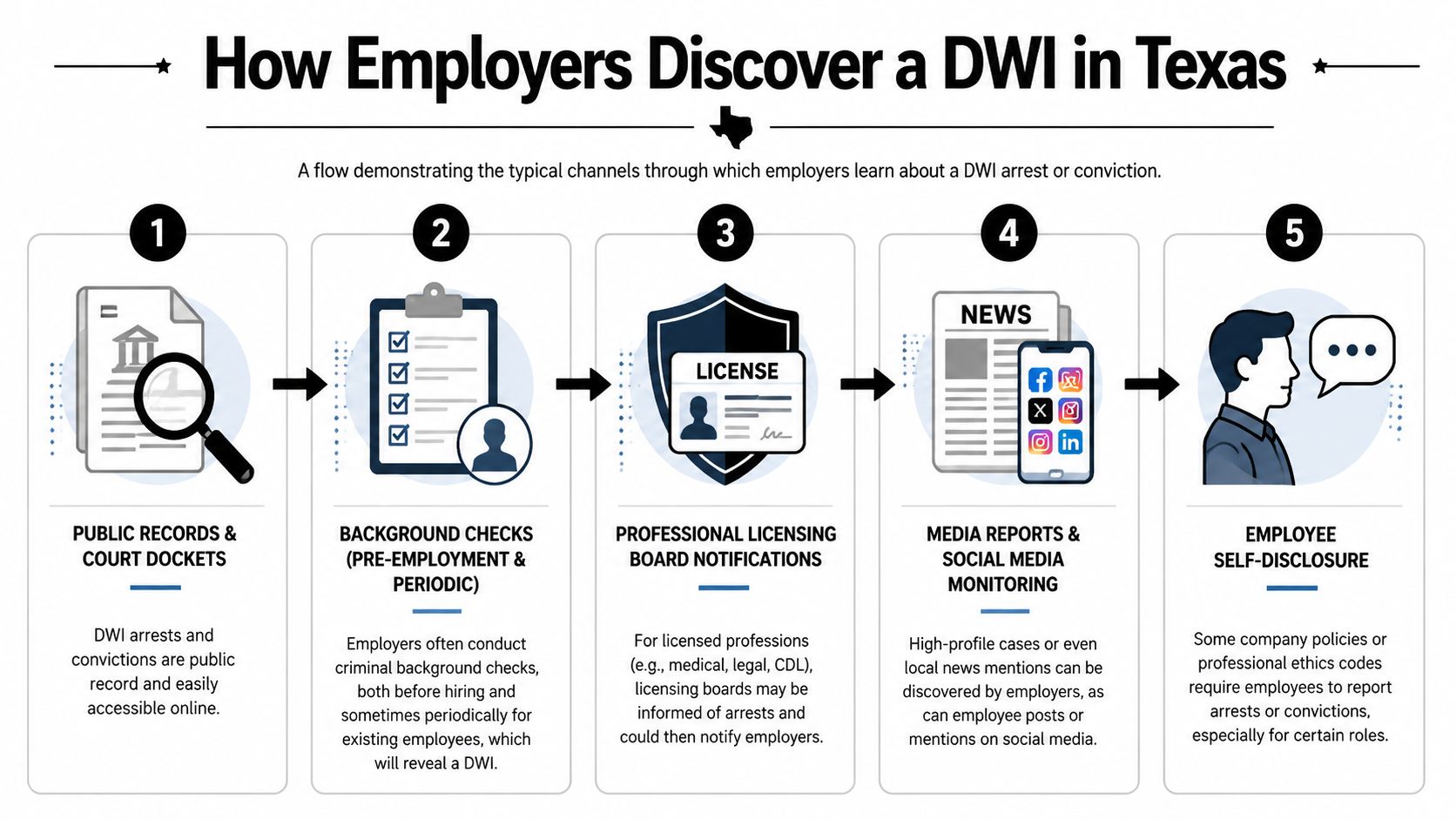
Many employees hope a DWI will stay private. Sometimes it doesn't. Sometimes it stays quiet for a while and then appears at exactly the wrong time, such as a promotion, internal transfer, renewal of credentials, or new job search.
Background checks are the biggest reason
For non-driving jobs, the main issue is screening persistence. Texas employer-facing guidance states that a DWI conviction generally appears on most background checks and may remain on the criminal record indefinitely unless legal relief is obtained. That matters in fields such as healthcare, education, and government, where employers may view a DWI as an ongoing compliance and trust concern rather than a one-time mistake, as explained in Texas guidance on how a DWI affects your profession.
That single point clears up a lot of confusion. People often ask, “If I keep my head down for a while, will this go away on its own?” A conviction may not.
For readers who want a plain-English overview of what companies often review during hiring, Digital Footprint Check's insights give a useful general look at the pre-employment screening process.
It may come up in more than one way
A DWI can reach your employer through different channels:
- Periodic screening: Some employers don't just run checks when they hire. They also rescreen current employees.
- License or policy reporting: Certain jobs require you to report arrests, charges, or convictions.
- Driving record review: If your role includes any driving, the employer may check your driving status separately.
- Public-facing information: In some workplaces, managers hear about arrests through local networks, online records, or workplace rumors.
The video below gives another overview of how these cases can affect employment.
Why regulated industries react more strongly
A private office may care mainly about attendance and judgment. A regulated employer often has extra concerns. Hospitals, schools, agencies, and security-related employers may ask whether the incident suggests risk, poor judgment, or future compliance problems.
That doesn't mean every employer will fire someone after a DWI. It does mean you shouldn't assume silence equals safety.
Job-Specific Risks From CDL Drivers to Office Workers
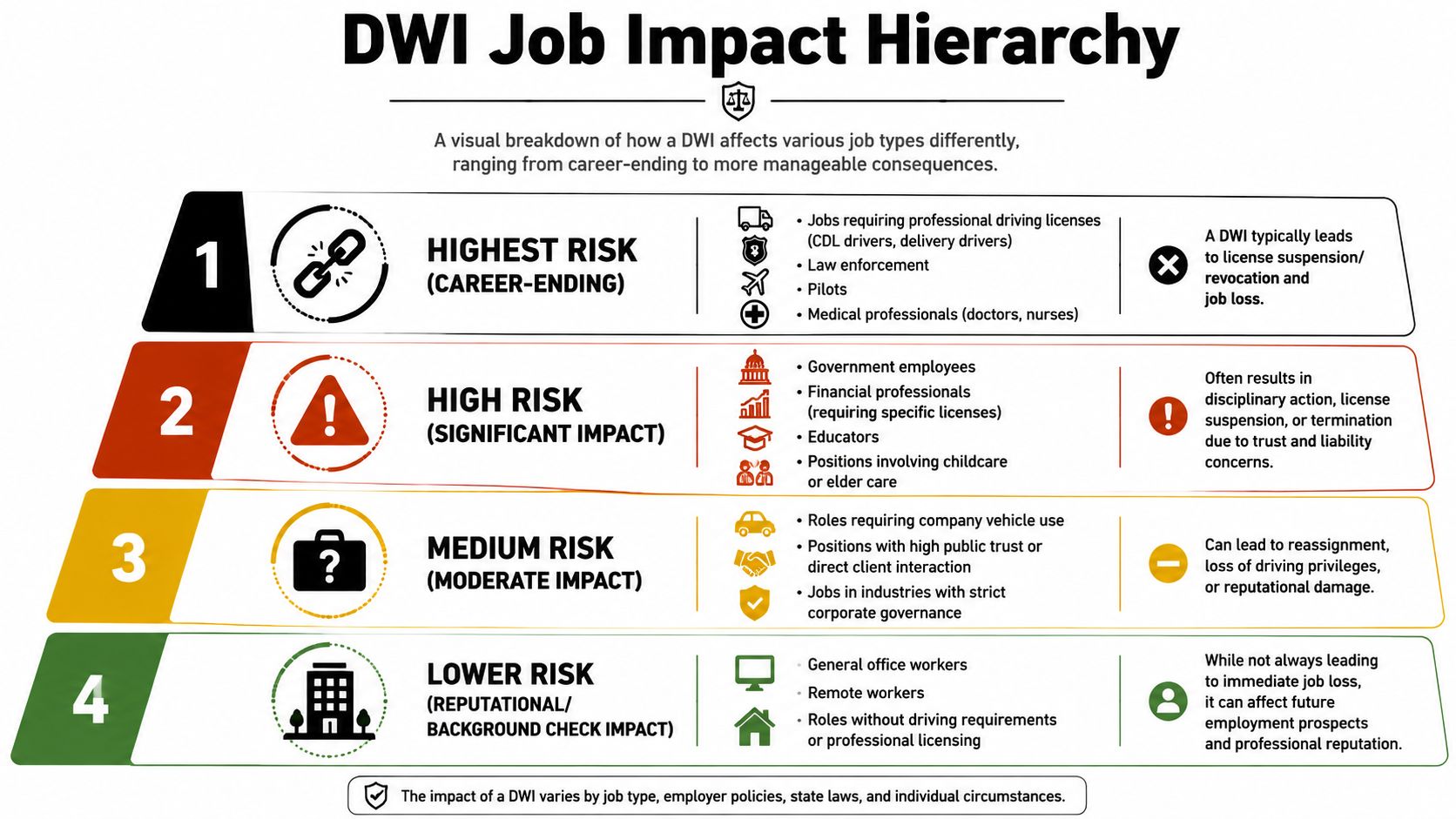
The answer to will a DWI affect my job in Texas depends heavily on what you do for a living. The same arrest can be a manageable problem in one field and a career crisis in another.
A quick comparison by job type
| Job type | Typical concern | Why risk can be higher |
|---|---|---|
| CDL and other professional drivers | Loss of ability to work | Driving is the core job duty |
| Licensed professionals | Board scrutiny and employer discipline | Employers and boards may view the case as a trust issue |
| Government and security roles | Reporting and reliability concerns | Public trust and compliance matter more |
| Company vehicle or field work roles | Driving restrictions | You may still need a valid license even if driving isn't your main task |
| Office and remote jobs | Background checks and reputation | Risk may show up later during hiring or promotion |
CDL holders and people who drive for income
For commercial drivers, delivery drivers, and other workers whose jobs depend on legal driving status, the consequences are often the harshest. Even when the arrest happened off the clock, the impact on employment can be immediate because the job itself depends on driving eligibility.
If you hold a CDL and need role-specific background on how employers and regulators view these cases, Patriot CDL for CDL with a DUI is a useful resource. You can also read this Texas-focused discussion of a DUI with a CDL.
A Houston truck driver, for example, may not be fired because of office politics. They may be sidelined because they can't lawfully perform the central task of the job.
Licensed professionals and trust-based jobs
Nurses, teachers, lawyers, real estate professionals, and others with state-issued credentials often face a second layer of trouble. Their employer may care. Their licensing board may care too.
These fields often focus on questions like:
- Disclosure obligations: Did you report the incident when required?
- Professional judgment: Does the conduct raise concerns about decision-making?
- Public trust: Would clients, patients, students, or the public lose confidence?
A teacher in Houston, for instance, may still be able to teach while the criminal case is pending, but district policy and certification rules can complicate that quickly. A nurse may face difficult questions long before any final courtroom outcome.
Government, safety-sensitive, and company vehicle roles
Some jobs don't require a professional license, but they still involve increased risk. Think about city workers, security employees, home health staff, field technicians, salespeople who visit clients, and employees who drive fleet cars.
An office employee who occasionally drives to meetings may think a DWI won't matter because driving isn't listed as the main duty. Then HR learns the role requires a clean driving status for insurance purposes. That's where people get blindsided.
A DWI often hurts employment not because of a job title alone, but because of the hidden rules attached to that role.
General office workers and remote employees
This group often has the most uncertainty. Some employers may take no action if the case doesn't affect attendance or violate policy. Others may react strongly if the company culture is strict, the role involves client trust, or a future background check flags the record.
A remote software worker may keep their current job but struggle later when applying elsewhere. A financial office employee may not lose the role immediately, but a promotion could stall if the company does a deeper review.
The key point is simple. Lower risk does not mean no risk.
Understanding Your Rights Under Texas At-Will Employment
Texas is generally an at-will employment state. In plain English, that means an employer can usually fire an employee for a legal reason, or for no stated reason at all, unless a contract or specific law says otherwise.
That's why people are often shocked to learn that a DWI arrest alone can create job danger. You may think, “I haven't been convicted, so they can't fire me.” In many situations, they still can.
What at-will means in real life
If your employer decides that the arrest creates too much risk, embarrassment, scheduling trouble, or insurance concern, Texas law often gives them broad room to act. This is especially true if:
- Your job involves driving
- Your role requires public trust
- Your handbook has conduct rules
- Your job depends on professional licensing
A Houston office manager, for example, may be let go because the employer believes the arrest reflects poor judgment. A field technician may be terminated because the company's insurer won't cover them on work vehicles.
What your employer still cannot do
At-will employment doesn't let an employer fire someone for an illegal reason. They still can't terminate you because of unlawful discrimination or retaliation.
That distinction matters. If the employer says the issue is the DWI, the question usually becomes whether that reason is legally permissible. Often, it is. But if a firing is tied to race, sex, disability, protected leave, or another unlawful reason, that's different.
Important: At-will employment gives employers wide discretion, but it doesn't erase anti-discrimination protections.
Why policy review matters
Before you talk to HR or a supervisor, read your:
- Employee handbook
- Employment contract, if you have one
- Fleet or driving policy
- Professional conduct or disclosure rules
Many people create extra trouble by guessing. Some disclose too early without a strategy. Others stay silent when a policy clearly required notice. Both can backfire.
Proactive Steps to Protect Your Career After a DWI Arrest
You leave jail, turn your phone back on, and see what is waiting for you. A message from your supervisor. A notice from your insurer. Maybe photos from the crash that led to the arrest. In a few hours, one event can split into three separate problems: a criminal case, a threat to your job, and a civil claim from anyone hurt in the collision.
That is why speed matters after a DWI arrest. Early choices can affect whether you keep driving privileges, what your employer learns, and how an insurance company evaluates a crash claim. If alcohol is alleged to have contributed to the collision, the civil side often becomes harder because the injured person's insurer or lawyer may push fault arguments more aggressively.
A DWI case works a lot like a house fire that spreads room by room. The criminal charge is one room. Your employment problem is another. If there was a wreck, the civil claim is a third room, and it can burn at the same time. Waiting too long gives each problem more space to grow.
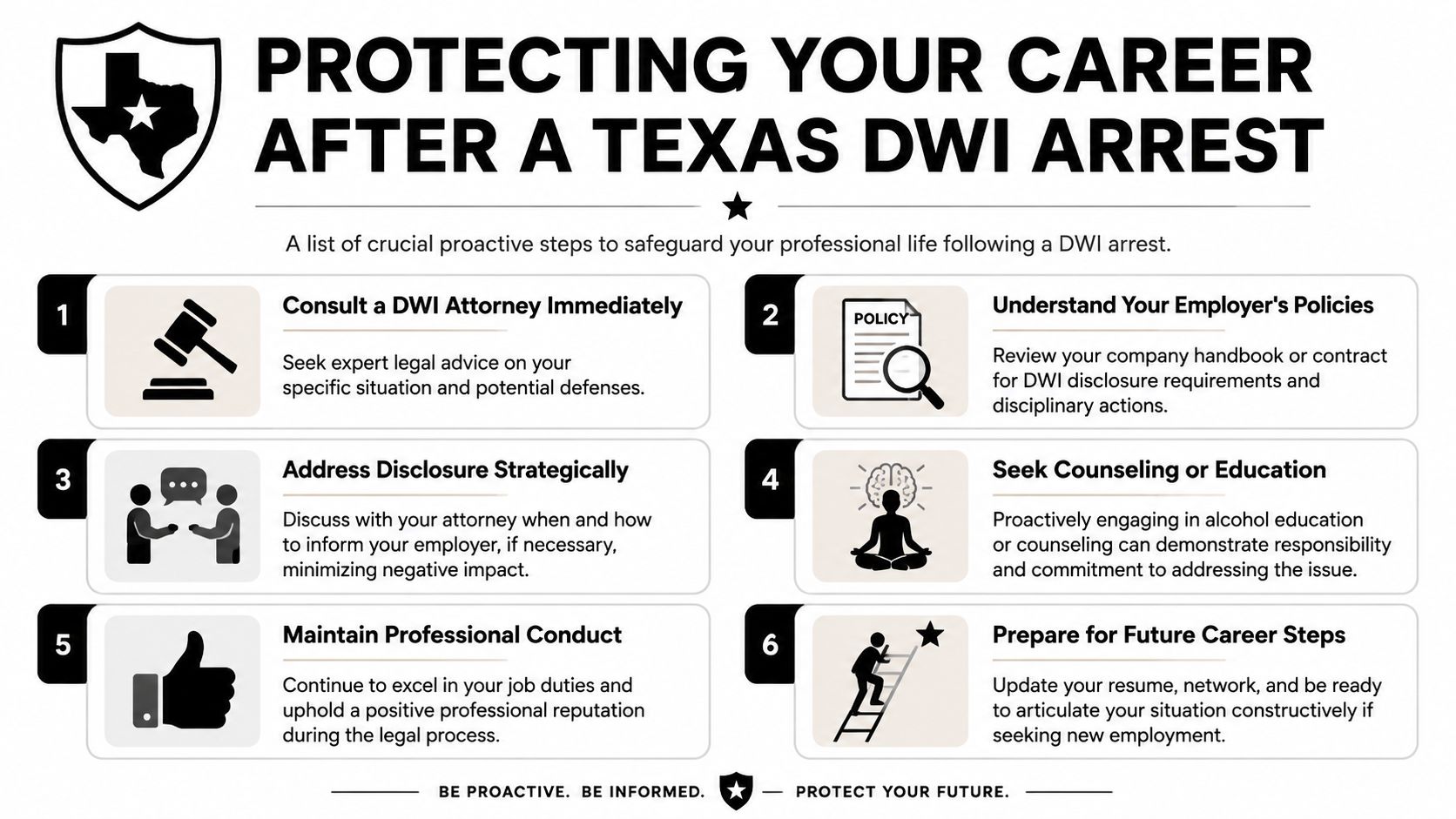
A practical checklist
Get legal advice early
If possible, speak with a DWI defense lawyer soon after the arrest. If the arrest involved a crash, ask whether you also need advice about civil exposure, insurance statements, and possible injury claims.Gather every document in one place
Keep bond papers, court notices, towing records, insurance letters, repair estimates, and any employer policy documents together. Memory fades fast under stress. Paperwork usually tells the story more accurately than recollection.Separate the criminal case from the work issue
They are connected, but they are not the same. Your criminal defense strategy should not be improvised in an email to HR, and an employer update should not include guesses about guilt, fault, or what happened in the crash.Check whether your ability to drive affects your job
Some workers can keep doing their jobs while the case is pending. Others cannot if they lose driving privileges. If commuting or work-related driving is part of your employment, this guide on driving to work after a DWI in Texas explains an issue many people overlook early.Handle insurance communications with care
Give prompt factual notice if a policy requires it. Keep it simple. Do not speculate about fault, minimize what happened, or make broad statements about alcohol use, injuries, or who “caused” the crash.Preserve evidence from the collision
Save photos, dashcam footage, witness names, vehicle location details, and medical or repair records if they exist. This matters for more than the criminal case. It can shape how a civil claim is valued and whether comparative fault becomes part of the dispute.
Why the crash matters to your career
Many people focus only on court dates and miss the pressure coming from the accident itself. If another person claims injury, your employer may start viewing the arrest through a different lens. The question shifts from “Was there an arrest?” to “Could this create business risk, insurance trouble, missed work, or public fallout?”
That is especially true if the crash caused visible injuries, involved a company vehicle, happened during work hours, or drew police attention that an employer is likely to hear about. A civil claim can also create practical job problems. You may need time off for court, meetings, medical evaluations, or vehicle issues. If you drive for work, a license problem and a pending injury claim can squeeze your job from both sides at once.
If a crash victim makes a claim
A personal injury firm talks about DWI employment fallout for a simple reason. One incident can trigger criminal penalties for the driver and civil damages claims from the injured person or family.
For example, a rear-end collision on I-45 may lead to claims for medical bills, lost income, vehicle damage, pain and suffering, or, in a fatal case, wrongful death damages. At the same time, the driver accused of DWI may be trying to keep a job, answer employer questions, and protect insurance coverage. Those tracks run together even though they are handled in different parts of the legal system.
If you need civil guidance after an intoxication-related collision, The Law Office of Bryan Fagan, PLLC provides Texas accident representation for injury victims and families.
What to say to your employer
Keep your message short, accurate, and limited to what the employer needs to know. A useful rule is this: report obligations, not theories.
You may need to say that you are dealing with a legal matter, that you are confirming any effect on your license or schedule, and that you will provide any required update under company policy. Avoid extra detail unless a policy, contract, or licensing rule requires it. Long explanations often create new problems because they mix emotion, assumptions, and facts that may later change.
Your Next Steps and Frequently Asked Questions
The call from HR comes the morning after your arrest. Then your phone buzzes again. It is your insurance company asking about the crash. For many Texans, that is the moment the problem stops feeling like one case and starts feeling like three at once. A criminal charge, a job risk, and a civil claim tied to the same incident.
That overlap is what makes a DWI so disruptive. The criminal case asks whether you violated Texas law. Your employer is asking whether you can still do your job safely and reliably. If someone was hurt in the crash, the civil side asks who caused the harm and what losses must be paid. Those are different systems, but they can affect each other in real life.
A few legal terms help make the civil side easier to follow. Liability means legal responsibility for the crash. Damages means the losses being claimed, such as medical bills, lost wages, property damage, pain and suffering, or wrongful death losses. Comparative fault means more than one person can share blame under Texas law. Statute of limitations means the filing deadline for a lawsuit. Insurance adjusters and employers may both react to the same event, but for different reasons.
Common questions
Can I be fired for just a DWI arrest?
Often, yes. Texas at-will employment works a lot like a month-to-month arrangement. Unless a contract, policy, or law limits the employer, the employer can often end the relationship based on an arrest, driving concerns, missed work, insurance issues, or business risk, as long as the reason is not otherwise illegal.
Do I have to tell my employer?
Sometimes. The answer usually turns on your job duties and your employer's rules, not just the charge itself. If you drive for work, carry a professional license, handle children or vulnerable adults, or must report any loss of license, your duty to disclose is more likely.
What if the case is dismissed or resolved without a conviction?
That can improve your position, but it does not erase every consequence automatically. An employer may still have learned about the arrest. A crash victim may still pursue an injury claim if the facts support one. It helps to review both your criminal record options and any accident-related exposure, because those tracks do not always end at the same time.
What should I do after a crash tied to a DWI?
Start with safety and medical care. Then preserve the facts the way you would protect evidence after any serious business dispute. Save photos, witness names, the police report information, towing details, and all insurance communications. Do not guess about fault, and do not give a broad recorded statement without understanding how it could affect both the criminal case and any injury claim. If the collision caused serious injuries or a death, speak with a Houston car accident lawyer, available for consultations, or another Texas injury attorney before accepting an insurer's version of what happened.
How do insurance companies use these facts?
Insurance companies look for a clear story they can use. They examine fault, medical treatment, vehicle damage, coverage defenses, and the timing of every statement you make. In a DWI-related crash, they may argue that intoxication settles the blame question, while still disputing how much damage was caused. That can affect settlement talks, your finances, and sometimes your employment if your job depends on driving, insurability, or a clean record.
Small mistakes can spread fast here.
A short, careful plan helps. Keep copies of every court date and work notice. Follow employer reporting rules exactly, but do not volunteer extra details. Track any license restrictions, because a transportation problem can become a job problem before the criminal case is resolved. If a crash injured someone, treat the civil side seriously from the start.
If a DWI or intoxication-related crash has put your job, your finances, or your family's future at risk, talk with The Law Office of Bryan Fagan, PLLC about your situation. The firm offers a free, confidential consultation for Texans dealing with car accident claims, insurance disputes, and serious injury or wrongful death cases. You deserve clear answers about your rights and a practical plan for what comes next.