The morning after a DWI arrest usually feels unreal. Your car may still be somewhere else. Your paperwork is spread across the kitchen table. You're trying to remember what the officer handed you, what court date you heard, and whether you can still drive to work tomorrow.
That fear is normal. It's also why so many people make the same mistake. They focus only on the criminal charge and miss the separate fight over their license.
If you want to understand how to keep your license after a DWI in Texas, start with one core idea. You are dealing with two different tracks at the same time. One track is the state's administrative process over your driving privilege. The other is the criminal case in court. They affect each other in practical ways, but they are not the same case, and winning one does not automatically fix the other.
After a DWI Arrest Your World Hasn't Ended It Has Just Changed
A lot of people wake up after an arrest thinking the same thing: “I've lost everything.” In most cases, that isn't true. What has changed is that your life is now running on legal deadlines, paperwork, and decisions that need to be made quickly.
The biggest misunderstanding is what “keeping your license” even means. The Texas Department of Public Safety treats the license issue as its own separate matter. The administrative suspension and the criminal case are separate tracks, and winning the criminal case does not automatically restore driving privileges through DPS, as explained on the Texas DPS reinstatement page.
That separation confuses people because it feels unfair. If the criminal case gets reduced, dismissed, or resolved favorably, many assume the license issue disappears too. It doesn't work that way.
Two problems start at once
Think about what usually happens after an arrest. You're worried about court, jail records, insurance, work, and family. Meanwhile, the state has already started the license process. That process moves fast, often faster than the criminal case itself.
Practical rule: If you were arrested for DWI, treat your license problem as urgent on day one, even if your first court date feels far away.
This is one reason it helps to read how other states handle similar license questions. While Texas law is its own system, Gerald Miller P.A. on DUI licenses gives a useful comparison point on why license consequences often move separately from the criminal charge.
What clients need to hear first
You still have options. You may be able to challenge the suspension. You may be able to keep driving during parts of the process. Even if the state suspends your license, you may still have a path to limited driving privileges for essential needs.
What doesn't work is waiting for the criminal court to sort everything out. That delay is where people lose ground.
The first fight is usually not about guilt or innocence. It's about preserving your right to contest the loss of your license before the administrative process rolls forward without you.
The First 24 Hours What You Must Do Now
Start with the paperwork from the arrest. Don't rely on memory. Find the sheet the officer gave you, because that document often controls what happens next with your driving privilege.
In many Texas DWI arrests, the officer takes your plastic license and gives you a temporary paper document. That document is not just a receipt. It usually serves as notice that the state is moving toward a suspension and that you now have a temporary authorization to drive for a limited period.

Find the notice and read it carefully
Set aside ten uninterrupted minutes and do this:
- Locate every page from the arrest. Check your wallet, car, booking property, glove box, and any envelope you received at release.
- Identify the notice about suspension or temporary driving privilege. The exact title can vary, but the purpose is the same.
- Look for dates. The date of arrest matters. Any expiration language matters.
- Keep the paperwork flat and legible. Take clear photos of every page.
If you're still trying to get organized, this guide on what to do immediately after a DWI arrest in Texas is a helpful companion checklist.
Why this form matters so much
That paper is often the first official notice that your license is in jeopardy through an administrative process, not just through the court case. Many people set it aside because they think the criminal complaint is the only urgent document. It isn't.
Your temporary permit may let you drive for now, but it does not mean the state has decided to leave your license alone. It usually means the clock has started.
Don't assume “I still have a paper license” means “I'm safe.” It usually means the deadline is already running.
Your first-day priorities
The first day after arrest should be simple and disciplined.
- Preserve documents: Keep the arrest paperwork, bond paperwork, and any test-related forms together.
- Write down what happened: Note where you were stopped, what the officer said, whether testing was requested, and what you remember saying or doing.
- Protect your schedule: If you drive for work, school, caregiving, or medical treatment, list those needs now. That information may matter later if you need limited driving relief.
- Get legal advice quickly: The sooner a lawyer reviews the paperwork, the easier it is to spot the deadlines and choose the right response.
This early step is not glamorous, but it works. The people who protect their licenses usually start by getting organized before panic takes over.
The 15-Day Countdown to Save Your License
The most important number in the license fight is 15 calendar days. In Texas, you have 15 calendar days from your arrest to request an Administrative License Revocation hearing, and if you miss it, the temporary paper license is typically valid for only 40 days, after which the suspension can begin without a hearing, as explained in this article on saving your driver's license after a DWI arrest.
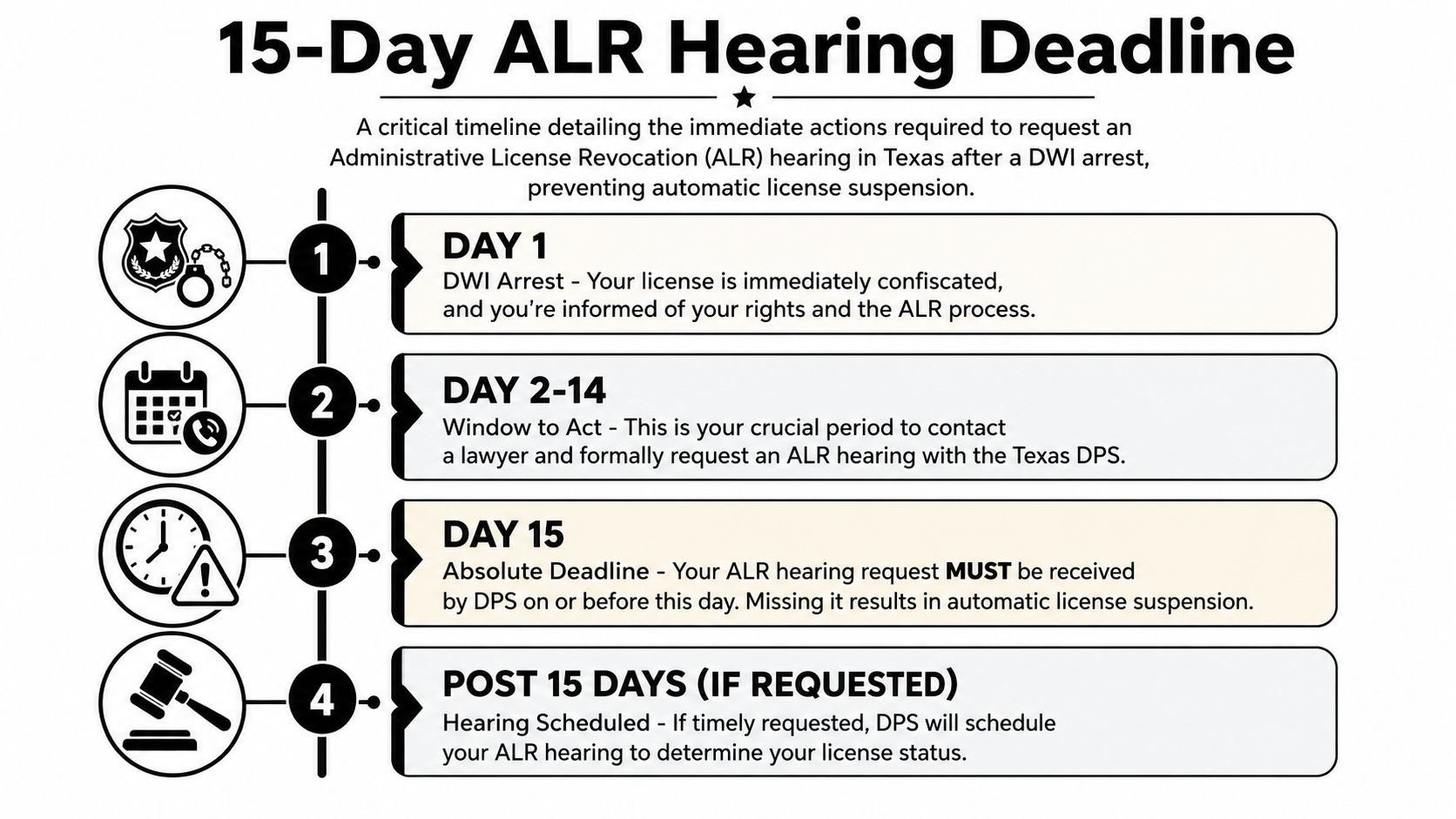
That deadline is the center of the entire early strategy. If you do nothing else right after a DWI arrest, protect the right to that hearing.
What the ALR hearing is
The Administrative License Revocation hearing, often called the ALR hearing, is not your criminal trial. It is the civil administrative process tied to whether DPS can suspend your driving privilege after a DWI arrest involving an alleged refusal or failure of a breath or blood test.
The hearing is a chance to challenge the basis for the suspension. In practical terms, it can also help you see evidence early and force the state to put its version of events on the record.
For people asking whether they can keep driving before court, this overview on driving after a DWI arrest in Texas before court helps explain the immediate reality.
What to do before the deadline
Handle the deadline like this:
- Count from the arrest date, not from your court date. Court dates come later. The license deadline comes first.
- Do not wait for police reports. You don't need the full case file to preserve the hearing request.
- Do not assume an informal call is enough. Make sure the request is properly made so there is a clear record.
- Keep proof of the request. Save confirmations, emails, transmission records, and notes.
A lawyer usually handles this quickly because the risk of missing the deadline is too high.
Here's a short visual summary of that timeline.
What the hearing can accomplish
Some people think requesting an ALR hearing is only about delay. That's too narrow. The hearing can matter for several reasons:
| Issue | Why it matters |
|---|---|
| Probable cause | The state may have to justify the stop and arrest in a focused setting. |
| Test issues | The hearing can address whether there was an alleged refusal or failed test basis for suspension. |
| Procedure | Administrative cases can turn on whether the required process was followed. |
A timely ALR request doesn't guarantee you'll keep your license, but failing to request it often guarantees you lose the chance to fight for it early.
If you're trying to learn how to keep your license after a DWI in Texas, this is the first real answer. Preserve the hearing right before the deadline expires. Everything else builds from there.
What Happens if Your License Is Suspended
If the suspension happens, the situation is serious, but it's not the end of the road. A suspension changes your options. It doesn't always eliminate them.
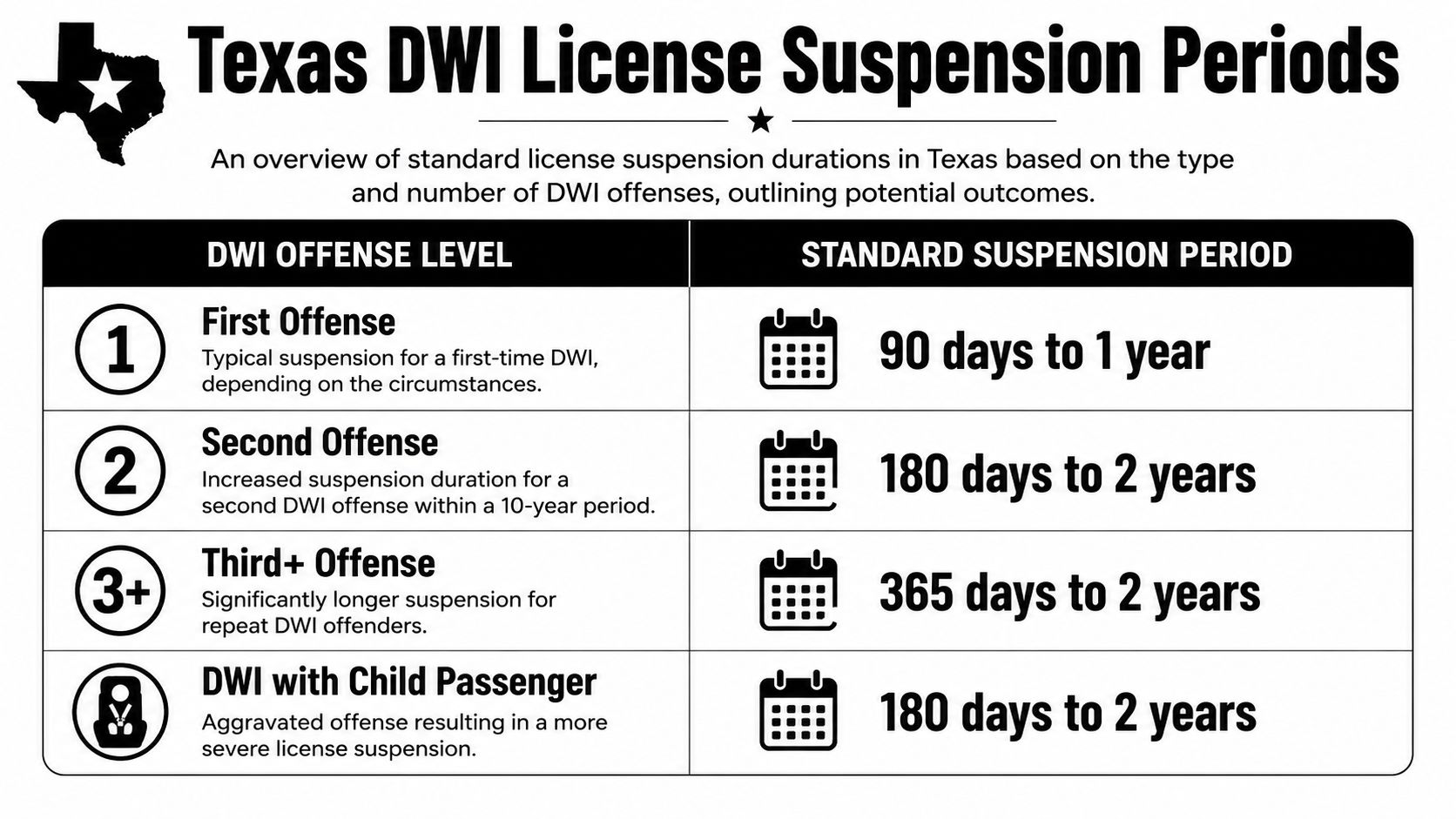
For a first DWI offense in Texas, failing a chemical test with a BAC at or above 0.08% typically results in a 90-day suspension, refusing the test can trigger a 180-day suspension, and a BAC of 0.15% or more can lead to a suspension of up to one year, according to this discussion of the impact of a DWI conviction on your driver's license.
Suspension does not always mean zero driving
A lot of people hear “suspended” and assume they can't legally drive under any circumstance. In many cases, that's not the full story. Texas may allow an occupational driver's license, sometimes called a hardship license, for essential driving needs.
That can mean driving for work, school, household duties, or medical needs, depending on the court order and your circumstances. The rules are strict, and the paperwork matters, but this option often keeps people employed and functioning.
When limited driving relief matters most
An occupational license tends to matter most for people who:
- Commute to work: If missing work means losing your job, waiting passively can cause more damage than the suspension itself.
- Care for family: Parents, caregivers, and people responsible for school pickups or medical appointments often need immediate planning.
- Have no realistic transportation backup: In many Texas communities, public transit won't solve the problem.
If you're also weighing what happened before the arrest, including roadside testing decisions, this article on refusing roadside sobriety tests in Texas may help you understand part of the bigger picture.
Trade-offs people should understand
An occupational license is helpful, but it isn't the same as full restoration. You may face limits on where you can drive, why you can drive, and what proof you must carry. In some cases, an ignition interlock device can become part of the conditions tied to getting back on the road.
The practical question isn't always “Can I avoid every consequence?” Sometimes it's “How do I keep working and taking care of my family while this case is pending?”
That's a better way to approach the problem. A strong response looks at both goals. Fight the suspension where you can, and if the suspension stands, move quickly toward lawful limited driving instead of waiting for the criminal case to fix it.
How the Criminal Case Affects Your License Long-Term
A lot of drivers get through the first license emergency and then make a costly assumption. They believe the hardest part is over if they requested the ALR hearing or found a way to keep driving for work. The criminal case can still create new license problems months later, even if the administrative fight went well.
That happens because Texas runs two separate systems after a DWI arrest.
The administrative side deals with the arrest-based suspension and your standing with DPS. The criminal side deals with the charge, the court's orders, and the final outcome of the case. Those systems overlap in practical ways, but one does not automatically clean up the other. You can win ground on the administrative side and still have license-related duties from the criminal case. You can also resolve the criminal case and still need to satisfy DPS before your license is fully clear.
That distinction matters in real life. I regularly have to explain to clients that a good result in court does not always mean they can ignore DPS paperwork, insurance filings, or class requirements.
What the criminal case can trigger
If the criminal case ends in a conviction, probation, or another result that carries driving-related conditions, Texas may require additional steps before your license is in good standing. Common examples include:
- DWI education or intervention classes
- SR-22 insurance filings
- Ignition interlock requirements in some cases
- Proof that court-ordered conditions were completed
These are not technical details. They are the reasons people finish court and still cannot put the license issue behind them.
SR-22 is often where delays start
An SR-22 is a filing from your insurance company showing financial responsibility. It is not a separate insurance policy, but it often raises premiums and creates headaches if it is canceled or allowed to lapse. If that filing drops before you are legally allowed to remove it, DPS can continue treating your license as noncompliant.
This is one of the clearest examples of the two-track problem. The court may be done with you. DPS may not be.
Drivers sometimes look online and find material from other states, such as Alcohol and drug test DMV Florida, and assume the rules work the same way in Texas. They do not. Texas procedures, deadlines, and reinstatement requirements need to be handled under Texas law.
What helps protect your license over time
The drivers who avoid long-term license trouble usually do three things consistently:
- They keep the criminal case and the DPS process separate in their mind. That helps prevent missed requirements.
- They finish classes, filings, and court conditions as soon as they are required. Delay often turns a temporary problem into a longer suspension or reinstatement issue.
- They verify compliance instead of assuming it. If paperwork was supposed to be filed, confirm it was filed. If insurance was supposed to stay active, make sure it stayed active.
A DWI lawyer helps coordinate that process and catch the practical overlap between the court case and the driving consequences that follow. The Law Office of Bryan Fagan, PLLC is one Texas firm that handles these matters, but the larger point is simple. Treat the criminal case and the license case as two separate jobs, and stay on top of both if you want to protect your ability to drive over the long term.
Your Path to Reinstatement and Moving Forward
Once a suspension period is over, many people assume their license automatically reactivates. That assumption causes delays. Reinstatement is its own process, and DPS expects you to clear every administrative condition before full driving privileges return.

The reinstatement checklist that matters
Texas guidance on reinstatement is practical, not dramatic. You generally need to finish the suspension period, satisfy all required conditions, and submit what DPS still needs.
A clear working checklist looks like this:
- Serve the suspension fully: Don't assume you can drive the day you think it should end without confirming your status.
- Complete all required programs: If your case requires DWI education or intervention, finish it and keep proof.
- Pay the required fees: One published Texas guide reports a standard reinstatement fee of $125, and says online processing typically takes 24 to 48 hours while mailed payments can take up to 21 business days, as described in this guide on reinstating a suspended license in Texas.
- Maintain SR-22 if required: That same guide describes SR-22 as commonly lasting two years after conviction in some cases.
- Submit every remaining document: DPS won't restore full driving privileges until the administrative conditions are cleared.
Common mistakes after the suspension ends
Most reinstatement problems are not dramatic legal failures. They are paperwork failures.
People often run into trouble because they:
| Mistake | Result |
|---|---|
| Assume time alone fixes everything | DPS may still show requirements outstanding |
| Let SR-22 lapse | Driving privileges can remain blocked |
| Mail documents too late | Processing delays can keep you off the road longer |
Keep copies of every receipt, filing confirmation, completion certificate, and insurance document. Reinstatement problems often come down to proving that something was submitted.
Moving forward with a plan
This part of the process feels administrative because it is. That doesn't mean it's minor. A missed filing after the suspension can create just as much disruption as the original deadline did.
If you're trying to understand related education requirements in other states, this overview of the Alcohol and drug test DMV Florida process is a useful comparison for how post-case compliance can affect driving privileges beyond the courtroom.
The practical approach is simple. Treat reinstatement like a checklist, not a guess. Confirm what DPS requires. Submit it on time. Keep proof. Don't drive on assumptions.
If you were arrested and you're worried about losing the ability to work, care for your family, or get through daily life, legal help is available. The lawyers at The Law Office of Bryan Fagan, PLLC offer a free consultation to discuss your situation, your deadlines, and the steps that may help protect your driving privileges while your case moves forward.