A car crash can change your life in seconds, but you don't have to face recovery alone.
A DWI arrest can feel the same way. One night ends with flashing lights, a tow truck, and a pile of papers in your hand. The next morning, you're trying to figure out how you'll get to work, pick up your kids, make court dates, or handle daily life if your license is suspended.
That's where many people start searching for what is a hardship license in Texas DWI cases. The problem is that Texas uses terms that sound similar but mean different things. If you use the wrong term, you can waste time, file the wrong paperwork, or misunderstand what relief may be available.
This guide breaks it down in plain English. If you're an adult dealing with a DWI-related suspension, the license you usually need is not a true Texas hardship license. It's usually an Occupational Driver's License, often called an ODL.
A DWI Arrest Is Overwhelming But You Have Options
If you've just been arrested for DWI, your mind usually goes straight to the practical problems.
You may be asking yourself how you'll get to your job on Monday. You may be worried about driving your child to school, getting to medical appointments, or keeping your household running. For many Texans, losing the ability to drive even for a short time can throw everything off balance.

A common example looks like this. A Houston driver is stopped late at night, arrested, and released hours later. By sunrise, the fear isn't only about the court case. It's about getting to work, keeping income coming in, and not falling behind on family duties. If that's where you are, start with practical first steps after arrest, including timing issues and paperwork, in this guide on what to do immediately after a DWI arrest in Texas.
The good news
A suspension doesn't always mean you're completely cut off from driving.
Texas law allows some drivers to ask for limited driving privileges for essential needs. That relief is often called an Occupational Driver's License. It can allow driving for things like work, school, and necessary household duties, but only if a court signs off.
Practical rule: An ODL is not automatic. You have to ask for it, prove why you need it, and follow strict limits if the court grants it.
Why this matters so much
Texas courts don't treat these requests lightly. In Texas, 42% of all traffic fatalities in 2022 were alcohol-impaired, and from 2014 to 2023, DUI was an identified factor in 14,389 fatalities, representing 37% of all traffic deaths in the state, according to the verified data provided for this article. That background helps explain why judges look closely at whether your need to drive outweighs the risk to public safety.
Still, a DWI charge doesn't automatically mean your job, school, or family routines have to collapse. If you're prepared and you ask for the right kind of restricted license, there may be a path forward.
The Critical Difference Between a Hardship and Occupational License
Most confusion starts with one phrase: hardship license.
People use it online as a catch-all term for any restricted license after a DWI. In Texas, that isn't technically correct. The distinction matters because the remedy for an adult after a DWI suspension is usually different from the remedy for a minor with special driving needs.
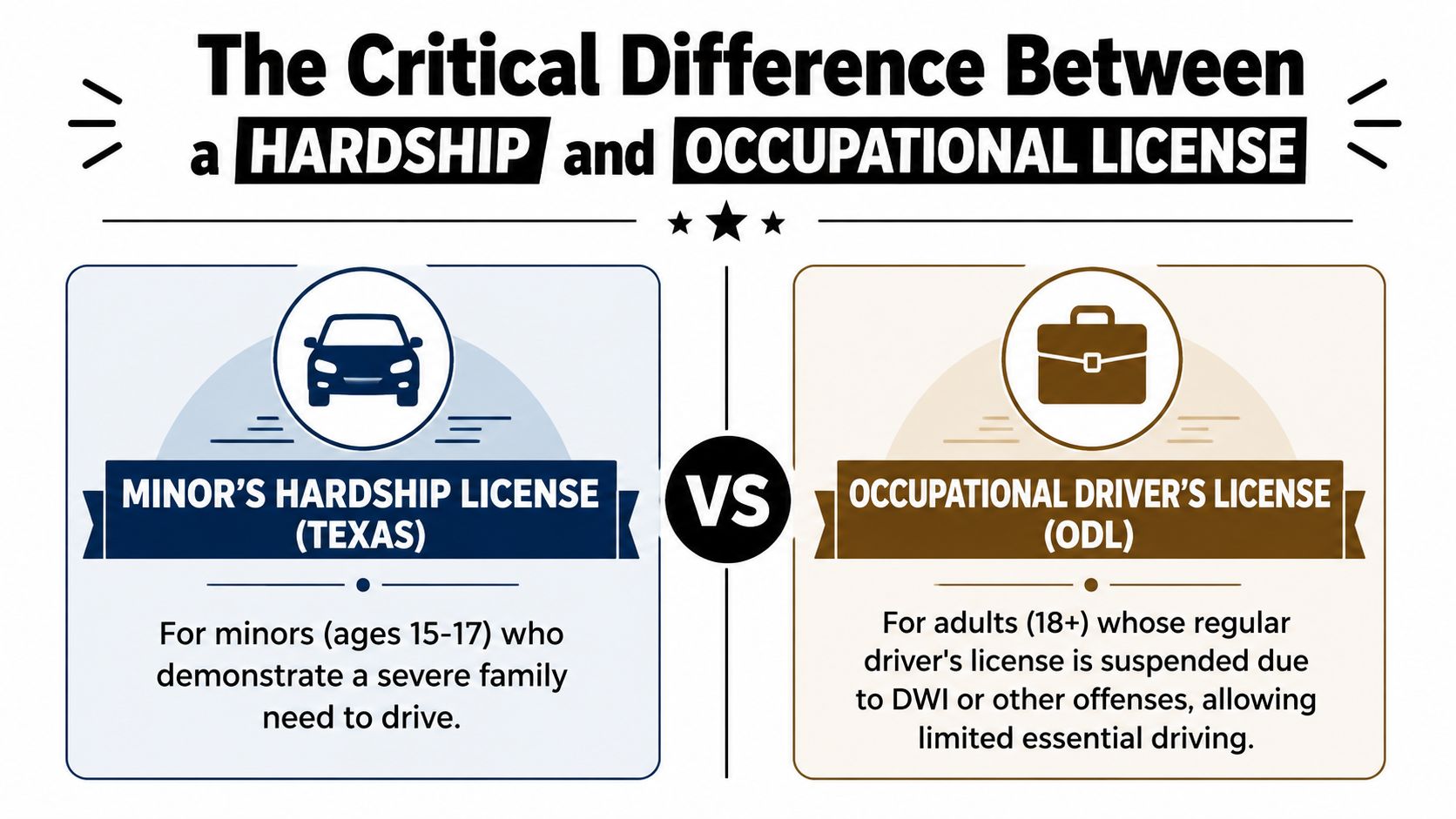
Hardship license in Texas: A Minor's Restricted Driver License (MRDL) for applicants under 16.
Occupational Driver's License: The court-ordered restricted license adults commonly seek after a suspension.
Texas DPS makes that distinction clear on its page about the Graduated Driver License program and hardship license.
What adults usually need after a DWI
If you're an adult asking what is a hardship license in Texas DWI cases, the answer is usually this: you're probably looking for an Occupational Driver's License, not a true hardship license.
An ODL is designed for limited, essential driving after a suspension. It usually applies when an adult needs to drive for necessary reasons such as employment, school, or medical needs. It requires court involvement and proof that the driving is necessary.
If you're trying to protect your driving privileges while the case unfolds, this article on how to keep your license after a DWI in Texas can help you understand the bigger picture.
Why the wrong label causes problems
Using the wrong term can lead to the wrong expectations.
For example, a parent may search "hardship license" and assume there's a simple DMV form for adults after a DWI. In many cases, there isn't. Adults generally need a court order. That means evidence, filings, and a judge who must be convinced that limited driving is justified.
Here's the simplest way to separate them:
| License type | Who it generally applies to | Why someone seeks it |
|---|---|---|
| Minor's Restricted Driver License | Applicants under 16 | Severe need for a minor to drive |
| Occupational Driver's License | Adults with a suspended license | Limited driving for essential needs |
The phrase people search versus the legal term you should use
Search engines don't care much about legal precision. Courts do.
So if you've been typing what is a hardship license in Texas DWI cases, keep using the phrase if it helps you find information. But when you speak with a lawyer, clerk, or judge about an adult DWI-related suspension, the more accurate term is usually Occupational Driver's License or ODL.
That small wording change can save you time and point you toward the correct process.
Are You Eligible for an Occupational License After a DWI
Eligibility usually comes down to one big idea. Can you show an essential need to drive?
Texas requires a court order proving that need. The court must decide that your need outweighs the risk to public safety. The process includes a petition, a state fee of $10 to $25 plus court costs, and an SR-22 insurance form, as reflected in the verified data tied to the Texas rule document.
What judges usually look for
Judges want specifics, not broad statements.
Saying "I need to drive" usually isn't enough. A stronger request explains where you need to go, why that travel matters, and why there isn't a reasonable alternative. The more concrete your proof, the better.
Examples of essential need often include:
- Job travel: You need to drive to a specific work location to keep your employment.
- School attendance: You need transportation to classes required for your education or training.
- Medical care: You must drive to your own medical appointments or those of a family member.
- Essential household duties: You need to handle basic family responsibilities that can't realistically be done without driving.
What can make approval harder
Not every driver is eligible right away, and not every petition succeeds.
One issue that often creates confusion is chemical test refusal. The verified data for this article states that if the stop involved intoxication and the driver refused chemical testing, the cited source says the person is generally not eligible for this relief. If you're unsure how refusal affects your case, this guide on whether you can refuse roadside sobriety tests in Texas may help you separate roadside tests from later testing issues.
Judges usually respond better to evidence than emotion. Employer letters, school records, treatment schedules, and medical documentation can matter more than general statements about inconvenience.
A quick self-check
Ask yourself these questions before filing:
- Can you document the need? Pay stubs, work schedules, class schedules, or appointment records can help.
- Can you explain the route? Courts often want a limited, practical reason for each trip.
- Can you maintain SR-22 insurance? If not, the process can stall quickly.
- Is your request narrow? Courts are more receptive to essential driving than broad requests for unrestricted use.
An ODL isn't a way to restore normal driving. It's a limited legal tool meant to preserve stability while your regular license is suspended.
The Two Paths to License Suspension ALR vs Criminal Case
Many drivers think there is only one way a DWI affects a license. In Texas, there are often two separate tracks.
One is administrative. The other is criminal. They can overlap, and that's why the process feels confusing.
Administrative License Revocation
The first track is often called Administrative License Revocation, or ALR.
This is tied to the stop itself and the testing issue. In Texas DWI cases, verified data for this article states that a restricted license is tied to the ALR timeline. After a first-offense suspension, restricted driving privileges may begin only after the first 30 days of the suspension period, and the underlying suspension can last from 90 days up to two years depending on the case posture, according to this article on what you should know about hardship licenses in Texas.
The same verified data states that if the driver refused chemical testing, the person is generally not eligible for this relief.
Criminal court suspension
The second track comes from the criminal DWI case itself.
A judge in the criminal case may impose a separate suspension if there is a conviction or another court-ordered basis for restriction. That means a driver may be dealing with both the ALR process and the criminal case at the same time.
These are parallel systems. Winning ground in one doesn't automatically fix the other.
ALR vs criminal court license suspension
| Aspect | Administrative License Revocation (ALR) | Criminal Court Suspension |
|---|---|---|
| What triggers it | Issues tied to the stop and testing process | A court outcome in the criminal DWI case |
| Who handles it | Administrative process linked to DPS | Criminal court |
| Timing | Can begin early in the case | Usually tied to court proceedings |
| ODL impact | Restricted driving may begin only after the first 30 days in a first-offense suspension, based on the verified data above | May require separate court attention depending on the case |
| Common confusion | Drivers often think this is the same as the criminal case | Drivers assume resolving the charge fixes all license issues |
Why this distinction matters in real life
A driver in Houston might think, "My criminal case isn't finished, so my license should be fine for now." That assumption can be dangerous.
You can have an ALR-related suspension issue while the criminal case is still pending. Or you can resolve one piece and still have to address the other. That's one reason lawyers often review both the administrative paperwork and the court file at the same time.
This two-track system also matters for accident-related cases. If an intoxicated driver caused your crash, questions about suspension, liability, and insurance often develop on a separate timeline from a civil injury claim. In a personal injury case, liability means legal responsibility for causing harm. Damages means the losses a person seeks to recover, such as medical bills, lost income, and pain and suffering. If fault is shared, Texas uses comparative fault rules under Texas Civil Practice & Remedies Code Chapter 33, which can affect how much an injured person can recover.
That civil side is separate from whether the other driver gets an ODL.
How to Apply for a Texas Occupational License Step by Step
The application process feels less intimidating when you break it into tasks. It is often more effective to treat it like a checklist rather than one giant legal problem.
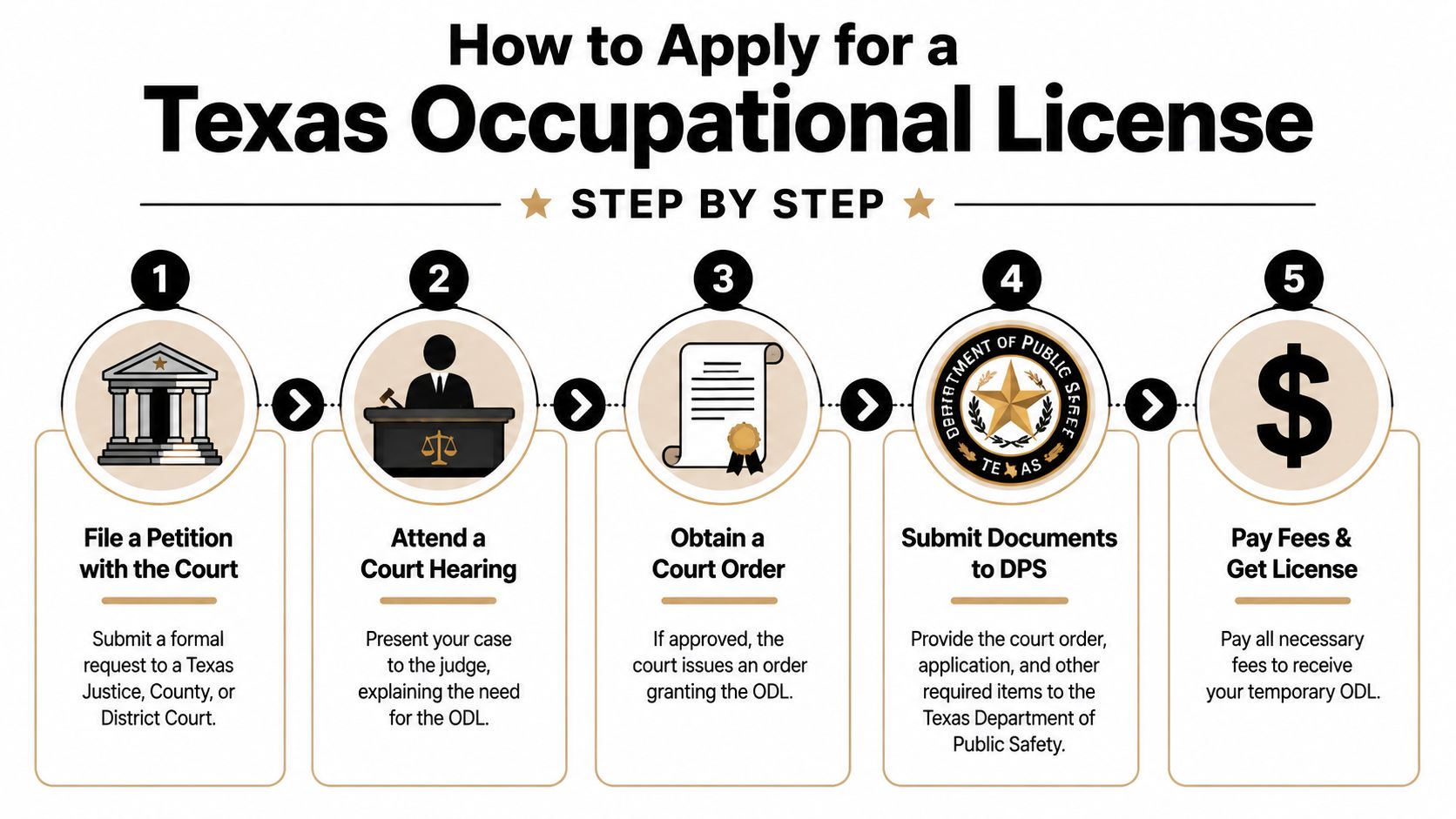
Step 1 File the petition in the right court
You usually start by filing a petition asking for an Occupational Driver's License.
That petition needs to clearly explain why you need limited driving privileges. It should identify the essential reasons for driving and give the court enough detail to evaluate the request.
For some drivers, this is the point where getting legal help makes the biggest difference. One option is consulting The Law Office of Bryan Fagan, PLLC, which handles Texas DWI-related matters and can help evaluate whether an ODL petition fits your situation.
Step 2 Gather the supporting documents
Before the hearing, collect the papers that back up your request.
A strong packet often includes:
- SR-22 proof so the court can see you've addressed the required insurance issue.
- Work or school records showing where you must go and when.
- Medical documentation if health-related travel is part of your request.
- Driving record and case paperwork so the court has the full context.
Short, direct documents usually work better than vague letters.
Step 3 Prepare for the hearing
The hearing is your chance to show the judge that your request is limited, necessary, and responsible.
Be ready to explain:
- Where you need to drive
- Why the trips are essential
- What schedule you need
- How you'll comply with restrictions
A useful approach is to think like a judge. If your plan sounds broad or casual, it may raise concerns. If it sounds narrow and practical, it may feel more credible.
Here's a visual walkthrough of the process:
Step 4 Get the signed court order
If the judge grants the request, the court signs an order setting out the terms.
That order matters as much as the license itself. It usually defines when, where, and why you may drive. Read it carefully. If something is unclear, ask before you leave court.
Step 5 Submit the order and required items to DPS
Once you have the signed order, you still have work to do.
You generally need to submit the court paperwork and any required fees or forms to the Texas Department of Public Safety. Keep copies of everything. If you're approved, carry the required documents with you any time you drive under the ODL.
Understanding ODL Restrictions Costs and Penalties
Getting an ODL isn't the finish line. It's the start of a more controlled driving period.
The court can limit your driving to specific purposes, routes, or time windows. That means you may be allowed to drive to work, school, treatment, court-ordered programs, or essential medical needs, but not for open-ended personal travel.
Common restrictions drivers should expect
Most ODLs are narrow by design.
You may face restrictions such as:
- Purpose limits: Driving only for work, school, treatment, court obligations, or medical needs.
- Time limits: Driving only during approved hours.
- Route limits: Using only authorized routes or travel within certain areas.
- Document rules: Keeping the order and related proof with you when driving.
An ODL gives you permission to meet essential obligations. It doesn't give you your old driving life back.
What it can cost
The direct filing cost is only part of the picture.
Verified data for this article states that Texas imposes an annual surcharge of $1,000 to $2,000 for three years to retain a driver's license post-DWI conviction, and that drunk-driving crashes cost the nation $68.9 billion annually, according to the verified data associated with the NHTSA impaired-driving fatalities release. Even apart from attorney's fees and insurance pricing, those state-imposed costs can put real pressure on a household budget.
Other common expenses can include:
| Cost category | What it usually involves |
|---|---|
| Court-related cost | Filing fee and court costs |
| Insurance cost | SR-22 coverage requirements |
| Compliance cost | Additional paperwork or court-ordered conditions |
| Long-term DWI cost | State surcharges after conviction |
What happens if you violate the order
Many people encounter new trouble at this point.
If you drive outside the allowed times, purposes, or routes, you can face new legal problems and lose the restricted privilege you worked to obtain. Courts tend to view ODL violations as a sign that the driver can't be trusted with limited driving authority.
That's especially important if your DWI arrest involved a crash. In a civil injury case, a violation can also affect how insurers and opposing lawyers argue about your behavior, credibility, and responsibility. If an intoxicated driver injured you or your family, claims may involve an auto insurance claim, questions about wrongful death compensation, and damages under Texas Civil Practice & Remedies Code Chapter 41, which addresses certain limits and rules related to exemplary damages.
Your Next Steps and Answers to Common DWI License Questions
The key takeaway is simple. If you're an adult asking what is a hardship license in Texas DWI cases, you're usually asking about an Occupational Driver's License.
That distinction matters because the adult remedy usually requires a court order, proof of essential need, SR-22 compliance, and strict adherence to the court's limits. It isn't automatic, and it isn't broad. But for many people, it's the tool that keeps work, treatment, school, and family life from falling apart during a suspension.
Start with a short action plan
If you're overwhelmed, focus on the next few moves only:
- Read every paper from the stop and release. Deadlines and suspension issues may already be running.
- List your essential driving needs. Work, school, medical care, and household duties should be specific.
- Gather proof now. Employer notes, schedules, and appointment records are easier to collect early.
- Avoid guessing about eligibility. Small facts, especially testing issues, can change the answer.
- Keep the civil side separate if there was a crash. If someone was hurt, personal injury issues are distinct from your license issue.
If you were hit by an intoxicated driver instead of being the person arrested, your focus is different. A Houston car accident lawyer or Texas injury attorney may investigate fault, preserve evidence, and deal with the insurance company while you focus on recovery. In Texas injury law, the statute of limitations is the legal deadline to file suit. Missing that deadline can end a claim, even if the underlying case is strong.
Common DWI license questions
Can I get an ODL immediately after a suspension starts
Not always.
The verified data for this article states that after a first-offense suspension, restricted driving privileges may begin only after the first 30 days of the suspension period in the ALR context. Timing depends on the posture of the case and the type of suspension involved.
What if I refused chemical testing
That can seriously affect eligibility.
The verified data used here states that if the driver refused chemical testing, the cited source says the person is generally not eligible for this relief. That's one reason early legal advice matters.
How long can an Occupational Driver's License last
The verified data for this article states that a first-offense DWI conviction can lead to a suspension lasting up to one year, while a second and third can involve suspensions up to two years. The court can grant the license for a maximum of one year at a time, extendable upon renewal, according to the verified data provided in the prompt.
Is an ODL the same as getting my full license back
No.
An ODL is limited permission to drive for approved purposes. It is not a full return to unrestricted driving.
What if a drunk driver caused my crash
Then your case shifts into injury law.
You may have rights to pursue compensation for medical bills, lost wages, pain and suffering, and in fatal cases, wrongful death compensation. Texas uses comparative fault rules under Chapter 33, which means each party's share of responsibility can affect the outcome. That issue is separate from whether the other driver applies for an ODL.
If you're dealing with a DWI-related license problem or you were injured by an intoxicated driver, The Law Office of Bryan Fagan, PLLC offers free consultations to discuss your options. You can get clear answers about restricted licenses, injury claims, liability, comparative fault, damages, and the next practical steps for your case without added pressure.