Yes. In Texas, you can get a DWI the morning after drinking if you were intoxicated when you were driving, and that can mean either a blood alcohol concentration of 0.08% or the loss of normal mental or physical faculties.
You may be reading this after a late night out, a wedding, a work event, or a few drinks at home that turned into more than you planned. You woke up, took a shower, drank coffee, and thought you felt normal. That feeling matters to you, but it doesn't control what Texas law looks at.
A car crash can change your life in seconds, but you don't have to face recovery alone. Morning-after DWI cases sit at the intersection of criminal law, roadway safety, and civil liability. If you're worried about your own risk, or you were hurt by a driver who should never have been on the road, clear information helps you make better decisions fast.
The Morning After Dilemma You Can't Ignore
A common Texas scenario looks like this. You stop drinking late, sleep a few hours, wake up with no spinning room and no obvious signs that you're drunk, then head to work, school, or to pick up your kids. On the surface, it feels different from a nighttime bar stop.
Legally, it may not be different at all.
The question isn't when you finished drinking. The question is whether alcohol was still affecting you when you drove. That's why morning-after cases surprise people. They assume time alone fixed the problem.
Why this risk gets taken seriously
Texas treats alcohol-related driving as a major public-safety issue for a reason. Texas reported 1,699 alcohol-impaired driving deaths in 2023, and TxDOT open data says DUI driving was a factor in 14,389 fatalities from 2014 through 2023, equal to 37% of all traffic fatalities in that period, according to Texas alcohol-impaired driving statistics summarized here.
Those numbers aren't abstract if your family has lived through a crash. A Houston driver on the way to work can be hit by someone who says, “I only drank last night.” A passenger can suffer a serious injury because another driver guessed wrong about being okay to drive. In the worst cases, families end up pursuing wrongful death compensation after an ordinary morning commute turns fatal.
Morning-after impairment often feels less obvious than nighttime intoxication. That doesn't make it less dangerous, and it doesn't reduce the legal exposure after a crash.
Two readers usually land here
This topic usually matters to one of two people:
- You're worried about your own exposure: Maybe you were stopped, tested, or arrested after thinking you had slept long enough.
- You were hurt by another driver: Maybe the other driver seemed tired, foggy, or smelled of alcohol, but insisted the drinking happened the night before.
Both situations are serious. A criminal charge can affect your license, your record, and your job. A crash can also trigger an auto insurance claim, a personal injury lawsuit, and hard questions about liability if someone else got hurt.
Texas Law Defines Intoxication in Two Ways
A morning-after DWI case often turns on a legal point drivers never learned. Texas does not require the State to prove only one kind of intoxication, and that matters whether you are facing charges or trying to understand how a crash happened.
The legal standard in plain English
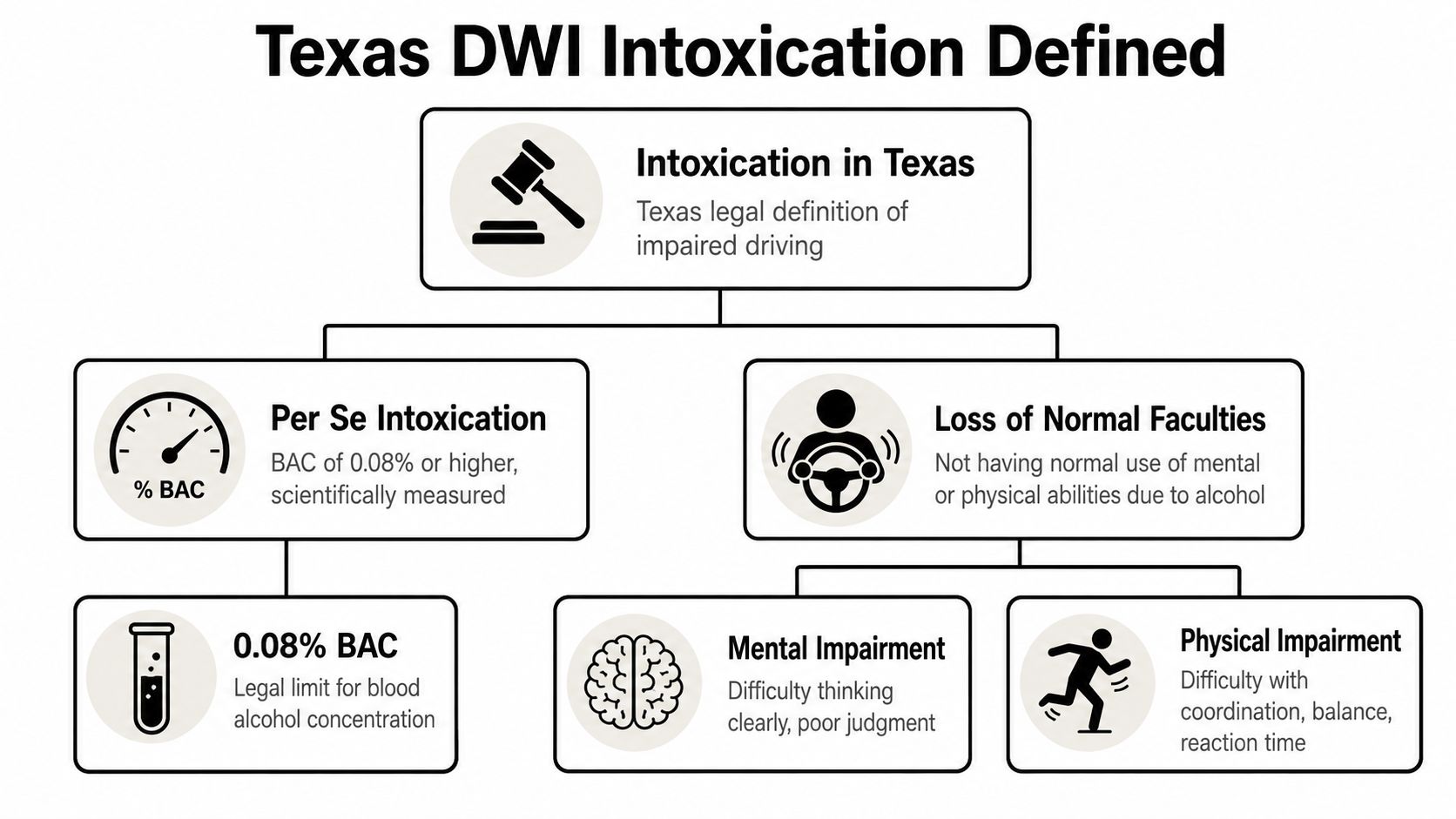
Under Texas law, intoxication can be proven in either of two ways. A prosecutor may rely on a chemical test showing a blood alcohol concentration of 0.08% or higher. The State may also argue that alcohol caused you to lose the normal use of your mental or physical faculties.
Legal rule: In Texas, intoxication means either a blood alcohol concentration of 0.08% or the loss of normal mental or physical faculties.
That second path is where many morning-after cases become more complicated than drivers expect.
Per se intoxication
The first route is the numeric one. If testing supports a BAC of 0.08%, the prosecution will use that result as direct evidence of intoxication.
On paper, that sounds straightforward. In practice, it often is not. Morning-after arrests raise questions about timing, testing delay, and whether the result accurately reflects your condition when you were behind the wheel. Those same timing issues can matter in related cases involving DWI arrests while sitting in your car in Texas, where the fight may center on operation, location, and what the evidence really shows.
Loss of normal faculties
Texas also allows a DWI charge when alcohol affects normal judgment, reaction time, coordination, or concentration, even without a test result at or above 0.08%.
This standard is broader, and juries usually hear about real-world behavior. Did the driver drift in a lane, miss signals, respond slowly, fumble with basic instructions, or show poor balance? Those details matter because a person can believe they are functional and still be legally intoxicated under this definition.
That issue becomes even more serious after a collision. In a criminal case, the State uses those observations to prove intoxication. In a civil injury case, the same facts can support an argument that the driver made an unsafe choice, caused preventable harm, and should pay for another person's medical bills, lost income, pain, or wrongful death damages.
Where people misjudge the law
Drivers often focus on the wrong measure. They ask whether they feel sober enough to drive. Texas law focuses on whether alcohol still left them over 0.08% or affected their normal faculties at the time of driving.
Several common assumptions lead people into trouble:
- Sleeping for a few hours does not answer the legal question.
- Coffee, food, and a shower do not determine intoxication.
- Feeling alert does not mean your coordination, judgment, or reaction time are back to normal.
- A BAC under 0.08% does not automatically end the case if other evidence points to impairment.
That distinction is why the question “can you get a DWI the morning after drinking in Texas” has such a clear answer. Yes, you can.
People who drink heavily enough to still have alcohol in their system the next morning may also face a separate health issue, which is one reason some turn to information about medically supervised alcohol detox timelines. Legally, though, the immediate problem is simpler. If alcohol is still affecting you when you drive, Texas can treat it as DWI, and if someone gets hurt, the consequences can extend far beyond the criminal courtroom.
Why Sleeping It Off Is Not a Legal Guarantee
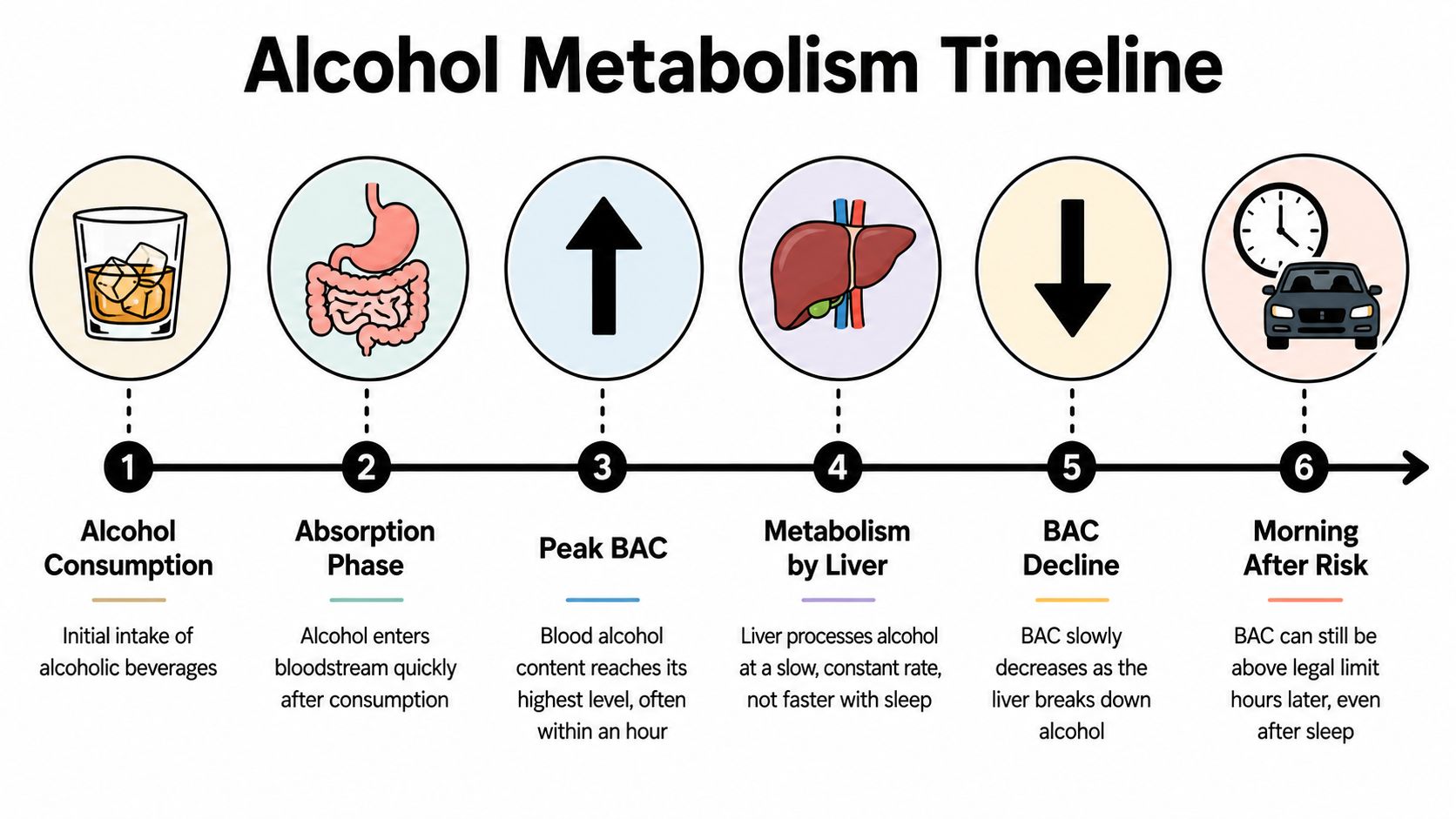
Sleep helps you feel better. It doesn't reliably remove alcohol from your system fast enough to make driving safe.
Your body clears alcohol on its own timeline
Think of alcohol in your body like water soaking through a sponge and then slowly dripping out. Going to bed doesn't squeeze the sponge dry. Time does the work, and your body does that work gradually.
One source notes that alcohol elimination is slow and variable, and that it can take up to 90 minutes for BAC to drop to zero after a single drink, with BAC sometimes still high the next morning depending on how much you drank, as discussed in this explanation of hungover driving risk.
That's why “I slept it off” isn't a legal strategy. It's a guess.
What works and what doesn't
Some choices reduce risk before you ever drive. Others only make you feel more alert.
What doesn't reliably solve the problem
- Coffee: It may wake you up, but it doesn't clear alcohol.
- A shower: You may feel refreshed, but your BAC doesn't care.
- Breakfast: Food can matter earlier in the process, but it won't magically erase what is already in your system.
- A quick nap: Rest changes fatigue, not necessarily intoxication.
What helps
- More time: Time is the primary factor.
- Not driving when uncertain: If you aren't sure, don't gamble with a morning commute.
- Planning ahead: A ride, delayed departure, or staying put is often the safest decision.
Why people misjudge the morning after
People usually underestimate two things. First, late-night drinking can leave alcohol in the body longer than expected. Second, a person can feel more normal before their body has finished processing the alcohol.
If you want a broader health-based explanation of how long alcohol may remain in the body, these medically supervised alcohol detox timelines are a useful starting point. They aren't a legal standard, but they help show why alcohol doesn't disappear just because the clock moved forward.
For readers comparing related Texas DWI scenarios, this discussion of whether you can get a DWI while sitting in your car in Texas helps show how fact-specific these cases can become.
How Police Gather Evidence for a Morning After DWI
By the time an officer stops a driver in the morning, the person may not look like the stereotype of someone leaving a bar. Officers know that. They build cases from smaller pieces.
What starts the investigation
The stop often begins with driving behavior. A drifting lane position, delayed response at a light, braking oddly, or another traffic issue can draw attention. After the stop, the officer starts observing the driver directly.
That usually includes things like:
- Physical signs: Odor of alcohol, bloodshot eyes, slurred speech, or unsteady movement.
- Conversation clues: Confusing answers, poor memory about the night before, or inconsistent statements.
- Driving context: Early morning timing after weekends, events, or holidays can shape the officer's suspicions, though timing alone doesn't prove intoxication.
Field sobriety and chemical testing
If the officer believes alcohol may still be affecting the driver, the investigation may expand to field sobriety testing and later to breath or blood testing. These tools serve different purposes.
| Evidence type | What police use it for |
|---|---|
| Officer observations | To describe visible signs of impairment |
| Field sobriety tests | To evaluate balance, attention, and divided attention tasks |
| Breath or blood tests | To measure alcohol concentration after the stop |
Texas authorities also explain the issue this way: a morning-after arrest can be supported by chemical testing or by officer-observed impairment, and the state must prove intoxication at the time of driving, not only at the later time of testing, as outlined in the Dallas Police Department's Texas DWI law overview.
A later test result is important, but prosecutors still connect that result back to the actual driving period.
Why timing becomes a fight
Morning-after cases often turn on timing. If testing happens well after the stop, lawyers may argue about whether the result reflects the person's BAC when they were behind the wheel. The state may try to estimate backward from the later test. The defense may challenge whether that estimate is reliable in the specific case.
That's one reason these cases need careful review. Traffic video, body camera footage, dispatch times, test records, and witness statements can all matter. If you want a deeper look at that process, this article on how prosecutors prove DWI in Texas breaks down the evidence issues further.
DWI Penalties and Your Civil Liability in a Crash
A morning-after DWI can split your life into two cases at once. The State may prosecute the criminal charge, and if a crash injured someone, the other driver or passenger may also bring a civil claim for money damages.

Criminal penalties can be serious
Even a first DWI in Texas can bring jail exposure, fines, license consequences, court costs, supervision requirements, and expensive increases in insurance rates. A conviction can also affect professional licensing, background checks, and jobs that require driving.
Those penalties often get worse when the facts do.
If the case involves a high alcohol concentration, a child passenger, a crash with injuries, or a prior record, the stakes rise quickly. In practice, I often tell people that the criminal sentence is only part of the damage. The hidden costs usually include towing, bond conditions, missed work, ignition interlock requirements in some cases, and the long tail of higher premiums.
Texas also applies stricter alcohol rules to drivers under 21, as noted earlier.
A crash creates a separate financial risk
If your morning-after DWI led to a wreck, the injury case may become more expensive than the criminal case. That is the part many drivers underestimate.
An injured person may pursue payment for medical bills, lost wages, reduced earning ability, vehicle damage, physical pain, mental anguish, physical impairment, and disfigurement. In a fatal crash, surviving family members may bring wrongful death claims. If the facts are bad enough, the civil case can involve claims for exemplary damages too.
Insurance helps in some cases, but policy limits do not make the problem disappear. Serious injuries can exceed available coverage, which may expose personal assets and future income depending on the circumstances.
The civil case turns on fault, damages, and proof
Texas civil cases usually focus on a few practical questions:
- Liability: Who caused the crash.
- Damages: What losses the injured person suffered.
- Comparative fault: Whether the injured person also shares some blame.
- Deadlines: How long the injured person has to file suit.
Under Texas law, comparative fault can reduce what an injured person recovers if that person also contributed to the collision. Defense lawyers and insurance carriers use that issue constantly. They may argue the other driver was speeding, following too closely, distracted, or failed to avoid the impact.
That argument matters, but intoxication evidence can still carry enormous weight with a jury. A morning-after driver who says, “I stopped drinking hours ago,” may still face strong civil exposure if the evidence shows impaired driving contributed to the crash.
A common morning-after crash scenario
A driver leaves for work after only a few hours of sleep, believing the alcohol is out of their system. On the freeway, reaction time is slow, attention drifts, and a rear-end collision follows. Police respond. One case becomes two.
The criminal file asks whether the driver was intoxicated while operating the vehicle. The civil file asks who pays for the ambulance bill, the ER visit, the follow-up care, the time missed from work, the car repairs, and the pain that lingers for months. If you are the injured person, those losses are real even if the at-fault driver insists the drinking happened “last night.”
What injured victims should do
If you believe a morning-after driver caused your crash, act quickly and keep the focus on proof:
- Get medical care right away. Delays give insurers room to argue you were not badly hurt.
- Report what you observed to police. Statements about drinking, confusion, odor of alcohol, and poor coordination may matter.
- Preserve evidence. Photos, witness contact information, dashcam footage, and discharge paperwork can all help.
- Use caution with insurance adjusters. Early recorded statements often become tools to minimize your claim.
- Get legal advice if the injuries are significant. A lawyer can evaluate both the injury claim and how the DWI evidence may affect settlement value. For a related discussion, see common defense strategies in Texas DWI cases.
The Law Office of Bryan Fagan, PLLC handles Texas vehicle collision cases involving intoxicated drivers, including claims for bodily injury, insurance negotiations, and wrongful death compensation after fatal wrecks.
Common Defenses in a Morning After DWI Case
A charge isn't a conviction. Morning-after cases often involve technical disputes, and details matter.
Where defense lawyers look first
A defense attorney may start by asking whether the traffic stop itself was lawful. If the officer lacked a valid basis to stop the car, that can affect what evidence comes in later.
Lawyers also examine whether the officer's observations point to alcohol impairment. Tiredness, illness, anxiety, and other conditions can sometimes overlap with signs officers associate with intoxication.
Some morning-after cases are less about whether a person drank and more about whether the state can prove intoxication at the precise time of driving.
Common pressure points in the evidence
Defense challenges often focus on several areas:
- Field sobriety testing issues: Were the instructions clear? Was the surface uneven? Did a medical condition affect performance?
- Breath test concerns: Was the machine properly maintained and administered according to procedure?
- Blood test handling: Was the sample stored, labeled, and tracked correctly?
- Timing arguments: Did the BAC result later rise or fail to reliably show what the driver's level was earlier?
These aren't loopholes. They are part of testing whether the state can meet its burden of proof with reliable evidence.
Why this matters in injury cases too
If a crash led to both a criminal case and a civil claim, weaknesses in one case can affect the other. That doesn't mean a victim automatically loses a claim if the criminal prosecution has problems, but it does mean the evidence must be reviewed carefully from both angles.
For a broader overview, this guide on what is the best defense for a DWI in Texas outlines several defense themes that often come up.
Protect Your Rights and Your Future Today
If you were charged with a morning-after DWI, your next steps matter. So do your words. Don't try to explain the whole night, guess about your BAC, or talk yourself into more trouble.

If you were charged
Take these steps as soon as possible:
- Use your right to remain silent: Be polite, but don't make admissions without counsel.
- Save information: Keep paperwork, bond documents, test details, and your timeline of events.
- Get legal advice early: Morning-after DWI cases often depend on timing, testing, and officer observations.
If you were injured by a suspected impaired driver
Your path is different, but just as urgent.
- Get treatment and follow-up care: Medical records connect the crash to your injuries.
- Preserve evidence: Photos, names, dash cam footage, and the police report can all help.
- Report what you noticed: If the other driver mentioned drinking the night before, seemed impaired, or smelled of alcohol, tell the officer.
- Be cautious with the insurance company: Adjusters may push for a quick recorded statement before the full picture is clear.
If your crash involved a commercial vehicle, rideshare vehicle, or a fatal collision, the legal issues can become even more complex. A truck case may involve company records and multiple insurance layers. A wrongful death compensation claim may involve both the estate and surviving family members.
When you're unsure whether alcohol was still a factor, don't dismiss your instincts. Let the evidence get reviewed.
If you have questions about a morning-after DWI crash, an auto insurance claim, or your rights after being injured by an impaired driver, contact The Law Office of Bryan Fagan, PLLC for a free consultation. You can talk through what happened, learn how Texas liability and comparative fault rules may apply, and get clear guidance on the next step for your case.