After a Texas DWI arrest, you should only provide your identification and insurance. Beyond that, say, “I am exercising my right to remain silent and I want to speak with my attorney,” because anything else you say can be used against you in both criminal and civil court.
A car crash can change your life in seconds, but you don't have to face recovery alone. If you're reading this after a late-night arrest, a call from jail, or a collision involving alcohol, you're probably worried about more than one problem at once. You may be facing a criminal charge, a license suspension, an insurance claim, and if someone was hurt, a civil case that could affect your finances for years.
The question, should i talk to police after a dwi arrest texas, has a very clear answer. In almost every case, talking hurts you. The better approach is calm, respectful cooperation without answering investigative questions.
An arrest is not a conviction, you have rights and options
A DWI arrest feels final, but it isn't. Being arrested means the State has started a case. It does not mean the State has proved one.
Two rights matter immediately. The Fifth Amendment protects you from being forced to incriminate yourself. The Sixth Amendment protects your right to a lawyer. In plain English, that means you do not have to help police build their case by explaining where you were, what you drank, or why you think you were stopped.
A lot of people misunderstand Miranda warnings. Police do not have to read them the moment they put handcuffs on you. The key issue is custodial interrogation, which means questioning while you are in custody. Once that happens, your words become evidence problems very quickly if you haven't clearly invoked your rights.
Practical rule: Be polite. Provide basic identifying information. Then stop talking and ask for counsel.
That matters even more if a crash happened. A DWI arrest can feed a later injury claim or wrongful death compensation case. Statements made in the patrol car, at the jail, or over the phone after release can affect both criminal exposure and civil liability, which means legal responsibility for the harm caused.
If you were injured by a drunk driver, many of these same principles matter from the other side. The other driver's statements, bodycam footage, and officer observations may become critical evidence in your auto insurance claim and injury case.
Your Constitutional Rights After a Texas DWI Arrest
Under Texas law and U.S. constitutional precedent, once you're in police custody following a DWI arrest, anything you say can be used as substantive evidence of guilt. Officers are trained to move from identification questions to DWI-specific questions quickly, and to stop interrogation you must affirmatively say, “I am exercising my right to remain silent” and “I want to speak with my attorney,” as explained in this Texas DWI arrest rights overview.
What these rights look like in real life
The law sounds abstract until you're sitting in the back of a patrol car hearing questions that seem casual.
An officer may ask:
- Where were you coming from
- How much did you have to drink
- When was your last drink
- Do you feel okay to drive
- Why were you swerving
Those are not harmless conversation starters. Those are case-building questions.
If you answer, “I only had two beers,” the report may later frame that as an admission that you consumed alcohol before driving. If you answer, “I was tired,” prosecutors may compare that answer to bodycam footage, driving allegations, and test results to argue you were impaired and trying to minimize it.
Silence must be clear
Many people think staying quiet is enough. Often, it isn't. If you want the questioning to stop, you need to say so out loud and plainly.
Use a script like this:
“Officer, I'm exercising my right to remain silent. I want to speak with my attorney.”
Then stick with it. Don't soften it with “but” statements. Don't follow it up with explanations.
A simple comparison helps:
| Situation | Better response | Risky response |
|---|---|---|
| Officer asks for license | Provide it | Arguing or refusing basics |
| Officer asks where you were | “I want my attorney” | “Just dinner with friends” |
| Officer asks how much you drank | “I'm remaining silent” | “Only a couple” |
| Officer keeps talking in the car | Stay quiet | Trying to talk your way out |
Why this matters beyond the criminal case
If the arrest involved a collision, your statements can spill into a personal injury case. In Texas, damages means the losses a person seeks to recover, such as medical bills, lost wages, pain and suffering, or in fatal cases, wrongful death compensation. Comparative fault means each side may argue about who caused the crash and by how much.
Under Texas Civil Practice and Remedies Code Chapter 33, fault can be allocated among the people involved. Under Chapter 41, additional limits and rules can apply to certain damage claims, including exemplary damages in the right case. A statement like “I knew I shouldn't have driven” can become a major civil problem because it may be used to argue fault, negligence, and conscious disregard for safety.
The Dangers of Talking and How Your Words Are Used Against You
Texas DWI numbers tell a hard story. Out of 83,088 DWI charges, only 3,275 resulted in releases with no charge and 6,771 were dismissed, which means only about 12% of defendants beat the charge entirely according to Texas DWI case statistics and outcomes. That same analysis explains how routine comments such as “I had two drinks” are written into reports as formal admissions and used to support guilty pleas.
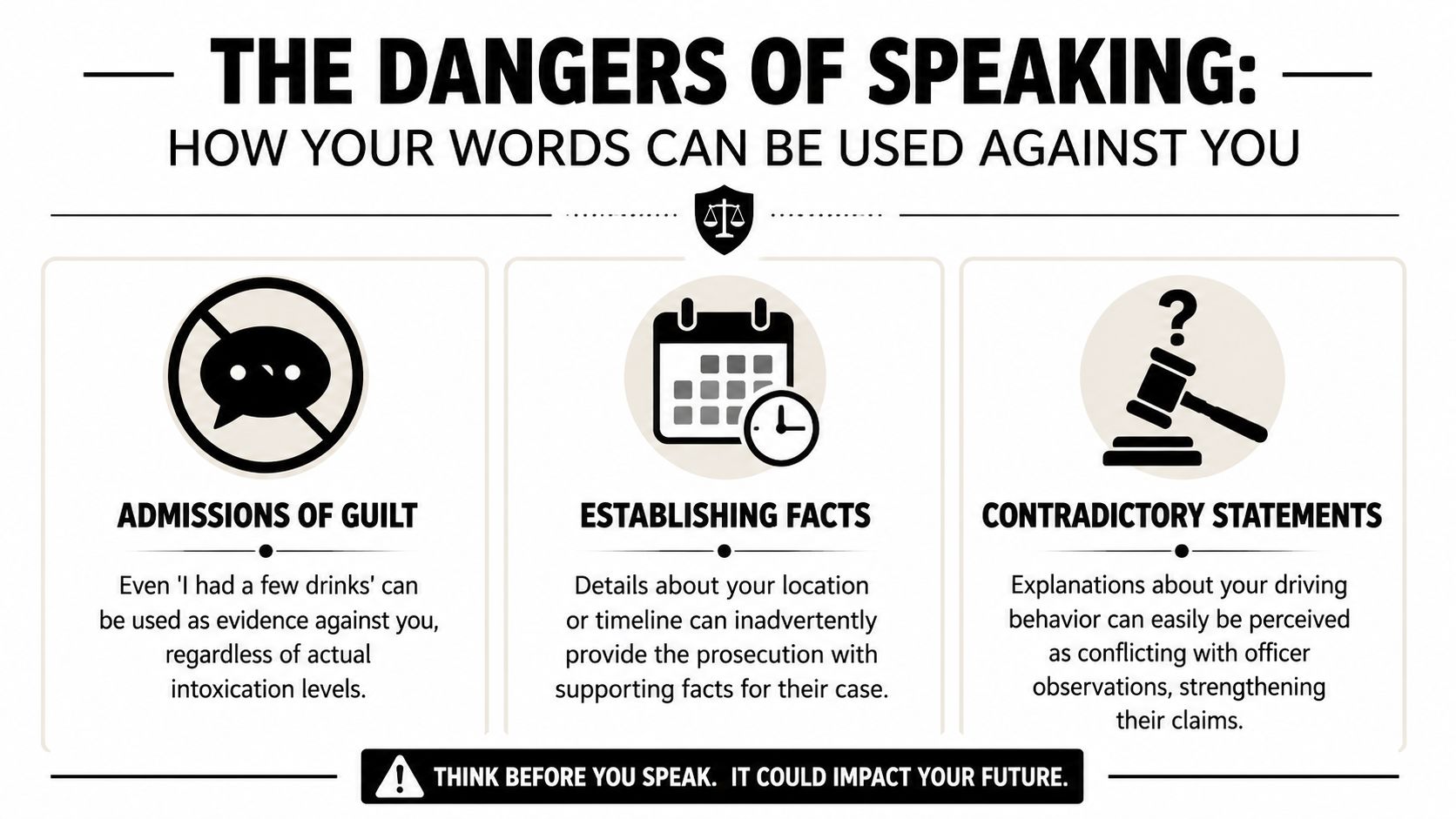
How officers turn conversation into evidence
Police reports are not diaries. They are prosecution tools.
A casual statement like “I'm coming from a friend's birthday” can help the State build a timeline. “I had dinner downtown” can place you at a bar district. “I was reaching for my phone” can become an explanation for poor driving that still supports a stop. “I'm sorry” can sound like a confession even when you meant simple politeness.
What hurts most is that people usually speak because they think honesty will help. In DWI cases, it usually doesn't.
Anything you say after arrest is filtered through an officer's narrative, then read later by prosecutors, judges, insurance adjusters, and sometimes civil lawyers.
If you want a broader plain-English refresher on Understanding your rights during a police stop, that resource is useful for seeing how quickly roadside questions become evidence.
Do this, not that
Here is the practical difference between cooperation and self-incrimination.
- Do provide basics. Hand over your driver's license and proof of insurance when requested.
- Don't explain your night. You don't need to discuss dinner, drinks, stress, fatigue, or medication.
- Do stay physically cooperative. If told to step out, step out calmly.
- Don't try to charm your way out. Jokes, apologies, and long stories usually make the report worse.
- Do repeat your script. “I want to remain silent and speak with my attorney.”
- Don't keep talking in the patrol car or at booking. Officers listen there too.
People who need more detail on immediate mistakes often find this guide on what not to do after a DWI arrest in Texas helpful.
Why this also matters in a crash claim
If there was a wreck, your words may affect both criminal guilt and civil liability. Liability means who is legally responsible. If an injured person files a claim, the other side may use your statements to argue fault, intoxication, recklessness, or even to push for enhanced damages depending on the facts.
For victims, this is why drunk-driving crash cases often move differently from ordinary wrecks. A Houston driver rear-ended on I-45 by an impaired motorist may have a stronger case if bodycam video, officer testimony, and admissions line up. For the arrested driver, those same facts can be devastating.
What to Say and Do During a DWI Stop and Arrest
The safest approach is respectful, limited cooperation. You are not trying to win an argument on the roadside. You are trying to avoid making your case harder.

A nuanced strategy of cooperating without talking can help. Politely providing ID while calmly stating that you want a lawyer can reduce escalation and shows respect for the process without handing over incriminating statements, as discussed in this guidance on staying compliant but silent after a Texas DWI arrest.
What you should do at the roadside
Start with your body language and tone. Keep your hands visible. Follow simple physical instructions. Don't argue, don't challenge, and don't become sarcastic.
Use short sentences.
A workable roadside script looks like this:
- Provide identification. Give your license and insurance when asked.
- Keep your answers narrow. For basic identification questions, answer truthfully.
- Invoke your rights clearly. Say, “I am exercising my right to remain silent. I want to speak with my attorney.”
- Repeat if needed. If questioning continues, use the same sentence again.
- Stay calm during transport and booking. Silence matters after arrest too.
What not to say
These statements commonly create problems:
- “I only had a couple.” This sounds modest to you. It sounds like an admission to the State.
- “I'm fine to drive.” If tests or observations look bad later, this can be framed as poor judgment.
- “I was distracted.” That may support the stop even if it doesn't prove intoxication.
- “I'm sorry.” In a crash case, this may be treated as an admission.
- “I knew I shouldn't have driven.” This can become one of the worst lines in the file.
For readers dealing with the immediate aftermath, this breakdown of the first 48 hours after a DWI arrest in Texas is a practical next step.
A short explainer may help you hear how these interactions usually unfold:
If there was an accident
If your DWI arrest followed a wreck, the consequences are more significant. Do not discuss fault with police beyond required identifying information. In civil law, negligence means failing to use reasonable care. If that failure causes injuries, the injured person may pursue a claim.
Texas uses a comparative fault system under Chapter 33. That means people often fight over how much each driver contributed. A driver who says too much at the scene may make that fault fight much easier for the other side. Insurance companies listen for the same admissions police do.
If you were injured by another driver, take the opposite lesson. Get medical care, document the scene, notify your insurer carefully, and speak with a Texas injury attorney before giving detailed recorded statements if serious injuries are involved.
Texas Implied Consent and Standardized Field Sobriety Tests
After a Texas DWI arrest, drivers usually face two separate testing questions. One is whether to perform roadside field sobriety tests. The other is whether to give a breath or blood sample under Texas implied consent law after arrest. Those choices carry different risks, and treating them like the same thing is a mistake.
Field sobriety tests and chemical tests are different
Standardized Field Sobriety Tests usually involve eye movement, walking heel-to-toe, and standing on one leg. Officers use them to build observations they can later describe in a report or in court. Even a sober person can perform poorly because of anxiety, fatigue, injury, age, uneven pavement, flashing lights, or medical issues.
Chemical testing is different. That usually means a breath test or a blood draw after arrest. A refusal can trigger a license suspension case through the Administrative License Revocation process, even before the criminal charge is resolved.
Here is the practical distinction:
| Type of test | General purpose | Main concern |
|---|---|---|
| Field sobriety testing | Gives officers more observations | Performance can be used against you |
| Breath or blood testing | Measures alcohol concentration evidence | Refusal can trigger license action |
A respectful approach matters here. Drivers do not need to argue, lecture the officer, or become physically resistant to protect themselves. Calm non-verbal cooperation, such as providing identification and following basic booking instructions, is very different from volunteering to perform roadside tests or making explanatory statements that can later be framed as signs of intoxication.
Refusal issues are real, but so is the defense value of the ALR case
Texas implied consent law creates immediate license consequences if a driver refuses a lawful request for breath or blood testing, and those consequences are handled in a separate administrative case. That process also gives the defense an early chance to question the officer under oath. The Texas Department of Public Safety outlines the administrative license revocation hearing process, including the deadlines and suspension procedures tied to a refusal or a failed test.
That hearing can matter for far more than driving privileges. In practice, it is often the first opportunity to examine whether the stop, arrest, warnings, and testing request were handled correctly. If the driver holds a commercial license, the stakes can be even higher because a suspension can affect employment and future eligibility. That problem deserves separate attention in cases involving a Texas CDL DWI arrest and license consequences.
A testing decision can affect both the evidence in the criminal case and the separate fight over your license.
Alcohol timing is harder to predict than people think
Drivers often try to do roadside math. They count drinks, hours, food, and body size, then guess whether a test will come back under the limit. That guess is unreliable. This alcohol detection times guide explains why alcohol absorption and elimination can vary more than people expect.
I tell clients the same thing after arrest. Do not make a testing decision based on confidence, panic, or a rough estimate of what your body "should" have done. Make it with a clear understanding that the legal and factual consequences may reach beyond the criminal file.
A crash can turn test evidence into civil evidence too
If the arrest followed a collision, breath or blood evidence may also become part of an injury claim or wrongful death case. The same statement or test result that affects the DWI prosecution can influence how insurers and civil lawyers evaluate fault, damages, and settlement value.
That is why silence should be respectful, not confrontational. A driver can decline to answer investigative questions and still avoid making the stop worse. A calm response such as, "I want to remain silent and speak with a lawyer," protects rights without creating a new problem at the scene.
The Critical 15-Day Deadline for Your Driver's License
The paperwork starts running before many people have even made bond. After a Texas DWI arrest, your license case does not wait for the criminal case to catch up.

You have only 15 days from the date of arrest to request an ALR hearing. Miss that deadline, and the suspension process usually moves ahead automatically. The Texas Department of Public Safety explains the license suspension process and hearing request rules on its Administrative License Revocation program page.
That hearing matters for more than transportation. In many cases, it is the first opportunity to question the officer under oath, pin down the State's version of the stop, and preserve testimony before memories get polished and reports get repeated. Done well, that early record can help your defense in the criminal case.
Why experienced defense lawyers move on this fast
Clients often call because they need to keep driving to work, pick up children, or handle basic daily life. Those are serious concerns.
The hearing also has strategic value. An officer has to explain the reason for the stop, the basis for the arrest, and what happened with any breath or blood request. If that account later shifts, the change can matter. I look for details that do not line up, shortcuts in procedure, and facts that were stronger in the report than they are under oath.
A prompt hearing request can help you:
- Protect the chance to contest a suspension.
- Preserve sworn testimony early.
- Identify weak points in the stop, arrest, or testing process.
- Start building a defense before the criminal case gains momentum.
If you hold a commercial license
A license problem hits commercial drivers harder and faster. Even a short loss of driving privileges can threaten a job, income, insurance status, and future hiring. If your livelihood depends on driving, review this page on Texas DUI consequences for CDL holders right away.
What to do today
Keep it simple.
- Read every paper you were given. Look for the notice tied to suspension or a temporary driving permit.
- Calendar the 15-day deadline immediately. Do not trust memory.
- Get legal advice quickly. Delay helps the State, not you.
- Say less, not more. That includes insurers, other drivers, and anyone asking for your version of events after a crash.
- Save everything. Bond paperwork, tow documents, receipts, and release papers can all matter later.
If the arrest followed a collision, the timing issue gets even more serious. Your statements, test records, and license suspension file may end up affecting both the DWI prosecution and a civil claim for injuries or property damage. Respectful silence still matters here. So does quick action.
Common Questions After a Texas DWI Arrest
Will staying silent make me look guilty
No. Using your constitutional rights is not wrongdoing. Juries are instructed on the law, and your lawyer can address the issue if necessary. The larger danger is usually the opposite. People talk because they think silence looks bad, then they create statements that the prosecution uses later.
What if police call or text me after I'm released
Don't respond. Police may use calls, texts, or even social media messages to seek “clarifications” before you have counsel involved, and any engagement can be treated as a voluntary statement according to this warning about post-release digital contact after a Texas DWI arrest.
If that happens:
- Hang up politely. You do not need to explain.
- Save the message. Keep screenshots, voicemails, and call logs.
- Forward it to your attorney. Let counsel handle communication.
If police contact you after release, silence still protects you.
Can social media be used against me
Yes. Posts, messages, photos, and jokes can all be misread or taken out of context. Don't post about the arrest, the crash, the night out, your drinking, or your frustration with the process.
What does statute of limitations mean in a crash case
The statute of limitations is the deadline to file a lawsuit. Different claims can have different deadlines and exceptions, so this is something to discuss with a lawyer quickly after a serious crash. Waiting too long can damage or end a valid claim.
If I was hurt by a drunk driver, what should I do
Get medical care first. Then preserve evidence, notify insurance carefully, and speak with a Houston car accident lawyer or Texas injury attorney if your injuries are significant. If a family member died, ask about wrongful death compensation and how Texas negligence law applies.
Take Control of Your Future and Contact a DWI Attorney Today
A DWI arrest can leave you feeling boxed in, but your next steps still matter. The best immediate move is usually the same one people resist in the moment. Stop talking, stay calm, protect your license deadline, and get legal advice fast.
If there was no crash, that approach protects your criminal defense. If there was a crash, it also helps limit damage in any related civil case involving negligence, liability, comparative fault, and damages. Insurance carriers, prosecutors, and opposing lawyers all pay close attention to what was said at the scene and after release.
You do not need to solve everything in one night. You do need to avoid making it worse.
For accident victims and families, the same urgency applies from the other side. A drunk-driving case can involve bodily injury claims, disputed auto insurance claim issues, long-term medical needs, and in the most serious cases, wrongful death compensation. Strong legal help can protect evidence, deal with insurers, and build a clear case for recovery.
The right response is measured, not emotional. Protect your words. Protect your license. Protect your future.
If you or someone you love is dealing with a DWI-related crash, injury claim, or arrest in Texas, The Law Office of Bryan Fagan, PLLC offers a free consultation to help you understand your rights and next steps. Whether you need a Houston car accident lawyer after being hit by a drunk driver, guidance on an auto insurance claim, or help evaluating wrongful death compensation for your family, the firm serves clients across Houston, Dallas, San Antonio, and throughout Texas with compassionate, practical support.