A car crash can change your life in seconds, but you don't have to face recovery alone.
If a drunk driver hit you, you may be dealing with pain, medical appointments, missed work, a damaged car, and the fear that the person who caused all of this might somehow avoid real consequences. That fear is common. So is the question behind it: what are the chances of beating a DWI in Texas, and what does that mean for your case?
A lot of injured people assume the criminal case will answer everything. It won't. The State of Texas decides whether to prosecute the driver for DWI. You decide whether to pursue a civil claim for your losses. Those are two different paths, and your right to recover compensation doesn't disappear just because the criminal process takes a turn you didn't expect.
Your Life Changed in an Instant Now What?
Maybe it happened on I-45 in Houston. You were driving home, stopped at a light, and another car slammed into the back of you. Or maybe a driver drifted across lanes and hit your family head-on. At the scene, the officer suspected alcohol. Later, you heard the words “DWI arrest,” and for a moment that sounded like justice.
Then the questions started.
Will the case stick? Will the driver get away with it? Who pays for your ER visit, your physical therapy, your time off work, and the daily pain that wasn't there before the crash?
Those are the right questions to ask.
A DWI arrest matters, but it isn't the whole story. Criminal court focuses on whether the state can prove a crime. Your injury claim focuses on liability, which means legal responsibility for the harm you suffered. If the intoxicated driver caused the wreck, your civil case can seek damages, which is the legal term for money meant to cover losses like medical bills, lost income, property damage, and pain and suffering.
You don't need to wait for the criminal case to end before protecting your own claim.
That's especially important because evidence can fade fast. Witnesses forget details. Surveillance footage gets deleted. Insurance adjusters start building their own version of events almost immediately. If you want a practical look at the other side of the process, this guide on what to do immediately after a DWI arrest in Texas helps explain the timeline the driver is facing.
What you should focus on first
In the first days after a drunk driving crash, your priorities are usually simple:
- Get medical care: Follow up even if you hoped the pain would pass.
- Keep records: Save discharge papers, prescriptions, bills, photos, and repair estimates.
- Report changes: If your symptoms get worse, tell your doctor and document it.
- Be careful with insurers: The other driver's carrier may sound helpful while looking for ways to limit your claim.
A Texas injury attorney can help you track both tracks at once. The criminal case may create useful evidence. Your civil case makes sure your own recovery doesn't get treated like an afterthought.
Understanding DWI Dismissal Rates in Texas
The short answer is that some DWI charges are beaten in Texas, but many are not. For victims, that means you should take the criminal case seriously without assuming conviction is automatic.
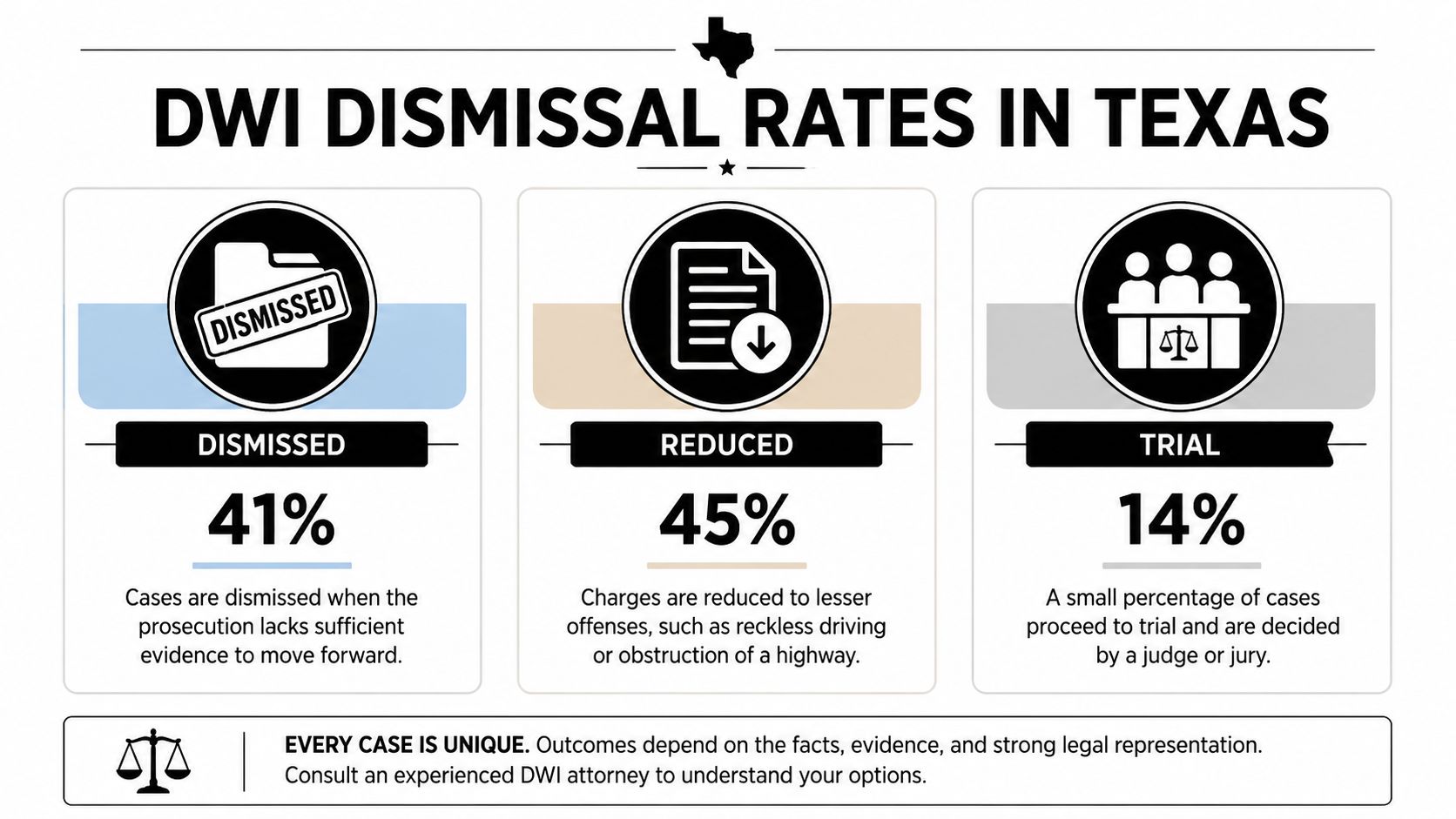
According to Texas DWI dismissal data summarized from DPS records, 2024 figures show a 34.2% dismissal rate for first-time DWI cases, 15.2% for second offenses, and 6.17% for felony DWIs. The same source states that for people who plead not guilty, the combined chance of a dismissal, no charge, or conviction on a lesser offense can be as high as 53%.
What those outcomes actually mean
These terms matter because they affect how you interpret the news in the driver's case.
| Outcome | Plain-English meaning | Why it matters to you |
|---|---|---|
| Dismissal | The charge is dropped | Criminal punishment may not happen, but your injury claim can still proceed |
| No charge | The case doesn't move forward formally | You may still prove the driver caused the crash |
| Reduced charge | The driver is convicted of a lesser offense | That may still support your civil case |
| Conviction | The driver is found guilty or pleads guilty | This often strengthens your leverage in settlement talks |
A dismissal doesn't always mean the driver was sober. It may mean the prosecutor lost key evidence, a stop was challenged successfully, or a test result couldn't be used.
Why victims need realistic expectations
Many people hear “DWI arrest” and expect a straight line to conviction. Texas cases don't work that way. Some are strong. Some are fragile. Some turn on a technical issue that has nothing to do with whether a crash victim was badly hurt.
Practical rule: Treat the criminal case as helpful evidence when it goes well, not as the only path to justice.
That mindset protects you. It keeps you from tying your financial recovery to decisions you don't control, like plea bargaining, suppression rulings, or prosecutorial discretion. It also helps you move early on an auto insurance claim, instead of waiting for a criminal courtroom to solve problems it was never designed to solve.
Key Factors That Influence a DWI Case
Most DWI cases don't rise or fall on one dramatic moment. They turn on details. Defense lawyers look closely at how the stop began, how tests were given, and whether the officer followed required procedures. If one link in that chain breaks, the prosecution may lose important evidence.

The traffic stop has to be lawful
Under Texas DWI guidance discussing procedural errors, an unlawful stop without reasonable suspicion can lead to evidence being suppressed under Texas Code of Criminal Procedure Art. 38.23. In plain English, “suppressed” means the court may block the prosecutor from using that evidence.
A simple example helps. Say a Houston driver is pulled over on I-10 without a valid legal reason. If the stop itself was improper, later observations, field tests, and even chemical test results may become vulnerable.
That matters to you because a weak criminal case doesn't always reflect a weak injury case. It may reflect a mistake by law enforcement.
Deadlines and hearings can shift the case fast
The same source explains that requesting an Administrative License Revocation, or ALR, hearing within 15 days of arrest allows a lawyer to cross-examine the officer and review dashcam footage. That can expose gaps in probable cause or inconsistencies in the officer's report.
Here are the pressure points that often matter:
- Reason for the stop: The officer needs a lawful basis to pull the driver over.
- Officer observations: Smell of alcohol, speech, balance, and driving behavior are all examined closely.
- Video evidence: Dashcam and bodycam footage can support the report or contradict it.
- Timing: Early hearings may reveal issues before the criminal case is fully built.
Why this matters in your civil claim
Your personal injury case uses a different legal framework. Under Texas Civil Practice & Remedies Code Chapter 33, Texas uses a modified comparative fault system. Comparative fault means each side can argue about who was responsible and by how much. If the defense tries to shift blame to you, your lawyer works to show the intoxicated driver caused the crash.
A rear-end collision example shows the difference. If a drunk driver rear-ended you at a red light, the criminal case may fight over stop legality or test procedure. Your civil case can focus on simpler facts like impact damage, witness accounts, your medical records, and the driver's unsafe conduct behind the wheel.
Common Defenses Used to Fight a DWI Charge
When victims ask why some DWI cases get reduced or dismissed, the answer is usually not sympathy from the court. It's usually a defense challenge to evidence.
Motions to suppress and test challenges
One common defense tool is a motion to suppress. That asks the judge to exclude evidence because police obtained it illegally or handled it improperly. If the judge agrees, the prosecution may lose enough proof that the case weakens sharply.
Another major battleground is chemical testing. According to Texas DWI defense analysis discussing BAC challenges, breathalyzer results can be challenged if the machine's simulator solution was not certified within the required ±0.01% tolerance under Texas Admin. Code §19.4. The same source states that blood test results can be thrown out if the warrant was improper or if lab contamination or mishandling is found, which occurs in an estimated 5-10% of cases.
Other defenses you may hear about
Some defenses are highly technical. Others are more practical.
- Medical explanations: A defense lawyer may argue that a medical condition affected balance, speech, or appearance.
- Field sobriety problems: Uneven pavement, poor lighting, weather, or bad instructions can all be challenged.
- Chain of custody issues: If blood evidence wasn't tracked correctly, the defense may question whether the sample is reliable.
- Officer credibility: Inconsistent reports and video gaps can become major issues.
If you hear that the driver is “fighting the DWI,” this is often what that means.
For a broader look at early case decisions and statements to law enforcement, see whether someone should talk to police after a DWI arrest in Texas.
A short video can also help make the courtroom process easier to follow:
Why these defenses don't end your injury case
These are criminal defenses. They are aimed at limiting what the prosecutor can prove in criminal court. Your lawsuit works differently. You are not trying to send the driver to jail. You are trying to prove the driver's negligence caused your injuries.
That distinction matters when the news is frustrating. A drunk driver may avoid a DWI conviction for technical reasons and still be legally responsible for the wreck that hurt you.
Criminal Case vs Your Civil Claim What You Must Know
This is the part most victims aren't told early enough. The criminal case and your injury case are connected, but they are not the same.
Two different courts. Two different goals.
In the criminal case, the State of Texas prosecutes the driver. The goal is punishment. That can include jail, probation, license consequences, or other penalties.
In your civil case, you seek compensation from the at-fault driver and usually their insurer. The goal is recovery for what you lost.
According to Texas guidance on DWI dismissals and civil claims, even if a DWI is dismissed, which happens in 10-25% of cases depending on the county, victims can still pursue a civil claim. The same source explains that a criminal acquittal does not block a personal injury lawsuit because civil cases use the lower standard of preponderance of the evidence, instead of beyond a reasonable doubt.
What those legal standards mean
The simplest way to view the situation is:
| Case type | Who brings it | Standard of proof | Main goal |
|---|---|---|---|
| Criminal | The state | Beyond a reasonable doubt | Punishment |
| Civil | You, the injured person | Preponderance of the evidence | Compensation |
Preponderance of the evidence means showing it is more likely than not that the driver's negligence caused your harm.
That lower burden matters. If a prosecutor loses a DWI case because of a test problem, you may still prove that the driver crossed the center line, ran a light, rear-ended you, or otherwise drove negligently.
Your claim may include more than the driver's bad decision
Under Texas Civil Practice & Remedies Code Chapter 41, some cases also raise questions about enhanced damages when conduct is especially serious. Whether that applies depends on the facts and evidence. In every case, your core claim still focuses on provable losses and legal responsibility.
A practical example helps. A Dallas family can still pursue compensation if the driver's DWI charge is dismissed on a procedural issue, so long as crash evidence, witness statements, medical records, and other proof show the driver caused the collision.
A criminal courtroom asks, “Can the state prove this crime?” A civil courtroom asks, “Did this driver cause compensable harm?”
That's also why related claims may extend beyond the driver. In some drunk driving crashes, a case may involve bar or restaurant liability under Texas dram shop law. If you want to understand when that issue may arise, read about Texas dram shop laws.
Texas DWI Penalties and Your Path to Compensation
Victims often feel some relief when the criminal case results in a conviction. That reaction makes sense. A conviction can validate what happened and increase pressure on the insurance company handling your claim.
According to Texas DPS-based analysis of contested DWI outcomes, over 70% of DWI cases still result in a conviction. The same source states that pleading not guilty yields a 13% dismissal rate and a 30% reduction to a lesser charge, but most defendants are still found guilty of the original offense.
Why conviction helps your settlement position
If the driver is convicted, the insurer has a harder time pretending the crash was just an “unfortunate accident.” A conviction can strengthen your argument that the driver violated the law and caused your injuries.
Lawyers often describe this as evidence supporting negligence per se. In plain English, that means violating a safety law can help establish fault in a civil case. It does not guarantee recovery by itself, but it can be powerful.
Here is how that can affect your claim:
- Liability becomes harder to dispute: The defense may have less room to deny dangerous conduct.
- Adjusters face more pressure: A conviction can make lowball offers look less reasonable.
- Your narrative gets stronger: Medical records, crash reports, and criminal outcomes may line up clearly.
Know the civil rules that affect your recovery
Even with strong evidence, your case still has to fit Texas injury law.
Comparative fault under Chapter 33 means the defense may argue you share some blame. If that happens, your recovery can be reduced by your percentage of responsibility. That's why details matter. Speed, lane position, traffic signals, phone use, and witness statements can all become part of the fight.
Damages are the losses you claim. These may include medical expenses, lost wages, pain and suffering, vehicle damage, and in fatal cases, wrongful death compensation for surviving family members.
Statute of limitations means the legal deadline to file suit. If you miss it, you can lose your claim entirely. The exact deadline depends on the type of case and facts involved, so it's smart to get advice early instead of assuming you have plenty of time.
Don't wait for the insurance company to tell you what your claim is worth. Their timeline and your interests are not the same.
If your vehicle was repaired but worth less afterward, that can also be part of the financial damage picture. For a practical explanation of recovering resale value after an accident, this resource on diminished value can help you understand that separate loss.
How a Houston Car Accident Lawyer Can Fight for You
After a drunk driving crash, your job is to heal and protect your family. Your lawyer's job is to build the claim.
That usually means gathering the crash report, preserving video, interviewing witnesses, organizing medical proof, handling the insurance company, and tracking what happens in the criminal case without letting your civil claim stall out. A Houston car accident lawyer also looks for all available insurance coverage, including situations involving commercial vehicles, rideshare drivers, uninsured drivers, or possible third-party liability.
What practical legal help looks like
A strong injury case is built step by step.
- Investigate early: Get the report, photos, 911 records, bodycam if available, and witness names before they disappear.
- Document your damages: Keep records of treatment, work loss, prescriptions, and daily limitations.
- Control insurer communication: Adjusters are trained to gather statements that may later be used against you.
- Value the full claim: Some losses are obvious right away. Others, like future treatment needs or lasting pain, take time to understand.
One option for handling that process is The Law Office of Bryan Fagan, PLLC, which represents Texas crash victims in personal injury matters on a contingency-fee basis.
What you can do today
If you're reading this after a recent crash, start with the basics:
- Follow your treatment plan
- Save every bill and receipt
- Avoid posting details online
- Don't accept a quick settlement without review
You do not need a criminal conviction to pursue justice. You need evidence, a clear legal strategy, and someone focused on your side of the case.
If a drunk driver hurt you or someone you love, contact The Law Office of Bryan Fagan, PLLC for a free consultation. You can get clear answers about your rights, your auto insurance claim, your potential damages, and the next steps in your recovery. You pay nothing unless your case is won.