A car crash can change your life in seconds, but you don’t have to face recovery alone.
One minute you’re walking through a crosswalk in Houston, heading to work or crossing to your car. The next, you’re on the pavement, hearing sirens, feeling pain, and wondering how this happened. Your phone may be broken. Your family may be panicking. The driver’s insurer may already be calling.
That confusion is normal. So is the fear that follows. How will you pay for treatment? What if you can’t work? What if the insurance company says the crash was partly your fault?
If you’re searching for answers about pedestrian hit by car compensation, you’re probably not looking for legal jargon. You want clear guidance. You want to know what your rights are under Texas law, what steps matter most, and what mistakes could hurt your case.
Texas law gives injured pedestrians the right to seek compensation when a driver’s negligence causes harm. Under the Texas Civil Practice & Remedies Code, Chapters 33 and 41, a claim can involve fault allocation, recoverable damages, and limits that depend on the facts of the case. In plain English, that means the law looks at who caused the crash, how badly you were hurt, and what losses the collision created in your life.
A Houston car accident lawyer or Texas injury attorney can help you sort through those issues, but understanding the process yourself is a powerful first step. Knowledge helps you protect your claim. It also helps you push back when an insurance adjuster tries to rush you, blame you, or undervalue your injuries.
Your Life Changed in an Instant But You Are Not Alone
A pedestrian crash often feels unreal at first.
You may remember small details. A walk signal. Headlights turning too fast. A horn. Then the shock sets in. Later, further problems emerge. The hospital bills. Missed work. Follow-up care. Calls from insurance. Questions from your employer. Pain that doesn’t fade as quickly as you hoped.
A lot of people blame themselves even when they shouldn’t. They replay the moment and ask whether they could have moved faster, looked twice, or chosen another route. That’s human. It’s also why these cases need careful legal review instead of quick assumptions.
Take a common Texas example. A person crosses at an intersection in downtown Austin. A driver turns without yielding and hits them. The pedestrian suffers a fracture, can’t work for a while, and needs ongoing treatment. Soon after, the insurance company starts asking pointed questions about where the pedestrian was standing, whether the light had changed, and what they were wearing.
That isn’t casual conversation. It’s part of the claim battle.
Practical rule: After a pedestrian collision, the facts that seem small in the first few hours often become major issues later.
Liability means legal responsibility for the crash.
Negligence means someone failed to use reasonable care.
Damages means the losses the law allows you to recover, such as medical bills, lost income, and pain caused by the crash.
Those ideas may sound technical, but they drive everything that follows.
You don’t need to solve this alone while you’re trying to heal. A strong claim is built step by step, with records, photographs, treatment notes, witness accounts, and a clear timeline. When you understand how the process works, you’re in a much better position to protect your rights and your future.
What Compensation Can You Recover After a Pedestrian Accident
Following a pedestrian crash, many individuals focus on the first stack of medical bills. That makes sense, but your claim may be broader than that.
In Texas, compensation in a personal injury case is usually divided into economic damages and non-economic damages. Chapters 33 and 41 of the Texas Civil Practice & Remedies Code shape how damages are pursued and how some claims are evaluated. In plain language, the law separates losses you can count on paper from losses that affect your life in a more personal way.
Economic damages cover financial losses
These are the direct costs tied to the crash.
They may include:
- Medical care: Emergency treatment, hospital stays, surgery, follow-up visits, medication, imaging, and rehabilitation.
- Lost wages: Income you missed while you couldn’t work.
- Reduced earning ability: If your injuries make it harder to return to the same job or work the same hours.
- Out-of-pocket costs: Transportation to appointments, medical equipment, and other necessary expenses related to recovery.
Some injuries need longer rehabilitation than people expect. If your doctor recommends therapy, resources about physical therapy conditions resulting from motor vehicle accidents can help you understand the kinds of problems that often continue after the first ER visit.
Non-economic damages address human losses
These damages matter because a pedestrian crash doesn’t just create receipts.
They may include:
- Pain and suffering: Physical pain during recovery and beyond.
- Emotional distress: Anxiety, fear, sleep disruption, or trauma tied to the collision.
- Disfigurement: Scarring or visible injury changes.
- Loss of enjoyment of life: When daily activities, hobbies, movement, or independence become harder.
A claim should reflect both categories. If you only focus on the bills already in your mailbox, you may leave out losses that become obvious later.
What settlement amounts can look like
Texas pedestrian settlements vary widely. According to this Texas pedestrian settlement overview, the average payout for a pedestrian hit by a car in Texas typically ranges from $15,000 to $150,000, and severe or catastrophic cases can exceed $150,000, often reaching $300,000 or more.
Here’s a simple snapshot:
| Injury Severity | Description | Typical Settlement Range |
|---|---|---|
| Minor | Sprains, bruises, or soft tissue injuries that heal with basic care | $15,000 to $25,000 |
| Moderate | Fractures, surgery, extended therapy, or temporary disability | $30,000 to $75,000 |
| Severe or catastrophic | Spinal cord injuries, traumatic brain trauma, amputations, permanent disability | $150,000+ and often $300,000 or more |
A real-world example
Suppose a teacher in Austin is hit while crossing lawfully. She breaks a leg, needs surgery, misses work, and struggles with ongoing pain. Her claim may include the ambulance bill, surgery costs, follow-up care, physical therapy, lost income, and the daily pain that limits basic movement.
That’s why it helps to learn more about how to calculate damages before you discuss numbers with an adjuster.
A fair claim value usually depends on the full effect of the injury, not just the first invoice.
Why early settlement offers can be risky
Insurance companies often want to resolve claims before the long-term picture is clear.
That can be a problem if:
- Your treatment isn’t finished: You may not yet know whether you’ll need more care.
- Your work limits are still changing: A temporary absence can turn into a longer disruption.
- Your pain lingers: Some injuries look simple on paper but interfere with daily life for months.
If the crash caused a fatal injury, surviving family members may also have a separate claim for wrongful death compensation. Those cases involve different losses and need careful review.
How Fault Is Determined in a Texas Pedestrian Accident
The biggest legal issue in many pedestrian cases isn’t whether you were hurt. It’s who was at fault.
In Texas, fault usually comes down to negligence. That means a person failed to act with reasonable care. A driver who speeds through a turn, ignores a crosswalk, looks at a phone, or drives distracted may be negligent. A pedestrian can also be accused of negligence if the insurer claims they crossed unsafely or entered traffic unexpectedly.
That’s where Chapter 33 of the Texas Civil Practice & Remedies Code matters most. It controls comparative fault, which is the rule that assigns each side a share of responsibility.
Texas uses the 51 percent rule
Texas follows modified comparative negligence.
According to this explanation of pedestrian liability in Texas, a pedestrian can recover damages only if they are 50% or less at fault. If they are found 51% or more responsible, they recover nothing.
Think of fault like a pie.
If the driver gets most of the pie, you may still recover compensation. If your share grows too large, your recovery drops. If it reaches the legal cutoff, the claim can be barred completely.
The same source explains how damages are reduced proportionally. If total losses are $100,000 and the pedestrian is 20% at fault, recovery would be $80,000. If fault is 50%, recovery would be cut in half. If fault reaches 51%, recovery becomes zero.
For a clearer plain-English breakdown, this guide on comparative fault definition helps explain how shared blame works.
Evidence decides the fault fight
Fault is rarely based on one statement alone.
Lawyers and insurers often look at:
- Police reports: These can identify the location, statements, and initial observations.
- Witness accounts: Independent witnesses often matter a lot.
- Photos and video: Traffic cameras, security cameras, dashcams, and phone footage can change a case.
- Scene details: Crosswalk markings, traffic lights, skid marks, and lane positions help reconstruct what happened.
Texas Transportation Code §552.003 requires drivers to yield to pedestrians in marked and unmarked crosswalks. That rule can be important in cases where a driver failed to stop during a turn or at an intersection.
Common fault scenarios
Some cases are straightforward.
A driver in Houston turns right on red, doesn’t check the crosswalk, and strikes a pedestrian crossing with the signal. That usually points strongly toward driver negligence.
Other cases are more contested.
A pedestrian crosses mid-block at night, outside a marked crosswalk, and the driver says they stepped into traffic suddenly. The insurer may argue that the pedestrian shares fault. That doesn’t automatically end the case, but it can reduce the claim’s value.
The insurance company often tries to turn uncertainty into blame. Your job is to preserve facts early, before those facts disappear.
A serious pedestrian injury case can be won or lost on those details. That’s why quick photos, prompt treatment, and witness names matter so much.
The Texas Pedestrian Accident Claim Process Step-by-Step
You are in a crosswalk, the walk signal is on, and then a car hits you. By that evening, your phone is ringing, the bills are starting, and the insurance company already wants information. At that point, every step matters. Some steps protect your health. Some protect the value of your claim. Often, they do both.
The claims process is not just paperwork. It is a timed contest over proof. Insurance companies often use delays, gaps in treatment, and fault arguments to pay less. A careful lawyer works to close those openings before the insurer can use them against you.
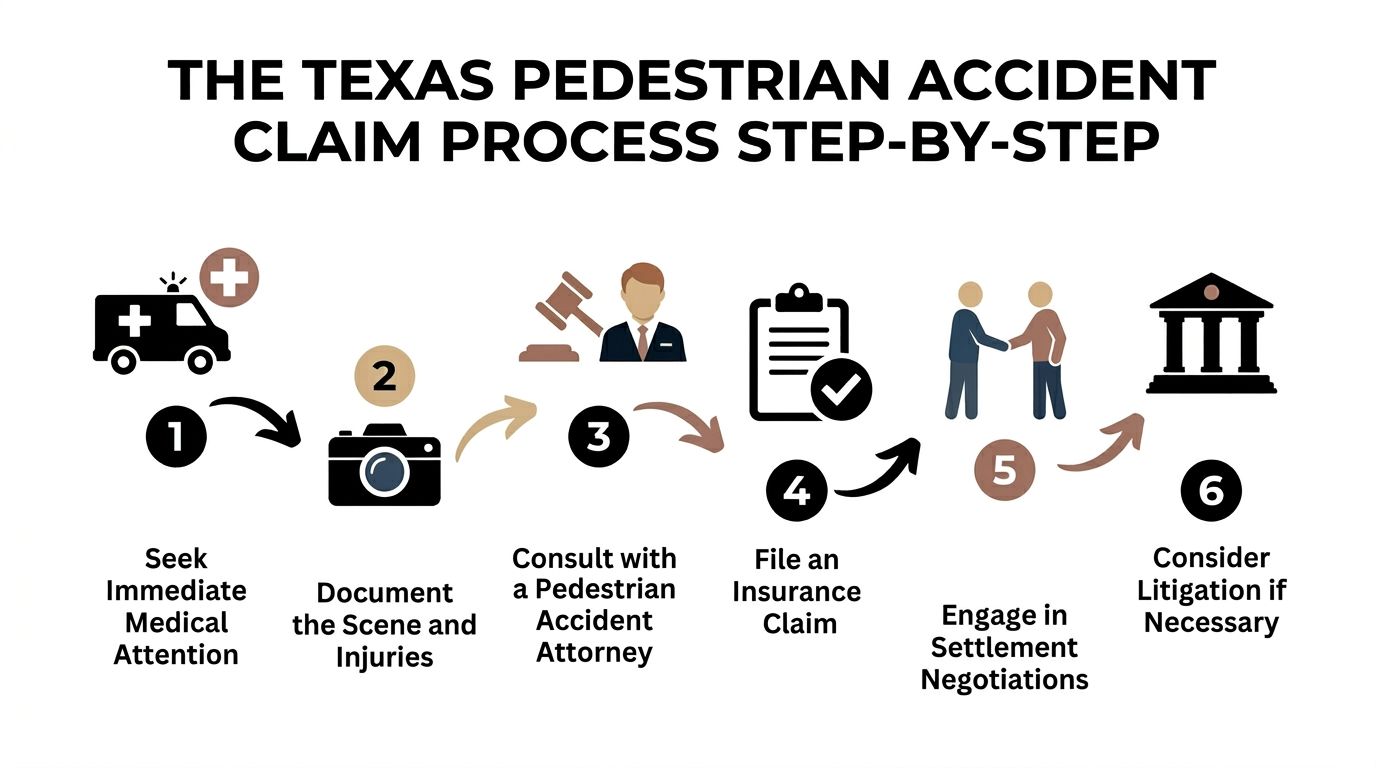
Step one protects your body and the foundation of the claim
Right after the crash, safety comes first.
Call 911. Ask for police and medical help. Accept an evaluation even if you hope the pain will pass by morning. Pedestrian injuries often work like a cracked pipe behind a wall. The damage may be serious before it is obvious.
Keep your words simple at the scene. Give facts. Do not guess about speed, distance, or fault. Do not apologize out of shock. Insurers sometimes treat a frightened, polite comment as an admission.
If you are physically able, collect the basics. Get the driver’s name, contact details, insurance information, license plate number, and witness names.
Step two preserves evidence before it disappears
A pedestrian case can change quickly once the scene is cleared.
Take photos of the crosswalk, signals, lane markings, vehicle position, debris, weather, lighting, and visible injuries. If a nearby store, apartment building, or home may have video, note the location right away. Footage is often erased on a short cycle.
Write down your memory the same day if you can. A short note on your phone is enough. Include where you were, what signal you had, where the car came from, and anything the driver said. That note can help later if the insurer argues you crossed outside the crosswalk or stepped out suddenly.
Step three creates the medical record the insurer will examine
Follow-up care is part of treatment, but it is also part of proof.
Go to the doctors you are referred to. Keep appointments. Save discharge papers, prescriptions, work notes, receipts, and mileage records for medical travel if you have them. If you stop treatment for long stretches, the insurer may argue you healed sooner than you did or that something else caused your pain.
Daily notes can help too. Record trouble sleeping, walking, concentrating, driving, or caring for your children. Those details show how the injury affected real life, not just what appeared on a hospital bill.
This overview of the car accident injury claim process can help you see how early documentation shapes the rest of an injury claim.
A short video can make the process easier to visualize.
Step four starts the insurance claim without giving away ground
Soon after the crash, notice usually goes to the insurance company that may be responsible.
That can include:
- The driver’s liability insurer
- Your own auto insurer, especially if uninsured or underinsured motorist coverage may apply
- Another insurer, if the vehicle was owned by a business, employer, or someone other than the driver
Be careful here. Reporting a crash is one thing. Giving a recorded statement before you know the full extent of your injuries is another. Adjusters often ask questions that sound routine but are designed to pin down fault or minimize symptoms early.
Step five organizes the case before the insurer shapes the story
By this stage, the issue is no longer only what happened. The issue is what you can prove clearly and in order.
A strong file usually includes:
- Medical records and bills
- Proof of missed work or lost income
- Photos and video
- Witness information or statements
- The police report
- A timeline of treatment and recovery
- Notes showing how the injuries affected daily life
Organization matters more than many people realize. An insurer looks for holes. A missing record, a treatment gap, or an unclear timeline can become the excuse for a lower offer.
This is also the point when many injured pedestrians decide they want legal help. The Law Office of Bryan Fagan, PLLC can gather records, deal with adjusters, prepare a demand package, and assess whether filing suit makes sense if the insurance company refuses to be reasonable.
Step six pushes the case toward settlement or lawsuit
Most pedestrian injury claims do not end with the first offer. They move through review, pushback, and negotiation.
That stage can feel frustrating. The insurer may question whether all treatment was necessary, argue that a preexisting condition explains your pain, or claim you were partly at fault. Those arguments are not random. They are common ways to cut the payout.
A lawyer counters by lining up the evidence in a clear sequence. What happened at the scene. What the medical records show. How the injury changed your work and daily life. Why the insurer’s fault argument does not fit the facts.
Keep every crash-related document in one folder, paper or digital. Good records make it harder for an insurance company to delay, deny, or downplay your claim.
The goal is not speed for its own sake. The goal is to build a claim that is hard to discount.
Fighting for Fair Compensation Your Guide to Insurance Negotiations
Insurance adjusters may sound friendly. Some are polite, patient, and calm. That doesn’t change their job.
Their role is to protect the insurance company’s financial interests. In practice, that often means looking for ways to narrow your claim, question your treatment, or settle before the full cost of the injury is known.

Common insurance tactics after a pedestrian crash
Most adjusters don’t say, “We want to pay as little as possible.” They show it in subtler ways.
You may see tactics like these:
- A fast settlement offer: This can happen before you know whether you’ll need more treatment.
- Requests for a recorded statement: The insurer may use your own words later to question fault or injury severity.
- Selective reading of medical records: An adjuster may focus on old injuries and ignore how the crash changed your condition.
- Blame shifting: If there’s any ambiguity, the insurer may argue you crossed too late, moved too suddenly, or weren’t visible enough.
These arguments often show up when liability seems clear but damages are expensive.
Why negotiation is about proof, not emotion
A strong claim doesn’t rely on outrage alone.
It relies on a clear package showing:
- Why the driver was liable
- What treatment you needed
- How the injuries affected work and daily life
- Why the insurer’s fault arguments don’t hold up
That package is often called a demand. It should be organized, supported by records, and timed carefully. Sending it too early can weaken the case. Waiting too long without preserving evidence can also hurt.
A practical example from Houston
A pedestrian in Houston is hit near a shopping center entrance. The driver says the person “came out of nowhere.” But photos show a marked crossing path, and nearby surveillance footage captures the driver turning while looking left for vehicle traffic instead of checking the walkway.
That changes the negotiation.
The adjuster may still challenge the extent of treatment or argue that some care was excessive. But with strong liability evidence, the room for blame-shifting gets smaller.
Important: If an adjuster asks for a recorded statement, you don’t have to treat that request as routine. It can shape the entire claim.
When legal help makes the biggest difference
Negotiation is often the point where injured people feel most overwhelmed.
That’s understandable. You’re trying to heal while someone with experience in claim reduction asks technical questions, requests records, and presses for quick answers. A Texas injury attorney can take over those communications, frame the evidence properly, and keep the focus on documented losses instead of insurer talking points.
That matters in pedestrian cases because adjusters often build their defense around two themes. Fault and value.
They argue you caused some of the crash. Then they argue your injuries aren’t worth what your records show.
A lawyer’s job is to answer both with facts.
If negotiations don’t become reasonable, the next step may be filing suit and preparing the case for court. Sometimes the willingness to do that changes the insurer’s posture. Sometimes it doesn’t. Either way, the claim needs to be built as if someone else will someday read every page closely.
The Clock Is Ticking Texas Statute of Limitations for Injury Claims
A statute of limitations is the legal deadline for filing a lawsuit.
In Texas, an injured pedestrian generally has a limited time from the date of the accident to file a personal injury lawsuit. A similar deadline applies in many wrongful death cases brought by surviving family members seeking wrongful death compensation.
That deadline matters because filing late can destroy an otherwise valid claim.
People sometimes assume they can wait because treatment is ongoing or because negotiations are still happening. That’s risky. Insurance talks don’t automatically extend your lawsuit deadline. If the statute expires, the court can dismiss the case even if the injuries were serious.
Why earlier is better
Waiting also creates proof problems.
- Witness memories fade: People forget timing, signals, and details.
- Video may be lost: Businesses often record over footage.
- Records get harder to gather: Delays create gaps the insurer can attack.
Texas Civil Practice & Remedies Code Chapter 16 governs many filing deadlines, while Chapters 33 and 41 affect fault and damages issues once a case is underway. The practical takeaway is simple. Don’t treat the deadline as the date to start thinking about your case. Treat it as the date by which action may already need to be taken.
If you’re unsure when the clock started or whether an exception might apply, speak with a lawyer well before the deadline approaches.
Frequently Asked Questions About Pedestrian Accidents in Texas
What happens if the driver who hit me was uninsured or underinsured
You may still have options.
Many people turn to their own UM/UIM coverage, which stands for uninsured or underinsured motorist coverage. This can become important when the at-fault driver has no coverage, too little coverage, or leaves the scene. These claims often involve disputes with your own insurer, so it’s still wise to be careful with statements and documentation.
What if it was a hit-and-run
Hit-and-run claims can be especially stressful because the driver may never be identified.
Texas-specific settlement information notes that hit-and-run compensation often depends on the victim’s uninsured motorist policy. The practical point is that you should report the crash quickly, preserve every piece of evidence, and ask whether nearby cameras captured the vehicle. You may also want to ask about other possible victim compensation resources, depending on the facts.
Can I still get compensation if I was jaywalking
Possibly, yes.
A jaywalking allegation does not automatically defeat your case. Texas uses comparative fault rules, so the legal question becomes how much responsibility each side had. If the evidence shows the driver was still primarily negligent, you may still recover compensation. If your assigned fault is too high, recovery may be reduced or barred.
How much does it cost to hire a pedestrian accident lawyer
Many personal injury lawyers handle these cases on a contingency fee basis.
That means the attorney’s fee is tied to the outcome of the case rather than an upfront hourly bill. In plain English, you usually don’t pay attorney’s fees at the start. The specific contract terms matter, so ask for them in writing and make sure you understand how litigation costs are handled.
What does liability mean in a pedestrian case
Liability means legal responsibility.
If a driver failed to yield, drove distracted, or otherwise acted carelessly and that conduct caused your injuries, the driver may be liable. In some cases, another party may also share responsibility, such as an employer, vehicle owner, or another motorist involved in the sequence of events.
What should I say to the insurance company
Keep it limited and factual until you understand your injuries and rights.
You can usually report that a crash happened, identify the vehicles or people involved, and confirm basic contact information. Be cautious about detailed statements on fault, speed, visibility, or your medical condition while the facts are still developing.
Take the First Step Toward Recovery Contact a Houston Accident Lawyer Today
You have rights after a pedestrian crash. You also have decisions to make early, and those decisions can affect your health, your claim, and your financial recovery.
The good news is that you don’t have to figure it all out by yourself. If you were hit by a car in Houston or anywhere in Texas, a Houston car accident lawyer can help you understand liability, preserve evidence, deal with the insurer, and pursue compensation for medical care, lost income, pain and suffering, and other damages allowed by law.
A consultation can give you answers about fault, insurance coverage, deadlines, and whether a settlement offer makes sense. If your family lost someone in a fatal pedestrian crash, a Texas injury attorney can also discuss wrongful death compensation and the next legal steps with care and respect.
When you’re injured, clarity matters. So does timing. Reaching out early can help you protect both.
If you were hurt in a pedestrian collision, contact The Law Office of Bryan Fagan, PLLC for a free consultation. We can review what happened, explain your options in plain language, and help you decide what to do next. If we take your case, you won’t pay us unless we win for you.