A car crash can change your life in seconds, but you do not have to face recovery alone.
You may be reading this in the middle of the hardest week of your life. Maybe your phone rang late at night. Maybe a police officer came to your door. Maybe you are trying to plan a funeral while also answering insurance calls you never expected to receive.
When a death should never have happened, grief mixes with confusion, anger, and fear about what comes next. A dallas wrongful death attorney helps families understand their rights, protect evidence, and pursue accountability under Texas law. No legal case can undo what happened. It can, however, help your family seek wrongful death compensation, financial stability, and a measure of justice.
After a Devastating Loss Your Family Is Not Alone
One moment, a family is waiting for a loved one to get home from work. The next, they are calling relatives, speaking with officers, and trying to understand a crash report filled with unfamiliar terms. That kind of sudden loss leaves people stunned. Many families in Dallas find themselves in exactly that position after fatal wrecks.

In 2022, Dallas recorded 227 fatal motor vehicle accidents, including 64 involving impaired drivers, according to McGilberry & Shirer. Those are not just numbers. Each death left behind parents, spouses, children, or siblings trying to understand how a normal day turned into a tragedy.
Grief and legal questions often arrive together
Families often ask practical questions right away.
- Who can get the car from the tow yard
- Should we speak to the insurance adjuster
- What if the other driver was drunk
- How will we pay medical bills and funeral costs
- Do we even have the right to file a case
Those questions are normal. So is the feeling that you cannot handle one more task.
If you are struggling emotionally after a fatal crash, support matters just as much as legal guidance. Resources like Mental Health Recovery After a Motor Vehicle Accident can help families understand the emotional toll trauma can take.
Justice can mean more than money
A wrongful death case is not about placing a dollar figure on a loved one’s life. It is about recognizing that a preventable death created real harm. That harm may include lost income, medical expenses, loss of companionship, and deep mental anguish.
For many families, taking action also creates a sense that someone is finally being held responsible. That matters when the death came from drunk driving, distracted driving, a dangerous truck crash, unsafe property, or another act of negligence.
What Is a Wrongful Death Claim in Texas
A wrongful death claim is a civil case. It is filed when someone dies because another person or company acted wrongfully. In plain language, that usually means careless conduct caused a death that should not have happened.
The simplest way to think about it
If your loved one had survived, they may have had a personal injury claim. Because they died, Texas law allows certain family members to bring a wrongful death claim instead.
A civil claim is different from a criminal case.
- Criminal case: The government tries to punish a defendant with penalties like jail or fines.
- Civil case: The family seeks compensation for losses caused by the death.
Both can happen at the same time. For example, a drunk driver may face criminal charges, while the family also files a civil wrongful death lawsuit.
Key legal words in plain English
Texas families often hear legal terms that sound complicated. Here is what they usually mean.
- Liability: Legal responsibility. If a driver caused a fatal crash by running a red light, that driver may be liable.
- Negligence: Failing to use reasonable care. A texting driver, a speeding truck operator, or a doctor who makes a preventable treatment error may be negligent.
- Damages: The losses the law may compensate. This can include financial losses and human losses.
- Statute of limitations: The deadline to file a lawsuit. If you miss it, you may lose the right to bring the claim.
- Comparative fault: Texas follows a fault-sharing system under Texas Civil Practice & Remedies Code Chapter 33. If more than one party contributed to what happened, fault can be divided. In some cases, the defense argues the deceased person was partly at fault. That argument can affect recovery.
How negligence works in a fatal accident case
A wrongful death case usually turns on a chain of proof:
A duty existed.
Drivers must follow traffic laws. Property owners must address dangerous conditions. Doctors must meet the standard of care.Someone breached that duty.
They acted carelessly, recklessly, or failed to act when they should have.That failure caused the death.
There must be a direct connection between the wrongful conduct and the fatal outcome.The family suffered losses.
Those losses may be financial, emotional, or both.
Here is a simple example. A Houston driver rear-ended on I-45 may bring an injury claim if they survive. If the same type of crash causes a death because the other driver was intoxicated or distracted, the surviving family may have a wrongful death claim.
Chapters 33 and 41 matter
Texas Civil Practice & Remedies Code Chapter 33 deals with proportionate responsibility, which is the Texas version of comparative fault. Defendants and insurers often try to shift blame to reduce what they owe; understanding this is important.
Texas Civil Practice & Remedies Code Chapter 41 addresses exemplary damages, which many people call punitive damages. These damages may be available when the conduct goes beyond ordinary negligence and rises to gross negligence. A fatal drunk driving crash is one example families often ask about.
A wrongful death case is about accountability in civil court. The question is not whether the defendant goes to jail. The question is whether the evidence shows their conduct caused the death and what compensation the law allows.
Who Has the Right to File a Wrongful Death Lawsuit
This is one of the most misunderstood parts of Texas law. Many people assume “next of kin” can file. That is not how it works.
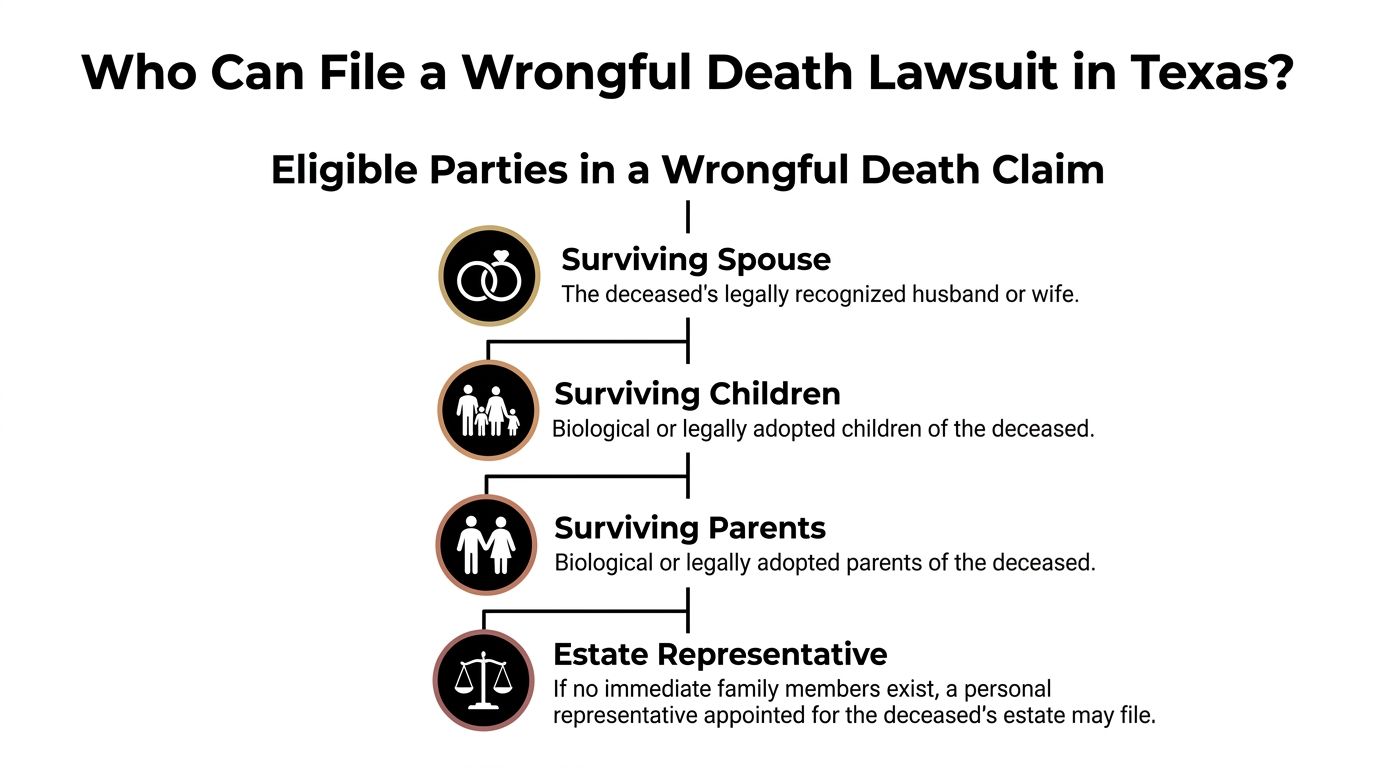
Under Tex. Civ. Prac. & Rem. Code § 71.004, only certain people have standing to bring a wrongful death claim. Texas calls them statutory beneficiaries.
The primary people who can file
Texas law generally limits wrongful death claims to these family members:
Surviving spouse
A legally recognized husband or wife can file.Surviving children
Biological children and legally adopted children may file.Surviving parents
Biological or legally adopted parents may file.
According to TexTrial, 20 to 30% of initial inquiries involve eligibility disputes. That helps explain why families so often get stuck at the very beginning of the process.
Who usually cannot file
This surprises many grieving families.
In most Texas wrongful death cases, these relatives do not have the right to file just because they were close to the person who died:
- Siblings
- Grandparents
- Fiancés or unmarried partners
- More distant relatives
That does not mean their grief matters less. It means the statute gives filing rights only to specific categories of beneficiaries.
What if several beneficiaries exist
The spouse, children, and parents can bring the claim together. In some situations, one beneficiary may file for the benefit of all eligible beneficiaries. Families sometimes encounter conflict regarding this. An adult child may want to file right away, while another relative wants to wait. A surviving spouse may disagree with parents about strategy. Those disagreements can delay the case if no one gets clear legal guidance early.
What if no eligible family member files
Texas law also allows the personal representative or executor of the estate to file if the statutory beneficiaries do not file within the allowed period, unless the beneficiaries request that no action be taken.
That estate-based role is important in cases where there is confusion about who should act, or where probate issues overlap with the wrongful death claim.
A simple example
Suppose a Dallas delivery driver is killed in a commercial truck crash. He leaves behind a wife, one adopted daughter, and his mother.
All three categories listed in the statute exist here:
- spouse
- child
- parent
They may have standing to pursue the case. His brother, even if he helped care for him daily, generally would not be a statutory beneficiary.
Why this matters so much
Standing is not a minor technicality. If the wrong person files, the case can be delayed or dismissed. Families who are already grieving can lose valuable time while insurers continue building their defense.
Before discussing settlement value, get one issue answered first. Do you have the legal right to file? In wrongful death cases, that answer shapes everything else.
The Critical Two-Year Deadline for Texas Wrongful Death Claims
Texas families usually have two years to file a wrongful death lawsuit. That deadline is often called the statute of limitations.
The phrase sounds technical, but the idea is simple. The law gives you a limited time to bring your case. If that window closes, the court may refuse to hear it.
Why waiting can hurt the case
This deadline matters for more than paperwork.
Evidence starts disappearing almost immediately after a fatal crash or other deadly incident. Skid marks fade. Surveillance footage gets deleted. Witnesses move away or forget details. Vehicles are repaired, sold, or destroyed. In trucking cases, records may not remain available forever.
A family may think, “We are not ready yet.” That feeling is understandable. But contacting a lawyer early does not force you to make rushed decisions. It helps preserve options while the evidence is still available.
Early action protects the facts
A dallas wrongful death attorney may move quickly to collect and protect evidence such as:
- Crash reports and scene photos
- Vehicle data and inspection records
- Phone records in distracted driving cases
- Company records in truck or work-related deaths
- Medical records when treatment issues are involved
- Witness statements before memories fade
This is one reason legal timing matters so much. By the time a family feels emotionally ready, the strongest proof may already be harder to find.
The deadline and insurance claims are not the same thing
Many people think opening an auto insurance claim is enough. It is not.
An insurance claim is one process. Filing a lawsuit is another. The insurer may keep talking with you past the point where your lawsuit deadline is approaching. If the filing deadline expires, those conversations may not save your rights.
If you want a plain-English overview of how these legal time limits work, this guide on statutes of limitations in Texas is a useful starting point.
A practical way to think about it
You do not need to have every answer before you speak with a lawyer. You only need to know that time affects evidence, your negotiating position, and your family’s ability to seek justice.
Acting promptly is not about pushing grief aside. It is about protecting your ability to act later from a position of strength.
Compensation Your Family Can Recover After a Fatal Accident
Families often ask the hardest question in the quietest voice: “What can a case cover?”
Texas law allows wrongful death compensation for both financial losses and human losses. In some cases, exemplary damages may also apply when the conduct was especially serious.

The three main categories
The law usually groups damages into three broad categories.
| Damage Type | What It Covers |
|---|---|
| Economic damages | Medical bills, funeral costs, lost earnings, and other financial support the deceased would likely have provided |
| Non-economic damages | Mental anguish, loss of companionship, loss of care, counsel, and guidance |
| Exemplary damages | Punitive-style damages that may apply in cases of gross negligence under Texas law |
Economic damages
These are the tangible financial losses tied to the death.
A family may recover compensation for medical treatment provided before death, funeral and burial costs, and the income the person likely would have earned and contributed over time. In some families, that also includes lost household services, such as childcare, home maintenance, transportation, or day-to-day support.
Consider a parent who handled school pickups, coached a child’s sports team, and paid a large share of household bills. Their death creates emotional devastation, but also a serious financial gap. Economic damages try to account for those losses in a concrete way.
Non-economic damages
These losses are real, even though they do not arrive as invoices.
A surviving spouse may lose companionship and emotional support. A child may lose parental guidance. Parents may suffer severe mental anguish after the death of an adult son or daughter. Texas law recognizes these harms, even though they are harder to measure than a hospital bill.
This is one reason there is no fixed “average” wrongful death settlement in Texas. The value depends on the person, the relationships, the evidence, and the depth of the loss.
Exemplary damages under Chapter 41
Under Texas Civil Practice & Remedies Code Chapter 41, exemplary damages may be available in cases involving gross negligence or other especially wrongful conduct.
A fatal drunk driving crash is a common example. So is conduct showing an extreme risk paired with conscious indifference to the safety of others. These damages are not available in every case, but when they apply, they serve a punishment and deterrence purpose.
Insurance problems can reduce recovery
The legal value of a case and the available insurance coverage are not always the same thing.
In complex commercial vehicle cases, Duke Seth reports that over 22% of drivers in DFW are uninsured, and a 2025 Nolo study found 40% of Texas wrongful death settlements were under $500K due to coverage gaps. The same source warns that insurers may use step-unit clauses to cut payouts in multi-party crashes.
That matters in trucking, rideshare, and multi-vehicle fatal wrecks. A family may assume there is one large policy, only to learn several insurers are disputing priority, exclusions, or available limits.
If you want a plain-language backgrounder on car insurance in Texas, it can help you understand why uninsured and underinsured coverage questions become so important after a fatal crash.
Insurance companies often talk about sympathy early and limitations later. Let your lawyer handle those conversations before a recorded statement or rushed release affects your claim.
A real-world example
A Texas injury attorney handling a fatal trucking crash might pursue compensation from the truck driver’s policy, the carrier’s policy, and the family’s own uninsured or underinsured coverage if needed. The attorney may also investigate whether a maintenance company, cargo loader, or employer shares liability.
That wider investigation can make a major difference in what your family is able to recover.
How Our Attorneys Build a Strong Wrongful Death Case
A strong case does not come from one dramatic piece of evidence. It comes from careful work, done in the right order, by the right people.

It starts with listening and investigating
The first meeting is not just about forms. It is about hearing what happened, identifying possible defendants, and spotting time-sensitive evidence.
A legal team may begin by collecting the police report, reviewing scene evidence, securing photographs, identifying witnesses, and requesting records. In a fatal crash, that can also include looking at vehicle damage, road conditions, phone use, trucking logs, or toxicology evidence, depending on the facts.
A simple rear-end crash can become a complex liability case if multiple vehicles were involved, if a company vehicle was being driven for work, or if a dangerous road condition contributed to the event.
Liability is often broader than families expect
People often assume one person caused the death. Sometimes that is true. Sometimes the evidence points to several responsible parties.
Possible defendants may include:
- A negligent driver who was speeding, distracted, or impaired
- A trucking company that hired carelessly or ignored safety rules
- A business owner whose unsafe property conditions contributed to the death
- A product manufacturer if a defective part made the incident worse
- A medical provider if negligent treatment followed the original injury
This is why a careful legal investigation matters. The full picture can increase accountability and expand the sources of recovery.
Discovery is where the case becomes provable
Much of the most important work happens during discovery. According to Winocour Law, this phase can take several months and involves gathering and exchanging evidence such as medical records, expert testimony, depositions, and other key documents.
Discovery is often where lawyers test the defense story against the paper trail. If a company claims a truck was safely maintained, maintenance logs may prove otherwise. If a driver denies distraction, phone records or witness testimony may challenge that claim.
The strongest wrongful death cases do not rely on assumptions. They rely on documents, testimony, and experts who can explain exactly how the death happened and why the defendant is legally responsible.
Experts help connect the dots
Many fatal accident cases require specialists who can explain technical issues in a way a jury understands.
An attorney may work with:
- Accident reconstruction experts to explain how a collision occurred
- Medical experts to connect injuries to the death
- Economists to calculate lost earnings and support
- Vocational experts to describe the person’s likely work life and earning capacity
In a Dallas freeway crash, for example, reconstruction evidence may show speed, lane position, braking, or impact sequence. That can be critical when the defense tries to blame the deceased.
For families who want to understand the proof side of these cases more clearly, this article on how to prove wrongful death explains the basic framework in straightforward terms.
A short video can also help make the process less intimidating:
The goal is a case that can stand up in negotiation or trial
Every strong wrongful death file tells a clear story:
- what duty existed
- how it was broken
- how that caused the death
- what losses the family suffered
That clarity matters in settlement talks, mediation, and courtroom presentation. Insurers pay attention when they know a legal team is prepared to prove each part of the case.
Navigating Settlement Negotiations and Your Financial Peace of Mind
Most families worry about two things at once. Will we have to go to court? And how can we afford a lawyer after everything that has happened?
Both concerns are understandable.
Settlement versus trial
Many wrongful death cases resolve through settlement rather than a full trial. Settlement can offer privacy, speed, and certainty. Trial can sometimes create the chance for a larger result, but it also brings risk, delay, and emotional strain.
Here is the practical comparison:
Settlement can be better when
the defendant accepts meaningful responsibility, the offer reflects the evidence, and the family wants closure without prolonged litigation.Trial can be necessary when
the insurer denies liability, minimizes the death, disputes damages, or refuses to negotiate fairly.
Neither option is automatically best. The right choice depends on the evidence, the defense position, and your family’s goals.
If you want a broader look at how case values are discussed, this overview of wrongful death settlement amounts can help frame the issues families usually weigh.
What comparative fault can do to settlement talks
Under Chapter 33, insurers often argue that the deceased person shared blame. They may say your loved one was speeding, failed to react, or made an unsafe turn. Sometimes those arguments are weak. Sometimes they are built around partial facts.
That is why negotiations are not just about adding up losses. They are about proving liability persuasively enough that the defense cannot cheaply discount the case.
How contingency fees help families
Most wrongful death lawyers work on a contingency fee basis. In plain English, that means you pay no attorney’s fees unless the lawyer wins compensation for your family. This arrangement is important because wrongful death cases are expensive to build. They often require records collection, expert review, depositions, and substantial legal work. Contingency representation gives families access to that help without paying upfront while they are already under financial pressure.
For grieving families, that fee structure creates breathing room. You can focus on your household, your children, and your healing while your legal team handles the case.
Frequently Asked Questions and How to Get Help Today
What if my loved one was partly at fault
Texas uses comparative fault under Chapter 33. That means a case may still move forward even if fault is disputed, but the amount recoverable can be affected by how responsibility is allocated. These cases often require strong investigation because insurers use partial-fault arguments to reduce payment.
How long does a wrongful death case take
There is no single answer. Some cases resolve in settlement. Others require extended discovery, expert review, and trial preparation. The timeline often depends on whether liability is clear, how many parties are involved, and how hard the insurer fights.
Do we need a lawyer if the insurance company already offered money
Usually, yes. Early offers often come before the family knows the full value of the claim or the full scope of available coverage. Once you sign a release, you may give up the right to pursue more compensation later.
Why does a firm’s track record matter
Because wrongful death cases are resource-heavy. According to Lyons & Simmons, the firm has secured over $1 billion in verdicts and settlements since 2023. Results like that do not guarantee any future outcome, but they do show why experience, staffing, experts, and trial readiness matter when large insurers and corporations are involved.
If your family has questions about a fatal crash, a truck collision, an uninsured driver, or another negligence-related death, getting answers now can protect your rights and reduce uncertainty. A Houston car accident lawyer or dallas wrongful death attorney who knows Texas law can explain liability, damages, deadlines, and your next steps in plain language.
If you lost a loved one because of someone else’s negligence, The Law Office of Bryan Fagan, PLLC is ready to help you understand your rights with compassion and clarity. Our team offers a free consultation, and you pay no attorney’s fees unless we win your case. Whether you are dealing with a fatal car wreck, a trucking collision, an uninsured driver dispute, or questions about wrongful death compensation, we can help you take the next step with confidence. Call today or reach out online to speak with a Texas legal team that will treat your family with care and fight for the accountability you deserve.