A car crash can change your life in seconds—but you don’t have to face recovery alone. In a single moment, a preventable mistake behind the wheel can change everything. The most common causes of crashes on Texas roads—things like distracted driving, speeding, or driving while impaired—are almost always rooted in driver negligence.

The aftermath of a car accident is a whirlwind of shock, pain, and overwhelming uncertainty. Your life gets turned upside down, leaving you to deal with physical injuries, piling medical bills, and deep emotional trauma. We want you to know you don’t have to face this by yourself.
We created this guide to give you clear, straightforward information about your rights and what you can do next. The very first step toward getting justice and the financial support you need to recover is understanding the true cause of the crash.
Why the Cause of the Crash Is Critical for Your Recovery
Figuring out exactly what caused the accident isn't just for your own peace of mind. It’s about proving who is legally responsible—or liable—for your injuries and losses.
Liability is a legal term for responsibility. In Texas, when another driver’s careless actions cause harm—whether it’s texting on I-45 in Houston or blowing through a stop sign—they can be held legally responsible for the damage they cause. This is the foundation of a personal injury claim.
Our job is to show you how to identify that negligence, build a case to prove it, and protect your rights from start to finish. Think of The Law Office of Bryan Fagan, PLLC as your ally, here to take on the legal burdens so you can focus on healing. We’ll dig deep to uncover the facts of the crash, including:
- Driver Behavior: Was the other driver texting, drunk, overtired, or otherwise not paying attention?
- Road Conditions: Did poorly maintained roads, blind corners, or missing signs play a role?
- Vehicle Defects: Could a hidden mechanical failure, like bad brakes or a faulty steering system, be the real culprit?
By performing a thorough investigation, a skilled Texas injury attorney can construct a powerful case for you. You’ve been through enough. Let us handle the legal fight while you work on putting your life back together.
Common Causes of Car Crashes in Texas
Very few car crashes in Texas are genuine "accidents." The overwhelming majority are the direct result of negligence—one driver making a careless or reckless choice that ends up causing preventable harm to others.
Figuring out the specific cause of your crash is the critical first step toward holding the responsible driver accountable for the injuries and chaos they've caused in your life. Most of the time, the cause isn't a surprise storm or sudden mechanical failure. It’s a person making a bad call.
Distracted Driving: The #1 Culprit on Texas Roads
You know the feeling. You’re driving down I-45 in Houston, your phone buzzes, and for a split second, you're tempted to look. It’s in that single moment of distraction that lives are changed forever. Distracted driving is, without a doubt, a leading cause of collisions today.
In fact, the National Highway Traffic Safety Administration found that driver-related errors, with inattention being a huge factor, were the critical reason in an astonishing 94% of crashes they studied. This goes way beyond just texting.
Common distractions include:
- Fiddling with a GPS or the car's infotainment screen
- Eating or drinking behind the wheel
- Turning around to talk to passengers
- Reaching for a fallen item on the floor
Anything that takes a driver's hands off the wheel, eyes off the road, or mind off the task of driving is a recipe for disaster.
Speeding and Aggressive Driving
Speeding is another tragically common cause of serious wrecks. When a driver decides to race down a San Antonio highway, they're not just risking a ticket; they're gambling with the lives of everyone around them. The faster a car is moving, the less time there is to react and the more violent the impact will be.
Under Texas law, exceeding the speed limit or driving too fast for road conditions is a clear example of negligence. If a speeding driver caused your injuries, they can be held financially responsible.
This category isn't just about speed, though. It also includes other aggressive behaviors we see all too often, like tailgating, weaving through traffic with unsafe lane changes, or refusing to yield the right-of-way. Every one of these actions puts innocent people like you in danger.
Top 3 Negligent Driving Behaviors and Their Consequences
| Cause of Crash | Example of Negligence | Common Texas Accident Type |
|---|---|---|
| Distracted Driving | Texting, using an infotainment system, or talking to passengers instead of watching the road. | Rear-end collisions at stoplights; drifting into another lane causing a sideswipe. |
| Speeding | Driving over the posted limit or too fast for rain, fog, or heavy traffic. | Loss-of-control accidents on curves; high-impact T-bone crashes at intersections. |
| Impaired Driving | Getting behind the wheel after consuming alcohol, marijuana, or prescription drugs. | Head-on collisions from driving the wrong way; severe rear-end crashes due to slow reaction time. |
Identifying which of these behaviors caused your accident is the foundation for building a strong case and getting the compensation you deserve.
Driving While Intoxicated (DWI)
It’s hard to believe that after decades of public awareness campaigns, driving while intoxicated is still a major cause of carnage on Texas roads. Alcohol and drugs devastate a driver's judgment, coordination, and reaction time.
The choice to get behind the wheel while impaired is a grossly negligent act that often leads to the most catastrophic and fatal accidents. If a drunk driver hurt you, our team can help you pursue justice, which may even include punitive damages designed to punish the offender. This is a special type of compensation awarded under Chapter 41 of the Texas Civil Practice & Remedies Code.
Of course, other dangerous behaviors cause crashes, too. Drowsy driving can impair a driver just as much as alcohol. And sometimes, a mechanical failure, like hidden brake fluid problems, can play a role. Each of these root causes often leads to very specific types of car crashes. Pinpointing that exact negligent act is the key to proving fault and winning your case.
Who Is Liable in a Texas Car Accident?
Figuring out why your crash happened does more than just satisfy your curiosity—it's the foundation for establishing legal liability. Simply put, liability is the legal and financial responsibility for the harm you've suffered. It’s how we determine who pays.
In Texas, the entire system is built around a concept called negligence. It’s not some complicated legal jargon. It just means a driver failed to act with reasonable care, and that failure hurt someone. Every time a driver texts behind the wheel, floors it in a school zone, or drives drunk, they are acting negligently.
Understanding Texas's Proportionate Responsibility Rule (Comparative Fault)
Life isn't always black and white, and Texas law recognizes that. Our state uses a rule called proportionate responsibility, which you might also hear called "comparative fault." This rule, found in Chapter 33 of the Texas Civil Practice & Remedies Code, exists because sometimes, more than one person shares the blame for a wreck.
Imagine the total fault for an accident is a pie that adds up to 100%. A judge or jury’s job is to look at everyone’s actions and assign them a slice of that pie.
As long as your slice of the fault "pie" is 50% or less, you can still recover money for your damages in Texas. But if you're found to be 51% or more at fault, you are barred from recovering anything at all.
Let's say a driver blows through a red light and T-bones your car in a Dallas intersection. It seems clear-cut. But what if you were driving just five miles per hour over the speed limit? A jury might decide the other driver is 90% at fault for running the light, but you carry 10% of the blame for speeding. In that scenario, your final compensation would be reduced by your 10% share of the fault.
How Negligence Impacts Your Claim
The cause of the crash is what points directly to the other driver's negligence. Once we establish that negligent act, we can begin building a case to get you compensated. As you can see below, the most common causes are all rooted in clear—and preventable—driver error.
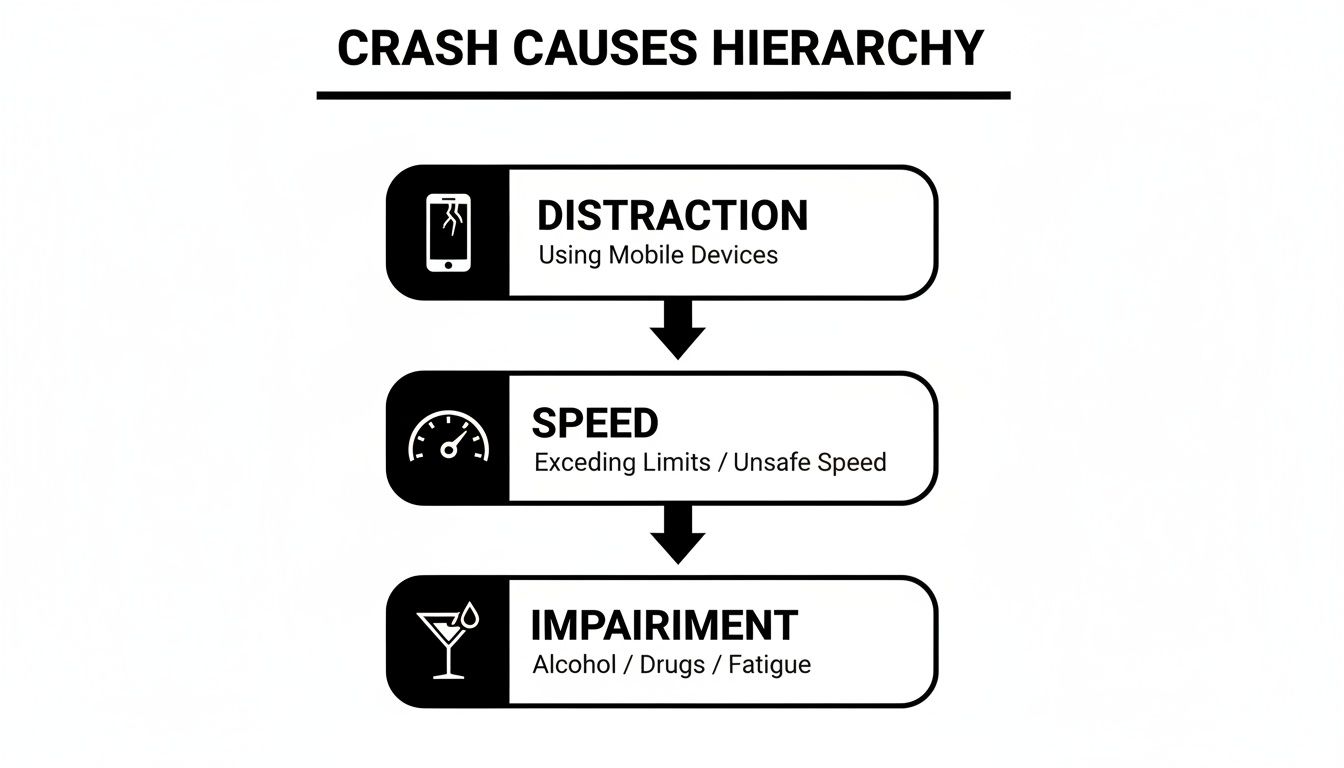
This hierarchy isn't just data; it represents dangerous choices. Distraction, speed, and impairment are consistently the top reasons for collisions, and each one starts with a driver's decision.
Take speeding, for example. It’s so much more than a simple traffic ticket—it’s a deadly gamble. Back in 2023, speed was a factor in a shocking 29% of all traffic fatalities across the U.S., contributing to over 11,800 deaths. This isn't just a statistic; it's a persistent, deadly trend that shows how a single bad choice can have fatal consequences.
Proving this kind of negligence is exactly what a Houston car accident lawyer does to build a powerful case for you. By connecting the specific cause to the legal definition of an accident, we can hold the at-fault driver fully accountable for the damage they’ve caused.
Proving the Cause to Secure Fair Compensation

Knowing what caused your crash is one thing. Proving it is how you get paid.
To hold a negligent driver accountable, you need solid evidence that tells a clear, undeniable story. This evidence becomes your shield against an insurance company that will look for any reason to downplay your injuries or, worse, blame you for the accident.
Think of it like building a house. Each piece of evidence is a brick, and a skilled Houston car accident lawyer knows exactly how to lay them to build a foundation so strong it can’t be knocked down. That’s how you demand the compensation you rightfully deserve.
Gathering the Evidence That Wins Cases
Evidence has a shelf life. It can vanish in hours or days, which is why moving quickly after a crash is so critical. The proof needed to establish negligence is often a mix of official records, eyewitness accounts, and expert analysis.
The key pieces of evidence we look for include:
- The Official Police Report: This is the starting point. It provides an official narrative of the crash and often includes the officer’s initial assessment of who was at fault.
- Photos and Videos: Nothing tells a story like a picture. Photos of vehicle damage, skid marks on the road, traffic signs, and your injuries—all taken right at the scene—are incredibly powerful.
- Witness Statements: An independent witness with no skin in the game can provide an unbiased account of what they saw, cutting through the back-and-forth between drivers.
- Cell Phone Records: If we suspect distracted driving was the cause, we can use legal tools to get the other driver's phone records. This can be the smoking gun that proves they were texting when they hit you.
Real-world example: Imagine you were rear-ended on I-45. The other driver swears they were paying attention. We can subpoena their phone records, which might show a text was sent seconds before the impact. Suddenly, their story falls apart, and your case for negligence becomes crystal clear.
Understanding the Compensation You Are Owed
Once we’ve proven the other driver was at fault, we shift focus to calculating the full scope of your losses. In the legal world, we call this compensation damages. It’s the money you are owed to make things right and help you get back on your feet.
In Texas, damages are broken down into two main categories:
- Economic Damages: These are the tangible costs that come with a clear price tag. Think of all your medical bills (both past and future), lost income from time you couldn't work, and the cost to repair or replace your vehicle.
- Non-Economic Damages: These are the losses that don't have a receipt but are just as devastating. This category covers your physical pain and suffering, the emotional trauma of the accident, and the loss of enjoyment of life. In a tragic case, this can also include pursuing wrongful death compensation.
An experienced Texas injury attorney will meticulously document every bill, receipt, and expert opinion to build a complete picture of your damages. We leave no stone unturned to make sure the full value of your claim is recognized.
Steps to Take After a Crash to Protect Your Claim
It’s nearly impossible to think straight in the chaotic moments after a car crash. But the steps you take in the hours and days that follow can make or break both your physical recovery and your ability to get fair compensation.
Protecting your legal rights starts right there at the scene. By taking a few crucial actions, you begin building the foundation for a strong claim and defend yourself against the insurance company's inevitable tactics.
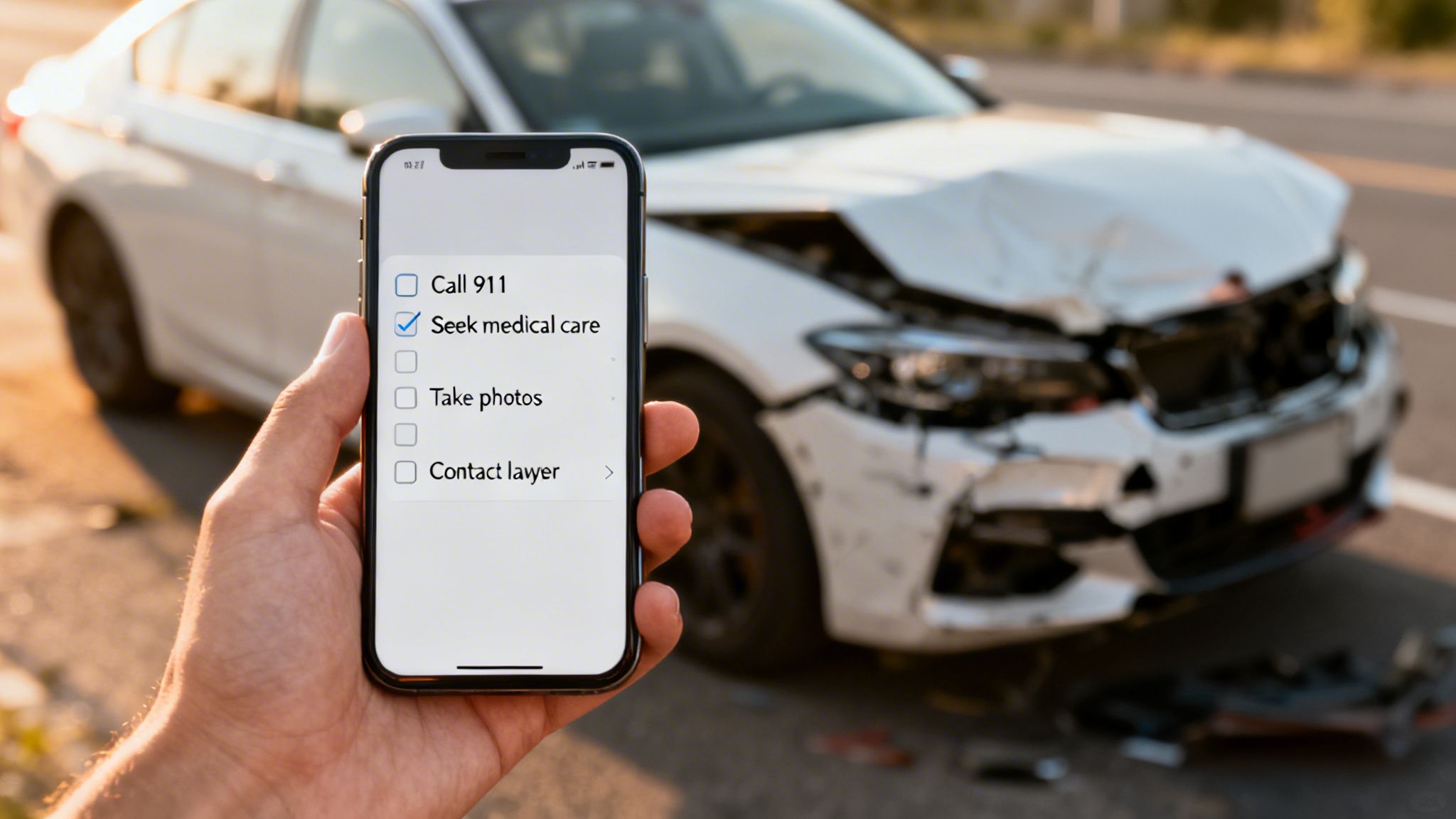
Your Immediate Post-Crash Checklist
Think of this as your guide to protecting your health and your legal rights. Every step has a specific purpose—to help prove what caused the crash and to document the harm you’ve suffered.
- Seek Immediate Medical Care: Your health is the number one priority. Period. Even if you think you feel fine, go see a doctor. Adrenaline is a powerful painkiller that can easily mask serious injuries, and a trip to a physician creates an official record connecting your injuries to the accident. This is vital proof for your claim.
- Call the Police and Report the Crash: Always call 911 and have law enforcement come to the scene. The officer will create an official Texas Peace Officer’s Crash Report, a critical piece of evidence that documents the basic facts of the collision.
- Document Everything: Use your smartphone. Take pictures and videos of everything you can think of—the damage to all vehicles, skid marks on the road, the weather conditions, traffic signs, and any visible injuries you have. Get the other driver's contact and insurance information, but do not get into a discussion about who was at fault.
- Never Admit Fault: Be very careful with your words. Avoid saying things like, "I'm so sorry," or "I didn't even see you." Insurance adjusters are trained to twist even simple, polite apologies and use them to pin blame on you and deny your claim. Stick to the facts.
- Talk to an Attorney Before the Insurance Company: Before you give a recorded statement to any insurance adjuster, speak with an experienced lawyer. They can advise you on how to deal with insurance companies and protect your rights from the very beginning.
The Clock Is Ticking: The Texas Statute of Limitations
This part is absolutely critical. Texas law puts a strict deadline on your right to take legal action. It’s called the statute of limitations, and for most personal injury cases, you have just two years from the date of the accident to file a lawsuit.
Let me be clear: if you miss this deadline, you lose your right to sue the at-fault driver for your injuries forever. It doesn't matter how strong your case is.
This two-year window is exactly why you need to speak with a Houston car accident lawyer as soon as you can. An experienced attorney will make sure every deadline is met, giving you the space to focus on what truly matters: your auto accident recovery.
How Our Lawyers Investigate and Win Your Case
Figuring out what caused a crash is important, but it’s only the first step. What comes next is taking action to hold the person who hurt you accountable.
At The Law Office of Bryan Fagan, PLLC, we don't just talk about getting justice—we build the case to make it happen. Our work begins the second you hire us. We immediately launch our own investigation, separate from what the police are doing, to get to the bottom of what really happened. This is far more than just a quick look at the police report; it’s about digging deep to build a case for liability that can’t be ignored.
Building Your Case for Maximum Compensation
Our investigative team gets to work collecting the hard evidence that forces insurance companies to take your claim seriously. We manage every single detail so you can put all your energy into healing.
Here are a few of the immediate actions we take:
- Managing Insurance Communications: We take over all calls and emails with the insurance adjusters. They have tactics designed to get you to settle for less, and our job is to shut them down.
- Hiring Experts: If there are questions about how the crash occurred, we bring in accident reconstruction experts. These professionals use science to prove exactly what happened and who was at fault.
- Calculating Full Damages: We go through everything you’ve lost with a fine-tooth comb—every medical bill, every lost paycheck, and the very real cost of your pain and suffering. During our investigation, it's also vital to determine if your car has been in a crash previously, as this history can impact our understanding of the current incident.
We fight for a settlement that truly reflects what was taken from you. If the insurance company refuses to do the right thing, our trial-tested attorneys are always ready to take the fight to a Texas courtroom.
Best of all, you don't have to worry about the cost. We handle every case on a contingency fee basis. Simply put, you pay us absolutely nothing unless we win. There is zero financial risk to you.
Our only job is to get you the justice and compensation you need to start putting your life back together.
Frequently Asked Questions About Car Accident Claims
When you're dealing with the aftermath of a car wreck, the questions can feel as overwhelming as the crash itself. We hear them every day from people just like you.
Here are straight, honest answers to some of the most common concerns we address, designed to give you clarity as you figure out what to do next.
What if the Other Driver’s Insurance Is Blaming Me?
Don’t be surprised. This is one of the oldest tricks in the book, and insurance companies use it constantly to slash or deny a perfectly valid auto insurance claim.
You must not take their word for what happened.
Texas operates under a proportionate responsibility rule, sometimes called comparative fault. In simple terms, this means you can still recover money even if you were partially to blame for the accident. An attorney’s job is to shut down these unfair blame games and make sure the fault is placed exactly where it belongs.
How Much Is My Texas Car Accident Claim Worth?
Honestly? There is no "magic number" or simple calculator for this. Every single crash is different, and the true value of your claim depends on a long list of specific factors.
A dedicated lawyer doesn't just pull a number out of thin air. They will meticulously calculate the full and fair value of your claim by adding up every single loss. This includes all your current and future medical bills, lost wages, and the very real impact of your pain and suffering. We make sure nothing gets left on the table so you know what you are truly owed.
Do I Really Need a Lawyer if the Cause of the Crash Seems Obvious?
Yes. Without a doubt.
Even in what seems like a slam-dunk case—like being rear-ended on a Houston freeway—you can bet the insurance company is already working to pay you as little as possible. They have entire departments of adjusters and lawyers whose only job is to protect their profits, not to help you.
Hiring an experienced attorney changes the entire dynamic. It’s a clear signal that you won’t be lowballed or pushed around. Your lawyer will take over all communications, shield you from their tactics, and fight to get you the full and fair compensation you deserve.
If you have more questions or you’re ready to talk about your case, the compassionate team at The Law Office of Bryan Fagan, PLLC is here for you. We offer a free, no-obligation consultation to go over what happened and explain your legal options. You have been through enough. Let a strong, empathetic team fight for the justice and recovery you deserve. Schedule your free consultation with us now to get the support and strong advocacy you need.