A car crash can change your life in seconds — but you don’t have to face recovery alone. A T-bone accident, often called a side-impact collision, happens when the front of one vehicle crashes into the side of another, forming a “T” shape. These crashes are uniquely dangerous because the sides of a vehicle offer very little protection compared to the front or back.
What Happens in a T-Bone Accident
When you are hit from the side, the force of the impact travels directly through the car door and into your body. While the front and rear of your vehicle have crumple zones designed to absorb energy, a T-bone collision leaves you exposed. There is often just a thin door and a window between you and the other car.
This sudden, violent impact is why T-bone crashes are some of the most devastating we see on Texas roads. Even at lower speeds, the direct force can cause life-altering injuries and lead to complex legal battles. Understanding what happened is the first step toward protecting your health and your legal rights.
The Dangers are Real
The statistics paint a grim picture of just how serious these collisions are. Nationally, side-impact crashes are responsible for a shocking number of fatalities, making them the second deadliest type of multi-vehicle accident. According to the National Highway Traffic Safety Administration (NHTSA), T-bones only make up about 13% of all crashes, but they account for over 25% of all occupant deaths. You can read more about the dangers of these accidents in this report on side-impact collisions.
Common Causes of Side-Impact Collisions
The vast majority of T-bone accidents are completely preventable and almost always happen because one driver was negligent. In our experience as Texas injury attorneys, some of the most common causes include:
- Failure to Yield: This is a major cause. For example, a driver trying to make a left turn at a busy Houston intersection on I-45 might misjudge the speed of oncoming traffic and pull out directly in front of another car.
- Running Red Lights or Stop Signs: Disregarding traffic signals is a primary cause of high-speed, catastrophic side-impact crashes.
- Distracted Driving: Texting, adjusting the radio, or any other distraction can cause a driver to blow through an intersection without ever looking up, leading to a serious wreck.
When you're hurt in a crash, you're suddenly facing a mountain of medical bills and have no idea what to do next. Our guide on who pays medical bills after a car accident can give you some much-needed clarity during a confusing time.
Why T-Bone Accidents Cause Severe Injuries
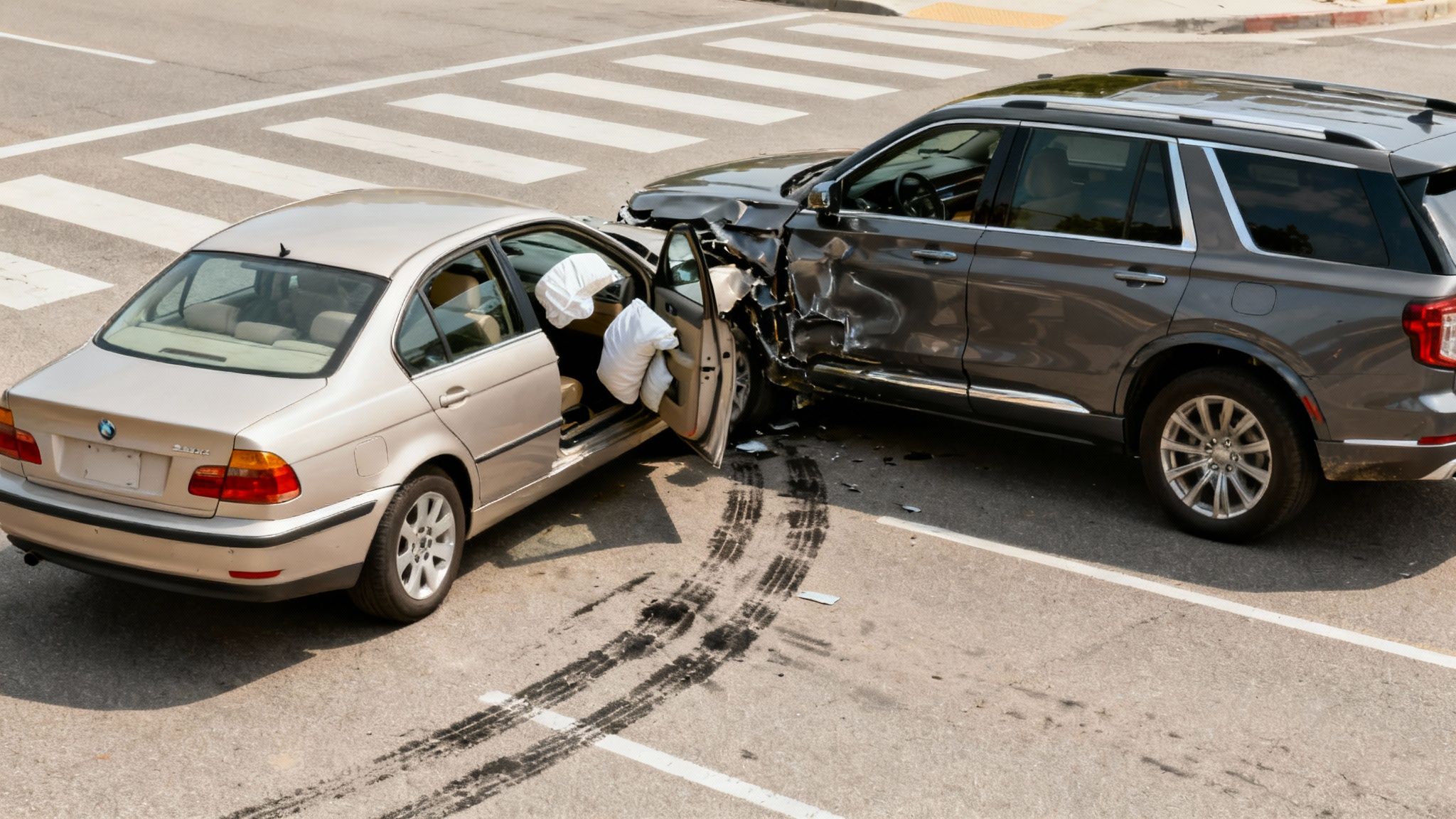
Have you ever wondered why a T-bone accident is so uniquely devastating? It really comes down to the basic design of your car. A vehicle's front and rear bumpers have "crumple zones" specifically engineered to absorb the crushing force of an impact and shield the people inside.
But the sides of your car are a completely different story. There is minimal structural reinforcement. You have little more than a door and a window acting as a barrier. This vulnerability means the violent energy from a side-impact collision isn’t absorbed—it’s transferred directly into the car’s cabin and to the people inside.
This lack of protection is what makes these crashes so dangerous. Research has shown that the sides of a vehicle absorb only a tiny fraction of the incoming force, leaving passengers horribly exposed. When a smaller car gets hit by a heavier vehicle like an SUV or truck, the results are often catastrophic. You can learn more about the raw physics involved from these insights on side-impact vehicle dynamics and how they impact passenger safety.
The Force of a Side-Impact Collision
In a head-on or rear-end collision, your body is thrown either forward or backward along a straight line. But in a T-bone crash, the force is lateral. Your body is jolted violently to the side.
This unnatural, sideways motion can cause your head to slam into the window or your body to smash against the door frame with incredible force. Our bodies simply aren't built to withstand that kind of powerful side-to-side impact, which is why injuries like traumatic brain injuries (TBIs), spinal cord damage, and severe neck trauma are so common.
The real danger of a T-bone collision is the minimal distance between the point of impact and the passenger. With only a few inches of protection, the force has nowhere to go but directly into the occupant's body.
Common Injuries and Their Long-Term Consequences
Because of this direct transfer of force, the injuries from a T-bone wreck are often severe and can demand a lifetime of medical attention. You may be facing a long, difficult road to recovery, which is why it’s so critical to understand the potential consequences when seeking compensation.
Think about it this way: a driver in Houston hit on their side while crossing an intersection on Westheimer Road could easily suffer multiple injuries at once. They might get a concussion from their head hitting the window, break several ribs from the door caving in, and fracture their pelvis from the sheer force of the impact.
The table below breaks down some of the most common injuries from T-bone crashes and the lasting effects they can have. This can help you understand what to watch for and what kind of future care you might need.
Common Injuries in T-Bone Accidents and Their Potential Long-Term Impact
| Type of Injury | Common Examples | Potential Long-Term Consequences |
|---|---|---|
| Traumatic Brain Injuries (TBIs) | Concussions, contusions, diffuse axonal injuries. | Memory loss, cognitive impairment, chronic headaches, personality changes, and inability to work. |
| Spinal Cord and Neck Injuries | Herniated discs, fractured vertebrae, whiplash, paralysis. | Chronic pain, limited mobility, loss of sensation, and quadriplegia or paraplegia requiring lifelong care. |
| Internal Injuries | Punctured lungs, ruptured spleen, liver damage, internal bleeding. | Organ failure, chronic organ dysfunction, and the need for ongoing surgeries and medical treatment. |
| Pelvic and Hip Fractures | Broken hip, fractured pelvis, acetabular fractures. | Difficulty walking, chronic pain, arthritis, and potential need for hip replacement surgery. |
Securing fair compensation for these kinds of injuries isn't just about covering today's medical bills. It’s about making sure you have the resources for future surgeries, physical therapy, and any long-term care you might need. A dedicated Texas injury attorney knows how to calculate the full, true cost of these damages to protect your future.
Who Is Liable in a Texas T-Bone Accident?
Figuring out who is legally responsible is the single most important step in any T-bone accident claim. In Texas, it all boils down to proving negligence. In plain English, this means showing that another driver was careless, and their carelessness directly caused your injuries. This isn't about assigning blame in a casual conversation; it's about establishing legal responsibility so you can get the compensation you deserve.
Picture this: you’re driving down a busy Dallas street, and another car blows through a red light, slamming right into your driver's side door. That driver was negligent. They broke a clear traffic law—a rule designed to keep everyone safe—and that violation is the foundation of your personal injury claim.
Understanding Key Legal Terms
- Liability: This is the legal and financial responsibility for the harm caused in a crash. To hold the other driver liable, your attorney must prove they were negligent.
- Negligence: This is established by proving four key elements:
- Duty: The other driver had a legal duty to drive safely and obey traffic laws.
- Breach: They failed in that duty by acting carelessly (e.g., speeding, texting, or failing to yield).
- Causation: Their failure directly caused the T-bone accident and your injuries.
- Damages: You suffered real losses, such as medical bills, lost income, and pain and suffering.
Texas Comparative Fault Rules Explained
Texas law recognizes that accidents are not always 100% one person's fault. This is where the state’s rule of modified comparative fault, also known as proportionate responsibility, comes into play. This rule is outlined in Chapter 33 of the Texas Civil Practice & Remedies Code.
Think of it as dividing up a pie of blame. Let's say the other driver ran a stop sign, but you were going a few miles over the speed limit. A jury might decide the other driver was 90% at fault, but you were 10% at fault.
Here's the key takeaway: Under Texas law, you can still recover money as long as your share of the blame is 50% or less. Your final compensation is just reduced by whatever percentage of fault is assigned to you. In our example, you could still recover 90% of your total damages.
However, if a jury finds you 51% or more responsible for the accident, you are barred from recovering any compensation at all. This rule is exactly why you need an experienced Houston car accident lawyer fighting to build a rock-solid case that minimizes any fault pointed in your direction.

How We Investigate to Prove Your Case
A good legal team never just takes the police report at face value. We launch our own independent investigation to uncover compelling evidence that proves the other driver’s carelessness.
Our process usually involves:
- Analyzing the Police Report: We start by combing through the officer’s notes, diagrams, and their initial opinion on who was at fault.
- Interviewing Witnesses: Eyewitness testimony can be incredibly persuasive in painting a clear picture of what really happened.
- Collecting Physical Evidence: We track down photos and videos from the scene, which could include crucial traffic camera or dashcam footage.
- Working with Experts: For more complicated cases, we bring in accident reconstruction experts who can use science and physics to show a jury exactly how the crash occurred.
Human error is, by far, the biggest cause of T-bone wrecks, with failing to yield the right-of-way being at the top of the list. According to the National Highway Traffic Safety Administration (NHTSA), human error is a factor in roughly 94% of all car crashes in the U.S. You can discover more insights about the role of human error in car crashes.
When we look at all the potential factors for fault in a Texas crash, we also have to consider things like whether the other vehicle was properly maintained according to the Texas state vehicle inspection requirements. A car with bad brakes or bald tires could easily shift some of the liability, making a thorough investigation absolutely essential.
Steps to Take After a T-Bone Accident
The seconds and minutes after a T-bone accident are chaotic. You're dealing with shock, confusion, and possibly serious pain. It's almost impossible to think straight, but what you do right then and there can have a massive impact on your health and your ability to get fair compensation.
Having a simple, practical plan can help you protect yourself.
First and foremost: your well-being. The adrenaline rush from a crash is powerful and can easily hide significant injuries. You must seek immediate medical attention, even if you think you're okay. What feels like minor soreness could be a sign of a more serious internal injury. Waiting to get checked out can not only worsen your condition but also give the insurance company an excuse to argue your injuries weren't caused by the crash.
Secure the Scene and Protect Your Rights
Once you've handled any immediate medical emergencies, the focus shifts to preserving evidence. This is your one chance to capture the scene as it was, before cars are moved and memories fade.
- Call 911 Immediately: This is an absolute must. A police officer will secure the area and create an official accident report, which is a cornerstone piece of evidence for your auto insurance claim.
- Document Everything: Use your phone to take photos and videos of everything—the damage to both cars, skid marks on the road, traffic signals, and the intersection. Get the other driver's contact and insurance information, and the names and numbers of any witnesses.
- Never Admit Fault: It's natural to say "I'm sorry," but those words can be twisted and used against you by an insurance adjuster. Stick to the facts of what happened and let the evidence speak for itself.
A clear, actionable checklist can be your best friend in a high-stress situation. Here’s a quick guide to help you navigate those first critical moments.
Post-Accident Checklist: What to Do vs. What to Avoid
| Action to Take | Why It's Important | Common Mistake to Avoid |
|---|---|---|
| Call 911 and seek medical help | Your health is the top priority, and a police report is crucial evidence. | Assuming you're fine and "toughing it out." Adrenaline can mask serious injuries. |
| Document the scene thoroughly | Photos, videos, and witness info create a clear record of the accident. | Relying on memory alone. Details fade quickly, and evidence disappears. |
| Exchange information calmly | Get the other driver's name, contact, insurance, and license plate number. | Arguing with the other driver or getting into a confrontation at the scene. |
| Notify your own insurance company | Report the basic facts of the accident promptly as required by your policy. | Giving a recorded statement to the other driver's insurance company without legal advice. |
| Do NOT admit fault or apologize | Saying "I'm sorry" can be interpreted as an admission of guilt by insurers. | Speculating on what happened or accepting blame before all facts are known. |
Following these steps helps ensure you don't unintentionally hurt your case while you're still processing the shock of the crash.
Dealing with Insurance Companies
When you call your own insurance company, keep it simple. Give them the facts: the date, time, location, and the other driver's information. You are under no obligation to provide a recorded statement to the other driver's insurance adjuster right away.
It's always a smart move to talk to a Texas injury attorney before giving any recorded statements. The adjuster's job is to protect their company's bottom line, which often means finding reasons to pay you as little as possible.
Trying to remember everything can feel impossible when you're hurt and stressed. For a more in-depth breakdown, check out these essential steps to take after a car accident to make sure you've covered all your bases. Protecting your rights begins with these simple but powerful actions.
How a Car Accident Lawyer Can Help You

After a traumatic T-bone accident, the last thing you want to do is fight with an insurance company. It can feel completely overwhelming. This is exactly where a skilled Houston car accident lawyer comes in, taking that stress off your shoulders so you can focus on one thing: getting better.
Think of your attorney as your advocate, your investigator, and your shield. From day one, they get to work protecting your rights and building a powerful case on your behalf.
Launching a Thorough Investigation
The moment you hire an attorney, they kickstart an independent investigation into what really happened. The police report is a starting point, but it rarely tells the whole story. A good legal team digs deeper to find the evidence needed to prove the other driver was negligent.
This isn’t just a paper review. It’s an active process that often includes:
- Securing Critical Footage: We immediately send preservation letters to businesses and city departments to get traffic camera or security footage before it’s erased.
- Interviewing Witnesses: People who saw the crash are invaluable. We track them down and get detailed statements that lock in their account of what happened.
- Working with Experts: For complex cases, we might bring in accident reconstruction specialists who use science to show exactly how the collision occurred and prove who was at fault.
Calculating the True Value of Your Claim
One of the biggest mistakes people make is accepting the insurance company's first offer. They often present a quick check, hoping you’ll take it before you understand the full scope of your injuries. An experienced attorney knows the real cost of a T-bone accident goes far beyond the initial ER bills.
Your lawyer will work with you and your doctors to calculate all the damages you are owed under Texas law. "Damages" is the legal term for the compensation you can recover. This detailed accounting can include:
- All current and future medical expenses, from surgeries to physical therapy.
- Lost wages for the time you couldn't work.
- Loss of future earning capacity if your injuries prevent you from returning to your old job.
- Compensation for your physical pain and emotional suffering.
This comprehensive approach ensures the settlement we demand actually covers your long-term needs. You can get more helpful advice on this process in our guide on if you should hire a car accident lawyer.
A lawyer's primary goal is to ensure you are not left paying out-of-pocket for a lifetime of expenses caused by someone else's mistake. They build a case that reflects the full impact the accident has had on your life.
Handling Insurance Adjusters for You
Insurance adjusters are trained negotiators. Their job is to protect their company's bottom line by paying you as little as possible. They might try to get you to admit partial fault, ask for a recorded statement they can twist later, or pressure you into a lowball offer.
When you have a lawyer, all of that stops. Every phone call, email, and negotiation goes through your attorney, shielding you from these high-pressure tactics. This not only protects the value of your claim but also gives you the peace of mind to heal without the constant stress of dealing with the insurance company.
Answering Your Questions About T-Bone Accidents
After a traumatic event like a T-bone accident, your mind is probably racing with questions. It's completely normal. Below, we've answered some of the most common questions our clients ask, giving you the clear and direct information you need to understand what comes next.
The Other Driver Ran a Stop Sign, but Their Insurer Says I Was Speeding. Can I Still File a Claim?
Yes, absolutely. This is a classic tactic insurance companies use and a perfect example of how Texas's comparative fault rule works.
In Texas, as long as you are found to be 50% or less responsible for the crash, you can still recover compensation. Your final settlement will simply be reduced by your percentage of fault. An experienced Texas injury attorney knows this game well and will immediately start gathering evidence—witness statements, traffic camera footage, or even accident reconstruction analysis—to prove the other driver was primarily to blame. Whatever you do, don't admit any fault to an insurance adjuster.
I Received a Settlement Offer from the Insurance Company Right Away. Should I Accept It?
Be extremely careful here. Insurance companies often make a low, quick offer hoping you’ll accept it before you truly understand the full extent of your injuries and future medical needs.
Accepting an early settlement means you sign away your rights to seek any further compensation for that accident, forever. Once that paper is signed, you can't go back and ask for more, even if your injuries turn out to be far more serious than you first thought.
Always talk to a personal injury lawyer to get a real sense of your claim's value before you even think about agreeing to a single dollar.
What is the Statute of Limitations for a T-Bone Accident in Texas?
In Texas, the statute of limitations is the legal deadline for filing a personal injury lawsuit. For most car accidents, including T-bone collisions, you have two years from the date of the crash to file your claim. If you miss this deadline, you will likely lose your right to seek compensation forever. It is crucial to contact an attorney well before this deadline expires to ensure your rights are protected.
What if My Loved One Passed Away in the Collision?
If you have tragically lost a family member in a T-bone accident, Texas law allows certain surviving family members to file a wrongful death claim. This type of legal action helps you seek compensation for your immense losses.
This compensation, also called damages, can cover devastating financial and emotional costs, such as:
- Lost financial support and future earnings
- Funeral and burial expenses
- Loss of companionship and guidance
- Emotional anguish and mental suffering
These are incredibly sensitive and complex cases. It is crucial to speak with a compassionate attorney who handles wrongful death compensation claims. They can take the legal burdens off your shoulders while your family focuses on healing.
A T-bone accident can leave you feeling lost and overwhelmed, but you don’t have to face the legal and financial aftermath alone. The dedicated team at The Law Office of Bryan Fagan, PLLC is here to offer the compassionate guidance and aggressive representation you need. We understand Texas personal injury law, and we will fight to protect your rights and secure the full and fair compensation you deserve. Contact us today for a free, no-obligation consultation by visiting The Law Office of Bryan Fagan. We are here to help you move forward.