A car crash can change your life in seconds, but you don't have to face recovery alone. If you're sitting at home after a collision near Westheimer Road, Beltway 8, or a busy Westchase office corridor, you may be dealing with pain, vehicle damage, medical bills, and calls from insurance adjusters before you even understand what happened.
You may also wonder whether the other driver had insurance, whether your own policy can help, or whether an insurer is asking you to say something that could hurt your claim. This guide explains those questions in plain English, including Texas fault rules, deadlines, damages, and the special problems created by uninsured, underinsured, and hit-and-run drivers.
A Westchase Houston accident lawyer can help preserve evidence and explain your options, but knowing the basic rules can help you make safer decisions today. You can also learn more about your rights from this guide to a Houston car accident lawyer and the recovery process.
You Do Not Have to Face Recovery Alone After a Westchase Crash
You are driving through Westchase after work when a vehicle turns across your lane near Westheimer. Your car stops, but your body keeps moving. Your neck hurts, your hands shake, and the other driver says you caused the crash. Soon, an insurance representative asks whether you are injured and wants a recorded statement.
You may feel pressure to respond immediately. Before you do, get medical care, preserve photos and messages, and avoid guessing about facts you have not confirmed. Pain that seems minor can become harder to explain if you delay treatment. Missed work, vehicle repairs, and medical bills can also affect your family.
Westchase crashes may involve commuters, delivery vehicles, rideshare drivers, trucks, pedestrians, cyclists, and busy roads near Westheimer Road and Beltway 8. TxDOT's 2024 Houston data recorded 124,210 total crashes in Houston, 41,410 injury crashes, and 22,578 suspected injury crashes in its 2024 crash report. That information does not decide your claim, but it shows why evidence and medical records matter after a collision.
You're allowed to slow down. An insurer may want quick answers. You have the right to understand what you are saying first.
The insurance question becomes harder if the driver has no coverage, carries too little coverage, or flees. In that situation, your uninsured/underinsured motorist coverage may provide a path to recovery through your own policy. Using that coverage does not mean you caused the crash, but statements, medical gaps, and settlement decisions can still affect the claim.
This guide explains liability, evidence, insurance claims, and recovery options for Westchase drivers, passengers, pedestrians, cyclists, motorcyclists, and families. A Houston car accident lawyer can review your policy, identify possible coverage, and help protect your position while you focus on treatment.
Who Is Liable in a Texas Car Accident and How Fault Works
Liability means legal responsibility for the harm caused by a crash. In a negligence case, you generally need to show that another person failed to use reasonable care and that this failure caused your injuries or losses.
A driver may be negligent by speeding, following too closely, texting, driving while intoxicated, ignoring a traffic signal, or making an unsafe lane change. But fault isn't always all or nothing. Texas uses proportionate responsibility under Chapter 33 of the Texas Civil Practice and Remedies Code.
Think of responsibility as dividing a pie. The court may decide that one driver caused most of the collision while another driver contributed to it. Your recovery can be reduced by your assigned share of fault. Under Section 33.001, you generally can't recover damages if you're found more than 50% responsible under Texas proportionate responsibility law.

How comparative fault changes a claim
Consider a Houston driver rear-ended on I-45. If a jury finds that driver 20% at fault for following too closely, the driver may still recover, but the award is reduced by 20%, as described in the Texas statute above. If the evidence assigns the driver more than 50% responsibility, the driver generally can't recover damages.
Comparative fault is the process of measuring each person's share of responsibility. It matters because an insurer may try to place blame on you, even when the other driver caused the impact. Photos, traffic-camera footage, vehicle positions, witness statements, medical records, and the crash report can all help show what really happened.
For a plain-language discussion of this issue, see comparative fault in Texas car accident claims. A Houston Car Accident Lawyer provides representation for car accident victims in Houston and Harris County.
What damages and deadlines mean
Damages are the losses you may seek in a legal claim. They can include medical care, lost wages, rehabilitation, physical pain, emotional harm, and other losses connected to the crash. A wrongful-death claim may also involve the family's loss of companionship and financial support.
A statute of limitations is the deadline for filing a lawsuit. Texas personal injury law generally gives most crash victims two years to file suit under Section 16.003 of the Texas Civil Practice and Remedies Code. Waiting can make evidence harder to find and can end a claim if the filing deadline passes.
What to Do Immediately After an Accident in Westchase
The first priority is safety, not proving fault. If you can move safely, get away from traffic and check on everyone involved. Don't argue with the other driver, even if the cause of the collision seems obvious.
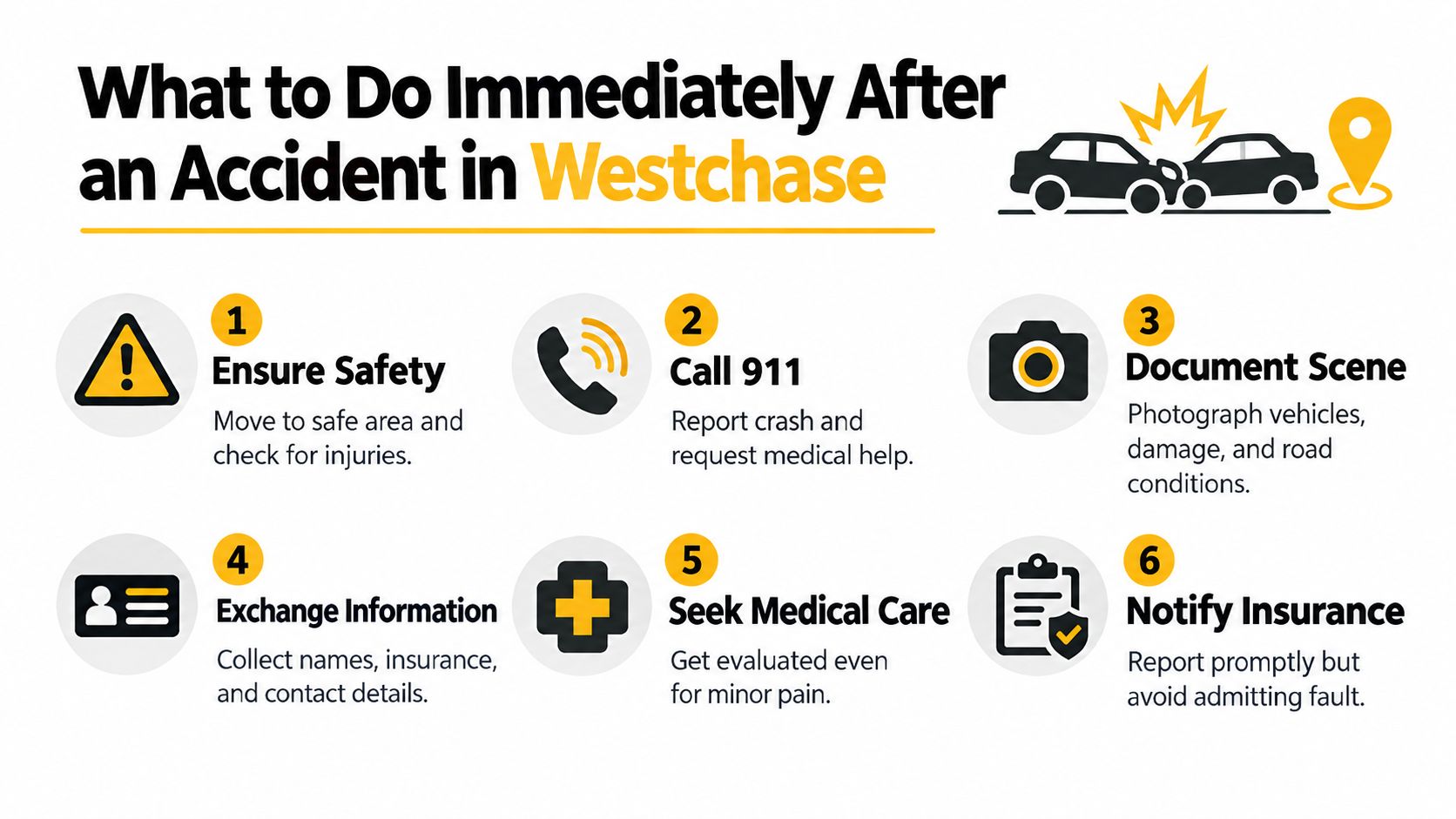
Follow these steps at the scene
Call 911. Request police and medical assistance. A police report creates an official record and may identify witnesses, road conditions, vehicle damage, and statements made at the scene.
Get medical care. Adrenaline can hide symptoms. A medical evaluation creates a record of your condition and helps doctors identify injuries that may develop after the crash.
Photograph the scene. Take pictures of vehicle positions, damage, traffic signs, lane markings, debris, lighting, weather, and visible injuries. If your phone has location or time information, preserve the original files.
Exchange information carefully. Collect names, phone numbers, driver's license details, vehicle information, and insurance details. Don't admit fault or speculate about speed, distance, or what you “should have done.”
Find witnesses. Ask people who saw the impact for their names and contact information. A witness may leave before an officer can speak with them.
Preserve evidence. Keep damaged clothing, repair estimates, photographs, medical records, prescriptions, and bills. Don't repair or discard damaged parts before documenting them.
Notify insurance without weakening your claim
Report the collision to your insurer promptly, but keep your first notice factual. Give the date, location, vehicles involved, and basic description of the event. You don't have to guess about fault or describe your future medical condition.
Texas requires insurers to offer uninsured and underinsured motorist coverage. The Texas Department of Insurance explains that this coverage may apply when the at-fault driver has no insurance, lacks enough coverage, or leaves the scene, and may help with vehicle repairs, rental transportation, medical bills, pain and suffering, and diminished value under Texas UM/UIM guidance.
The same Texas-focused insurance guidance reports that insurers must acknowledge a claim within 15 business days after notice and accept or deny it within 15 days after receiving documentation. Those timelines don't mean your claim will be resolved that quickly.
Don't sign a release or give a recorded statement before you understand what you're giving up, especially when the other driver is uninsured or the crash was a hit-and-run.
Types of Accident Cases a Westchase Houston Lawyer Handles
Westchase claims can involve much more than a simple two-car collision. The crash type often determines what evidence matters, which parties may be responsible, and how the injuries should be evaluated.
A rear-end crash may look minor because the vehicles have little visible damage. Yet the neck can move through a rapid retraction, extension, and rebound sequence within the first 100 to 150 milliseconds, according to the medical review linked in this discussion of common car crash types. The same medical literature explains that vehicle damage is a poor predictor of occupant injury, so prompt medical documentation can matter greatly in a low-speed claim.

Common collision patterns
Rear-end crashes: Evidence may include following distance, brake lights, traffic flow, vehicle damage, and medical records for neck, back, and shoulder injuries.
T-bone and intersection crashes: Signal timing, right-of-way rules, lane positions, and nearby business or traffic-camera footage may help determine who entered the intersection improperly.
Head-on and rollover crashes: These often create severe forces and may require reconstruction evidence, photographs, vehicle inspections, and detailed medical support.
Multi-vehicle collisions: Several drivers may share responsibility. Investigators must separate the first impact from later impacts and identify how each vehicle contributed.
Truck and commercial-vehicle crashes: Driver logs, company policies, maintenance records, vehicle data, and employer responsibility may become important. Commercial collisions on Beltway 8 and Houston freeways may require a lawyer familiar with 18-wheeler crashes in Houston.
Special coverage and vulnerable-road-user claims
Rideshare and delivery crashes can involve the driver's personal policy, a company policy, or platform-based coverage. The driver's status at the time of the collision matters, so preserve app records, trip information, vehicle markings, and messages.
Distracted-driving and intoxicated-driving claims may require phone records, witness accounts, video, officer observations, or criminal-case information. Pedestrian, bicycle, and motorcycle claims often turn on visibility, right of way, speed, roadway design, and whether the driver noticed the vulnerable road user.
A hit-and-run presents a different problem. You may need to pursue your own UM/UIM coverage, and Texas insurance materials warn that a police report is usually required to trigger coverage. Wrongful-death cases also need prompt attention because a family may have to preserve evidence while handling funeral arrangements, financial strain, and grief.
What Compensation Is Available and How Texas Law Limits Damages
Economic damages compensate for measurable financial losses. They may include emergency treatment, hospital care, medication, follow-up visits, rehabilitation, vehicle-related losses, and wages you couldn't earn because of the injury.
Non-economic damages address losses that don't come with a simple price tag. They can include physical pain, emotional distress, reduced quality of life, and loss of companionship. In a fatal crash, surviving family members may pursue wrongful death compensation for losses recognized by Texas law.
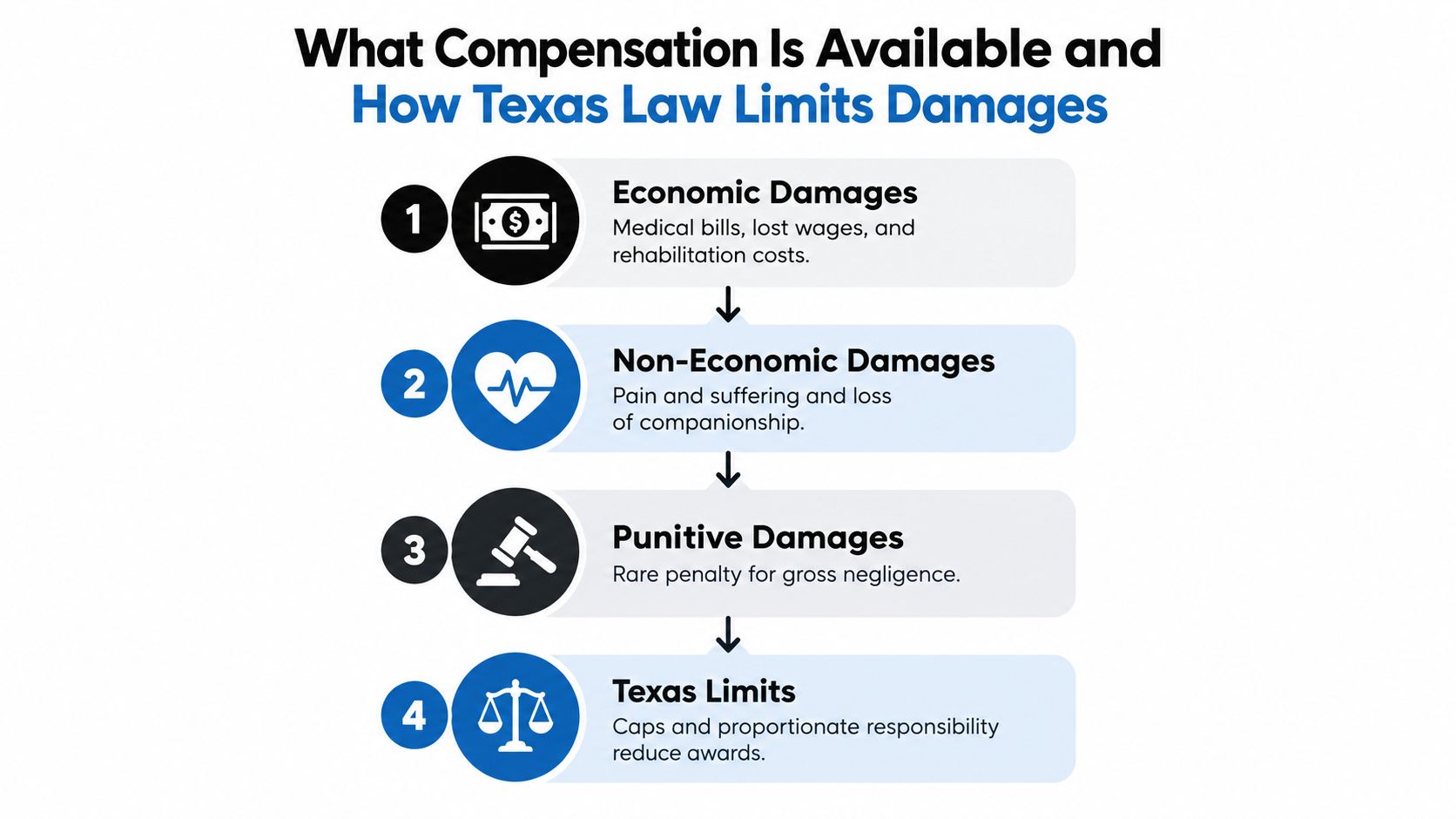
How the categories fit together
A serious Westchase crash may create immediate medical expenses and long-term rehabilitation needs. It may also affect your ability to work, care for your family, sleep, exercise, or enjoy ordinary activities. Strong documentation connects each loss to the collision instead of leaving the insurer to minimize it.
Your damages can still be reduced by your assigned share of fault under Chapter 33. For example, if proven damages total a certain amount and a court finds you partly responsible, the court applies that responsibility percentage to the award.
When exemplary damages may apply
Chapter 41 governs exemplary damages, sometimes called punitive damages. These damages aren't meant to reimburse ordinary medical bills. They're designed to punish especially wrongful conduct and deter similar behavior.
Texas law generally caps exemplary damages at the greater of $200,000, or two times economic damages plus an amount equal to non-economic damages, up to $750,000, as provided by Texas Civil Practice and Remedies Code Chapter 41. Whether exemplary damages are available depends on the evidence and the legal requirements of the case.
UM and UIM coverage can provide another path
When the at-fault driver has no assets or carries insufficient insurance, your own UM/UIM policy may become important. Texas regulators explain that coverage may include vehicle repairs, a rental car, medical bills, pain and suffering, and diminished value. Your insurer may still evaluate liability, injuries, and policy conditions, so your own insurance company isn't automatically your advocate.
How Long Your Claim Takes and Why Acting Quickly Protects Your Rights
After a Westchase crash, your claim may take weeks, months, or longer. The timeline depends on the evidence, your medical treatment, the insurance coverage, and whether the parties agree about fault. A lawyer may investigate the collision, collect records, submit the claim, negotiate with insurers, and file suit if a fair resolution is unavailable.
The statute of limitations is the deadline for filing a lawsuit. Most Texas personal injury and wrongful-death claims from a crash must be filed within two years under Section 16.003 of the Texas Civil Practice and Remedies Code. Missing that deadline can end your claim, even when the evidence points to the other driver.
Handling the claim yourself or with counsel
| Handling the claim alone | Working with a contingency-fee lawyer |
|---|---|
| You speak directly with adjusters and medical providers. | Counsel can manage communications and organize records. |
| You identify responsible parties and all applicable policies. | Counsel can investigate drivers, employers, carriers, and UM/UIM coverage. |
| You decide whether an offer covers future losses. | Counsel can compare the offer with your documented damages. |
| You track deadlines and court requirements. | Counsel can monitor deadlines and prepare for litigation. |
Early action protects evidence. Security footage may be erased, witnesses may become harder to find, and a damaged vehicle may be repaired before inspection. Westchase traffic around Westpark Tollway, Sam Houston Tollway, and busy intersections can also make prompt witness and camera searches important when fault is disputed.
A hit-and-run creates a separate coverage problem. If the driver flees or has no insurance, your UM/UIM coverage may become the path to compensation through your own policy. Report the crash promptly, preserve photographs, vehicle fragments, witness information, and nearby-camera details, and notify your insurer carefully. Your own carrier still evaluates coverage, fault, and damages, so early documentation helps protect the claim rather than leaving the record to the insurer alone.
Why Choose The Law Office of Bryan Fagan for Your Westchase Claim
After a Westchase crash, you need advice that connects the legal rules to your actual life. The Law Office of Bryan Fagan, PLLC handles Texas personal injury matters involving car, truck, rideshare, uninsured-driver, underinsured-driver, and wrongful-death claims.
The firm offers a free consultation and contingency-fee representation, so you don't pay unless the firm wins your case. That arrangement allows you to discuss your options without paying an hourly legal bill at the beginning of the case.
Support built around your recovery
A claim may involve fault disputes, medical documentation, lost wages, vehicle damage, future treatment, or coverage through your own insurer. Legal counsel can gather evidence, communicate with insurance companies, negotiate where appropriate, and prepare for trial when negotiation doesn't protect your rights.
You should also receive clear communication about your claim. You deserve to understand what the insurer is offering, what evidence is missing, what deadlines apply, and what decisions require your approval.
If you're grieving a loved one after a fatal Houston crash, the legal process can feel especially difficult. A wrongful death claim may help address financial and personal losses, while your family takes the time it needs to cope.
You don't have to decide everything today. You can start with a conversation about what happened and what options may be available.
The sooner you seek guidance, the sooner someone can protect evidence, review insurance coverage, and evaluate the two-year filing deadline. That's especially important when the driver fled, had no insurance, carried limited coverage, or blamed you for the crash.
The Law Office of Bryan Fagan, PLLC offers free consultations and contingency-fee representation for Westchase car accident, truck accident, uninsured-driver, underinsured-driver, and wrongful death claims. Contact the firm today to discuss your crash, protect your rights, and focus on your recovery by visiting The Law Office of Bryan Fagan, PLLC.