Skip to content
A car crash can change your life in seconds, but you don't have to face recovery alone.
If you're reading this, you may be in a very familiar Houston situation. Your car is badly damaged or totaled. The other driver caused the wreck. Their adjuster keeps asking for “one more document,” then goes quiet. Meanwhile, you still need transportation, you're paying out of pocket, and nobody seems eager to make this simple.
When the fight is about vehicle damage after a crash, a Harris County JP court property damage claim after a crash is often the most practical place to start. But only if you file in the right court, sue the right person, prove your losses clearly, and understand what happens after you win. That last part matters because a judgment on paper doesn't always mean money in hand.
Texas law also gives you other rights that may matter beyond car repairs. If the wreck caused bodily injury, your case may involve liability, comparative fault, damages, and a statute of limitations under the Texas Civil Practice & Remedies Code. In serious cases, or in a fatal crash, a Houston car accident lawyer or Texas injury attorney may need to evaluate injury damages and possible wrongful death compensation along with the property claim.
Why Harris County Justice Court Is Often the Right Starting Point
A common example looks like this. A Houston driver gets rear-ended on I-45. The car is undrivable. The body shop says repairs may not make financial sense. The insurer for the other driver drags its feet, and the owner needs a direct path to force movement.
That's where Justice Court usually comes in. Harris County Justice of the Peace courts handle many lower-dollar civil disputes, and Harris County's own materials confirm that justice courts can hear civil suits involving up to $20,000, exclusive of interest and court costs, including property-damage disputes. The same Harris County guidance also says a suit for damage to property must generally be brought within two years. You can verify both points in the Harris County Justice Court FAQ.
Why JP court fits crash-only property disputes
If your losses are limited to the vehicle and related out-of-pocket costs, JP court is often a better fit than jumping straight into higher civil court. It's more efficient. The paperwork is simpler. The hearing format is more direct. And for many everyday crash disputes, that's exactly what you need.
A lot of people miss one key point. In this kind of case, you usually sue the at-fault driver, not the insurance company.
Practical rule: If the insurer won't pay fairly, your lawsuit is typically against the person who caused the crash. Their insurer may step in to defend or settle, but that doesn't make the insurer the named defendant in your JP petition.
Basic legal terms you need to understand
Here's the plain-English version:
- Liability means legal responsibility for the crash.
- Comparative fault means the court can divide blame between drivers.
- Damages means the money you're asking the court to award for your losses.
- Statute of limitations means the filing deadline. Miss it, and your claim can die even if the other driver was clearly at fault.
JP court also has limits. It awards money. It doesn't issue orders forcing someone to act in the way people often imagine. That matters if you think the court can make an insurance company “handle it correctly.” What the court can do is enter a money judgment if you prove your case.
Choosing the Right Precinct and Knowing Who to Sue
Filing in the wrong place wastes time. Sometimes it kills momentum entirely.
Harris County has multiple JP courts, and your choice of precinct isn't random. For a vehicle-damage claim, the practical venue question is usually tied to where the defendant lives or where the crash happened. Start with the defendant's last known address from the crash report, then confirm the right precinct through county court tools and precinct information.
How to choose the right JP precinct
Use a methodical approach:
- Pull the crash report and confirm the other driver's address. Don't rely on memory or text messages.
- Check where the wreck happened. If the residence address is uncertain, the crash location may help guide venue.
- Use Harris County precinct resources. Make sure you're filing in the court that matches the facts you can prove.
- Call the clerk if you're unsure. Clerks can't give legal advice, but they can often tell you whether you're in the right office.
If your claim also includes bodily injury, the process may move differently through the civil system. Filing an Injury Claim in Harris County Courts gives a factual overview of how personal injury cases proceed in Harris County civil courts.
Suing the driver is not the same as making a claim against Harris County
This is the fork in the road that many guides gloss over.
If a private driver hit you, your JP case is generally against that driver. If your damage was caused by a county vehicle or you believe Harris County itself is legally responsible, you don't just file a standard JP case and hope for the best. Harris County's own materials say claims against the county for auto accident or property damage must be submitted to the county's Risk Management Division. You can confirm that procedure through the Harris County Commissioners Court claims information page.
A claim against a person and a claim against the county are not interchangeable. Treating them like they are is one of the fastest ways to lose time and leverage.
When to get help early
If the defendant moved, the crash involved a government vehicle, the police report is unclear, or you're also dealing with injury treatment, stop trying to force a simple-property-damage template onto a more complicated problem. That's when a Houston car accident lawyer can save you from filing a clean-looking case in the wrong forum.
Building the Evidence Package Before You File
The people who do best in JP court usually aren't the loudest. They're the most organized.
Before you file anything, build one clean evidence packet. The petition, demand letter, and exhibits should tell the same story in the same order. If your timeline is sloppy, your claim looks inflated even when it isn't.
What to gather before you go to the clerk
Start with the core proof:
- Crash report details: the report number, investigating agency, and any exchange information
- Vehicle photos: wide shots, close damage shots, and photos taken before repairs or disposal
- Repair records: written estimates, supplements, invoices, or a total-loss valuation
- Insurance information: the other driver's carrier and claim number if you have it
- Witness information: names, contact details, and any statements you obtained
Harris County JP court materials note that the court expects a short, plain statement of the claim and that records matter in these cases, including repair estimates, invoices, and witness information. That's reflected in the Harris County Justice Court guidance for civil filings.
Turn a pile of papers into a damages number
Your damages number shouldn't be a guess. It should be the total of losses you can explain and support.
That may include:
- repair costs,
- fair value if the car is a total loss,
- towing,
- storage,
- rental expenses,
- diminished value when appropriate,
- other out-of-pocket costs tied to the crash.
If your insurer or the other side says the vehicle is totaled, it helps to understand how total-loss handling usually works before you argue value. Car owners often find Cararam's guide to total loss useful for understanding what typically happens after a car is declared totaled.
Get records in writing and line them up chronologically
Don't walk into court with screenshots and a verbal story. Ask the body shop for a written estimate. Ask for supplements in writing. Keep receipts for towing, storage, and rentals. If there's a value dispute, gather comparable sales information and your title or payoff records.
If you still need the official crash report, this step-by-step guide on how to obtain police records after a crash can help you collect the right documents.
Bring order to the claim before you bring it to court. Judges notice when your documents track the timeline cleanly from crash, to inspection, to estimate, to demand.
For injury cases, this same discipline matters even more. An auto insurance claim tied to medical care, lost work, or wrongful death compensation becomes far harder to prove when the records are scattered.
Filing the Petition, Paying the Fee, and Serving the Other Side
At some point, you stop gathering and start filing.
Your petition needs to do three things clearly. Name the correct defendant. State where and when the crash happened. State what you want in dollars, within the JP court limit for this forum.
What goes into the petition
Keep it simple and specific. Include:
- your name and address,
- the defendant's name and service address,
- the date and location of the crash,
- a short statement explaining how the defendant caused it,
- a plain statement of your property losses,
- the exact amount you seek.
Don't turn the petition into a rant about the adjuster. The insurance company's behavior may explain why you're suing, but the legal claim is still about the driver's negligence and the damage that followed.
If you want your filings and exhibits to look clean and readable, especially if you have photos, estimates, and affidavits, many people use outside document help such as Camelot Print & Copy Centers legal printing before heading to court.
What to expect at filing and service
Harris County has multiple JP courts, including Precinct 1 Place 1 through Precinct 5 Place 2, with additional county arrangements for certain public-entity matters. Bring your petition and supporting information, and be ready to follow the clerk's filing process.
For a broader look at how these local vehicle-damage cases move through the system, this page on a Harris County court accident claim gives useful local context.
Service matters just as much as filing. You do not serve the defendant yourself. Service is usually handled through authorized methods such as constable service, certified mail through the court, or a private process server, depending on the court's rules and what the clerk allows.
Smart filing habits
Use this checklist before you leave the clerk's office:
- Double-check the defendant name: Match the crash report, not the insurer's shorthand.
- Ask about service options: Don't assume your preferred method is available in that precinct.
- Calendar every date: Track service status, answer deadlines, and hearing settings.
- Keep stamped copies: You'll want a file-marked copy for your records and negotiations.
If your crash also caused physical injury, a Texas injury attorney often earns their fee. Property claims are manageable. Mixed injury and property cases get messy fast.
How Comparative Fault and Damages Caps Shape Your Recovery
Texas negligence law matters even in a modest property-damage case. If the other driver says you contributed to the wreck, the court may reduce what you recover.
Under Chapter 33, Texas follows a modified comparative responsibility rule. If your responsibility is greater than 50 percent, you recover nothing. If you are 50 percent or less responsible, your recovery is reduced by your share of fault. That rule appears in Texas Civil Practice and Remedies Code Chapter 33.
Here's a quick visual of how that works in justice court.
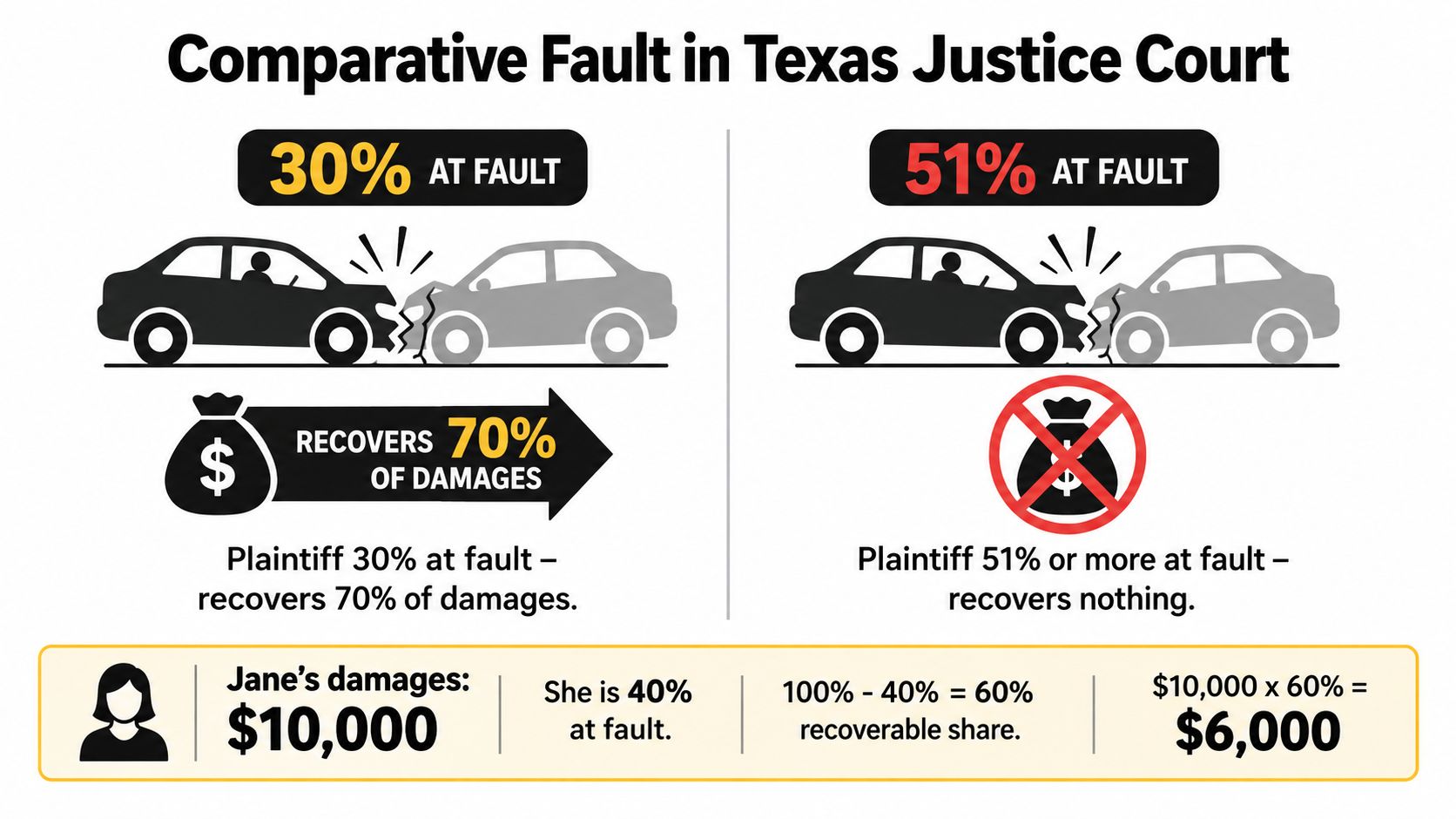
A simple crash example
Take a Houston rear-end collision where Driver A says Driver B ran a red light, but Driver B argues Driver A changed lanes without signaling. If the judge decides you share part of the blame, your award drops by that percentage.
That's why facts matter more than outrage. Photos, witness statements, scene layout, and consistent testimony all shape fault allocation.
To understand one piece of the insurance side, this overview of property damage liability coverage in Texas helps explain what coverage is supposed to pay when another driver damages your vehicle.
Damages, exemplary damages, and court limits
In plain English, damages are the money meant to compensate you for loss. In a JP property case, that usually means the financial impact of the vehicle damage itself.
For more serious personal injury cases, Chapter 41 of the Texas Civil Practice and Remedies Code can matter because it limits exemplary damages in most personal-injury cases to the greater of two times economic damages plus up to $750,000 in noneconomic damages, or $200,000, as set out in Texas Civil Practice and Remedies Code Chapter 41. That usually isn't the center of a JP property-only case, but it becomes important when a wreck involves especially blameworthy conduct and bodily injury claims outside the small-claim setting.
The hearing discussion below helps you see how these legal rules play out in real court.
Settlement Talks and the Day of Your Hearing
Once the defendant is served, the case starts feeling real. That alone often moves settlement talks forward.
Some defendants ignore the suit. Some hand everything to their insurer. Some call you directly and suddenly want to “work it out.” Don't treat every phone call as progress. Treat it as negotiation.
How settlement usually develops
Most JP property cases settle because hearing day creates pressure. The other side knows they now have to defend the claim in public, with a judge looking at the documents instead of an adjuster hiding behind delay.
A practical approach works best:
- send a clear written demand,
- attach the same damages breakdown you'll use in court,
- keep communication professional,
- don't negotiate against yourself.
Settle if the number is fair and paid promptly. Don't settle just because you're tired of waiting.
If the defendant never answers or never appears, default may become an option. But don't walk in expecting an automatic win. Judges still want proof that your damages are real and tied to the wreck.
What to bring and how to present it
Bring three organized sets if you can: one for you, one for the court, and one for the other side. Keep each exhibit labeled in the same order as your story.
A clean hearing presentation usually follows this sequence:
- Liability evidence such as photos, witness information, and the crash description.
- Damage proof such as estimates, invoices, and total-loss records.
- Out-of-pocket expenses such as towing, storage, or rental receipts.
- A short closing ask stating the amount you want and why.
You may need to prove up records through testimony or business-records paperwork, depending on the document and the court's expectations. Don't assume every estimate speaks for itself.
Courtroom reality in JP court
JP hearings are usually concise. The judge wants the facts, not a speech.
Check in with the clerk early. Have your exhibits ready. When it's your turn, stay calm and chronological. If the defendant says you were partly at fault, answer with facts, not sarcasm.
If either side isn't satisfied with the result, the case can move up for a fresh trial in county court. In practice, that means the fight may restart rather than being reviewed for legal error.
After the Judgment Collection Appeals and Next Steps
Winning at the hearing is important. Collecting is the part many underestimate.
A judgment gives you legal standing. It does not guarantee the other driver writes a check that afternoon. That's why any honest guide to a Harris County JP court property damage claim after a crash has to talk about collection.
Appeal risk comes first
After judgment, there may be a short window where the other side can appeal and seek a new trial in county court. If that happens, the JP result may not be the end of the dispute. It may be the beginning of the next round.
Many self-represented plaintiffs get blindsided. They think they already won, so they stop preparing. Don't do that. Preserve your file, your exhibits, and your witness contact information until the matter is over.
Collection tools people skip
If the judgment becomes final and unpaid, collection tools may include:
- an abstract of judgment recorded in the property records,
- a writ of execution aimed at non-exempt personal property,
- post-judgment discovery to find assets or income sources.
Some of those tools are technical. Some cost money. Some produce very little if the defendant has no reachable assets. That's the hard truth.
A judgment is leverage, not cash. Before you spend more money chasing collection, ask whether the defendant actually owns anything you can lawfully reach.
Know the limits before you chase assets
Texas protects certain property from collection. That means not everything a debtor owns can be taken to satisfy a judgment. Those exemption rules matter because they shape whether enforcement is practical or mostly symbolic.
If you're trying to collect from someone with no non-exempt assets, no real property, and inconsistent employment, you may end up spending more time and money than the judgment is worth. In that situation, strategy matters more than anger.
When calling a lawyer makes sense
You should strongly consider legal help if:
- the other side files an appeal after the JP judgment,
- the defendant used a fake or outdated address,
- the crash involved both injury and property claims,
- the defendant appears uninsured,
- a county or public vehicle may be involved,
- collection requires post-judgment enforcement steps.
For some readers, this is still a manageable do-it-yourself case. For others, especially where there's an injury claim, insurance coverage dispute, or possible wrongful death compensation issue, handling only the vehicle damage in JP court can leave money and rights on the table. A law firm like The Law Office of Bryan Fagan, PLLC can evaluate whether your matter belongs in JP court, county court, or a broader injury case strategy.
Texas negligence law also sits in the background of all of this. The practical deadline to act is generally tied to the two-year limitations period that applies to many negligence-based auto claims, as discussed in the Texas Tech Law Review article on limitations and related negligence issues. Waiting usually helps the insurer, not you.
If you're also fighting over an auto insurance claim, dealing with an uninsured driver, or trying to sort out injuries along with the car damage, get advice before you lock yourself into the wrong path.
If your vehicle was damaged in a wreck and the insurer keeps stalling, The Law Office of Bryan Fagan, PLLC can help you sort out whether JP court is the right move, identify the proper defendant, and step in if the case turns into an appeal or collection fight. To learn more about your options after a crash and get a free consultation, visit The Law Office of Bryan Fagan, PLLC.