A car crash can change your life in seconds, but you don't have to face recovery alone. If you were rear-ended near the Memorial City shopping district, hurt in a confusing intersection crash, or lost someone you love on Memorial Drive, you may be dealing with pain, missed work, medical bills, and an insurance adjuster who wants answers before you understand what happened.
Texas law gives you tools to pursue compensation, but your claim depends on evidence, insurance coverage, injury documentation, and deadlines. A Memorial City accident lawyer can help protect those details while you focus on treatment and your family.
When a Memorial City Crash Turns Your Life Upside Down
A driver stops in traffic near the Memorial City shopping district. The light changes, traffic hesitates, and another vehicle strikes the rear of the stopped car. The driver walks away from the scene, but soreness develops that evening. Within days, the driver misses work, schedules medical appointments, and receives calls from an insurance adjuster asking for a recorded statement.
That person has rights. They can seek medical care, pursue fair compensation for covered losses, and speak with a lawyer before signing a release or making statements that could later be used against them. A quick conversation with an adjuster doesn't require you to explain every symptom or decide the value of your claim.
Memorial City crashes can create special evidence problems. Traffic moves through Memorial Drive, I-10, Beltway 8, retail entrances, medical facilities, parking areas, and feeder roads. A nearby business may have surveillance footage. A transit vehicle or another driver may have video. That evidence can disappear if nobody asks for it quickly.
What to preserve immediately
Start by getting the police report and keeping every document connected to the collision. You should also:
- Follow medical advice: Tell providers about every symptom, including pain that appears after the crash.
- Save insurance communications: Keep letters, emails, claim numbers, and settlement offers.
- Record missed work: Preserve employer records and notes showing how the injury affects your job.
- Protect digital evidence: Save dashcam files and identify businesses or vehicles that may have captured the crash.
- Avoid broad releases: Don't sign away injury claims before you know the extent of your recovery.
Texas personal injury claims generally have a two-year statute of limitations, meaning the usual deadline to file an injury or wrongful-death lawsuit is two years under Texas law. A victim who waits beyond that deadline may lose the right to sue even when another driver clearly caused the wreck. See the Texas personal injury deadline information for the cited rule.
Practical rule: Report the crash to your own insurer as required by your policy, but get legal advice before giving the other driver's insurer a recorded statement.
Who Is Liable in a Texas Car Accident
Liability means legal responsibility for causing harm. In a Texas negligence claim, you generally must show that another person owed you a duty to drive with reasonable care, failed to meet that duty, caused the collision, and caused damages.
Damages are the losses you seek to recover. They can include medical expenses, lost income, physical pain, mental anguish, and other harm supported by evidence.
Comparative fault means more than one person can share responsibility. A driver who was speeding may bear part of the blame, while another driver may be responsible for following too closely or changing lanes unsafely. Texas Chapter 33 requires the court to reduce damages by the claimant's percentage of responsibility and by applicable settlement amounts. A defendant usually pays only that defendant's share unless a statutory exception applies. The governing provisions appear in Texas Civil Practice and Remedies Code Chapter 33 and Section 33.012.
Texas Car Accident Liability at a Glance
| Term | What It Means for You |
|---|---|
| Liability | The person or entity legally responsible for causing the crash and resulting harm |
| Damages | Financial and personal losses connected to the injury |
| Comparative fault | A percentage-based allocation of responsibility that can reduce recovery |
| Statute of limitations | The legal deadline for filing a lawsuit |
Under Chapter 33, you can't recover damages if your responsibility is greater than 50%. If your responsibility is 50% or less, your recovery is reduced by your assigned share. For example, if evidence shows that you contributed to a Memorial Drive collision, that issue may affect the amount available even if another driver also acted negligently.
The two-year filing period generally applies to personal injury and wrongful-death claims. However, insurance policies may impose separate notice and claim requirements, and claims involving a government entity can involve shorter notice rules. Don't assume the ordinary deadline is the only deadline that matters.
Common Accident Cases a Memorial City Lawyer Handles
A Memorial City accident lawyer often handles several crash patterns because the area combines commuter traffic, retail access points, medical facilities, freight movement, and high-speed routes.
Rear-end collisions occur when a driver strikes the vehicle ahead. A Houston driver stopped near Memorial Drive or approaching the I-10 and Beltway 8 interchange may be hit by someone following too closely, looking at a phone, or failing to respond to traffic. In a rear impact, the torso can move forward before the head, creating temporary S-shaped cervical spine deformation and abnormal loading during the first phase of the crash. That mechanism can produce whiplash even when visible vehicle damage is minor, as explained in this rear-end collision biomechanics discussion.
T-bone crashes often occur when one driver enters an intersection against a signal or fails to yield. A collision near Gessner and a Katy Freeway feeder road may leave the drivers with conflicting accounts, making traffic signals, vehicle positions, witnesses, and nearby video important.
Rideshare crashes can involve an Uber or Lyft driver picking up a passenger near a retail entrance or medical district. The available insurance may depend on what the driver was doing in the app and whether a passenger was present, so preserve screenshots, trip details, and communications.
Commercial truck wrecks can involve freight traffic moving through corridors connected to Houston's energy and business districts. A case may require reviewing driver records, company policies, vehicle maintenance, and electronic data. 18-Wheeler Crashes on Beltway 8 and Houston Freeways concerns representation for commercial-vehicle crashes on Houston's high-traffic corridors.
UM/UIM claims arise when the at-fault driver has no insurance, too little insurance, or disputed coverage. Texas generally requires physical contact for an unknown-driver claim involving uninsured motorist coverage. The Texas Insurance Code provision on uninsured motorist coverage is one starting point for evaluating that issue.
Pedestrian and bicycle crashes near shopping centers and transit stops require a careful review of crosswalks, turning movements, lighting, driver visibility, and roadway design. A generic police report may not answer those questions.
How the Texas Accident Claims Process Actually Works
Medical care comes first. Get evaluated promptly, follow the treatment plan, and tell each provider how the crash affected your body and daily activities. Insurance carriers often question gaps in treatment, so keep appointment records, prescriptions, bills, and notes about symptoms.
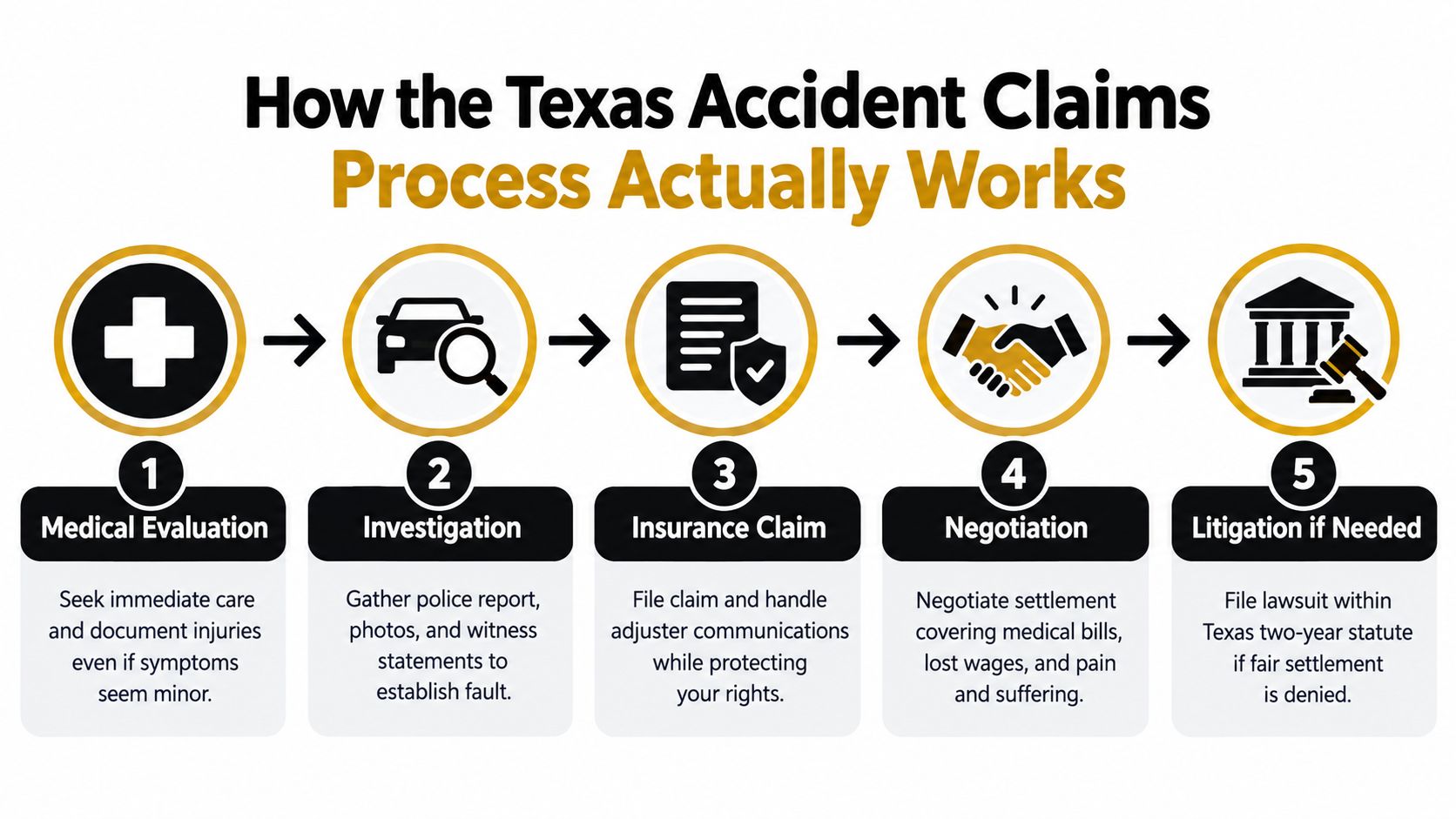
Evidence preservation follows. Photograph the vehicles, roadway, traffic controls, visible injuries, and surrounding businesses. Obtain the police report, collect witness information, preserve dashcam footage, and identify surveillance cameras near the Memorial City shopping and medical areas. Counsel can send preservation requests before footage is overwritten.
Notify your own insurer according to the policy. Be accurate and brief, and avoid admitting fault. You generally don't have to give the at-fault carrier a recorded statement before getting advice.
Building and resolving the claim
After your treatment becomes clearer, the claim can be supported with medical records, billing, wage-loss proof, photographs, witness information, and a liability narrative. A demand package should explain both what happened and how the collision changed your health, work, and daily life.
Adjusters may negotiate for weeks or longer. Mediation can help resolve a disputed case, but a fair result may require filing suit in Harris County. Litigation can take much longer than an insurance negotiation, sometimes extending over several years when injuries, defendants, or coverage issues are complicated. Readers who need a fuller procedural explanation can review the Harris County injury lawsuit process.
The process isn't about rushing to court. It's about preparing the evidence well enough that the insurer understands the claim cannot be dismissed with a generic denial or low offer.
What Compensation You May Be Able to Recover
Compensation depends on the injury, the evidence, available insurance, and each person's assigned responsibility. Don't measure a claim by vehicle damage alone. The biomechanics source discussed above explains why a relatively minor-looking rear impact can still cause meaningful neck symptoms, while the medical records must establish the actual diagnosis and treatment.
Economic losses
Economic damages are losses that can be documented with bills, records, or financial proof. They may include:
- Medical care: Emergency evaluation, imaging such as an MRI, orthopedic treatment, surgery, prescriptions, rehabilitation, and future care.
- Lost wages: Income missed while attending appointments or recovering.
- Reduced earning capacity: The effect of lasting restrictions on the work you can perform.
- Out-of-pocket costs: Transportation, medical equipment, and other reasonable injury-related expenses.
A demand should connect each expense to the crash. A long course of therapy, for example, needs treatment records and provider opinions that explain why it was necessary.
Personal losses and serious misconduct
Non-economic damages address harm that doesn't come with a simple receipt. Physical pain, mental anguish, disfigurement, loss of enjoyment of life, and loss of consortium may matter in an appropriate case. Insurers often try to discount these losses, which makes detailed personal records, witness observations, and medical documentation useful.
Chapter 41 addresses exemplary damages, which are separate from ordinary compensation and require the legal basis for punishment-level damages. In most cases, the cap is the greater of $200,000, or two times economic damages plus an amount equal to noneconomic damages up to $750,000, as stated in the Texas Civil Practice and Remedies Code Chapter 41.
Comparative responsibility can reduce the final recovery under Chapter 33. For a discussion of how settlement values are evaluated, see Houston car accident settlement amounts. The firm also handles Houston Slip and Fall / Premises Liability Lawyer matters involving injuries caused by unsafe property conditions in Houston.
How a Memorial City Accident Lawyer Works for You
A lawyer can take over claim communications, investigate the crash, organize medical proof, and address disputed liability or coverage. The point isn't to create conflict. The point is to keep an insurer from controlling the story before the evidence is complete.
The Law Office of Bryan Fagan, PLLC offers a free consultation and contingency-fee representation for qualifying personal injury matters. You don't pay upfront under that arrangement, and the fee is owed only if the case produces a recovery under the representation agreement. Ask for the fee terms in writing before hiring any firm.
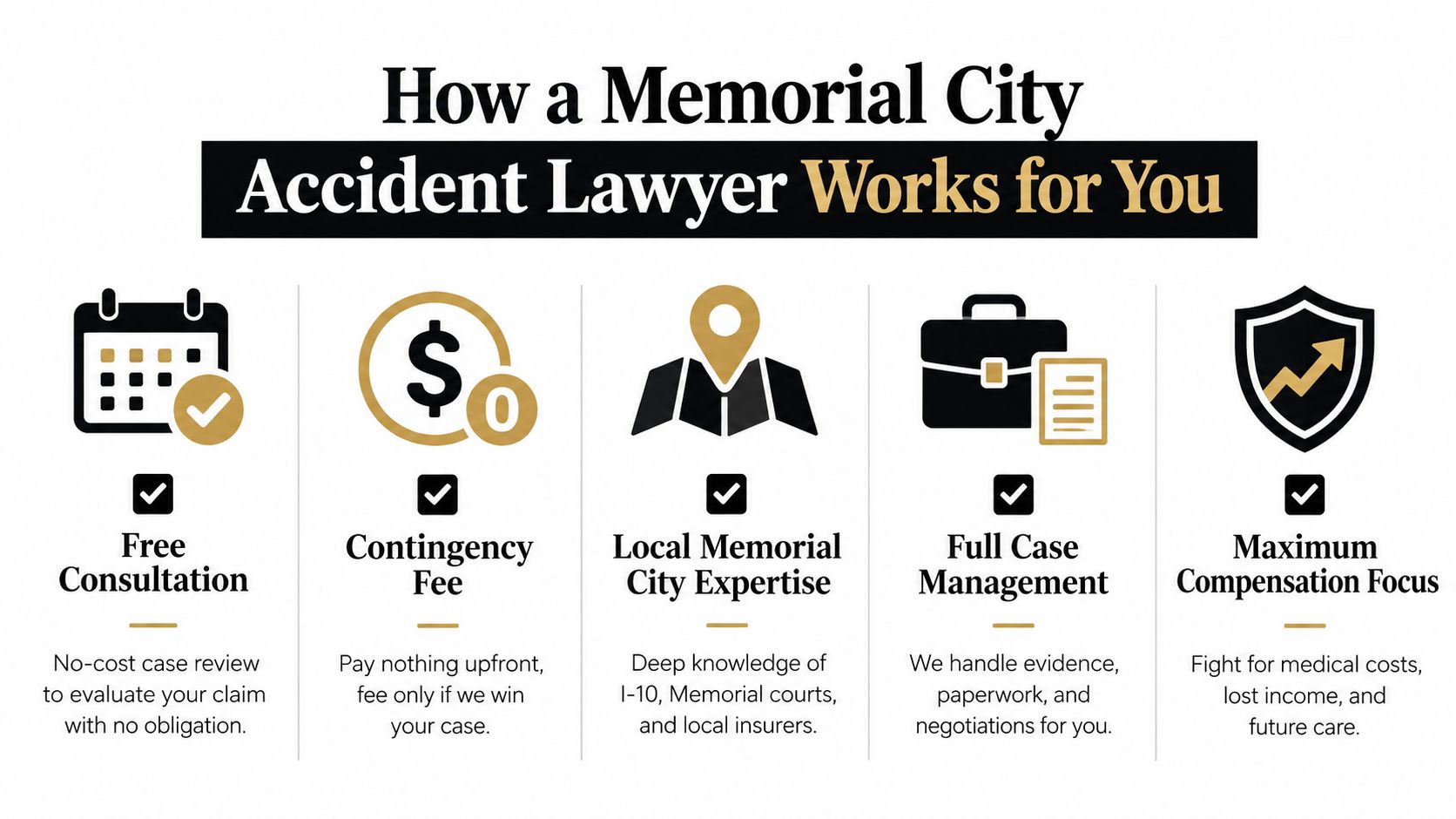
Local facts can shape the investigation. A lawyer familiar with Memorial Drive, I-10, Beltway 8, shopping access points, and medical-district traffic knows where to look for cameras, roadway evidence, and witnesses. The investigation may also require accident reconstruction, medical opinions, or employment records.
What representation should include
Look for a lawyer who will:
- Control insurer communications: Adjusters should receive accurate, legally appropriate responses.
- Preserve evidence early: Counsel should identify video, vehicle data, photographs, and witnesses before they disappear.
- Prepare for litigation: A case prepared for a Harris County jury is usually handled differently from a claim built only for quick settlement.
- Explain the numbers: You should understand medical liens, insurance limits, expenses, and settlement terms before deciding.
- Communicate clearly: You deserve updates that answer what changed, what comes next, and what decisions require your input.
No lawyer can promise a particular outcome. Strong preparation gives you a clearer basis for making decisions.
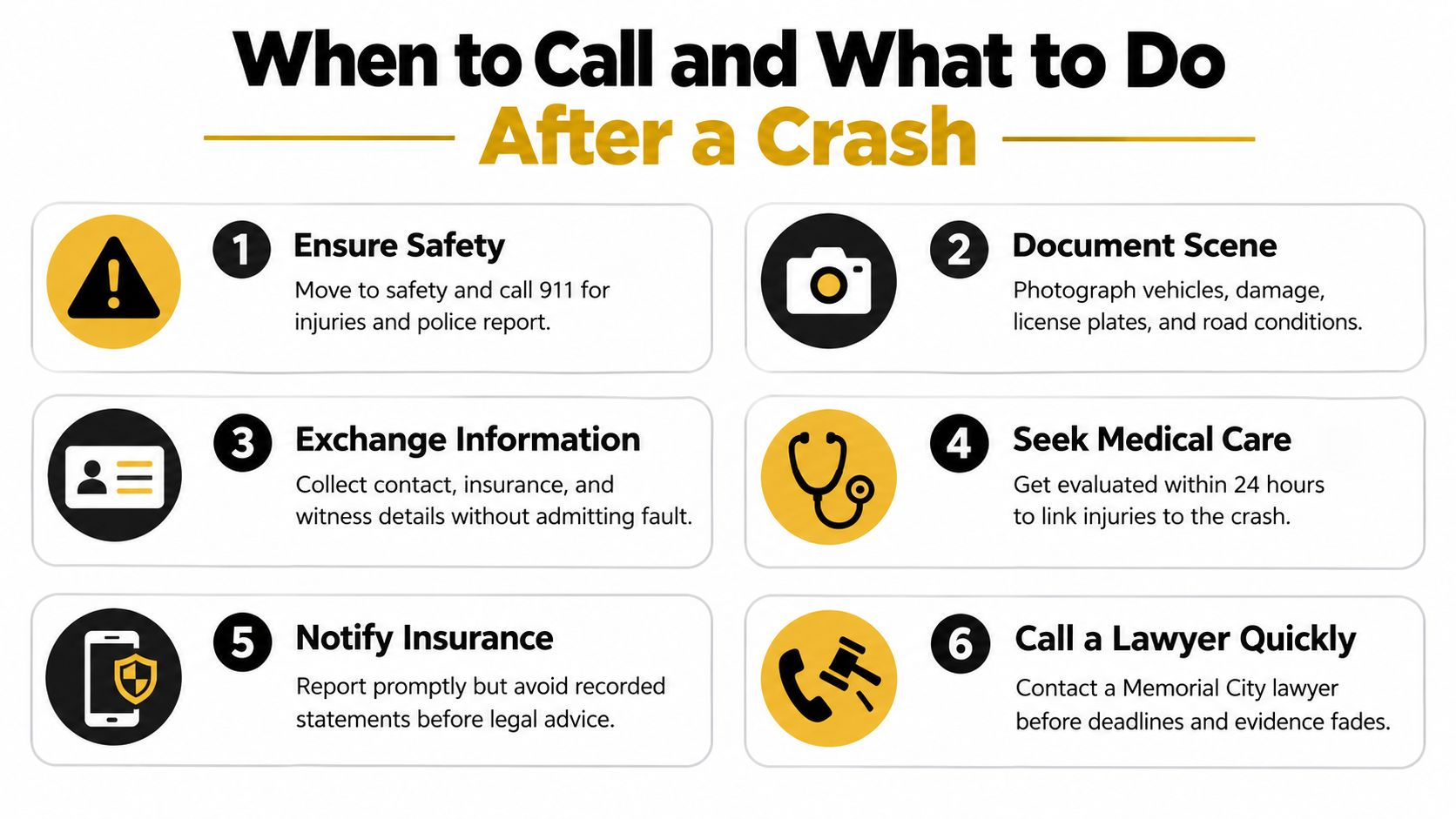
When to Call and What to Do After a Crash
Call a lawyer before giving a recorded statement to the other driver's insurer. You should also call promptly when the other driver disputes fault, your symptoms continue beyond a few days, several vehicles are involved, a commercial vehicle or rideshare is involved, or the insurer presents a quick settlement.
Bring the police report, scene and vehicle photographs, insurance letters, medical records, bills, prescription information, and a list of work you missed. Include the other driver's information, witness contacts, dashcam files, and any messages from an insurer. If you don't have everything, call anyway. Evidence can be gathered after the initial consultation.
Avoid common insurance mistakes
- Taking the first offer: Ask what future treatment, wage loss, and ongoing symptoms the offer covers before accepting it.
- Signing a broad release: A release may end claims you haven't fully evaluated.
- Guessing about fault: Give factual information and don't speculate about speed, distance, or medical causation.
- Posting online: Photos, comments, and check-ins can be taken out of context.
- Ignoring deadlines: Preserve evidence now and discuss the Texas filing deadline during the consultation.
For a practical checklist, read what to do after a car accident. The safest approach is simple: get care, document the facts, notify your carrier as required, and get advice before making statements that affect coverage or liability.
Your Next Step Toward Recovery and Justice
The legal questions after a Memorial City crash are concrete. Who caused the collision? What evidence proves it? What injuries and financial losses can be documented? Which policy applies if the other driver has little or no insurance? How might comparative responsibility affect recovery?
Texas Chapter 33 makes fault a percentage issue rather than an all-or-nothing argument. UM/UIM disputes can require separate attention to policy language, physical contact, liability, damages, and available limits. A wrongful-death claim may require a family to address both financial losses and the lasting personal harm caused by a fatal crash.
A first call should be practical, not intimidating. You can explain what happened, identify where the crash occurred, discuss your medical care, and share the police report if you have it. The firm can review potential insurance coverage, explain the next steps, and tell you what information still needs to be preserved.
A free consultation can help you understand your options before you sign a release or accept an offer. Representation doesn't erase the stress of recovery, but it can give you a clearer process and someone responsible for handling the legal work.
The next move is to contact the firm, provide the basic crash details, and ask specific questions about liability, damages, deadlines, and coverage.
The Law Office of Bryan Fagan, PLLC offers free consultations and contingency-fee representation for Memorial City car crashes, UM/UIM disputes, trucking collisions, and wrongful death compensation claims. Visit The Law Office of Bryan Fagan, PLLC to submit the online form or connect with a Texas injury attorney about your next step.