Skip to content
Yes, a DWI often does show up on a background check in Texas. How long it appears, and where it appears, depends on the type of background check being run and whether the DWI ended in a conviction.
A car crash can change your life in seconds, but you don't have to face recovery alone. If you're searching because you were charged with DWI, you may be worried about work, housing, and your future. If you're searching because a drunk driver hurt you or someone you love, you may be asking a different question: how do these records matter in a civil case?
Both questions matter in Texas. A DWI can create criminal consequences for the driver, and it can also become important evidence when an injured person pursues compensation. That's why it helps to understand what a background check shows, what records last, and how those records can affect both employment and a personal injury claim.
DWI Arrests and Convictions on Your Texas Record
People often use arrest and conviction as if they mean the same thing. They don't.
An arrest means law enforcement detained someone based on suspected drunk driving. A conviction means the court entered a final finding of guilt. That difference matters because background checks don't all pull the same records, and they don't all present the same information the same way.
A Texas DWI conviction is generally treated as a criminal conviction, not just a traffic ticket, so it can appear on a criminal background check rather than staying limited to a driving record, as explained by Texas DWI background check guidance.
Why the result of the case matters
A conviction usually creates the biggest long-term problem. It becomes part of the person's criminal record.
A dismissed case is different. It may still appear in some screenings, especially if the check is broad or if the record hasn't been cleared. Deferred adjudication sits in the middle. It isn't the same as a straight conviction, but it also isn't the same as having the case disappear.
Practical rule: If you want to know whether a DWI will show up, start by asking what happened to the case. Was it dismissed, deferred, or was there a conviction?
Many readers find this frustrating. They expect one yes-or-no answer. Texas law and reporting practices rarely work that way.
What employers and screeners may actually see
A standard employment screen might show a conviction. A more limited screen might only show certain criminal entries. A motor vehicle report might focus on driving history instead.
If you want a plain-language overview of the elements of a background screening, that resource helps explain why different reports can produce different results from the same underlying event.
Here's a simple way to understand it:
| Record type | What it usually reflects | DWI impact |
|---|---|---|
| Arrest record | Someone was accused or detained | May appear in some checks |
| Conviction record | Court entered guilt | Often appears on criminal checks |
| Driving record | License and driving-related history | May show DWI-related driving history |
| Dismissed case | Case did not end in conviction | May still appear unless cleared |
If your concern is about a case that hasn't been resolved yet, this guide on how long a DWI stays pending in Texas can help you understand the timeline problem from the criminal side.
For accident victims, this difference also matters. If the other driver was only arrested, your lawyer may need more evidence to prove intoxication in a civil case. If there was a conviction, that usually creates a much clearer record to work with.
Understanding Different Background Checks in Texas
There isn't one single thing called a background check. That phrase covers several different kinds of searches.
Some employers order a basic pre-employment report. Some industries use deeper screening. Government agencies and licensing boards may review records differently. A landlord may care about something else entirely. When people ask, “will a DWI show up on a background check Texas,” the honest answer depends on who is checking and what database or report they're using.
Here's a visual breakdown of the common categories:
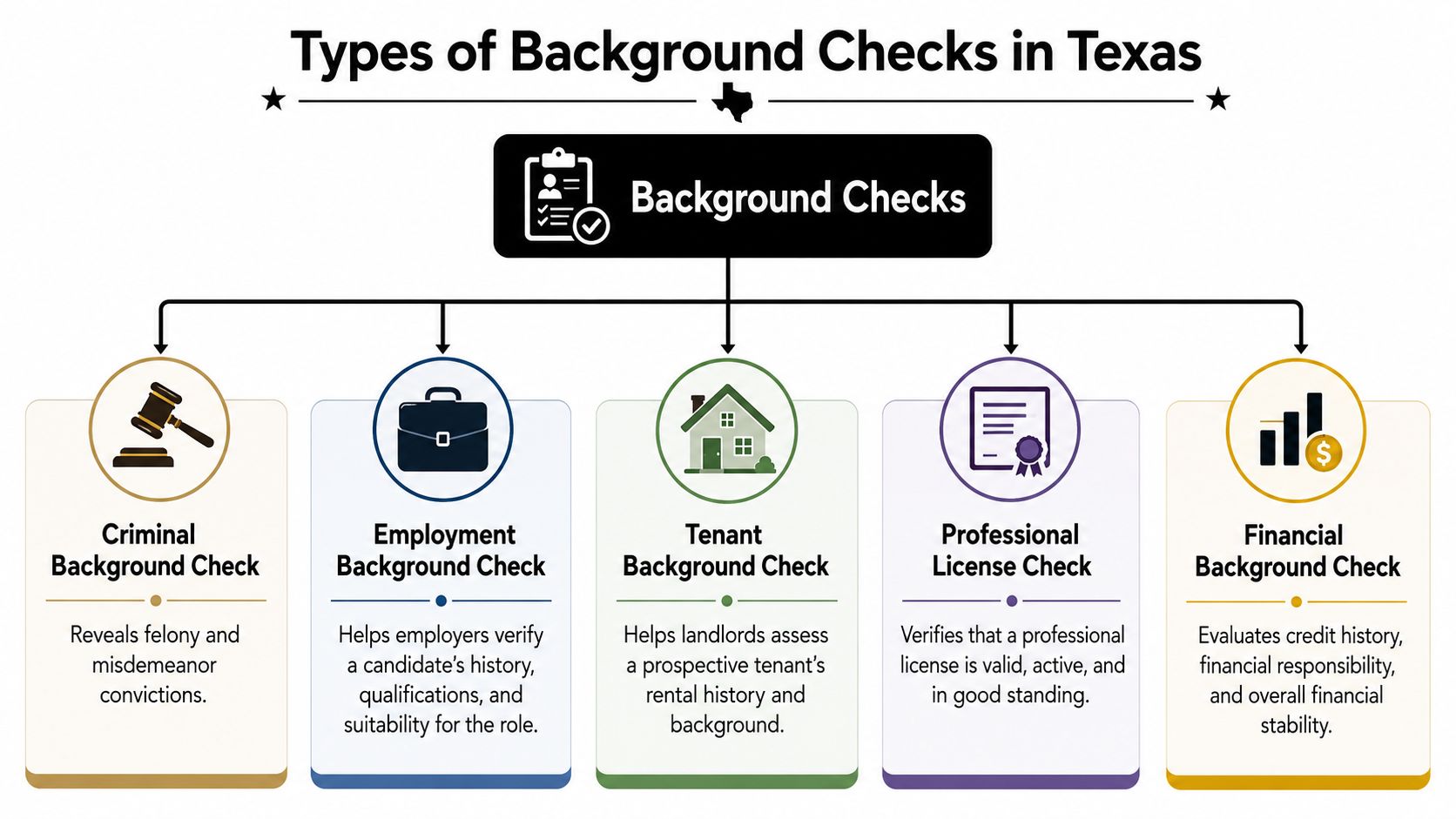
The most common report types
Criminal background check. This is the one most likely to reveal a DWI conviction because Texas generally treats DWI as a criminal matter rather than a simple traffic infraction.
Motor vehicle record check. This report focuses on driving history. Employers hiring for driving-heavy jobs often use it because they want to know whether the applicant has a risky driving record.
Professional licensing check. Boards that regulate licensed work may review criminal history, driving-related conduct, or both, depending on the profession.
Tenant screening. Landlords may use screening companies that pull criminal-history information, but the scope can vary.
Government or agency-level review. Some public positions and regulated roles involve deeper review than an ordinary private employer screening.
Why two background checks can show different results
A private employer may order a consumer report. Another employer may ask for a more direct criminal-history review. A driving company may care more about the applicant's motor vehicle record than a standard office employer would.
That's why one check may flag a DWI while another doesn't. It's not always because the record vanished. Often, it's because the report had a narrower purpose.
Different screeners ask different questions. The report only answers the question it was designed to answer.
Some people also confuse formal screening with private fact-gathering. For a general look at how discreet background investigations differ from ordinary screening reports, that comparison can help you understand why not every search works the same way.
A practical example
Take a Houston applicant applying for two jobs. One is an office position with no driving duties. The other involves transporting people or equipment. The first employer might run a standard criminal screening. The second might run both a criminal check and an MVR check.
The same DWI can matter in different ways in those two settings. On the office application, the issue may be the criminal record. On the driving job, the employer may focus on both the criminal record and the driving history.
For injured families, this also explains why records may need to be gathered from more than one place in a civil claim. A Texas injury attorney may look for court records, driving records, and employer safety history when evaluating fault and damages after a drunk driving crash.
How Long a DWI Can Affect Your Background Check
The timeline question is where people get tripped up most often.
Many Texans have heard about a 7-year rule and assume that means a DWI automatically disappears after that. That's not a safe assumption. In Texas, a DWI conviction is part of your criminal record, and criminal convictions may be reported indefinitely under federal Fair Credit Reporting Act rules, while some Texas consumer-reporting rules limit reports to the past 7 years for certain jobs, according to the Texas State Law Library guide on criminal conviction restrictions and background checks.
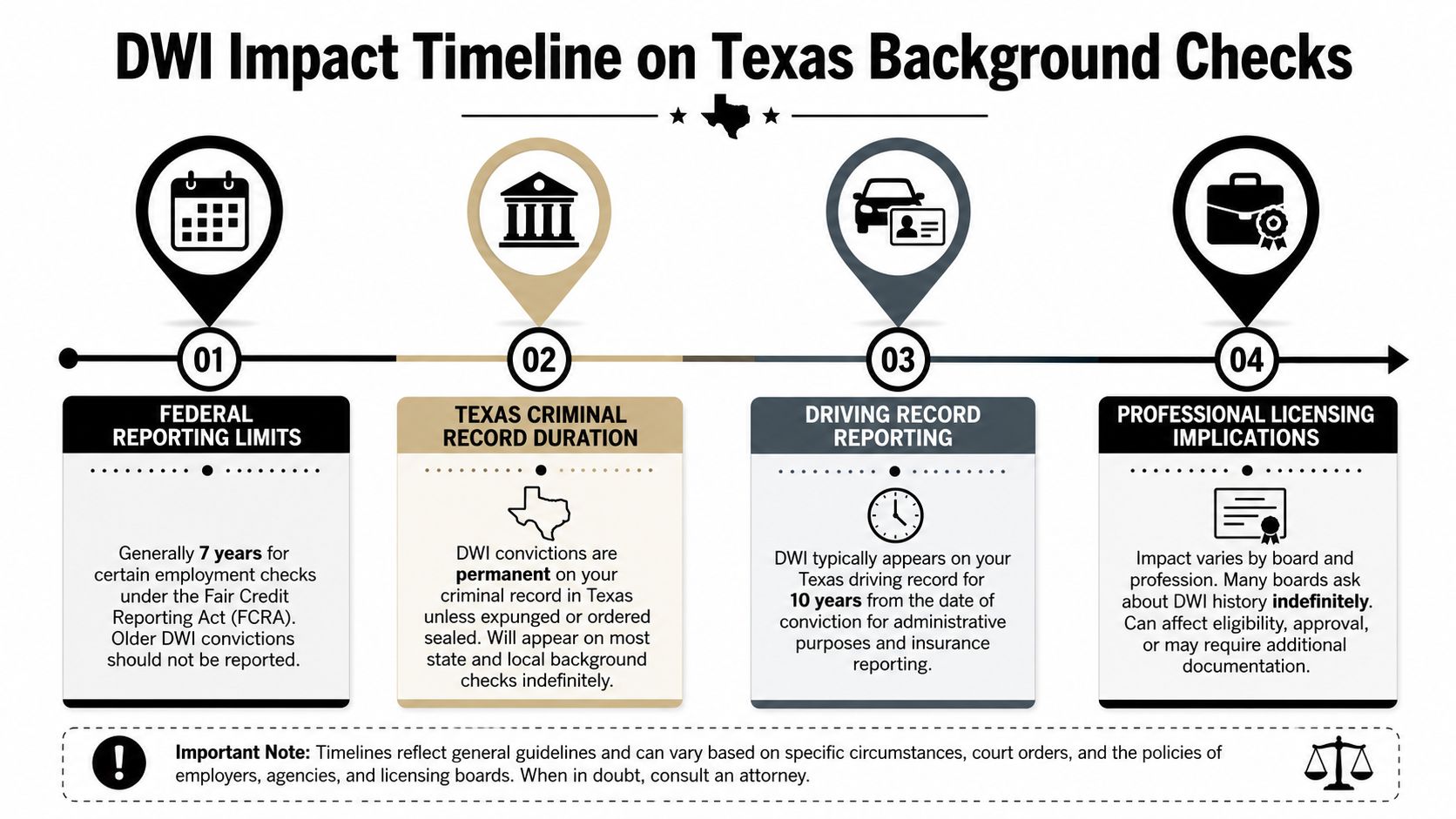
What the 7-year rule really means
The phrase usually refers to limits that can apply in some employment screening contexts. It does not mean every DWI becomes invisible after that point.
If the employer is using a report covered by those limits, older information may not appear in that report. But if the employer uses a different kind of criminal-history search, or the position falls outside that framework, the conviction may still surface.
That's why people with the same offense history can get different results from different employers.
The salary threshold people ask about
One Texas legal source says the state generally follows a 7-year rule for many employment screenings when the position pays less than $75,000 per year, with exceptions for some roles and industries, as described in this overview of what a background check can show in Texas.
Here's the plain-English takeaway:
- Some lower-salary positions: Certain consumer reports may be limited to the past 7 years
- Some regulated or exception-based roles: The reporting scope may be broader
- Criminal conviction records: Those may still be reportable indefinitely under federal rules
- Driving-related jobs: Employers may look at motor vehicle history separately from criminal history
Bottom line: Time alone doesn't automatically hide a Texas DWI conviction.
Why this matters beyond hiring
This isn't only about job applications. A long-visible DWI can affect licensing, housing, and reputation. It can also matter in civil litigation when an injured person is trying to prove a pattern of dangerous behavior.
For example, if a drunk driver caused a wreck and the victim later learns the driver had a criminal DWI conviction that remained accessible, that record may become part of the broader case investigation. It won't decide every issue by itself, but it can help explain why the driver's conduct deserves close scrutiny.
Options for Sealing or Clearing a DWI Record
After learning that a DWI can stay visible for a long time, the next question often arises immediately: Can it be removed?
Sometimes yes. Often no. The answer depends on how the case ended.
Expunction and non-disclosure are not the same
An expunction is the stronger remedy. It removes eligible records from public view in the situations Texas law allows.
An order of non-disclosure is different. It limits who can see the record, but it doesn't erase history the way people often imagine.
The hardest truth here is also the one people need most: Texas legal guidance says DWI convictions are generally not expungeable. That's one reason they can keep surfacing later.
When someone may have a better chance
A person may have options if the case was dismissed, if there was an acquittal, or if the final outcome falls into a category Texas law treats differently from a final conviction. Those situations are very fact-specific.
A final conviction is the tough scenario. That's where many online articles give false hope. The law usually doesn't.
If you're trying to understand whether a dismissal changes what employers can see, this article on how long it takes to get a DWI dismissed in Texas can help explain the practical timeline.
A simple way to sort your situation
Ask these questions in order:
- Was the case dismissed?
- Was there deferred adjudication or another alternative outcome?
- Was there a final conviction?
- Has any court already granted record-clearing relief?
Don't assume “old” means “gone.” In Texas, old and visible can be the same thing.
For victims of drunk driving crashes, this issue matters for another reason. If the at-fault driver has a conviction that can't easily be cleared, that record may remain useful when your lawyer investigates background facts tied to negligence and accountability.
How a DWI History Impacts a Car Accident Lawsuit
When a drunk driver causes a crash, the criminal side and the civil side may move on separate tracks. The state handles the criminal case. The injured person handles the civil claim.
That distinction matters. A criminal charge punishes wrongdoing. A personal injury claim seeks payment for the harm done to you.
Why the record matters to an injury case
A driver's DWI history can become highly relevant when you're trying to prove liability, which means legal responsibility for the crash. If the wreck happened because the driver was impaired, that fact may support a strong negligence claim.
In plain English, negligence means someone failed to act with reasonable care. Drunk driving is a serious example of unsafe conduct. In some cases, violating a safety law can strongly support the argument that the driver acted negligently.
Texas civil law also matters here. Under Texas Civil Practice and Remedies Code Chapter 33, comparative fault means blame can be divided between parties. If the defense argues you were partly at fault, your recovery may be reduced by your share of responsibility. Under Chapter 41, some cases also involve exemplary damages, sometimes called punitive damages, which are designed to punish especially reckless conduct rather than just compensate the victim.
What lawyers look for after a drunk driving crash
A Houston car accident lawyer may investigate more than the police report. The legal team may search for:
- Criminal case records that show whether there was a conviction or related court outcome
- Driving history evidence that may show prior alcohol-related issues
- Crash scene proof such as witness statements, body camera footage, and toxicology evidence
- Employer and vehicle-use records when the driver was working at the time of the wreck
For families facing a fatal crash, the evidence picture gets even more serious. Medical proof, cause-of-death analysis, and testimony can shape a wrongful death case. In that setting, the role of a wrongful death expert witness may help explain how expert review fits into a civil claim.
A real-world style example
A Houston driver rear-ended on I-45 by an impaired motorist may have a straightforward injury claim for medical bills, lost pay, and pain. If the evidence shows intoxication, the civil case may also focus on the driver's extreme recklessness.
That's one reason background and record questions matter so much. They aren't just private employment concerns. They can affect public safety and legal accountability when someone gets hurt.
For readers looking for practical information about Drunk Driving Accident Victims in Houston, that page addresses representation for victims injured by impaired drivers in Houston.
Steps to Take After Being Hit by a Drunk Driver
The first hours after a crash are chaotic. You may be hurt, angry, scared, and unsure what to do next. A clear plan helps protect both your health and your legal claim.
This part matters whether you expect to file an auto insurance claim, a lawsuit, or both.
Here's a simple visual checklist to keep in mind:

Start with safety and documentation
Call 911 and get to safety.
If you can move safely, get out of traffic. Ask for police and medical help. If you suspect intoxication, tell the dispatcher what you observed, such as slurred speech, the smell of alcohol, or erratic driving.Get medical care right away.
Some injuries don't fully show themselves at the scene. Follow up the same day if possible. Medical records connect the crash to your injuries, and that matters later when the insurer questions your claim.Photograph everything you can.
Take pictures of vehicle damage, skid marks, debris, road signs, visible injuries, and the wider scene. If the other driver appears impaired, note behavior, statements, and what witnesses saw.
Important: Your memory will fade faster than you think. Photos and notes usually tell the story better than recollection weeks later.
This short video also walks through practical post-crash concerns:
Know the legal words that affect your case
You don't need to talk like a lawyer to protect your rights. You do need to understand a few terms.
Liability means who is legally responsible for the wreck.
Damages means the losses caused by the crash. That can include medical bills, lost income, property damage, pain and suffering, and other harm recognized by law.
Comparative fault means Texas can assign part of the blame to more than one person under Chapter 33. If the insurer says you were partly at fault, it may try to lower what it pays.
Statute of limitations means the legal deadline to file a lawsuit. If you miss it, you can lose the right to bring the claim at all.
Wrongful death compensation refers to damages sought by certain surviving family members after a fatal crash caused by someone else's negligence.
Deal carefully with insurance companies
Insurance adjusters often sound polite and helpful. That doesn't mean their goals match yours.
- Report the crash promptly: Notify your own insurer and stick to the basic facts.
- Don't give a recorded statement to the other driver's insurer right away: You may not yet know the full extent of your injuries.
- Don't guess: If you don't know an answer, say so.
- Don't minimize your injuries: Saying “I'm fine” can be used against you later.
- Keep every document: Save repair estimates, discharge papers, receipts, work notes, and claim correspondence.
A common problem in drunk driving cases is early pressure to settle. The insurer may want to close the file before treatment is complete or before the full evidence comes in.
Build your case step by step
A strong claim usually comes from steady, organized action.
Follow your treatment plan. If you skip appointments, the insurer may argue you weren't badly hurt.
Request the crash report. That report can help identify witnesses, citations, and the officer's observations.
Track your losses. Write down missed work, pain levels, limitations at home, and out-of-pocket costs.
Talk to a lawyer before signing releases. Some forms let insurers gather broad information that may not help your case.
If you need a fuller overview of this process, this guide on what to do after a drunk driving accident is a useful next step.
A practical example from Houston
A Houston parent driving home with a child gets hit by an impaired driver at an intersection. The parent goes to the emergency room, misses work, and later learns the child also needs follow-up care. The insurer offers a quick settlement before the family even knows the full medical picture.
That family needs to think beyond the first check. A Texas injury attorney would look at liability evidence, medical documentation, witness accounts, and whether the drunk driver's conduct supports a broader damages claim. If the crash was fatal, the family may also need guidance on wrongful death compensation and the deadlines that apply.
One option for legal help is The Law Office of Bryan Fagan, PLLC, a Texas firm that represents accident victims in car wreck and drunk driving injury cases.
If a drunk driver hurt you or someone in your family, you don't have to sort through criminal records, insurance calls, and civil claims by yourself. A Houston car accident lawyer can explain your rights, investigate the driver's history, deal with the insurance company, and help you pursue the damages Texas law allows. Contact The Law Office of Bryan Fagan, PLLC for a free consultation so you can get clear answers, protect your claim, and move forward with confidence.