A car crash can change your life in seconds, but you don't have to face recovery alone. If a taxi hit you on the way to work, sent you to the ER after a night out, or left you hurt in downtown traffic, you're probably dealing with pain, missed time, and an insurance company that already sounds hard to trust. The issue is that taxi crashes are rarely simple, because the problem is often not just who caused the wreck, but who pays.
That's where a Houston taxi accident lawyer matters. You need someone who understands the fault rules, the coverage disputes, and the way taxi companies and insurers try to dodge responsibility when they say the cab was “off the clock.” If you're also trying to figure out next steps for treatment, a practical starting point is this guide on car accident injury treatment, because early care helps protect both your health and your claim. For broader recovery context, this overview on auto accident recovery is worth a look too.
A Taxi Crash Can Change Everything in Seconds
A Houston passenger gets in a cab expecting a normal ride home. Then the driver slams into another vehicle on I-45, the seatbelt tightens across your chest, and you're left stunned, sore, and trying to understand what just happened. That moment can turn into an ER visit, missed work, and a stack of insurance calls before you've even had time to breathe.
Taxi crashes are rarely simple. The problem is often not just who caused the wreck, but who pays.
The shock is real, and so is the legal mess that can follow. In Houston, crashes happen in a city that recorded 66,236 total accidents in 2024, including 58,263 multi-vehicle collisions, 3,587 commercial motor vehicle crashes, 1,341 pedestrian accidents, and 434 bicycle accidents source data. Those numbers matter because taxi cases often sit inside the same crowded, high-stakes traffic environment where injuries can turn serious fast.
A taxi crash also drops you into a coverage fight that many people never see coming. The driver may point at the company. The company may deny the driver was working. The insurer may say the policy does not apply. If you have already been through that, you know how quickly a claim turns from a painful event into a battle over paperwork and blame.
Practical rule: treat the scene like evidence, not just an accident. The photos, names, and records you gather in the first few minutes can shape the whole claim.
If you need a straight, local overview of what recovery can look like after a wreck, this Houston auto accident recovery resource gives useful context without the fluff. And if you're still hurting, don't wait for the pain to “prove itself.” Get checked, document everything, and start thinking like someone who may need to file a claim. If you are already trying to sort out treatment, car accident injury treatment explains why early medical care matters for both your health and your case.
Who Is Liable in a Houston Taxi Accident
Liability means who is responsible under the law. In a taxi crash, that answer often reaches beyond the driver in the seat, because more than one person or company can share fault. Texas negligence law still requires proof of duty, breach, proximate cause, and damages, so you must show that a driver or another party had a duty to act safely, failed to do it, caused the crash, and left you with losses.
The main players
A fatigued driver running a red light on Westheimer rear-ends your vehicle, and the taxi company still tries to deny it was on the clock. A company that skips maintenance can also be liable when worn brakes, bad tires, or other defects contribute to the wreck. A third-party driver can trigger a chain reaction by cutting across lanes, and a manufacturer can be pulled in if a defective part failed at the wrong time. A serious investigation does not stop with the person behind the wheel.
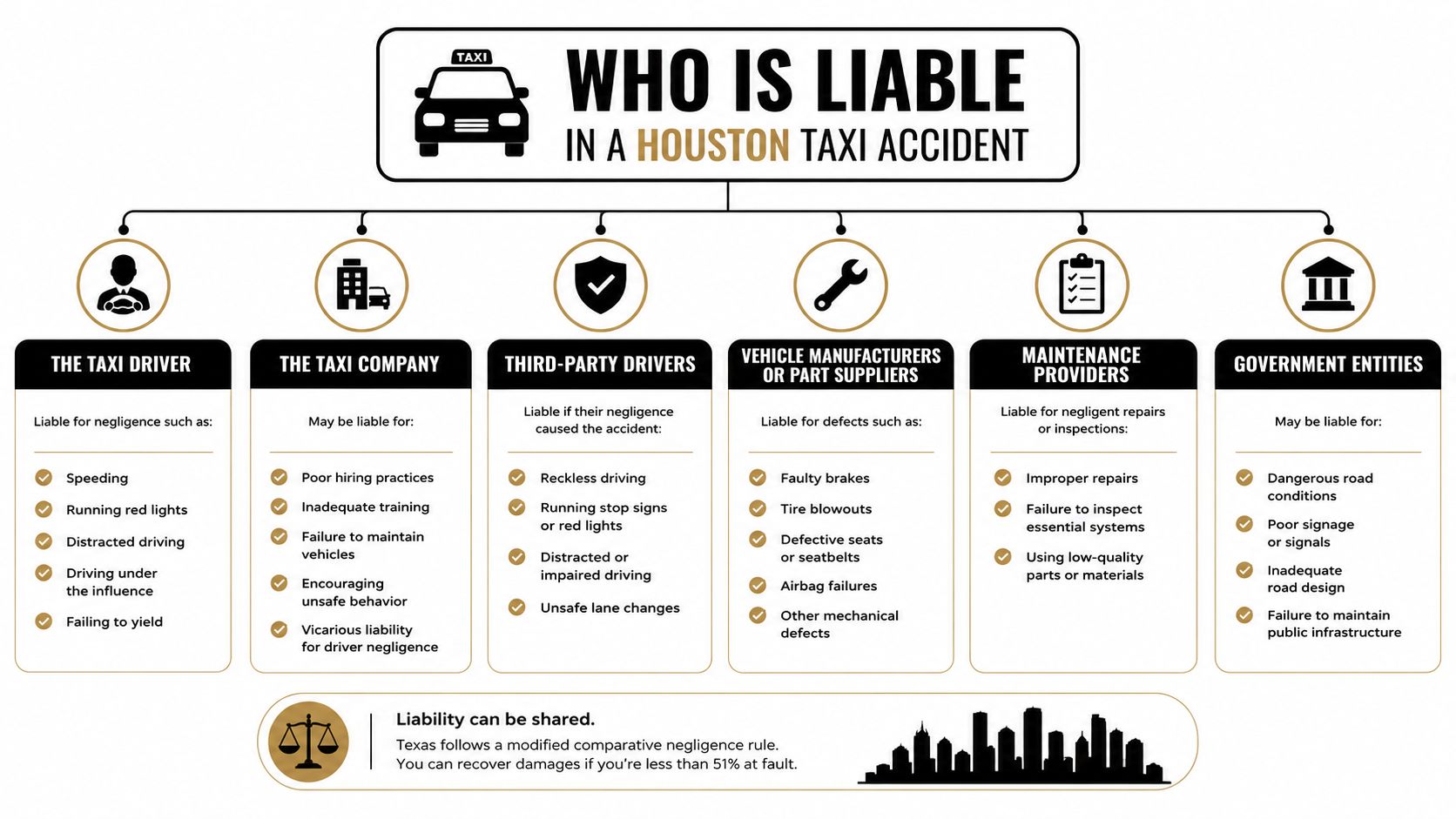
Texas also uses modified comparative fault under Civil Practice & Remedies Code Chapter 33. In plain English, if you are partly blamed for the crash, your compensation can be reduced. If you are found mostly at fault, you may recover nothing. That is why insurers push hard to say the passenger was distracted, the other driver was speeding, or someone else caused the impact. A clear comparative fault definition helps you see why that argument matters so much.
Bottom line: liability in a taxi case is not a guess. It is a chain of proof, and the chain has to hold up with records, not assumptions.
If you've searched for a Houston Car Accident Lawyer because your case feels bigger than a normal fender bender, that instinct is right. Taxi cases usually involve more than a simple rear-end claim. They require a lawyer to connect the crash to the right defendant, the right insurance layer, and the right damages. When the taxi company denies liability, the fight often turns on whether the driver was working, whether the cab was covered, and which policy applies.
How Taxi Claims Differ from Rideshare and Trucking Accidents
Taxi, rideshare, and trucking crashes all involve commercial transportation, but the insurance rules are not the same. That's where people get burned. A taxi usually has a commercial policy in place, while rideshare coverage can change depending on whether the app is off, on, or the passenger is already in the car. Trucking cases can bring in federal safety rules and very different risk profiles.
The difference matters because the wrong assumption leads to the wrong claim strategy. If you handle a taxi case like a regular car wreck, you may miss the coverage dispute. If you treat a rideshare crash like a taxi case, you may chase the wrong insurer. And if you confuse either one with a trucking claim, you could overlook a much deeper investigation into regulatory violations.
| Claim Type | Primary Insurance | Regulatory Oversight | Typical Policy Limits |
|---|---|---|---|
| Taxi | Commercial taxi policy | City and state passenger-for-hire rules | Depends on the policy and status of the cab |
| Rideshare | Layered coverage tied to app status | Coverage changes when the app is off or on | Can range from personal coverage to layered liability coverage, including the limits described in Texas rideshare materials |
| Trucking | Commercial trucking policy | Federal and safety regulations | Often much higher than ordinary passenger-vehicle claims |
If your crash involved a rideshare vehicle too, this Houston rideshare accident lawyer page can help you see why the coverage rules shift so much when an app-based driver is involved. The key point is simple. Commercial passenger transport is never just about who hit whom. It's about who insured the ride and what status the vehicle had at the exact moment of the crash.
Houston's broader traffic record shows why these distinctions matter. The city had 67,386 crashes in 2022, 67,045 in 2021, and 58,307 in 2020, with another Houston crash summary reporting 67,644 total motor vehicle crashes in 2023 and about 185 accidents per day source data. In a market that busy, coverage problems are not edge cases. They're part of the picture.
Critical Steps to Take Immediately After a Taxi Crash
The first hours after a taxi crash are not the time to improvise. They're the time to protect your health and preserve your evidence. Call police and get medical help if you can, because the police create a written record and emergency care documents your injuries early.

What you should do right away
- Call 911: Get police and an ambulance if anyone is hurt. That creates a record and gets your injuries documented quickly.
- Take photos before you leave: Capture the taxi, the other vehicles, skid marks, traffic signals, and the wider scene.
- Get the taxi details: Write down the taxi number, license plate, driver's taxi license number, and company name.
- Collect witnesses: Ask for names and phone numbers before everyone leaves.
- Follow medical instructions: Go to the ER or urgent care if you're told to do so, even if you think the injury is minor.
That list sounds basic, but basic evidence wins claims. The taxi number and license plate help tie the crash to a specific fleet. The driver's license information helps connect the incident to a credentialed operator. Witness contact information gives your lawyer people to call when the insurer starts disputing what happened.
Do not give a recorded statement to the insurer before you've gotten legal advice. Adjusters are trained to ask questions that narrow your claim, not protect it.
If you can move safely, photograph the cab's medallion or identifying number as well. In a Houston taxi case, that tiny detail can help identify the company, the driver, and the insurance policy that should be in play. The goal is simple, lock down the facts before they disappear.
The Insurance Coverage Gaps That Derail Taxi Claims
Many valid claims fall apart here. People assume the taxi company's insurer will just pay. That's not always how it works. Coverage fights usually turn on whether the driver was on-duty, whether the cab company's commercial policy applies, whether the vehicle was leased, and whether another policy has to step in first.
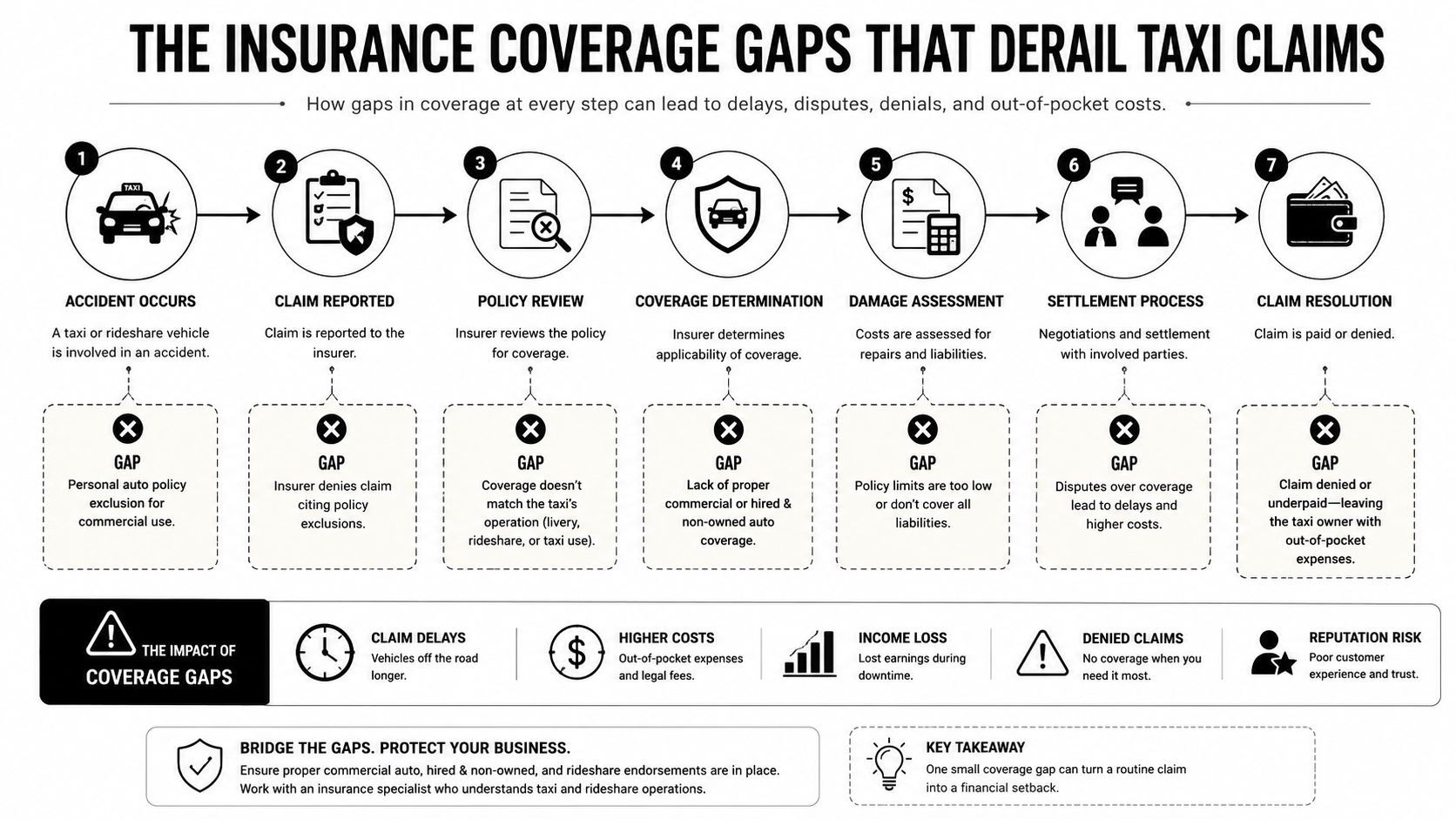
The denial often sounds neat and cold. “The driver was off the clock.” “The vehicle wasn't in service.” “This policy doesn't apply.” That language is designed to push the case out of the company's commercial layer and into a dead zone where nobody wants to pay. If you don't challenge it, the insurer controls the story.
What usually matters most
First, prove the vehicle was being used as a taxi-for-hire. Second, confirm whether the driver was working for the company or operating under some other arrangement. Third, look for the cab company's commercial policy and any lease paperwork tied to the vehicle. Fourth, check whether your own UM/UIM coverage may be the likely recovery source if the taxi's insurer refuses to respond.
That sequence is important because a denied taxi claim is often a coverage-status problem, not just a fault problem. The same confusion shows up in rideshare material, where coverage can shift sharply depending on the driver's status and the passenger's presence in the car coverage comparison guidance. Taxi cases can be just as messy, and sometimes messier, because companies may try to distance themselves from the crash by claiming the cab was not actively on duty.
Practical rule: if the insurer says “off the clock,” ask what document proves it and who had control of the vehicle at the moment of impact.
A Houston taxicab case without a coverage roadmap can stall for months. A lawyer who knows how to force the insurer to explain the denial, request policy documents, and trace the business relationship can cut through a lot of that noise. That's the difference between a claim that dies in the paperwork and one that moves toward compensation.
Understanding Your Damages and the Two-Year Filing Deadline
Your damages are the losses you can claim. That includes medical bills, lost wages, pain and suffering, rehabilitation costs, and, in the tragic cases, wrongful death compensation for families who lost a loved one. The point is not just that you were hurt. The point is how the crash changed your life, your work, and your future.
Texas has a two-year statute of limitations for personal injury lawsuits from car accidents, which means many claims must be filed within two years of the crash date or the court can dismiss them source data. A statute of limitations is the legal deadline for filing suit. Miss it, and a strong case can still die on time.
Why timing changes leverage
The sooner your case is built, the easier it is to connect your injuries to the taxi crash. Medical records line up with the scene. Wage loss can be documented while the time off work is still fresh. Witnesses are easier to find. The insurer also knows you are serious when your lawyer moves early and sends the right paperwork.
Texas's modified comparative fault rule also affects what you recover. If the insurer argues you were partly to blame, your compensation can be reduced. That makes early evidence collection even more important, because a small blame shift can become a big money difference later.
A Houston driver rear-ended by a taxi on a crowded street may have a straightforward injury claim on paper, but the actual value still depends on proving the full damage picture. Medical care, missed wages, and the ripple effect of ongoing pain all matter. If the crash caused a death, the focus moves to wrongful death compensation and the financial impact on the family left behind.
Bottom line: don't wait to “see how you feel.” Waiting helps the insurance company, not you.
How to Choose the Right Houston Taxi Accident Lawyer
A taxi crash can leave you arguing with two insurers at once, the driver's company and your own carrier, while each one points the finger somewhere else. That is why you need a lawyer who asks the hard questions early. How many taxi cases have they handled? Do they take cases to trial when the insurer refuses to pay? How do they communicate when records, policy limits, and medical proof start piling up? If a lawyer dodges those questions, keep looking.
Watch for red flags. No one can guarantee a result, and no one should pressure you to sign before you understand the fee, the strategy, and the risks. A good lawyer will talk plainly about liability, coverage gaps, and the proof needed to force a taxi claim forward when the company denies responsibility or claims the driver was off the clock.
If you are comparing firms, focus on substance, not marketing. In Houston, that means someone who understands local traffic patterns, Texas negligence law, and the way commercial insurers defend taxi crashes. It also means a firm that handles related matters like car wreck claims and trucking cases when the facts require it, because taxi crashes often overlap with broader commercial-vehicle disputes. You want a lawyer who knows how to trace the policy layers, find the decision-maker, and challenge the off-the-clock defense before it hardens into the insurer's story.
The Law Office of Bryan Fagan, PLLC handles Texas personal injury matters with that practical focus. If you need a Texas injury attorney who can look at the crash, the policy problem, and the medical proof together, that is the standard you should demand. The right lawyer won't promise magic. They'll trace the coverage gap, identify every liable party, and build a case that forces the insurer to take you seriously.