A car crash can change your life in seconds — but you don’t have to face recovery alone. Being hit by a car while walking is a terrifying, chaotic experience. Your mind is racing, adrenaline is pumping, and it's almost impossible to think clearly. But the steps you take in the first hour can make a massive difference for both your physical recovery and your ability to get fair compensation later on.
Your First Steps After a Pedestrian Accident
The most important thing—the only thing that really matters at first—is your health. You absolutely must get medical attention right away, even if you think you're okay.
Serious injuries like concussions, soft tissue damage, or internal bleeding don't always show symptoms immediately. Waiting to see a doctor not only puts your health at risk but also gives the insurance company an opening to argue your injuries weren't that serious. Down the road, specialized treatments like chiropractic care for car accident related pain can be a huge part of your recovery, but the initial ER or urgent care visit is non-negotiable.
Protect Your Safety and Your Rights at the Scene
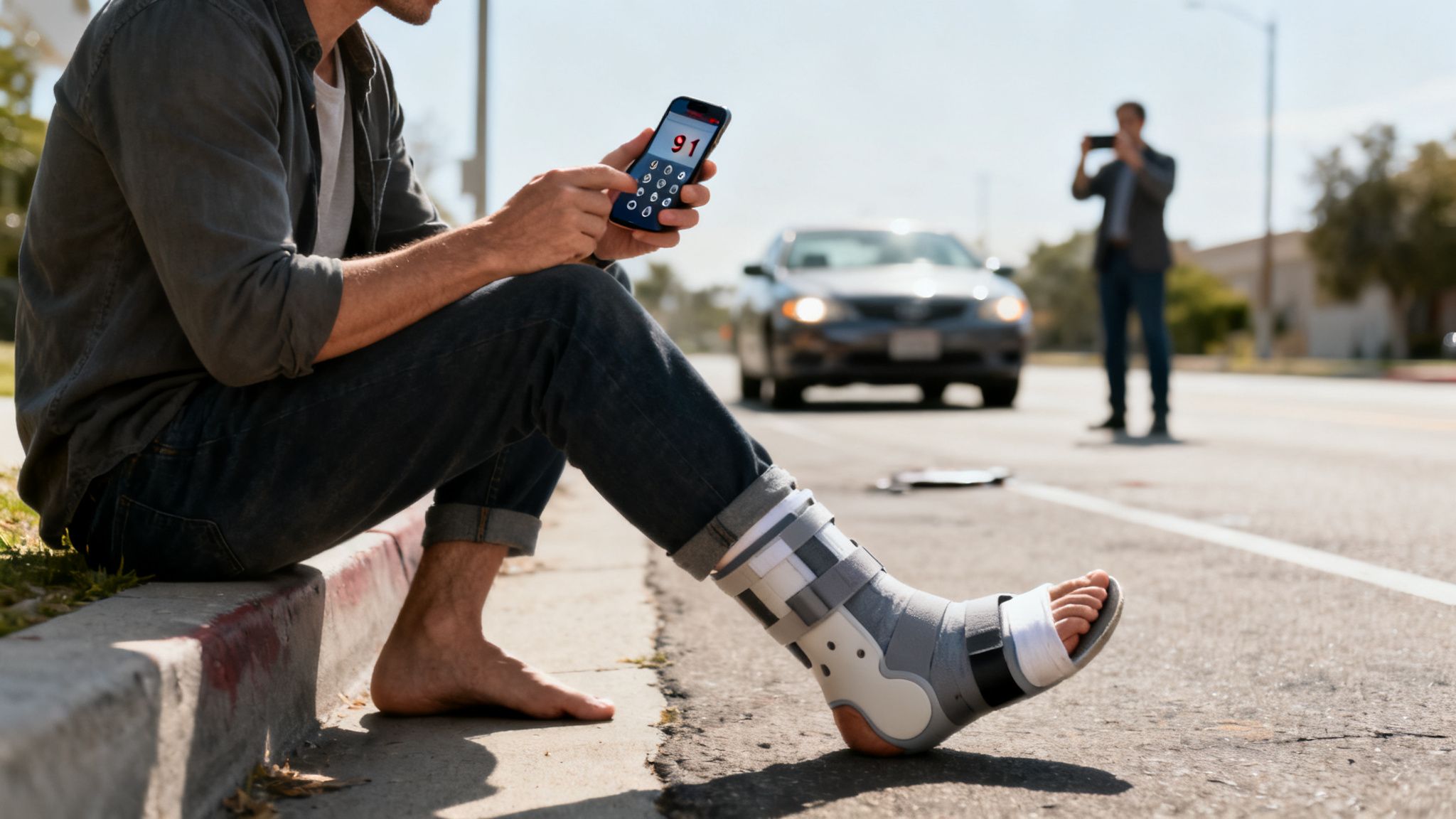
If you are able, get yourself out of the street and onto a sidewalk or shoulder. But do not leave the scene.
Next, call 911. This does two critical things at once: it gets paramedics on the way to check you out and brings the police to the scene to create an official accident report. That police report becomes a vital piece of evidence for your auto insurance claim.
While you wait for help, try to stay as calm as possible and start documenting. If you can, pull out your phone and take pictures of everything—the car that hit you (get the license plate!), your injuries, the crosswalk, street signs, and any skid marks on the pavement. A picture truly is worth a thousand words when dealing with insurance companies.
Key Takeaway: Never, ever say "I'm okay" at the scene. Shock and adrenaline can mask serious pain. Instead, stick to the facts: "I was hit by a car and I need a doctor." This simple statement prevents an insurance adjuster from using your own words against you.
This flowchart breaks down the essential protocol to follow in those first critical moments.
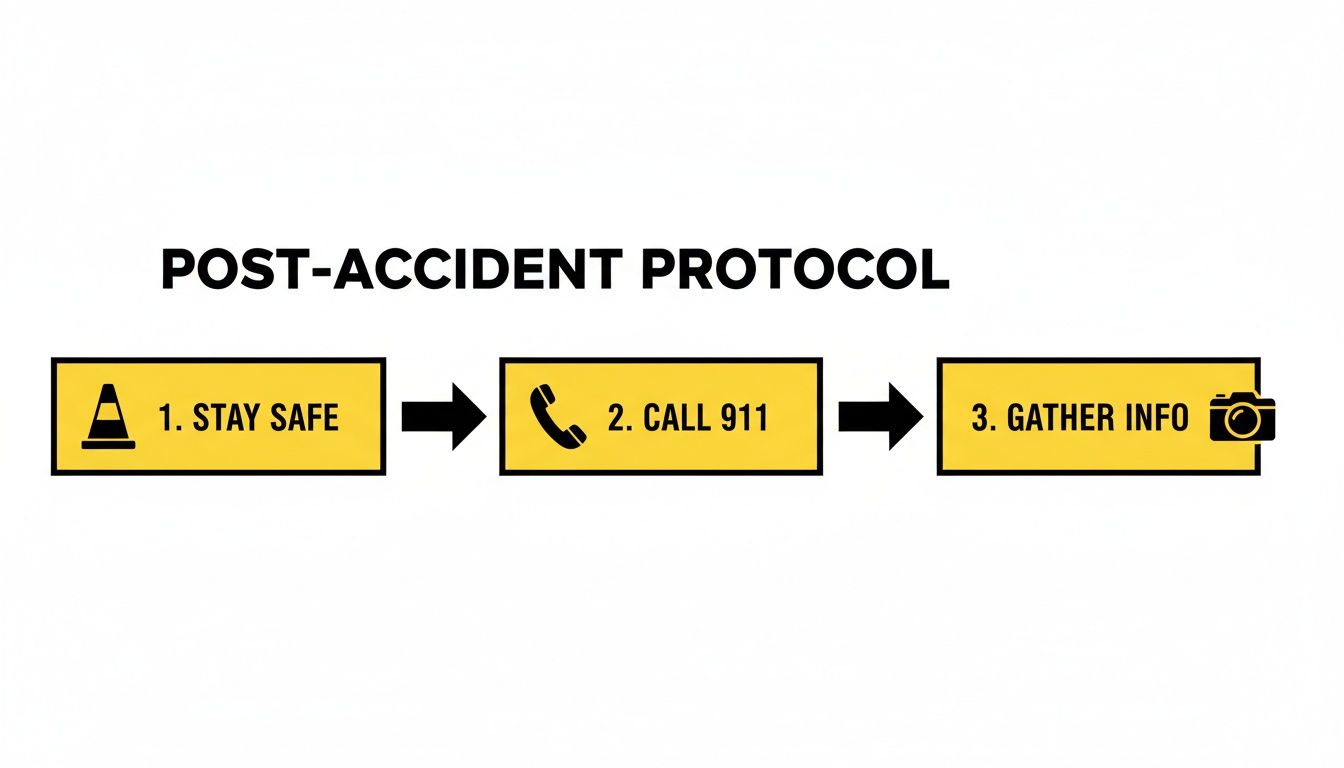
As the visual shows, your priorities are simple: stay safe, call for help, and gather the facts.
Gathering Information is Crucial
If you're physically able, exchange information with the driver. You'll need to get:
- Their full name and phone number
- Driver's license number
- The name of their insurance company and their policy number
- The vehicle's license plate number (take a picture of it!)
Also, look around for anyone who saw what happened. Witnesses can be incredibly valuable, especially if the driver tries to change their story later. Politely ask for their name and number. Their objective account can make or break your case. For a more exhaustive checklist, you can learn more about the essential steps after a car accident in our comprehensive guide.
Here is a quick summary of the most important things to do right after you've been hit.
Immediate Actions After a Pedestrian Accident
| Action | Why It's Critical |
|---|---|
| Seek Medical Attention | Your health is the priority. It also creates a medical record linking your injuries to the accident. |
| Call 911 | This dispatches medical help and ensures a police report is filed, which is official evidence. |
| Move to Safety | Get out of traffic to prevent further injury, but do not leave the scene of the accident. |
| Document Everything | Take photos of the scene, vehicle, and injuries. Visual proof is powerful. |
| Get Driver's Info | Collect their name, contact, license, and insurance details for your claim. |
| Find Witnesses | An independent account can verify the facts and support your version of events. |
| Don't Admit Fault | Avoid saying "I'm sorry" or "I'm okay." Let the facts and evidence speak for themselves. |
Following these steps helps protect you physically, medically, and legally in the chaotic aftermath of a pedestrian accident.
Sadly, the risk to pedestrians is on the rise. In a recent year, pedestrians accounted for a staggering 17.9% of all traffic fatalities in the United States. Here in urban Texas, especially in places like Houston, distracted driving and speeding are making neighborhood walks more dangerous than ever.
Who Is Liable in a Texas Pedestrian Accident?
When you're hit by a car, one of the first and most critical questions is: "Who was at fault?" In Texas, this isn't about pointing fingers. It's a legal process that boils down to a concept called negligence. In plain English, negligence means someone failed to act with the reasonable care expected of them, and that failure caused you harm. This is the foundation of Texas personal injury law.
Drivers have a fundamental duty of care to everyone else on the road, especially pedestrians who are far more vulnerable. This means more than just watching where they're going. A driver texting behind the wheel on I-45 in Houston, speeding through a quiet Dallas neighborhood, or rolling through a stop sign is breaching that duty. Their carelessness puts lives at risk.
Texas Law and The Duty of Care
Proving a driver was negligent is the cornerstone of any personal injury claim. To build a successful case, your Texas injury attorney must establish four key things:
- Duty: The driver had a legal responsibility to operate their vehicle safely.
- Breach: The driver violated that duty with a careless or reckless action, like running a red light.
- Causation: The driver’s mistake directly caused your injuries.
- Damages: You suffered real harm, like medical bills, lost income, and physical pain.
Think about a common scenario here in Texas. A person is crossing at a marked crosswalk on a busy Austin street. A driver, trying to speed through a yellow light, hits them. It's a clear-cut case: the driver breached their duty to yield, and that action directly caused the pedestrian's injuries. A skilled Houston car accident lawyer can use evidence like traffic camera footage and witness testimony to prove each of those four elements and establish liability.
The reality is often tragic. Statistics show that road crashes kill about 1.19 million people worldwide every year, and over half of them are vulnerable road users like pedestrians. Here in the U.S., pedestrian deaths have skyrocketed, making up 18% of all traffic fatalities in a recent year—a staggering 78% increase since 2009. The growing popularity of large SUVs and the constant distraction of smartphones only makes Texas roads more dangerous.
Understanding Comparative Fault in Texas
What happens if the insurance company tries to blame you? They might argue you were crossing the street outside of a crosswalk or were looking at your phone. This is where Texas's rule of proportionate responsibility, often called comparative fault, becomes crucial.
Under Chapter 33 of the Texas Civil Practice & Remedies Code, you can still recover money even if you were partially to blame. The critical rule is that your share of the fault cannot be more than 50%.
Here’s how it works in the real world: A jury determines your total damages are $100,000. But, they also find you were 20% at fault because you stepped into the street without looking both ways. Under Texas law, your final award is reduced by your share of the blame. So, you would receive $80,000 ($100,000 minus that 20%).
If a jury finds you 51% or more at fault, you get nothing. You are completely barred from recovering any compensation. This is an all-or-nothing threshold, and it’s precisely why insurance companies fight so hard to shift as much blame as possible onto you.
How Fault Impacts Your Claim
Insurance adjusters are trained professionals. They know exactly what questions to ask to get you to admit some fault, even unintentionally. They'll ask things like, "Were you in a hurry?" or "Did you see the car before it hit you?" Answering the wrong way can seriously harm your case.
This is why having an experienced Texas injury attorney in your corner is so important. We know their playbook. We build a strong case to prove the driver was the one primarily responsible by investigating every detail:
- Was the driver speeding, distracted, or on their phone?
- Did they fail to yield the right-of-way at an intersection?
- Were they driving under the influence of alcohol or drugs?
- Did they blow through a stop sign or a red light?
We gather police reports, track down and interview witnesses, and sometimes bring in accident reconstruction experts to piece together exactly what happened. Our goal is to minimize any fault assigned to you and maximize the compensation you deserve. The difference between being found 40% at fault and 60% at fault is the difference between getting a settlement and walking away with nothing. Don't let an insurance company dictate your future—let us fight for it.
Calculating the True Cost of Your Injuries
After you’ve been hit by a car, the shock and immediate medical bills are just the tip of the iceberg. The real cost of your injuries runs much deeper, impacting your finances, your job, and your quality of life for months—or even years—to come. Under Texas law, you have the right to seek compensation, legally known as damages, for every single one of these losses.
Figuring out what you can actually claim is the first step toward getting a settlement that truly covers what you've been through. The legal system breaks these damages down into two main buckets: economic and non-economic. Both are absolutely critical to making you whole again.
Tallying Up the Tangible Costs
Economic damages are the straightforward, measurable financial losses you’ve racked up because of the accident. These are the costs you can track with receipts, invoices, and bank statements.
Think of them as the black-and-white numbers that prove your financial hardship. They almost always include:
- Medical Expenses: This covers everything from the ambulance ride and ER visit to surgery, hospital stays, physical therapy, and any future medical care your doctors anticipate you'll need.
- Lost Wages: If your injuries have kept you out of work, you can claim the income you lost during your recovery.
- Loss of Earning Capacity: This is a big one for long-term or permanent injuries. If you can no longer do your old job or have to take a lower-paying one, you can be compensated for that future loss of income.
Let’s put this into a real-world context. Imagine a construction worker in Houston gets hit by a car on his lunch break and suffers a severe leg fracture. His economic damages would include the hospital bills for his surgery, the cost of his physical therapy, and every single paycheck he misses while he can't be on a job site. If that injury means he can never return to physically demanding construction work, his lawyer would calculate the difference in pay he’ll face for the rest of his working life.
The Immense Personal Toll of an Accident
While economic damages cover your financial bottom line, non-economic damages are meant to address the profound personal impact the accident has had on your life. These losses don’t come with a neat price tag, but they are just as real and, frankly, often more devastating.
Under Chapter 41 of the Texas Civil Practice & Remedies Code, you have the right to seek compensation for these intangible harms.
Key Insight: You are entitled to compensation not just for what you’ve paid out of pocket, but for what you have endured. Texas law recognizes that physical pain and emotional trauma are significant harms that deserve financial recovery.
This category of damages includes:
- Pain and Suffering: This is compensation for the physical pain and discomfort your injuries have caused.
- Mental Anguish: This covers the emotional trauma—the fear, anxiety, depression, or even PTSD—that comes after a violent accident.
- Physical Impairment: If you can no longer enjoy hobbies or daily activities you once loved, like playing with your kids, gardening, or going for a run, you can be compensated for that loss.
- Disfigurement: This applies to any scarring or other permanent changes to your appearance caused by the accident.
In the tragic event that a loved one is killed, families may be able to seek wrongful death compensation for their immense loss.
How to Document Your Losses Effectively
To build a strong case for both types of damages, documentation is everything. For your economic losses, get a folder and keep every single bill, receipt, and pay stub related to the accident. Don't throw anything away.
For non-economic damages, one of the most powerful tools you have is a simple journal. Just take a few minutes each day to write down:
- Your physical pain levels and what it feels like.
- Any feelings of anxiety, frustration, or sadness.
- Activities you had to miss or couldn't do because of your injuries.
- How your injuries are affecting your relationships with family and friends.
This personal record provides concrete evidence of your suffering that an insurance adjuster or jury can actually understand. It turns abstract ideas like "pain and suffering" into a compelling, human story, which is essential for recovering the full and fair compensation you deserve. A dedicated Houston car accident lawyer can show you exactly how to document these details to strengthen your insurance claim.
How To Handle Insurance Company Calls
It won’t be long after you’re hit by a car that your phone will start ringing. On the other end will be an insurance adjuster from the driver's company, and how you handle this conversation is absolutely critical.
Let's be clear about their job. They aren't calling to check on your well-being; they are calling to protect their company's bottom line. Their goal is to find any reason to minimize or flat-out deny your claim.

Why You Should Never Give a Recorded Statement
One of the very first things the adjuster will ask for is a recorded statement. You should always politely decline this request. You are under no legal obligation to give them one, and doing so will only hurt your case.
Adjusters are masters at asking tricky, leading questions designed to get you to say something they can twist later. They might ask something that sounds innocent, like, "You were in a bit of a hurry, weren't you?" or "You didn't see the car coming?" An honest but simple "yes" can be used as ammunition to shift the blame onto you.
This tactic is especially dangerous in Texas because of our state's proportionate responsibility rule. If they can use your own words to argue you were even partially at fault, they can drastically reduce—or even eliminate—your compensation.
Responding to a Quick Settlement Offer
Another common play from their book is offering a quick, lowball settlement. An adjuster might call just a few days after the accident and dangle a couple of thousand dollars in front of you. When medical bills are already piling up, that cash can seem tempting, but it’s a trap.
At this early stage, you have absolutely no idea what the full extent of your injuries will be or what future medical care you'll need. Accepting an early offer means you forfeit your right to seek another dime, even if you end up needing surgery or months of physical therapy down the road.
Our Strongest Advice: Never accept a settlement or sign any documents from an insurance company without first speaking to an experienced Texas injury attorney. Once you sign, your case is closed for good.
What to Say When the Adjuster Calls
So, what should you do when they call? Keep the conversation short and stick to the absolute basics. You can confirm your name and the date of the accident, but that’s it.
Here are some firm but polite phrases you can use to protect your rights:
- "I am not prepared to discuss the details of the accident at this time."
- "I am still receiving medical treatment and do not know the full extent of my injuries."
- "I will not be providing a recorded statement."
- "My attorney will be in contact with you shortly."
This approach stops you from accidentally saying anything that could jeopardize your claim. For a deeper dive into their tactics, you can check out our guide on how to deal with insurance adjusters. It's also helpful to review some general tips for handling insurance company calls to understand their common strategies, no matter the type of incident.
The simplest and safest path forward is to let a professional handle these communications from the start. Once you hire a Houston car accident lawyer, you can direct all calls straight to your legal team. This takes the pressure off you and ensures your rights are protected from day one.
Understanding Your Legal Deadlines and Special Cases
The legal system runs on a strict clock. If you’ve been hit by a car, missing a deadline isn't a minor slip-up—it can mean losing your right to compensation forever. That's why moving quickly isn't just a good idea; it's absolutely critical to protecting your future.
The Two-Year Countdown in Texas
In Texas, the single most important deadline is the statute of limitations. Think of it as a legal countdown timer. For almost every pedestrian accident case, you have exactly two years from the day you were hurt to file a lawsuit. In plain English, a statute of limitations is a law that sets the maximum time you have to initiate legal proceedings.
Two years might sound like a long time, but it disappears fast when you’re juggling doctor's appointments, physical therapy, and just trying to get your life back on track. Waiting is a huge mistake. Evidence doesn't last forever—witness memories fade, security footage gets deleted, and crucial physical proof from the scene can vanish.
Key Takeaway: The two-year clock starts ticking the moment the accident happens. If you delay, you're not just losing time; you're losing the evidence you need to build a strong case. Miss the deadline, and your case will almost certainly be dismissed.
You can learn more about the statutes of limitations in Texas and how these deadlines apply to different injury claims in our detailed guide.
When a Government Vehicle Is Involved
The rules get a lot more complicated if the vehicle that hit you was owned by the government. We're talking about a city bus in Houston, a county maintenance truck, or any state-owned vehicle. In these situations, the standard two-year deadline gets thrown out the window.
You're suddenly facing a much shorter, more demanding process. You have to file a formal Notice of Claim with the right government agency, sometimes in as little as six months from the date of the accident. This isn't a simple form, either. It has very specific, rigid requirements. One tiny mistake can get your entire claim thrown out before it even starts.
Because these deadlines are so short and unforgiving, you must contact a Texas injury attorney immediately if a government vehicle was part of your accident.
Navigating the Nightmare of a Hit-and-Run
It’s a terrifying scenario: a driver hits you and then speeds off, leaving you injured and alone. A hit-and-run can make you feel completely helpless, but you still have options to recover financially.
If police can't find the driver who fled, the first place to look for help is your own auto insurance policy. Your Uninsured/Underinsured Motorist (UM/UIM) coverage is designed for exactly this situation. It essentially steps into the shoes of the hit-and-run driver's insurance, covering your medical bills, lost income, and other damages.
Filing a UM/UIM claim means you have to prove that an unknown driver was at fault and that your injuries are a direct result of their actions. This often requires tracking down any available evidence, like witness statements or nearby surveillance footage. A skilled lawyer can take over this entire process, making sure you meet every requirement to get the compensation you're entitled to under your own policy.
Why a Pedestrian Accident Lawyer Is Your Best Ally
After getting hit by a car, your only job should be healing. But the hard reality is that a serious personal injury claim is a full-time fight. Trying to juggle doctors, physical therapy, and a mountain of bills while fending off an insurance company is more than anyone should have to handle alone. This is where a dedicated Texas pedestrian accident lawyer becomes more than just legal counsel—they become your shield, your strategist, and your strongest advocate.
Hiring an attorney isn't about being aggressive; it’s about leveling a playing field that’s heavily tilted against you. The at-fault driver's insurance company has a team of adjusters and lawyers whose entire job is to protect their bottom line. Your attorney’s only job is to protect you.
We Handle the Fight So You Can Focus on Recovery
From the moment you partner with our firm, the endless calls and intimidating letters from the insurance adjuster stop. We take over all communications, shielding you from their pressure tactics. This gives you the space to focus completely on your physical and emotional recovery without the stress of saying the wrong thing or being pushed into a quick, lowball settlement.
Our team immediately launches a thorough investigation into your accident. We don't just take the police report at face value. We get to work to:
- Gather crucial evidence: This means tracking down any available traffic or security camera footage that might have captured the incident, interviewing witnesses before their memories fade, and, when necessary, bringing in accident reconstruction experts to prove exactly how the driver's negligence caused your injuries.
- Calculate your total damages: We go far beyond just adding up your current medical bills. Our team works with medical and financial experts to project the full, long-term cost of your injuries. This includes future surgeries, ongoing therapy, lost earning capacity, and the profound, personal cost of your pain and suffering.
- Negotiate from a position of strength: Armed with powerful evidence and a complete valuation of your claim, we present a formal demand to the insurance company. We are skilled negotiators who know their tactics and how to counter their lowball offers, fighting for a settlement that truly reflects everything you’ve lost.
No Upfront Costs and No Financial Risk
We know the last thing you need after a devastating accident is another bill. That’s why The Law Office of Bryan Fagan works on a contingency-fee basis.
This means you pay absolutely nothing out of your own pocket. We cover all the costs of building and fighting your case. You only pay a legal fee if and when we successfully recover compensation for you. If we don’t win, you owe us nothing.
This approach removes all financial risk, allowing you to get expert legal representation right away, regardless of your current financial situation. It ensures that everyone has access to justice—not just those who can afford to hire a lawyer upfront.
Your Path to Justice Starts Here
Being struck by a car can leave you feeling powerless, but you have rights and you have options. You don't have to accept what the insurance company dictates or try to navigate this complicated legal maze by yourself. An experienced Houston car accident lawyer can stand up for you, handle the legal burdens, and fight for the financial security you need to rebuild your life.
Your recovery is too important to leave to chance. Let us be your voice and your strength. Contact The Law Office of Bryan Fagan today for a free, no-obligation consultation. We will listen to your story with compassion, answer your questions, and explain exactly how we can help you find a clear path forward. You don’t have to do this alone.
Common Questions After Being Hit by a Car in Texas

When you're recovering from an accident, you're bound to have questions. Here are some of the most common ones we hear from pedestrians we’ve helped across Texas.
What if I Was Jaywalking When I Was Hit?
This is a big one. Many people assume that if they weren't in a crosswalk, they automatically lose any right to compensation. That’s not true in Texas.
Our state follows a "proportionate responsibility" law. In simple terms, this means you can still recover damages as long as a court finds you were 50% or less at fault for the accident. Your final compensation will be reduced by whatever percentage of fault is assigned to you, but it doesn't shut the door completely. An experienced attorney can be crucial in building a case that demonstrates the driver held the majority of the responsibility.
The Driver's Insurance Company Offered Me a Settlement. Should I Take It?
My advice is always the same: never accept an insurance company's first offer without speaking to a lawyer.
Insurers are businesses, and their goal is to close your claim for the lowest amount possible. Those initial offers almost never account for the full scope of your needs—things like future physical therapy, lost earning potential, or the true cost of your pain and suffering.
Once you accept a settlement, it's final. You can't go back and ask for more money, even if your injuries turn out to be more severe than you first thought. It's a trap many people fall into, and it can be financially devastating.
How Long Will My Pedestrian Accident Case Take?
Every case is different, so there’s no single answer here. The timeline really depends on the specifics of what happened.
A straightforward case where liability is obvious and injuries are clear might settle in just a few months. However, if the case is complex, requires a deep investigation, or the insurance company refuses to negotiate in good faith, it could take over a year to resolve, especially if it heads toward a trial. After reviewing the details of your accident, a good lawyer can give you a much more realistic idea of what to expect.
The aftermath of being hit by a car is chaotic and overwhelming. You shouldn't have to navigate the legal complexities while trying to heal. The dedicated attorneys at The Law Office of Bryan Fagan, PLLC are here to protect your rights and fight for every dollar you deserve.
Contact us today for a free, no-obligation consultation. We'll listen to your story and help you find a clear path forward.