A car crash can change your life in seconds — but you don’t have to face recovery alone. A rear end accident is one of the most common collisions we see, often happening in heavy Houston traffic or at a simple stoplight. And while they might seem straightforward, the physical, emotional, and financial fallout can be surprisingly complicated, leaving you with serious injuries and a mountain of bills.
The Shock of a Rear End Accident in Houston Traffic
One minute you're driving down I-45, and the next, you're jolted forward by the screech of tires and the sickening crunch of metal. A rear end accident shatters your sense of safety in an instant. It leaves you disoriented, confused, and unsure of what to do next.
This experience is far too common, but that doesn't make it any less traumatic. These crashes are a significant problem across the country and especially here in Texas. In the U.S., rear-end collisions make up nearly 30% of all police-reported accidents. That number hits home when you consider that Texas sees hundreds of thousands of crashes every single year. Distracted driving, tailgating, and sudden stops in city traffic are major reasons these collisions happen.
For anyone who's been through it, the road to recovery can feel overwhelming. This guide is meant to be your roadmap. We’ll walk you through how Texas law determines who is at fault, what hidden injuries you need to watch for, and how to protect your right to fair compensation.
What This Guide Will Cover
We designed this resource to give you the knowledge you need to stand up for your rights after a crash. We will cover:
- Who Is Liable: How Texas negligence laws apply specifically to a rear end accident.
- Common Injuries: Why even a "minor" fender bender can cause serious, long-lasting physical harm.
- Protecting Your Claim: The practical, step-by-step advice you need right after a crash. You may also want to check out our detailed article on what to do after a car accident.
- Dealing with Insurance: How to file a claim and handle insurance adjusters to fight for the full compensation you deserve.
You are not alone in this. A dedicated Houston car accident lawyer can handle the legal headaches so you can focus on what truly matters: healing.
Who Is Liable in a Texas Rear End Accident?
Most people assume the driver who hits you from behind is always at fault in a rear end accident. While that’s often true, it’s not an absolute rule. Texas law is more nuanced, and understanding how liability works is the first step to protecting your rights.
At the heart of any Texas personal injury claim is the concept of negligence. In plain English, negligence means someone failed to act with reasonable care, and their carelessness caused you harm. Every driver on the road has a "duty of care" to operate their vehicle safely and avoid causing a crash.
This duty of care means a driver must be:
- Following other cars at a safe distance.
- Paying attention to the road, not their phone.
- Driving at a safe speed for the conditions.
- Keeping their vehicle in good working order (e.g., working brakes).
When a driver is tailgating or distracted by a text and can’t stop in time, they’ve breached that duty. In a rear-end collision, there is a legal presumption that the trailing driver was negligent because a responsible driver should have been able to stop. However, this is a rebuttable presumption, meaning the other driver can try to present evidence to argue they weren’t at fault—or that you shared some of the blame.
When the Front Driver Might Share Fault
While the rear driver is typically held responsible, there are situations where the lead driver can be found partially or even entirely at fault.
Here are a few real-world examples:
- Sudden, Unnecessary Braking: If a driver intentionally "brake checks" you out of road rage, they have created a hazard that even a cautious driver might not be able to avoid.
- Driving with Broken Brake Lights: It's impossible for the driver behind you to know you're stopping if your brake lights are out. In Houston traffic, that’s a recipe for disaster.
- Reversing Suddenly: Someone unexpectedly throwing their car into reverse in a lane of traffic is clearly not operating their vehicle safely.
- Cutting Someone Off: If a driver merges aggressively without enough room and immediately gets rear-ended, they can be held partially liable for causing the dangerous situation.
In these scenarios, the other driver's insurance company will likely try to pin at least some of the blame on you to reduce their payout.
Common At-Fault Scenarios in Rear End Accidents
To make things clearer, let’s break down how fault is typically assigned in different rear-end crash situations. The table below illustrates common scenarios and the legal reasoning behind who is usually held responsible.
| Scenario | Typically At-Fault Party | Governing Legal Principle |
|---|---|---|
| Driver is texting and fails to stop in time | Rear Driver | Negligence; Failure to Maintain Lookout: Distracted driving is a clear breach of the duty to pay attention to the road. |
| Lead driver "brake checks" the car behind them | Lead Driver | Reckless Driving; Creating a Hazard: Intentionally creating a dangerous situation negates the presumption of the rear driver's fault. |
| Rear driver is following too closely (tailgating) | Rear Driver | Failure to Maintain a Safe Following Distance: Drivers must leave enough space to stop safely if the vehicle ahead brakes suddenly. |
| Lead driver has non-functional brake lights | Lead Driver | Negligence; Failure to Maintain Vehicle: The lead driver has a duty to ensure their vehicle's safety equipment is working. |
| Rear driver is speeding in poor weather | Rear Driver | Failure to Control Speed: Drivers must adjust their speed for conditions like rain or fog, regardless of the posted limit. |
| Lead driver cuts off another car and gets hit | Lead Driver (or Shared Fault) | Unsafe Lane Change; Failure to Yield: Creating an immediate hazard by merging improperly can place liability on the lead driver. |
This table is a general guide, and the specific facts of your case will always determine the final outcome. However, it shows that assigning fault is about looking at the actions of both drivers.
Understanding Comparative Fault in Texas
This brings us to one of the most important legal rules in Texas personal injury cases: modified comparative fault. You might also hear it called proportionate responsibility. This rule is defined in Chapter 33 of the Texas Civil Practice and Remedies Code.
Comparative Fault (in Plain English): This law allows a jury to assign a percentage of fault to everyone involved in an accident. Your ability to receive compensation depends on your percentage of blame.
Here’s how it works in practice:
- You can only recover money if you are found to be 50% or less at fault for the crash.
- If you are found to be 51% or more at fault, you are legally barred from recovering any compensation.
- If you are found partially at fault (but 50% or less), your total compensation is reduced by your percentage of fault.
Let's use a real-world example. Imagine a Houston driver rear-ended on I-10 is awarded $100,000 in damages by a jury. However, the jury also believes the driver was 10% at fault because one of their brake lights was out. Their final award would be reduced by that 10% ($10,000), meaning they would receive $90,000. You can see how even a small amount of fault can make a big difference. To learn more, read our guide on how comparative negligence in Texas can affect your case.
Insurance adjusters use this rule to pressure victims into admitting partial blame. This is why it’s so critical to speak with a Texas injury attorney before giving a statement to the other driver's insurance company.
Understanding The Hidden Dangers Of Your Injuries
It's easy to dismiss a rear end accident as just a "fender bender," but that thinking is a dangerous mistake. The violent, unexpected jolt can snap your head and neck back and forth, causing serious injuries that don't always show up right away. Just because you can walk away from the crash doesn't mean you're uninjured.
The adrenaline that floods your system during an accident is a powerful painkiller. It can mask major symptoms for hours or even days. You might feel a little sore at first, only to wake up a week later with debilitating neck pain, headaches, or tingling in your arms. This delayed onset of pain is a classic sign of many common car crash injuries.
Common Injuries That Appear Later
Many of the most serious injuries from a rear-end collision take time to fully develop. It's critical to know what symptoms to watch for.
- Whiplash: This is the most frequent injury, causing damage to the soft tissues in your neck. Symptoms like stiffness, dizziness, and chronic pain often get worse over time. You can learn more about how long whiplash can last in our detailed guide.
- Herniated Discs: The impact can force the soft discs between your vertebrae to rupture or slip out of place. This puts intense pressure on your spinal nerves, leading to severe back pain, numbness, or weakness in your limbs.
- Traumatic Brain Injuries (TBIs): You don't have to hit your head to suffer a TBI. The violent shaking alone can cause your brain to slam against the inside of your skull, resulting in a concussion. Watch for symptoms like confusion, memory loss, and sensitivity to light.
Ignoring these "hidden" injuries is a risk to both your physical recovery and your ability to get fair compensation. For specialized care, medical professionals like Bell District Spine and Rehab can help after a car accident, offering treatment you may need to get back on your feet.
The Physics Of Injury In a Rear-End Accident
The mechanics of a rear-end crash are uniquely dangerous. Even a low-speed impact transfers a massive amount of energy through your car's frame and directly into your body. Because you often have no time to brace for it, you absorb the full force.
The damage to your car is not a reliable indicator of the damage to your body. A vehicle with only a dented bumper can still have occupants with serious, long-term spinal injuries.
This chart helps break down the first question everyone has: who is at fault?
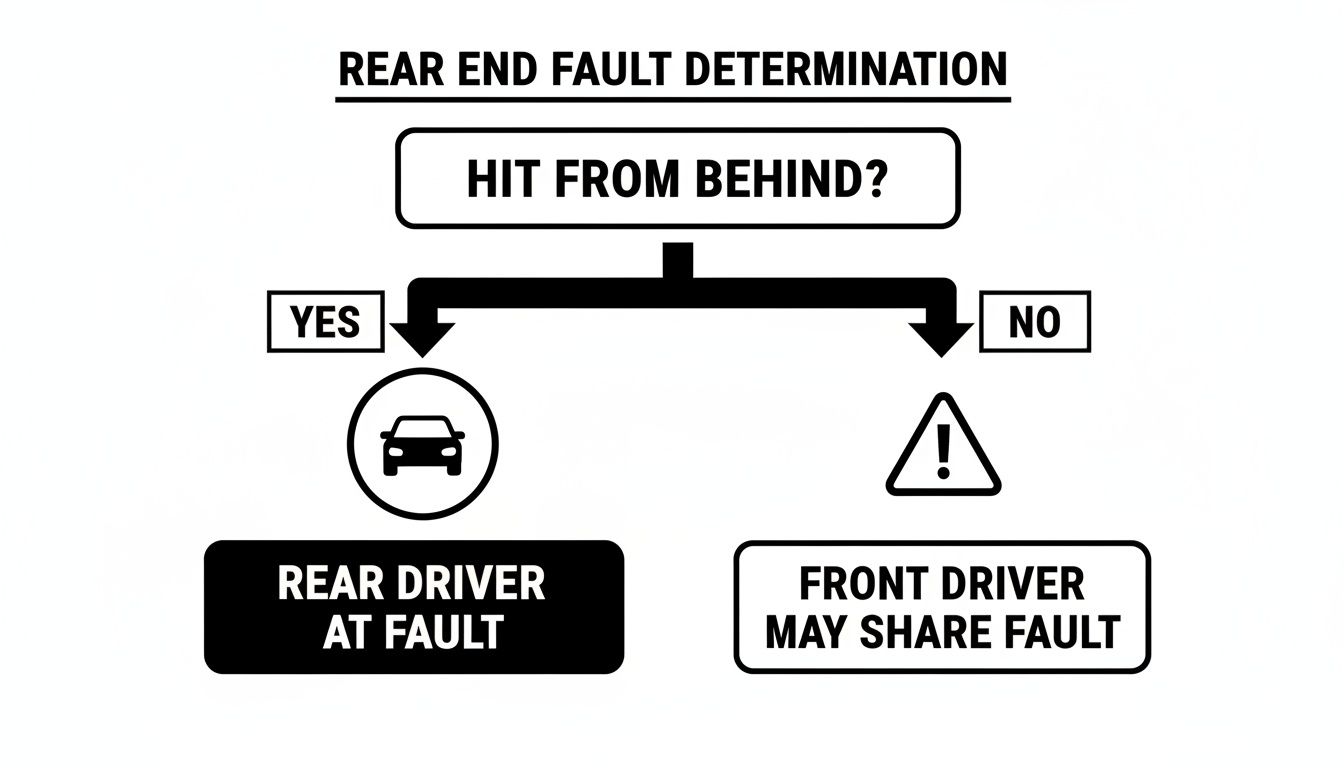
As the infographic shows, the driver in the back is usually presumed to be at fault. However, there are exceptions that can shift the blame, which is why a thorough investigation is so important. Seeking immediate medical attention is the single best thing you can do to protect both your health and your legal rights.
Protecting Your Rights After a Crash
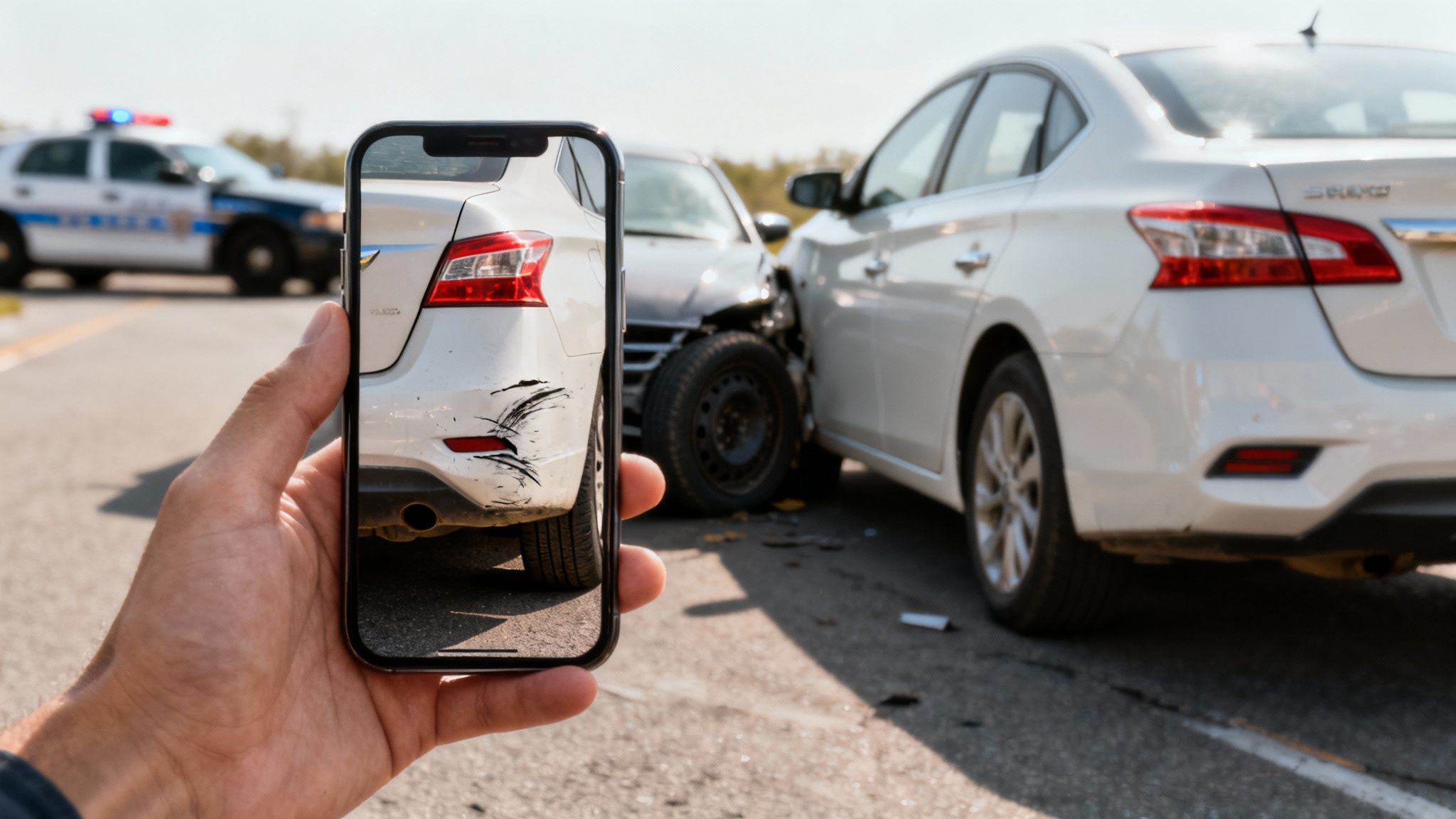
The moments after a rear-end collision are a blur of confusion and stress. But the steps you take in that chaos are crucial for protecting your health and your ability to get fair compensation. Taking the right steps from the beginning builds a strong foundation for your claim.
Your first priority is always your health. Even if you feel "fine," the adrenaline rush from a crash can mask serious injuries. Go to an urgent care clinic or an emergency room as soon as you can. This creates an official medical record that connects your injuries directly to the accident—a vital piece of evidence for your personal injury claim.
Practical Steps to Take at the Scene
If you're physically able, there are a few practical things you should do at the scene to safeguard your rights.
Here’s a step-by-step checklist:
Call 911 Immediately: Get the police to the scene. A formal police report provides an objective, third-party account of the incident and is one of the most powerful documents in a car accident claim.
Gather Evidence: Use your smartphone. Take photos and videos of everything—the damage to both cars from multiple angles, skid marks on the road, traffic signals, and the general area where the crash happened.
Exchange Information: Get the other driver's name, phone number, driver's license number, and insurance details. Also, get the names and contact information of any witnesses who saw what happened.
Do Not Admit Fault: You can be polite and cooperative without apologizing or saying the crash was your fault. Even a simple "I'm sorry" can be twisted by an insurance adjuster to argue that you accepted blame. Stick to the facts.
How to Deal with Insurance Companies
It won’t be long before you get a call from the other driver's insurance company. Be very careful. The adjuster's primary goal is to protect their company's profits by paying you as little as possible or denying your auto insurance claim altogether.
They may sound friendly and concerned, but they are trained to ask leading questions designed to get you to downplay your injuries or imply you were partly to blame.
Crucial Advice: Never give a recorded statement to the other driver's insurance company without first speaking to a Texas injury attorney. Anything you say can be used to undermine your claim. You are not legally required to provide one.
It’s easy for your words to be taken out of context. If an adjuster asks, "How are you feeling?" and you reply, "I'm okay," they may note in their file that you admitted to being uninjured, even if you are in significant pain. It is much safer to politely decline to provide a detailed statement and direct them to contact your lawyer.
A Houston car accident lawyer can handle these conversations for you, making sure your rights are protected every step of the way.
Navigating Your Insurance Claim for Fair Compensation
Filing an auto insurance claim after a rear end accident can be frustrating. The insurance company’s goal is to protect its bottom line, not to ensure you get everything you need to recover. Understanding how they operate is the first step toward getting the fair settlement you deserve.
The process begins when you formally notify the at-fault driver's insurance company that you are filing a claim. If you need a primer on those initial steps, here is a helpful resource on how to file an auto insurance claim. After your claim is opened, you will need to prove your losses with strong evidence.
Understanding the Types of Damages You Can Recover
In Texas, the compensation you can pursue after a crash is referred to as damages. These are the specific, recognized losses you suffered because of the other driver’s negligence.
- Economic Damages: These are the tangible financial losses with a clear dollar amount. They include medical bills, future healthcare costs, physical therapy, lost wages from missing work, and the cost to repair or replace your car.
- Non-Economic Damages: This is compensation for the real, but less tangible, suffering you have endured. This includes your physical pain, emotional distress, mental anguish, and the loss of enjoyment of life caused by your injuries.
An experienced Houston car accident lawyer knows how to document these damages to build the strongest case possible for fair compensation, which may include wrongful death compensation if a loved one was lost.
Beware of Common Insurance Adjuster Tactics
Soon after the crash, an insurance adjuster for the at-fault driver will likely call you. Remember, their job is to pay you as little as possible.
A common tactic is the quick, lowball settlement offer. The adjuster may call just days after the accident, offering what seems like a decent amount of money. This offer is almost always a fraction of what your claim is actually worth.
They hope you are worried about medical bills and will take the fast cash without knowing the full extent of your injuries or future needs. Once you accept a settlement, you sign away your right to seek more money for that accident, even if you later discover you need surgery. Their first offer is rarely their best offer.
The Importance of the Texas Statute of Limitations
In Texas, there is a strict deadline for taking legal action after a rear end accident. This deadline is set by a law called the statute of limitations.
Statute of Limitations (in Plain English): For most personal injury cases in Texas, including car accidents, you have only two years from the date of the crash to file a lawsuit.
If you miss that deadline, your right to seek compensation through the courts is permanently lost, no matter how severe your injuries are or how clear the other driver's fault was.
Two years may sound like a long time, but it passes quickly when you are focused on recovery. Waiting too long can weaken your case and put you at a disadvantage. A skilled Texas injury attorney will manage these deadlines and fight to ensure you get a settlement that truly covers all of your losses.
Why an Experienced Attorney Makes all the Difference
Trying to recover from a rear end accident while fighting a large insurance corporation is an overwhelming battle you shouldn't face alone. An experienced Houston car accident lawyer levels the playing field, ensuring your rights are protected against companies that prioritize profits over your well-being.
Insurance adjusters are trained negotiators whose job is to minimize claim payouts. A skilled attorney recognizes their tactics and counters them with evidence, facts, and a deep understanding of Texas law.
Your Advocate in a Complex System
From the moment you hire our firm, we lift the legal burden from your shoulders so you can focus on getting better.
Our team gets to work immediately to:
- Launch a Thorough Investigation: We gather critical evidence like the police report, witness statements, and traffic camera footage to build a strong case proving the other driver’s negligence.
- Calculate Your True Damages: We work with medical and financial experts to document the full extent of your losses, including future medical treatments and lost earning potential, to ensure nothing is overlooked.
- Negotiate Aggressively on Your Behalf: We prepare a powerful demand and handle all communication with the insurance company, shielding you from their lowball offers and pressure tactics.
The Law Office of Bryan Fagan works on a contingency fee basis. This means you pay absolutely nothing upfront. We only collect a fee if and when we win your case.
This removes the financial risk of seeking justice. We are invested in your success, and if the insurance company refuses to offer a fair settlement, we are always prepared to take your fight to court. A rear end accident can disrupt your life, but with the right legal team, you can get the justice you need to move forward.
Common Questions About Texas Rear-End Accidents
It's normal to have many questions after a rear end accident. Our goal is to provide clear, straightforward answers to help you understand your rights and options.
Here are some of the most common questions our Houston car accident lawyers hear.
Can I Still Recover Money if I Was Partially at Fault?
Yes, in most cases, you can. Texas follows a modified comparative fault rule. This means you can still recover compensation as long as you are found to be 50% or less responsible for the accident.
However, your final compensation will be reduced by your percentage of fault. For example, if your damages total $50,000 but you are found 10% at fault (perhaps for a broken brake light), your recovery would be reduced by $5,000, leaving you with $45,000. If you are found 51% or more to blame, you cannot recover anything under Texas law.
What Is the Average Payout for a Rear-End Accident?
There is no "average" payout because every case is unique. The value of your claim depends entirely on the specific facts of your crash and the severity of your injuries.
Key factors that determine the settlement amount include:
- The severity of your injuries: A serious injury requiring surgery will have a much higher value than a minor strain.
- Total medical expenses: This includes all costs—from the emergency room visit to ongoing physical therapy.
- Lost wages: This covers the income you've already lost and any future loss of earning capacity.
- Pain and suffering: This compensates you for the physical pain and emotional trauma the accident has caused in your life.
A skilled attorney can calculate the full and fair value of your claim to ensure you don’t leave money on the table.
What if the At-Fault Driver's Insurance Isn't Enough to Cover My Bills?
This is a common and stressful situation. If the at-fault driver has only minimum liability insurance, it may not be enough to cover the costs of serious injuries.
In this scenario, you may have another option: your own insurance policy. You can file a claim under your Uninsured/Underinsured Motorist (UM/UIM) coverage if you have it. This important coverage is designed to step in and cover the gap when the at-fault driver's policy falls short.
A rear-end accident can leave you with serious injuries, mounting medical bills, and a lot of uncertainty. You don’t have to take on the insurance companies and the legal system by yourself. The dedicated team at The Law Office of Bryan Fagan, PLLC is here to fight for your rights and help you secure the compensation you need to start rebuilding.
Contact us today for a free, no-obligation consultation to discuss your case. We are ready to help.