A car crash can change your life in seconds—but you don’t have to face recovery alone. Settlements for whiplash are designed to cover your medical bills, lost wages, and the very real pain and suffering caused by another driver's negligence on a Texas road.
While there is no single "average" amount, a fair settlement accounts for every single way the injury has impacted your life, ensuring you have the resources needed to heal.
What Is a Whiplash Settlement and Why Does It Matter?
A whiplash settlement is a legal agreement where the at-fault driver's insurance company pays you a specific amount of money to resolve your injury claim. In return, you agree not to pursue further legal action against them for that specific accident. This is your one opportunity to get the financial support you need to recover and move forward with your life.
Without a settlement, you could be left responsible for every doctor's visit, physical therapy session, and missed workday. For many Texas families, that financial pressure can be just as overwhelming as the physical pain of the injury itself.

How Common Are Whiplash Injuries?
Whiplash is far more common—and often more serious—than many people realize. It's easy to dismiss it as a minor sprain, but the reality for accident victims can be very different.
Imagine you're stopped in Houston traffic on I-10 when a distracted driver suddenly slams into your car from behind. That violent jolt is all it takes to cause a significant injury. You are not alone in this experience.
An estimated 3 million Americans suffer whiplash injuries every single year. For about 1.5 million of them, the pain becomes a chronic problem that lasts for months or even years. And for a staggering 300,000 people, the ongoing agony leads to a long-term disability.
These aren't just statistics; they represent real people whose lives have been permanently altered. This data also confirms that the amount of vehicle damage has little to do with how badly you're hurt, which is why your pain must always be taken seriously.
What Does a Settlement Actually Cover?
The purpose of a settlement is to make you "whole" again by covering every loss related to the accident. This isn’t just about paying for the initial emergency room visit. It's about providing funds for ongoing treatments like chiropractic care, physical therapy, and pain management.
To help you understand your rights, here is a breakdown of the key components you can claim.
Components of a Whiplash Settlement
This table outlines the different types of compensation, known as damages, that you can seek in a Texas whiplash settlement.
| Type of Damage | What It Covers | Example |
|---|---|---|
| Medical Expenses | All past, present, and future medical bills related to your injury. | ER visits, MRI scans, physical therapy, prescriptions, specialist appointments. |
| Lost Wages | Income you lost because you couldn't work while recovering. | Missing work for doctor's appointments or being on bed rest. |
| Loss of Earning Capacity | Future income you'll lose if the injury prevents you from returning to your old job. | Having to take a lower-paying job because of chronic neck pain. |
| Pain and Suffering | Compensation for the physical pain and emotional distress caused by the injury. | Chronic pain, anxiety, depression, loss of enjoyment of life. |
As part of a holistic recovery plan, many people explore different therapies to manage their symptoms. For instance, some individuals look into methods for managing symptoms like using an infrared sauna for inflammation relief. A fair settlement should give you the freedom and financial ability to pursue whatever care helps you get better.
Calculating the Value of a Whiplash Claim
After a car wreck, one of the first questions people have is, "How much is my claim worth?" While no magic formula exists for settlements for whiplash, you can get a realistic idea by understanding how these claims are built.
Every whiplash case is unique. A minor strain that heals in a few weeks is worlds apart from a severe injury that triggers chronic pain and months of physical therapy. Your settlement isn’t a number pulled out of a hat; it’s a figure built on hard evidence and real financial losses.

Economic Damages: The Foundation of Your Claim
The starting point for any whiplash settlement is your economic damages. These are the tangible, provable financial losses you've incurred because of the accident. Think of them as the costs you can back up with receipts, bills, and pay stubs.
These damages typically include:
- Medical Bills: This covers everything from the ambulance ride and ER visit to MRIs, specialist appointments, prescriptions, and physical therapy.
- Lost Wages: If your injury forced you to miss work, the income you couldn't earn is a critical part of your claim.
- Future Medical Expenses: If your doctor says you’ll need ongoing treatment, the estimated cost is factored into your settlement.
- Loss of Earning Capacity: In severe cases, you can seek compensation for the future income you'll lose because you can no longer perform your job.
Keeping detailed records of every expense is vital. Each bill and lost paycheck strengthens your claim and paints a clear picture of the accident's financial toll.
Non-Economic Damages: The Human Cost
A whiplash injury is more than just a stack of medical bills. The physical pain, emotional stress, and disruption to your daily life have real value under Texas law. These are called non-economic damages, but you may have heard the term "pain and suffering."
Because you can’t put a price tag on pain, insurance companies and attorneys often use a multiplier method. They add up your total economic damages and multiply that figure by a number, typically between 1.5 and 5, based on the severity and duration of your injuries.
A higher multiplier is justified for injuries that are severe, permanent, or significantly reduce your quality of life. For instance, someone who can no longer enjoy hobbies or sleep through the night due to chronic pain would warrant a much higher multiplier. You can learn more by reading our guide on how to calculate pain and suffering damages.
What Are Typical Payout Ranges?
Whiplash settlement amounts vary widely because they depend on the factors we've discussed. For example, a Houston driver rear-ended on I-45 with significant whiplash and clear evidence will have a very different case from a minor fender-bender.
Nationally, minor soft-tissue injuries might settle for $2,000 to $8,000. The U.S. average is closer to $18,950. Cases involving documented chronic pain often land in the $12,000 to $30,000 range. For severe whiplash with clear evidence and undisputed fault, settlements can easily exceed $100,000. These numbers show why documenting every step of your recovery is so important—the final amount is tied directly to the proof you provide.
What Goes Into Your Settlement Amount? Key Factors at Play
No two car accidents are identical, and neither are their settlements. The final value of your whiplash claim isn't arbitrary; it’s determined by a unique mix of hard evidence, Texas law, and the real-world impact of your injury.
Figuring out what your case is worth is about methodically proving the full extent of your losses.
The Seriousness of Your Injury (and How Well You Prove It)
The most important factor is the severity of your injury, backed by undeniable medical proof. It’s one thing to tell an insurance adjuster you’re in pain; it’s another to show them an MRI report detailing soft tissue damage or a physical therapist’s notes documenting your limited range of motion.
Solid medical evidence is the foundation of your claim. This includes:
- Diagnostic Imaging: X-rays, MRIs, or CT scans can visually show damage to your discs, ligaments, or nerves.
- Medical Records: Detailed notes from your primary doctor, specialists, and physical therapists create a clear timeline of your injury, treatment, and recovery.
- Treatment Duration: The length of your treatment is a strong indicator of the injury's severity. Months of consistent physical therapy carry more weight than a few visits to a chiropractor.
When an insurer calculates your claim's value, they look closely at the cost and duration of your medical care, including physical therapy sessions and at-home pain management, like using effective heat therapy for neck pain.
Who Is Liable in a Texas Car Accident?
To get a settlement, you must prove someone else was legally at fault—or liable—for the accident. In plain English, liability means legal responsibility. For example, a Houston driver texting on I-45 who causes a rear-end collision is clearly liable. But what happens if both drivers share some of the blame?
Texas uses a “modified comparative fault” rule. Found in the Texas Civil Practice & Remedies Code (Chapter 33), this rule says you can recover damages as long as you are not 51% or more at fault. However, your settlement will be reduced by your percentage of fault.
Let's say you were awarded $50,000, but a jury finds you were 10% to blame. Your final recovery would be cut by 10% ($5,000), leaving you with $45,000. Insurance companies often use this rule to shift blame and reduce payouts, which is why having a Texas injury attorney to fight back is so critical.
The Full Impact on Your Life and Your Wallet
A fair settlement must cover every way this whiplash injury has disrupted your world. Your claim must reflect the total financial and personal toll the crash has taken on you and your family.
This breaks down into two types of damages:
- Total Medical Costs: Every bill must be counted, from the ambulance ride to future physical therapy.
- Lost Wages and Earning Capacity: Did you miss work? Are you unable to do your job due to chronic pain? These are calculable financial losses that belong in your claim.
- Pain and Suffering: This is the human cost—compensation for physical pain, emotional distress, and loss of enjoyment of life. An injury that stops you from picking up your child or driving without anxiety has immense value.
The Reality of Insurance Policy Limits
Finally, there’s a practical limit: the at-fault driver's insurance policy. No matter how severe your injuries, an insurance company is typically only required to pay up to the maximum amount covered by that policy.
For example, if your damages total $75,000, but the driver who hit you only carries the Texas minimum liability coverage of $30,000 per person, their insurer is only responsible for that $30,000.
An experienced Houston car accident lawyer knows how to investigate other potential sources of recovery, like your own Underinsured Motorist (UIM) coverage or other responsible parties, to bridge that gap.
Navigating the Texas Whiplash Claim Process
Knowing your legal rights after a car crash is one thing, but using them effectively is another. When you're dealing with the pain and confusion of an injury, the claims process can feel overwhelming.
This guide provides a practical, step-by-step roadmap for what to do after a crash. Following these steps helps build a solid claim and protects you from the tactics insurance companies use to minimize their payouts.
Step 1: Report the Accident and Seek Medical Care
Your health always comes first. The first thing you should do after any accident is call 911 to get police and paramedics on the way. Even if you feel fine, get checked out by a doctor. Whiplash symptoms are often delayed—it can take hours or even days for the pain to fully appear. A medical visit creates an official record connecting your injuries to the crash.
Next, report the accident to your own insurance company as soon as possible. Stick to the basic facts. It's crucial to avoid giving a recorded statement or guessing at who was at fault until you've spoken with a lawyer. A simple, factual notification is all that is required.
Step 2: Document Everything and Gather Evidence
The strength of your whiplash claim depends on the evidence you gather. If you are physically able, use your phone at the scene to take pictures of everything: vehicle damage, the final positions of the cars, skid marks, and any visible injuries.
Make sure you exchange contact and insurance information with the other driver. If there were any witnesses, get their names and phone numbers—their account can be incredibly valuable.
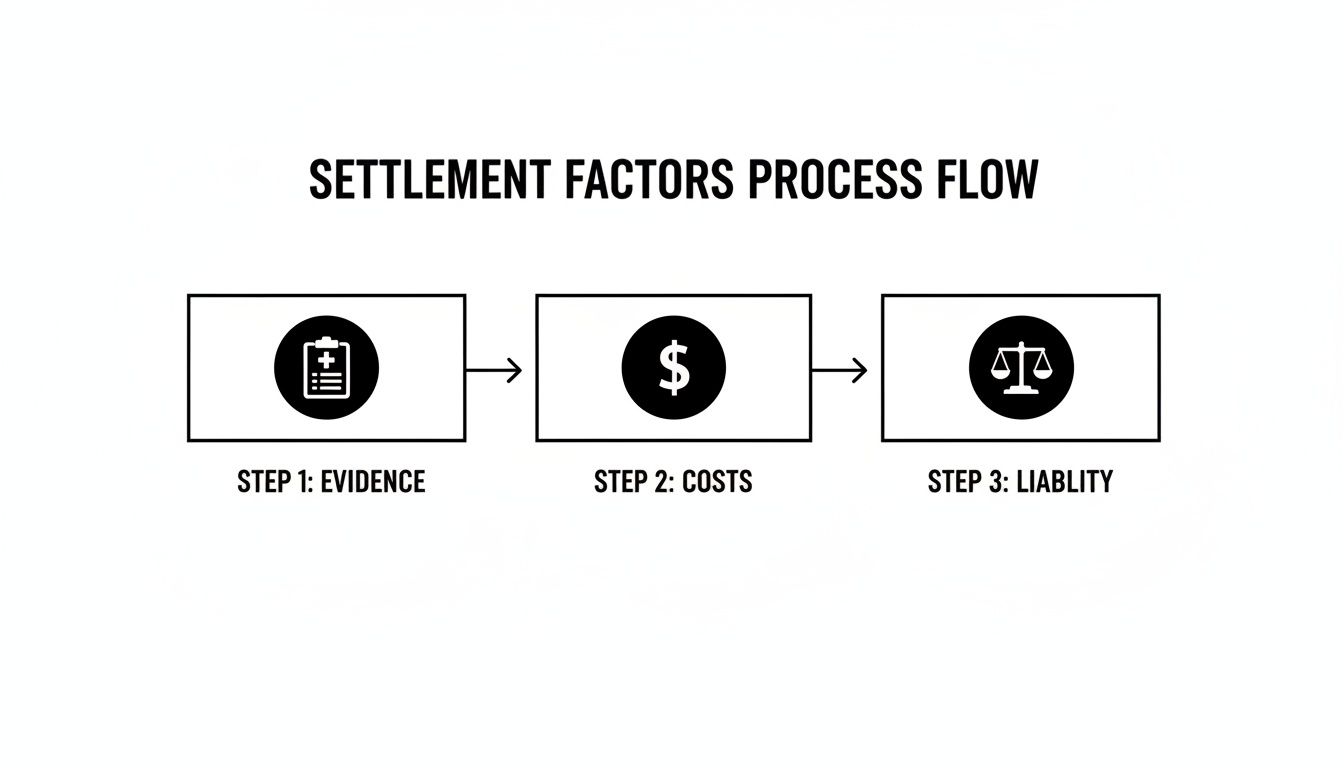
As you can see, a strong case rests on solid evidence, accurate cost calculations, and a clear story of who was at fault. Each piece builds on the last, creating a powerful claim that is difficult for an insurance company to dispute.
Step 3: Filing the Claim and Building Your Case
Once you’ve handled the immediate aftermath, the formal auto insurance claim process begins. This involves notifying the at-fault driver's insurance company that you are seeking compensation. The insurer will assign an adjuster to your case whose job is to protect their company's bottom line.
This is where having a Texas injury attorney on your side becomes a game-changer. Your lawyer will handle all communication with the insurance adjuster, shielding you from the pressure. They will collect all your medical records, proof of lost wages, the police report, and other evidence to build a "demand package."
This package is a comprehensive legal argument that lays out the facts, proves the other driver’s liability, and calculates the full value of your damages—both economic (like medical bills) and non-economic (like pain and suffering).
This demand package tells the insurance company you are serious and have the proof to back up your claim.
Step 4: Negotiation and Settlement
After the insurance company receives the demand package, negotiations begin. The first offer from the adjuster is almost always a lowball number. They might argue your injuries aren't that severe or try to pin some of the blame on you.
Your attorney will immediately push back, using the evidence they've collected to fight for a fair settlement. This back-and-forth can take time, but a skilled negotiator makes all the difference in securing a settlement that truly covers your needs.
If a fair agreement is reached, you will sign a release form, and the settlement check is issued. Most injury cases are resolved at this stage. However, if the insurance company refuses to be reasonable, your lawyer will be prepared to file a lawsuit to protect your rights.
You don't have to face this complicated process alone. The Law Office of Bryan Fagan, PLLC is here to manage every step, allowing you to focus on getting better. Contact us today for a free, no-obligation consultation.
Common Tactics Insurance Companies Use to Deny Claims
After a car accident, it’s natural to assume the other driver's insurance company will do the right thing. But the truth is, their primary goal is to protect their profits, which often means paying as little as possible or denying your claim entirely.
Knowing their playbook is the first step toward protecting your rights. Insurance adjusters are trained negotiators who know how to make you second-guess the severity of your injuries or the validity of your claim.
Arguing "No Damage, No Injury"
This is a common tactic. An adjuster will point to the minimal damage to your car and argue that you couldn't possibly be injured, saying things like, "It was just a fender bender."
The reality is that modern cars are designed to absorb impacts with little visible damage. That force is transferred directly to the people inside, causing the violent head-and-neck motion that leads to whiplash. Your body can sustain a serious injury even if your bumper doesn’t have a scratch.
Blaming Pre-Existing Conditions
Another tactic is to dig through your medical history for any old neck or back problems. If they find something, they’ll argue your current pain isn’t from the wreck but is just a flare-up of a previous issue.
Under Texas law, if an accident aggravates a pre-existing condition, the at-fault driver is still responsible for the new harm they caused. An experienced Houston car accident lawyer knows how to counter this argument with medical evidence that separates your old injuries from the new ones.
Offering a Quick, Lowball Settlement
Be cautious if an adjuster offers you a settlement check within days of the crash. This is often a trap. They are trying to get you to accept a low amount before you know the full extent of your injuries.
In Texas, while around 95% of personal injury cases settle before trial, insurance companies fight whiplash claims particularly hard. While most people recover within three months, a significant 25% of victims deal with pain for a year or longer. A quick settlement won't cover that kind of long-term care. You can discover more about recovery timelines and whiplash.
Once you cash that check, you sign away your right to seek any more compensation for that accident, no matter if your pain gets worse or you need surgery down the road.
Delaying and Denying
Finally, some insurance companies will simply drag their feet, hoping you’ll get frustrated and give up or accept a low offer. They might stop returning your calls or keep your claim stuck in "investigation." These are intentional tactics designed to wear you down. For a deeper look, you can learn more about why insurance companies deny claims in our guide.
Don't let these tactics intimidate you. Having a legal advocate from The Law Office of Bryan Fagan, PLLC, levels the playing field. We handle all communication with the insurer and fight for the full compensation you are owed.
How a Texas Car Accident Lawyer Maximizes Your Settlement
Hiring a lawyer after a car wreck is about more than just paperwork; it’s about having a dedicated advocate in your corner. While you focus on healing, a skilled attorney from The Law Office of Bryan Fagan, PLLC, works to protect your rights and build the strongest possible case for the whiplash settlement you deserve.

From day one, we take over all communication with the insurance company. This stops the adjuster from pressuring you into a recorded statement or pushing a lowball offer, allowing you to focus on your recovery without added stress.
Building a Powerful, Evidence-Based Claim
A strong settlement is built on a foundation of solid evidence. Our legal team meticulously gathers every piece of documentation needed to prove the other driver’s negligence and the full extent of your losses.
This process includes:
- Collecting Medical Records: We compile every note, scan, and report from your doctors and therapists to create a clear medical narrative of your injury.
- Securing Expert Testimony: When needed, we bring in medical experts who can explain the long-term impact of your whiplash to justify compensation for future care.
- Proving Lost Wages: We obtain records from your employer to document every dollar you lost from being unable to work and calculate the impact on your future earning potential.
By building such a comprehensive case, we leave little room for the insurance company to downplay the seriousness of your situation.
Aggressive Negotiation and Calculating Full Damages
One of our most vital roles is to accurately calculate the total value of your claim. We go far beyond just adding up medical bills, accounting for future medical costs, lost earning capacity, and the real impact of your pain and suffering.
We present this detailed calculation to the insurer and negotiate aggressively on your behalf. Our goal is to secure a settlement that truly reflects everything you have endured—not just the amount the insurance company wants to pay.
Understanding what a lawyer does can provide peace of mind during a difficult time. You can learn more about what a car accident lawyer does in our detailed guide.
Best of all, we handle all personal injury cases on a contingency fee basis. This means you pay absolutely nothing unless we win your case.
Whiplash Settlement Questions We Hear All the Time
After a car wreck, you’re left with physical pain, emotional stress, and many confusing legal questions. Here are straightforward answers to the most common concerns we hear from clients dealing with whiplash settlements in Texas.
What's the Deadline to File a Whiplash Claim in Texas?
In Texas, the statute of limitations is the legal deadline to file a lawsuit. For personal injury cases, you generally have two years from the date of the car accident. If you miss this deadline, you will almost certainly lose your right to seek compensation forever.
It is critical to act quickly. Building a strong case—investigating the crash, gathering medical records, and negotiating with the insurance company—takes time. Waiting too long can jeopardize your ability to recover the money you deserve.
Do I Have to Go to Court for a Whiplash Settlement?
It’s highly unlikely. The vast majority of personal injury claims—around 95%—are settled out of court through direct negotiations between your attorney and the at-fault driver's insurance company.
While filing a lawsuit is sometimes necessary to get an insurer to make a fair offer, most cases are still resolved before trial. A good Houston car accident lawyer prepares every case as if it will go to trial, putting you in the strongest possible negotiating position.
Can I Still Get a Settlement if I Was Partially at Fault for the Accident?
Yes, in many cases, you can. Texas follows a rule called “modified comparative fault” (Texas Civil Practice & Remedies Code, Chapter 33). In plain English, this means you can recover damages as long as you are not found to be 51% or more to blame for the accident.
However, your final settlement will be reduced by your percentage of fault. For example, if your case is worth $20,000 but you are found 10% responsible, your award would be cut by $2,000, leaving you with $18,000.
How Long Does a Whiplash Settlement Usually Take?
There's no single answer—the timeline can vary dramatically. A simple case with clear fault and minor injuries might settle in a few months.
However, if your injuries require long-term care or the insurance company disputes liability, it could take a year or more. The most important thing is not to rush. You should wait until your doctor says you’ve reached Maximum Medical Improvement (MMI)—the point where you have healed as much as possible. Only then will you know the true cost of your injuries and can avoid accepting an offer that doesn't cover your full recovery.
These answers are a starting point, but every accident is unique. If a Texas car wreck has left you injured and uncertain, you deserve an advocate who will fight for you every step of the way. The dedicated team at The Law Office of Bryan Fagan, PLLC is here to offer the skilled and compassionate legal help you need.
Don't try to take on the insurance companies by yourself. Contact us today for a free, no-pressure consultation to learn how we can help you get the fair settlement you deserve.