A car crash can change your life in seconds—but you don’t have to face recovery alone. An Uber or Lyft crash on a busy Houston highway like the 610 Loop or I-45 can turn your world on its head. One minute you’re a passenger on your way home, and the next you’re dealing with serious injuries, a mountain of bills, and a confusing legal mess. These aren't your typical car wrecks—they come with their own unique set of challenges. But you don't have to figure it all out on your own.
This guide will walk you through the complicated world of a rideshare Houston TX accident claim. We want to give you the clear, straightforward information you need while you focus on what really matters: your recovery.
Who Is Liable in a Texas Rideshare Accident?
Figuring out who’s on the hook for your injuries after an Uber or Lyft accident isn't as simple as a normal car crash. When someone else's carelessness causes you harm, you have the right to demand compensation for your losses. In Texas, this legal responsibility is called liability, and it all comes down to who was at fault.
The money you can recover for your losses is known as damages, which is meant to cover things like:
- Medical Expenses: Every single cost tied to your treatment, from the ambulance ride and ER visit to ongoing physical therapy and future surgeries.
- Lost Wages: The income you’ve lost because your injuries kept you from working.
- Pain and Suffering: Compensation for the physical agony and emotional trauma the crash and your injuries have put you through.
To get the compensation you deserve, you have to prove their negligence was the reason for your injuries. Think of it like a light switch with three different settings. Each setting flips on a different insurance policy, which dictates who will pay for your medical bills, lost income, and other damages. For any rideshare Houston TX crash, the first question is always: which "setting" was active?
Driver Is Offline or the App Is Off
If the driver has their app turned off, they’re just another private citizen on the road. In this scenario, Uber and Lyft have zero legal responsibility for the accident. Your claim would be filed against the driver’s personal auto insurance, just like any other car wreck.
But here’s where a major roadblock often pops up. Most personal insurance policies contain a “business-use exclusion,” meaning they won’t cover accidents that happen while the driver is working. If their insurance denies the claim on these grounds, you could be left with few options to get the compensation you need.
Driver Is Logged In and Waiting for a Ride Request
This is where things start getting complicated. As soon as a driver logs into the app and is available to take rides, a limited insurance policy from the rideshare company activates. This is often called Period 1 coverage.
Texas law requires rideshare companies to provide this backup coverage. It’s designed to apply only if the driver's personal insurance company denies your claim.
To give you a clear picture of how this works, here's a breakdown of the insurance coverage based on what the driver was doing at the time of the crash.
Texas Rideshare Insurance Coverage by Driver Status
| Driver Status | Primary Insurance Policy | Typical Liability Coverage Limits |
|---|---|---|
| App is off | Driver's personal auto insurance | Varies by policy (often denies claims for business use) |
| App is on, waiting for a request (Period 1) | Rideshare company's contingent liability policy | $50,000 per person / $100,000 per accident (bodily injury) $25,000 per accident (property damage) |
| En route to passenger or passenger is in the car (Periods 2 & 3) | Rideshare company's full commercial policy | $1 million in third-party liability and Uninsured/Underinsured Motorist coverage |
As you can see, the coverage available to you changes dramatically depending on a single factor: the driver’s status in the app. These are the critical details we investigate to build a strong claim.
The time after an accident is a whirlwind of shock, pain, and confusion. We’ve seen countless clients navigate this journey.
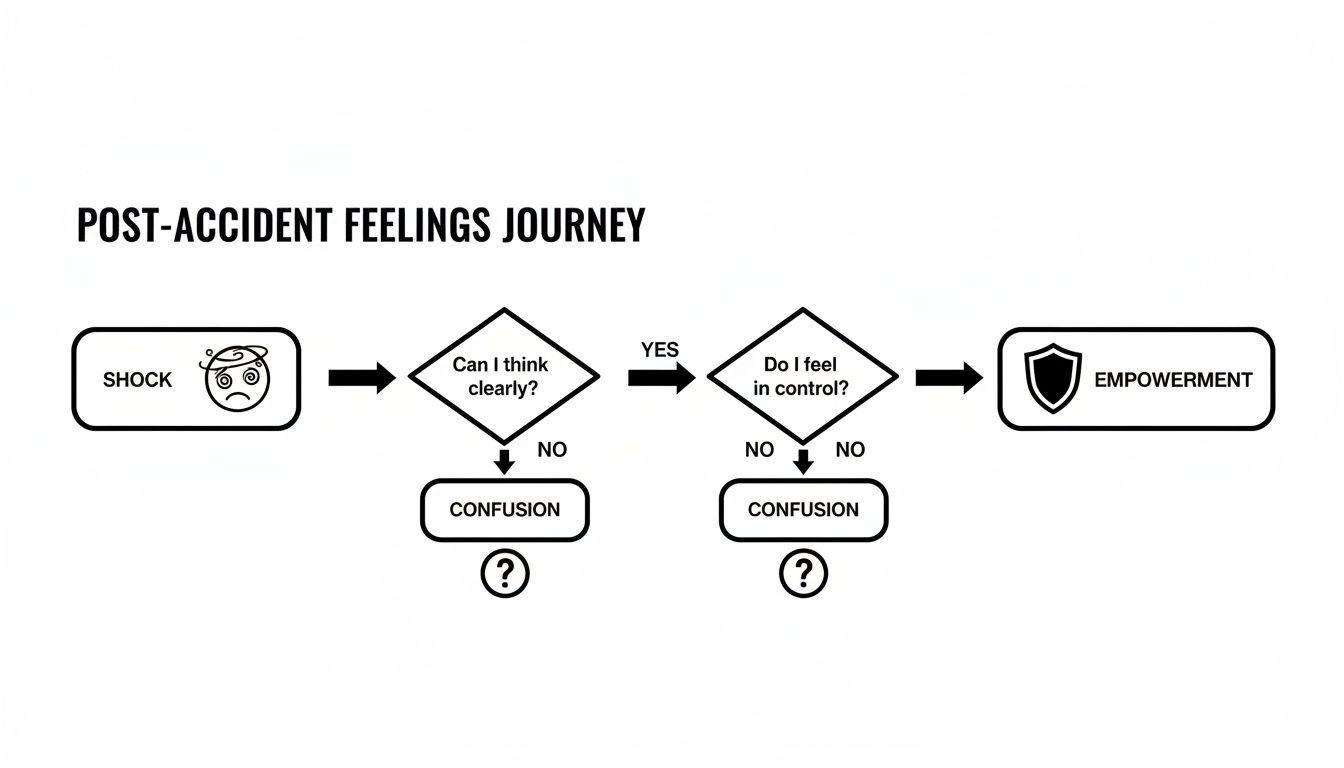
It’s a process, but with the right guidance, you can move from feeling overwhelmed to feeling empowered and in control.
Driver Has Accepted a Ride or Is Transporting a Passenger
Now we’re in Periods 2 and 3. The moment the driver accepts your ride request and starts heading your way, or as soon as you get in the car, the rideshare company's full commercial insurance policy takes effect. This is the highest level of protection available.
Uber and Lyft's commercial policies provide at least $1 million in third-party liability coverage. This policy is there specifically to cover your injuries and damages if their driver caused the crash.
Crucially, this massive policy also includes Uninsured/Underinsured Motorist (UM/UIM) coverage. This is a vital safety net for you. If another driver hits you and they have no insurance—or not enough to cover your serious injuries—the rideshare’s UM/UIM policy can step in to fill the gap. It's important to know the difference in how these claims work, and you can learn more about first-party vs. third-party insurance claims on our blog.
With so many potential policies in play—the rideshare driver’s, the other driver’s, and the company’s $1 million policy—these cases almost always turn into a battle of finger-pointing. Insurance companies will do anything to shift blame and avoid a payout. This is exactly why you need an experienced Houston car accident lawyer to prove who is liable and force the right insurer to cover the full extent of your damages.
Houston's Rideshare Boom and Your Risks
Uber and Lyft have completely transformed how we move through Houston. Whether you're commuting from the Energy Corridor or heading for a night out Downtown, hailing a ride is now just a few taps away. It's a tempting alternative to battling traffic on the Katy Freeway or circling for parking, and there's no denying the convenience.
The economic numbers are just as appealing. Across Texas, rideshare companies have brought significant cost and time savings to riders. In a major market like Houston, the impact is even more pronounced. The average Uber trip is said to provide $2.73 in cost savings, $6.07 in time saved, and another $6.17 in added value like comfort—that's a total benefit of over $14 for every single ride. You can dig deeper into these numbers in the full economic impact report.
But all this convenience has a downside. The very business model that makes ridesharing so popular introduces unique and serious dangers to our already crowded streets.
The Real Dangers of Ridesharing in Houston
While the benefits are easy to see, the risks are just as real. An accident involving a rideshare Houston TX driver isn't your typical fender-bender. These crashes often bring a whole different set of factors into play, ratcheting up the potential for severe injuries and complicated legal fights. Knowing what you're up against is the first step in protecting yourself.
Here are some of the most common dangers that come with the territory:
- Distracted Driving: Rideshare drivers live on their phones. They’re constantly juggling the app—accepting fares, navigating, and communicating with passengers. This creates a perfect storm for distraction, a deadly risk on high-speed roads like the Sam Houston Tollway.
- Driver Fatigue: The gig economy pressures drivers to work long, grueling hours, often on top of another job, just to make ends meet. A tired driver is a dangerous driver, with slower reactions and clouded judgment that can lead to a catastrophic wreck.
- Inexperience on Complex Roads: Houston is infamous for its spaghetti bowl of interchanges where I-10, I-45, and I-69 collide. A driver unfamiliar with these complex, fast-moving roads can make sudden, erratic moves that put everyone around them in harm's way.
- Aggressive Driving: The pressure is always on to complete more trips, faster. This can push some drivers to speed, tailgate, or weave through traffic unsafely, dramatically increasing the odds of a serious collision.
When a rideshare driver is more focused on their next fare than the road ahead, it’s passengers, other drivers, and pedestrians who pay the ultimate price. A crash on the Westpark Tollway or a T-bone in The Heights can leave victims with devastating injuries and a future filled with uncertainty.
Why These Accidents Are More Complicated
A crash with a rideshare vehicle is instantly more complex than a standard two-car accident. Suddenly, you're dealing with the driver's status on the app, multiple layers of insurance policies, and the massive legal teams of corporations like Uber and Lyft. These companies have built their empires on distancing themselves from their drivers, classifying them as independent contractors to dodge liability.
This corporate shield is designed to make it incredibly difficult for an injured person to get a fair shake. The insurance adjusters working for these billion-dollar giants are experts at minimizing payouts, delaying claims, and shifting blame. They'll try to argue you were partly at fault or that your injuries aren't as bad as you say.
This is exactly why you need a powerful advocate in your corner. An experienced Houston car accident lawyer who knows the playbook used in rideshare cases can level the field. At The Law Office of Bryan Fagan, we know how to slice through the corporate red tape, prove a driver's negligence, and hold the right companies accountable for your recovery. You should not have to face these giants alone.
Steps to Take After a Rideshare Accident
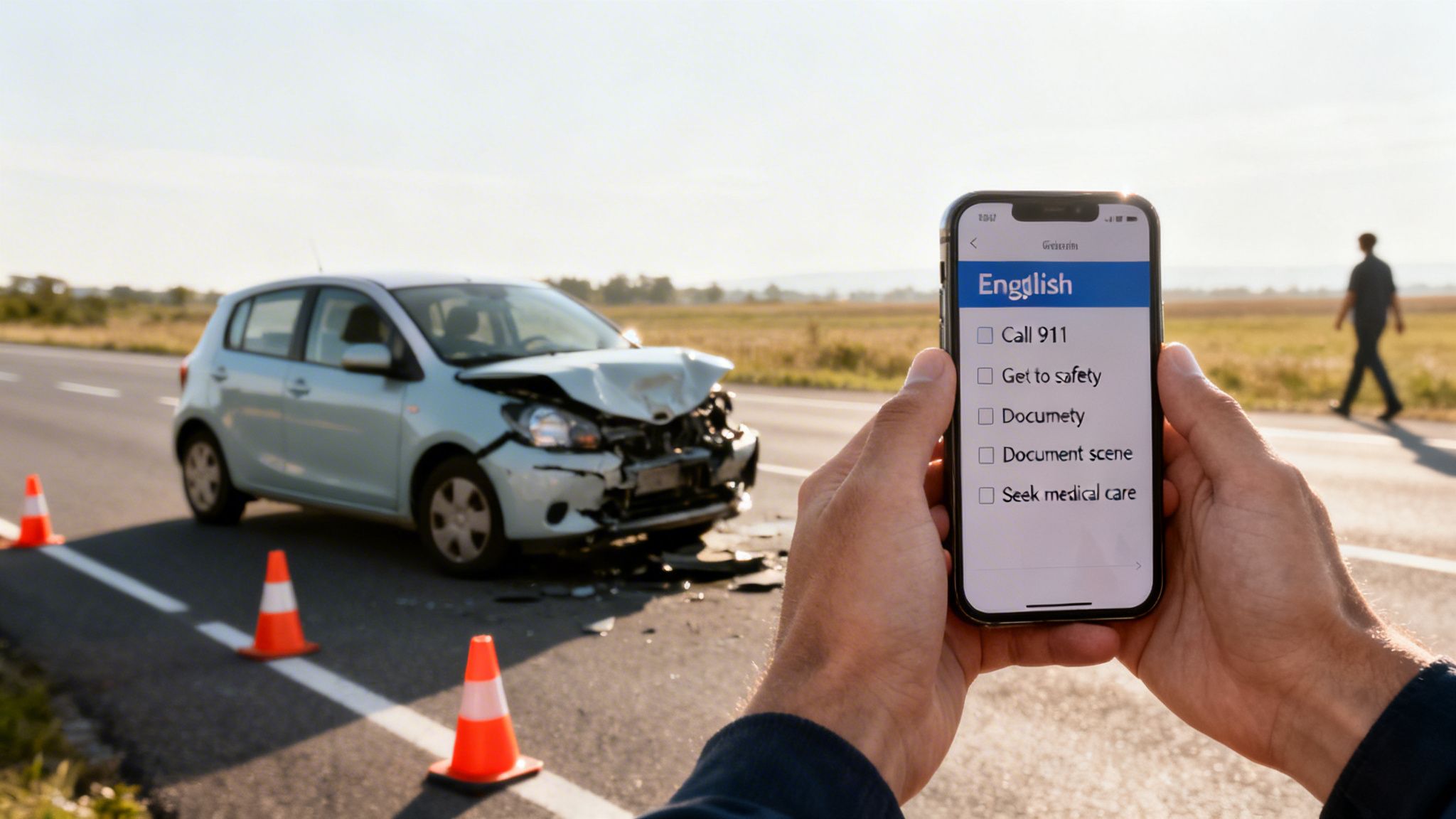
The moments after a crash are a blur of adrenaline and confusion. The screech of tires and the jolt of impact leave your mind racing. But what you do in the first few minutes and hours is absolutely critical for your health and your ability to get fair compensation.
Think of it this way: you are building the foundation of your case right there at the scene, long before you ever have to speak with an insurance adjuster. Following a clear plan will keep you grounded and help you gather the proof you’ll need for a successful rideshare Houston TX accident claim.
1. Call 911 and Get to a Safe Place
Your safety and the safety of everyone else involved is always the top priority. If you're physically able, take these immediate actions:
- Dial 911. Report the accident and request both police and paramedics. The official police report is one of the most powerful pieces of evidence for establishing what happened.
- Move Out of Harm’s Way. If it’s possible and safe, move your car out of traffic to the shoulder. If you're a passenger, don't get out of the vehicle unless you are certain it's safe to do so.
- Let Paramedics Check You Out. Even if you think you feel fine, let the EMTs evaluate you. Adrenaline is a powerful pain-masker and can hide serious injuries like whiplash or internal bleeding that might not show up for hours or even days.
A common mistake we see is people telling police or paramedics, "I'm okay." A better response is, "I'm not sure yet," or to simply describe your symptoms. This prevents an insurance company from twisting your words later to deny your injury claim.
2. Document Everything You Can at the Scene
Evidence has a short shelf life. It disappears quickly once a crash scene is cleared. If you are able, turn your smartphone into your best investigation tool. The more you collect, the stronger your claim will be.
Here’s what to gather:
- Driver and Vehicle Details: Get the names, phone numbers, driver's licenses, and insurance information for every driver involved in the wreck.
- Photos and Videos: Take pictures of everything from multiple angles. Document the vehicle damage, skid marks on the road, traffic signs, and any visible injuries you have.
- Witness Information: If anyone saw the crash, ask for their name and number. An independent witness who can back up your story is incredibly valuable.
3. Capture the Single Most Important Piece of Evidence
For any Uber or Lyft accident, one piece of evidence is absolutely non-negotiable: proof of the driver's status within the app. The insurance policy covering your injuries—and how much it's worth—depends entirely on whether the driver was offline, waiting for a ride request, or actively on a trip with you.
Take a screenshot of your trip details in the app immediately. This single image should show your driver's name, their car, and confirm that your trip was in progress. It is undeniable proof that the rideshare company's massive $1 million commercial policy was active when the collision happened. This one simple action can stop the company from trying to deny responsibility. If you run into trouble, an experienced lawyer can help you secure the official police report. You can learn more about getting an accident report in Houston TX in our detailed guide.
4. Get Follow-Up Medical Care
After you leave the scene, your next stop should be an emergency room, an urgent care clinic, or your family doctor. Make this visit a priority, preferably within 24 hours of the accident.
Seeking prompt medical care does two crucial things. First, it ensures that any hidden injuries are found and treated before they get worse. Second, it creates an official medical record that directly ties your injuries to the crash itself. Without this documentation, you give the insurance adjuster an easy excuse to argue that something else caused your injuries.
By taking these steps, you’re not just a victim. You are protecting your health and building a powerful case for the compensation you deserve, taking back control in a situation that made you feel powerless.
Understanding Your Right to Compensation Under Texas Law
After a traumatic rideshare Houston TX accident, the legal system can feel like another confusing, intimidating world. But knowing your basic rights is the first step toward getting your life back on track.
When someone else’s carelessness causes you harm, Texas law gives you the right to seek payment for your losses. In legal terms, this compensation is called damages. It's the law’s way of trying to make you "whole" again by covering every single loss you've suffered—both financial and personal.
It's absolutely critical to understand what you're entitled to. Why? Because you can be sure the insurance company will never volunteer this information.
The Two Types of Damages: Economic and Non-Economic
In Texas, damages are split into two main buckets. Knowing the difference is key to making sure you and your attorney are calculating the full and fair value of your claim.
Economic Damages
Think of these as the straightforward, calculable losses from the accident. They're tangible, with clear price tags attached.
- Medical Bills: This covers everything from the ambulance ride and ER visit to surgery, hospital stays, medication, and ongoing physical therapy.
- Lost Wages: This is the income you lost because you were unable to work while recovering.
- Future Lost Earning Capacity: If your injuries are so severe that you can't return to your old job or have to take a lower-paying one, you can be compensated for that future loss of income.
- Property Damage: This is the cost to repair or replace your vehicle and any other personal items that were damaged in the crash.
Non-Economic Damages
These are the deep, personal losses that don’t come with a receipt but are just as real and devastating. They represent the human cost of the accident.
- Pain and Suffering: Compensation for the physical pain and emotional turmoil your injuries have caused.
- Mental Anguish: This addresses the psychological toll of the crash, like anxiety, depression, new fears, or even PTSD.
- Physical Impairment: If the accident robbed you of your ability to enjoy daily life—things like walking, exercising, or playing with your kids—you can be compensated for that loss.
Insurance adjusters often try to downplay or completely dismiss non-economic damages. But a compassionate Texas injury attorney knows how to build a case that shows the true, human cost of what you've been through.
For a deeper dive, you can learn more about how to calculate damages in a Texas personal injury claim.
What if They Blame You? The Texas Comparative Fault Rule
It’s a common tactic: the insurance company tries to argue that you were partially to blame for the crash. When this happens, Texas uses a rule called comparative fault (also called proportionate responsibility) under Texas Civil Practice & Remedies Code § 33.001.
Think of it like a pie chart. If a jury decides your total damages are worth $100,000 but finds you were 10% at fault, your final award gets reduced by 10%. You'd walk away with $90,000.
Here's the catch: if the jury finds you were 51% or more responsible for the accident, you get nothing. Zero. This is a critical threshold, and you can bet the insurance company will do everything in its power to push your share of the blame over that 50% line.
Don’t Miss the Deadline: The Statute of Limitations
Finally, you have to know about the statute of limitations. This is a strict legal deadline for filing a lawsuit. In Texas, you generally have just two years from the date of the accident to file a personal injury lawsuit.
Two years might sound like a long time, but investigating a complex rideshare case, gathering all the evidence, and negotiating with massive insurance companies burns through the calendar quickly.
If you miss this two-year deadline, your right to seek compensation is gone forever—no matter how strong your case is. This is why it’s so critical to contact a Houston car accident lawyer as soon as you can. We'll make sure every legal deadline is met while you focus on the only thing that matters: your recovery.
How a Houston Car Accident Lawyer Can Help
When you're hurt in an Uber or Lyft crash, it’s not just you against the other driver. You're up against massive insurance companies with deep pockets and teams of lawyers whose only job is to protect their profits—usually by paying you as little as humanly possible. This is where The Law Office of Bryan Fagan comes in.

Our mission is simple: we lift the entire legal weight off your shoulders so you can focus on what truly matters—healing. We step in and take over all communications, putting an end to the constant, stressful calls from adjusters. You shouldn't have to fight this battle on your own.
We Dig Deep to Build Your Case
The moment you hire our firm, we launch a full-scale investigation into the crash. We don’t just accept the police report as the final word. Our team gets to work immediately to:
- Uncover the Truth and Prove Fault: We hunt down the evidence that tells the real story. This means securing traffic camera footage, tracking down witnesses, and using legal channels to get the rideshare driver’s app data to prove exactly what happened and who was responsible.
- Calculate the Real Cost of Your Injuries: The initial medical bills are just the beginning. We bring in medical experts and financial planners to build a clear picture of your total losses—not just what you owe today, but the future costs of medical care, lost wages, and diminished earning capacity.
- Take on the Insurance Giants: We know the playbook insurance companies use. Our lawyers are aggressive negotiators who are ready for the back-and-forth it takes to demand a settlement that truly covers everything you’ve lost.
An insurance company's first offer is almost always a lowball one. They're hoping you're desperate enough to take it before you realize what your case is truly worth. We build a case so strong that they have no choice but to take your claim seriously.
You Pay Absolutely Nothing Unless We Win
We firmly believe that everyone should have access to top-tier legal representation, no matter their financial situation. That's why we operate on a contingency-fee basis.
This is our promise to you: You will not pay us a single dime in legal fees unless we win your case and recover money for you. It’s that simple.
This approach takes all the financial risk off your plate. You get an elite legal team fighting for you with no upfront costs. Our fee is just a percentage of the final settlement or verdict we secure on your behalf. If we don’t win, you owe us nothing.
A serious car crash can leave your future feeling completely uncertain. A Houston car accident lawyer provides the clarity and strength you need to take back control. Contact The Law Office of Bryan Fagan today for a free, no-pressure consultation. Let us hear your story, explain your rights, and show you how we can fight for the justice you deserve.
Frequently Asked Questions About Houston Rideshare Accidents
After a jarring rideshare accident, your mind is probably racing with questions. The path forward can feel foggy, but getting clear, straightforward answers is the first step toward taking back control. We hear these same questions from clients every day, so we’ve answered some of the most common ones right here.
While every crash is different, understanding these fundamentals will give you a solid footing as you figure out what to do next.
Can I sue both the driver and the company like Uber or Lyft?
Yes, in many cases, you can hold both the driver and the rideshare company accountable. If the driver was at fault and they were actively working—meaning they were on their way to pick someone up or already had a passenger—you can typically file a claim against both the driver’s personal insurance and the company’s much larger $1 million commercial policy.
A skilled attorney will immediately investigate the driver’s app status at the exact moment of the crash. This is a critical detail that determines which insurance policies are in play and helps build a strategy to make sure all of your damages are covered.
What if the at-fault driver was uninsured or fled the scene?
It’s a terrifying thought, but hit-and-runs and crashes with uninsured drivers happen all the time on Houston's roads. For example, a driver rear-ended on I-45 may find the other vehicle speeds off. If you were a passenger in an Uber or Lyft and another driver hit you and fled, or they didn't have insurance, you still have a clear path to compensation.
The massive commercial policies that Uber and Lyft carry include Uninsured/Underinsured Motorist (UM/UIM) coverage. This coverage is designed specifically for these situations, acting as a financial safety net to pay for your medical bills and other losses when the responsible party can’t be found or can't pay.
Tapping into these benefits can get complicated, and it’s an area where having a lawyer to navigate the process is absolutely essential.
How long will my Houston rideshare accident settlement take?
There’s no magic number here, and anyone who gives you a specific timeline isn't being honest. The length of a claim varies dramatically. A simple case with minor injuries might settle in a few months. But a complex accident with severe injuries, arguments over who was at fault, or multiple vehicles could easily take a year or more, especially if a lawsuit is needed.
The most important thing to remember is not to rush. A fast settlement offer from an insurance company is almost always a lowball offer—a sign they know your claim is actually worth much more. The real priority is securing full and fair compensation for your entire recovery, however long that takes.
A serious accident throws your life into chaos, but you don’t have to fight the legal battle by yourself. The compassionate and experienced attorneys at The Law Office of Bryan Fagan, PLLC are here to manage the complex details of your claim so you can put all your energy into healing. For a free, no-obligation consultation to talk about your case and your rights, contact us today at https://houstonaccidentlawyers.net. We are ready to listen and help you explore your recovery options, including seeking wrongful death compensation if you have lost a loved one.