Skip to content
A car crash can change your life in seconds—but you don’t have to face recovery alone. After the chaos of a wreck, your first thoughts are about your health and safety. But once the immediate dust settles, getting a copy of the official accident report is one of the most critical steps you can take to protect your future.
This document, officially called the Texas Peace Officer’s Crash Report (Form CR-3), is the cornerstone of your entire injury claim.
Why Your San Antonio Accident Report Is So Important
A car crash can turn your world upside down in an instant. While you’re focused on healing, the evidence from the scene starts telling the story of what really happened. The most critical piece of that evidence is the official report filed by the responding officer—whether they're from the San Antonio Police Department (SAPD), the Bexar County Sheriff's Office, or another local agency.
This report is far more than just paperwork. It's a powerful legal document that insurance companies and your attorney immediately turn to when they start piecing together the facts of the collision.
Think of it as the bridge between the crash itself and your ability to get the compensation you deserve.
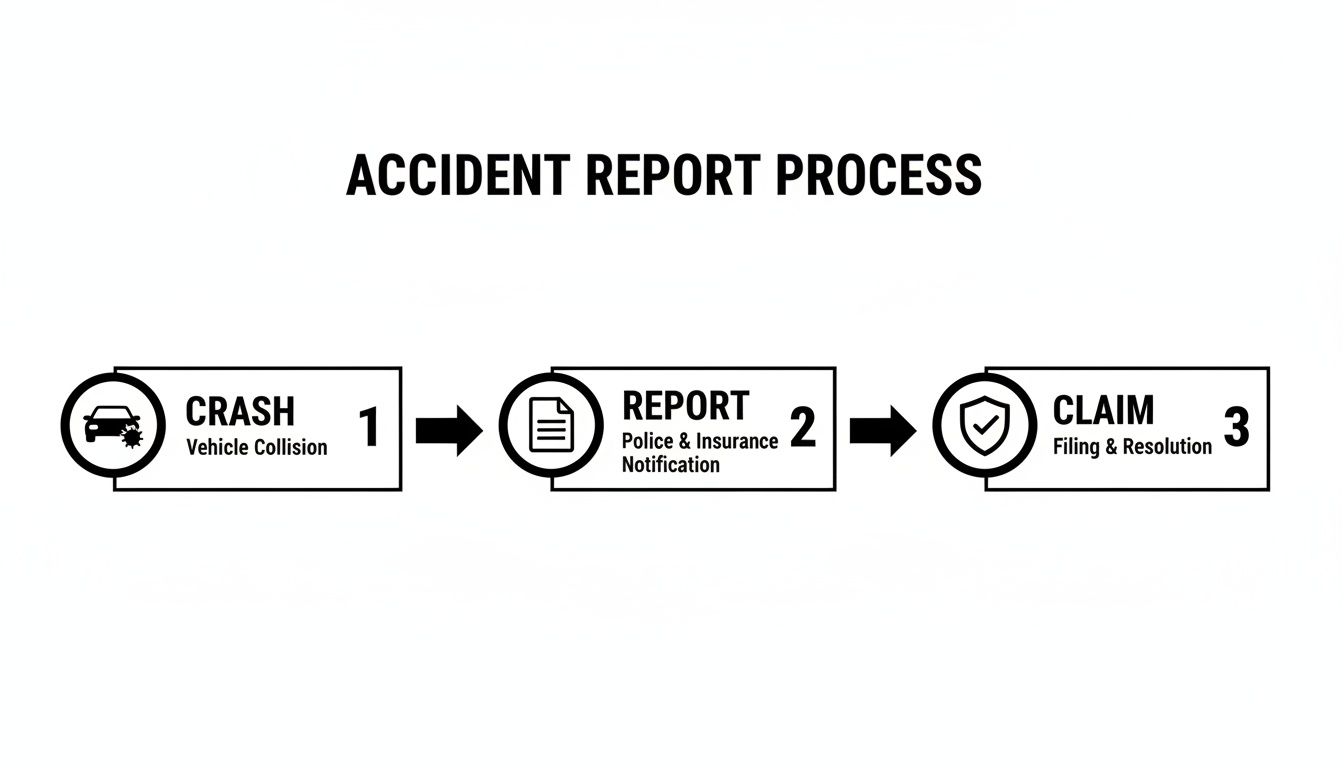
As you can see, the report is what allows you to move forward and hold the at-fault driver accountable for the harm they caused.
The Report's Role in Proving Fault
In Texas, proving who caused the crash is everything. This concept, known as liability, decides who is legally responsible for paying for your medical bills, lost wages, and other damages. Your accident report contains the officer’s firsthand observations and initial conclusions about the collision.
For example, imagine a San Antonio driver rear-ended on I-10. The report will note that one car struck the other from behind, which becomes a key piece of evidence your attorney can use to establish the other driver's negligence—their failure to act with reasonable care.
Inside the report, you'll typically find:
- Names, contact info, and insurance details for all involved drivers.
- Statements from any witnesses who saw what happened.
- A diagram showing the vehicle positions before, during, and after impact.
- The officer’s written narrative describing the scene and their findings.
- Special codes that point to contributing factors like speeding, distracted driving, or failure to yield.
Your Shield Against Insurance Company Tactics
You can bet the insurance adjuster will get a copy of this report right away. Their goal is often to find any excuse to minimize or deny your claim. Texas follows a "modified comparative fault" rule, also known as proportionate responsibility (Texas Civil Practice & Remedies Code § 33.001). This law means if you're found to be even partially responsible for the crash, your compensation can be reduced.
And if they can argue you are 51% or more at fault, you get nothing. Zero.
An accurate, detailed accident report is your first and best line of defense. It provides an objective, third-party account that can shut down an insurer's attempts to unfairly shift blame onto you.
Without a strong report, an insurance company might try to claim you were the one who made an unsafe lane change on I-35. A skilled San Antonio car accident lawyer knows how to analyze your report, pinpoint its strengths, and use it to build a powerful case that protects your right to full and fair compensation.
You can learn more in our guide on how to report a car accident in Texas. Securing this document isn't just a good idea—it's a non-negotiable step toward justice.
How to Get Your San Antonio Police Department Crash Report
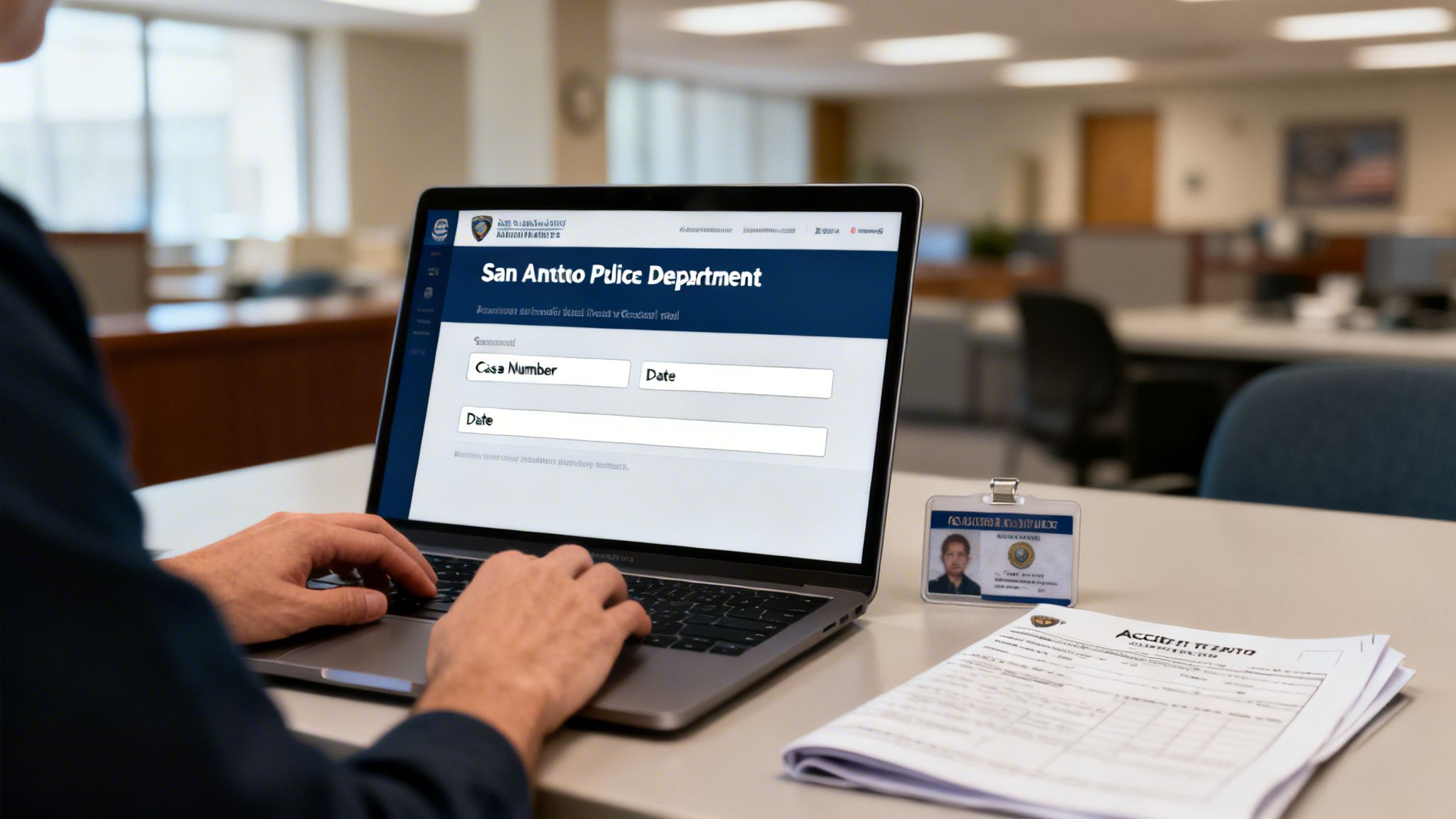
If the San Antonio Police Department (SAPD) responded to your crash, their report is the single most important document for your claim. This official report, the Texas Peace Officer's Crash Report (CR-3), contains the officer's unbiased findings about what happened.
The first thing everyone asks is when they can get it. The answer? Not right away. The officer has to write their narrative, get it approved, and file it. This process takes time, so you should plan on waiting at least 7 to 10 business days before it becomes available.
Once that waiting period is over, SAPD gives you a couple of ways to get a copy of your accident report in San Antonio.
The SAPD Online Request Portal
By far, the easiest method is using the SAPD Records Office online portal. This lets you search for and purchase your report from home, which is a huge relief when you're trying to recover from your injuries.
To find your report in the system, you'll need a few key pieces of information from the accident:
- Case or Incident Number: The officer should have given you a small slip of paper with this number. It's the fastest way to pinpoint your specific report.
- Date and Location: The exact date and street where the crash occurred will help narrow the search.
- Names of People Involved: You can also search by your name or the other driver's.
Downloading a digital copy is a practical first step for starting an auto insurance claim.
Requesting Your Report in Person
Sometimes, you need to speak with a person. Maybe you can't find the report online, or you suspect a detail like a misspelled name is causing issues. In that case, visiting the SAPD Records Office is your best bet.
Here’s the essential info for an in-person visit:
- Location: SAPD Headquarters, 315 S. Santa Rosa Ave., San Antonio, TX 78207
- Hours: Monday – Friday, 9:00 a.m. to 4:00 p.m.
Pro Tip: Bring your driver's license, any info you have from the scene (especially that case number), and a way to pay the report fee. A quick chat with a records clerk can often solve a problem that feels impossible to fix online.
This report is more than just paperwork; it's a vital tool for protecting your rights. Imagine you were rear-ended while stopped at a red light on Culebra Road. The CR-3 report, showing you were not in motion, becomes powerful proof of the other driver's liability. It’s the kind of evidence your Texas injury attorney uses to establish negligence and demand the full compensation you're entitled to under Texas law.
We know that chasing down documents is the last thing you want to do after a wreck. Let our team take this off your plate. We pull these reports every day and know exactly what to look for to start building a strong case for you.
Using the Texas Crash Report Online System (CRIS)

While the San Antonio Police Department has its own portal, most crashes across Texas end up in one central database: the Crash Report Online Information System (CRIS). Managed by the Texas Department of Transportation (TxDOT), this is the state’s official library for accident reports.
If your wreck happened in Bexar County, on a state highway patrolled by DPS, or even within San Antonio city limits, your report is likely here. It is often the most direct way to get a copy of the official Texas Peace Officer’s Crash Report (Form CR-3).
How to Find Your San Antonio Accident Report on CRIS
The CRIS portal is designed to be user-friendly, but remember to be patient. It typically takes an officer 7 to 10 business days to complete and file the paperwork, so it won't be available immediately.
To find your accident report in San Antonio on the CRIS system, you’ll need at least one of these details:
- Crash ID: The unique number the officer gave you at the scene. This is your fastest route.
- Driver’s License Number: The license of any driver involved will work.
- Vehicle Information: The Vehicle Identification Number (VIN) or license plate from any car in the crash.
- Name and Date: You can also search using the name of anyone involved plus the date of the accident.
A practical tip is to have as much information ready as possible. A name-and-date search might pull up multiple results, especially after a pileup on I-35. But plugging in a specific Crash ID or VIN will take you straight to the report you need.
Standard vs. Certified Copy: What’s the Difference?
Once you locate the report, you’ll see two options: a standard copy or a certified copy. They look almost the same, but they have very different uses.
Standard Copy
This is a basic digital copy of the report that costs $6.00. It’s perfectly fine for your personal records or for sending an initial notice to your insurance company.
Certified Copy
A certified copy costs $8.00 because it comes with an official seal from TxDOT. This seal verifies that it's a true and authentic copy of the original report. For any formal legal action, like filing a lawsuit, this is the version you’ll need. We almost always secure a certified copy when building a strong case.
The existence of a statewide system like CRIS is a stark reminder of how dangerous Texas roads can be. For example, a Houston driver rear-ended on I-45 during rush hour faces the same legal challenges as someone hit in San Antonio. Hotspots like Loop 410 and Highway 151 are notorious, logging hundreds of crashes, often due to high speeds and difficult merges. This is part of a tragic trend in San Antonio, which recorded 186 fatal crashes in 2022, claiming 199 lives. The same year, 542 serious injury crashes left 625 people with severe wounds.
Trying to track down the right documents while you're recovering from an injury is the last thing you should have to worry about. If you need help getting an accident report in Houston, our guide can help. Better yet, let our team handle it for you. We can secure the right report quickly so you can focus on healing while we start fighting for you.
How to Read and Understand Your Accident Report
When you finally get a copy of the Texas Peace Officer's Crash Report (CR-3), it can feel overwhelming. It’s a dense, multi-page document packed with codes, checkboxes, and jargon. But taking the time to understand this report is one of the most important things you can do to protect your rights after a San Antonio car wreck.
This report is the official story of what happened, at least from the police officer’s perspective. Knowing how to read it gives you the confidence you need when speaking with insurance adjusters and your attorney.
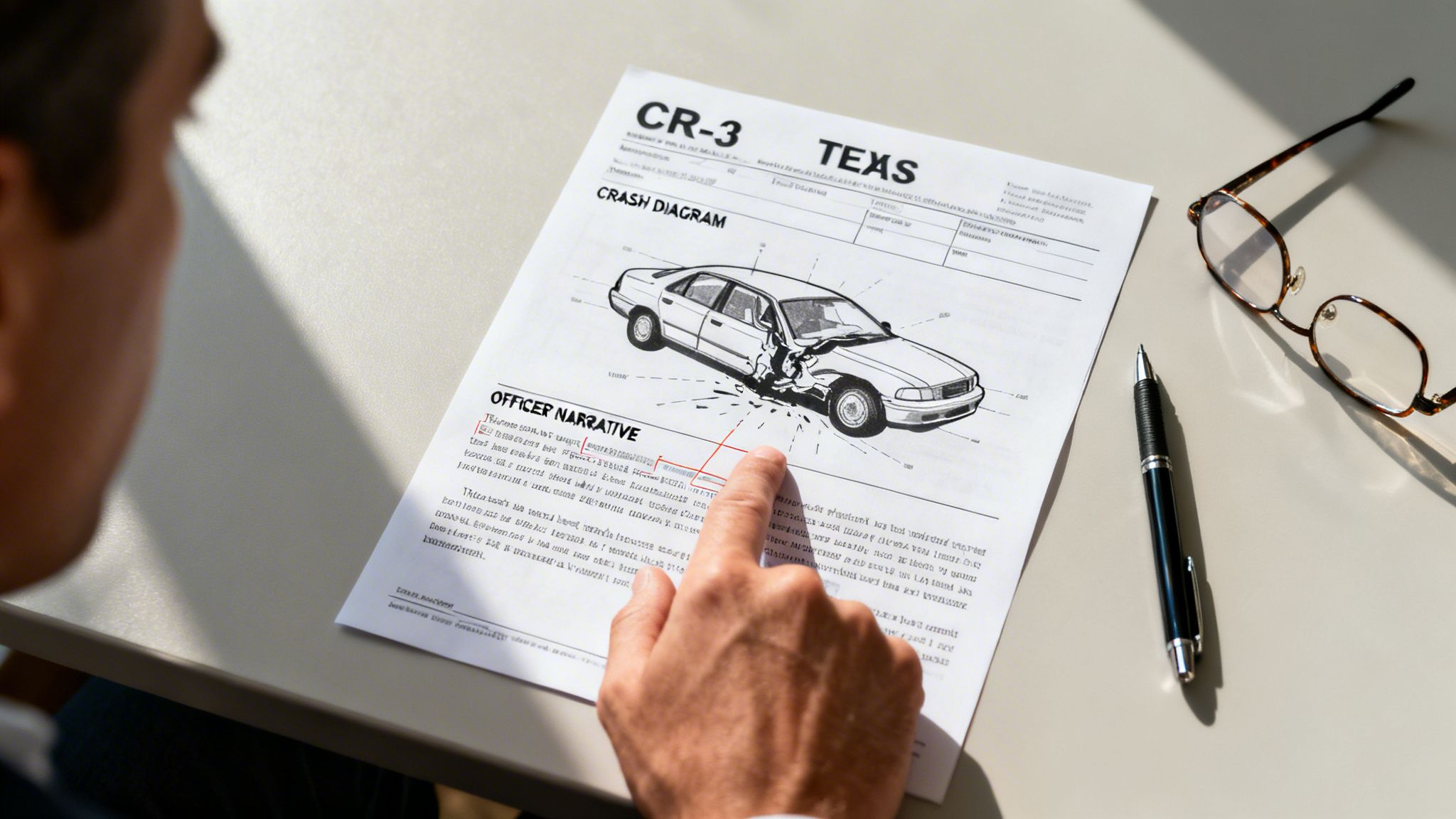
Let's walk through the key parts of the report so you know exactly what to look for.
Decoding the Key Sections of Your CR-3 Report
When you first open the report, you’ll want to focus on a few key areas that carry the most weight in an insurance claim. These sections help build the case for liability—or who was legally at fault for the crash.
- Page 1: The Basics – This page lays out the essential facts: the date, time, and exact location of the collision. It also lists the names, addresses, and insurance policy information for every driver involved. Your first step should always be to double-check that all of your personal details are 100% correct.
- Unit 1 vs. Unit 2 – In Texas, the investigating officer will almost always list the driver they believe to be at fault as "Unit 1." While this isn't a final legal ruling, it’s a very strong indicator of how the police see the accident and who the insurance company will likely hold responsible.
- The Narrative and Diagram – This is where the officer tells the story. The written narrative summarizes how the crash happened, often including details from witnesses. The diagram provides a simple, top-down sketch of the collision, showing vehicle positions and points of impact.
A classic example we see all the time is a rear-end collision on I-10. The crash diagram will show one vehicle hitting the back of the other, and the narrative will say something like, "Unit 1 struck Unit 2 from behind while in traffic." That combination becomes powerful evidence that helps us prove the other driver’s negligence.
Finding the Factors That Caused the Crash
One of the most critical sections on the entire report is titled "Factors and Conditions." This is where the officer uses specific codes to list what they believe caused or contributed to the accident. You can bet the insurance adjuster will look here first to start assigning blame.
Some of the most common contributing factor codes you might find are:
- Failed to Control Speed: The at-fault driver was going too fast for the conditions.
- Driver Inattention: This is often used for distracted driving, like texting or not watching the road.
- Failed to Yield Right of Way: A driver made an unsafe turn, often turning left in front of oncoming traffic.
- Disregarded Stop and Go Signal: This clearly indicates someone ran a red light or a stop sign.
These codes represent the officer's professional opinion, but they carry a lot of influence. An experienced San Antonio car accident lawyer knows how to use favorable codes to your advantage and, just as importantly, how to challenge incorrect ones to protect your claim.
What to Do If Your Accident Report Is Wrong
You’ve waited for the report, paid the fee, and finally get it—only to see a glaring error. Maybe it has the wrong street listed, or worse, it incorrectly states you were at fault. Don't panic. You have practical options.
Factual Errors: These are objective mistakes that can be proven wrong, like a misspelled name or an incorrect license plate number. You can usually get these fixed by contacting the SAPD Records Office or the reporting officer directly and providing proof, like your driver's license or vehicle registration.
Disputed Determinations: This is much tougher. This is when you disagree with the officer’s opinion on how the crash happened or who is at fault. An officer is highly unlikely to change their official conclusion based on a phone call.
This is where you need to talk to a personal injury attorney. We can help you draft a formal supplemental statement outlining your side of the story and request that it be attached to the official report. More importantly, an attorney can start gathering other evidence—like surveillance video from nearby businesses, photos from the scene, and witness statements—to build a case that proves what really happened, regardless of what the initial report says.
How to Use the Report to Build Your Personal Injury Claim
Once you have your San Antonio accident report, what's next? For a personal injury attorney, this document is the single most important piece of evidence we have to start building your case and fighting for the compensation you deserve.
The report provides an objective, third-party account that we can use to prove the other driver’s liability and shut down the insurance company’s attempts to deny your claim.
The Report Is Your First Line of Defense
Here’s a hard truth: the at-fault driver’s insurance company is not on your side. Their primary goal is to protect their bottom line by paying out as little as possible. One of their favorite tactics is to twist the facts and try to shift the blame onto you.
This is where Texas's “proportionate responsibility” rule comes into play. Under this law (found in Chapter 33 of the Texas Civil Practice & Remedies Code), an insurer can reduce your settlement by whatever percentage of fault they can pin on you. If they argue you were 20% at fault, they’ll try to slash your payment by 20%.
And if they can convince a jury you were 51% or more at fault, they owe you nothing at all.
Your accident report is the best weapon against these blame-shifting games. Let’s say you were T-boned on Loop 410. If the report clearly states the other driver ran a red light, it becomes incredibly difficult for their insurance adjuster to argue that you were somehow responsible. It’s an official record from a law enforcement officer.
Connecting the Crash to Your Losses
Beyond proving who was at fault, the report helps us document the full scope of your damages—the physical, financial, and emotional losses you've suffered because of the wreck. It documents critical details like property damage to your vehicle, any injuries noted at the scene, and whether an ambulance was called.
These details create an undeniable link between the crash and your medical needs. This connection is fundamental when we draft a formal personal injury demand letter to the insurance company, which outlines all your losses, including:
- All medical bills (both past and future)
- Lost wages from being unable to work
- Physical pain and emotional suffering
- The cost to repair or replace your vehicle
The crash statistics for our city show just how critical this evidence is. The real tragedy lies in the 160 fatal crashes that claimed 164 lives and the 536 serious injury crashes that left 612 people with life-altering injuries in a single year in San Antonio. With thousands of crashes happening across Texas, having solid proof isn’t just helpful—it’s essential. You can see more of these sobering San Antonio car accident statistics on kljlawpllc.com.
An experienced lawyer doesn't just read the report—they dissect it. We know how to use the officer's narrative, the crash diagram, and the contributing factor codes to build a powerful argument for the full and fair compensation you are owed.
When you're trying to recover from an injury, the last thing you need is a fight with an insurance adjuster. We know how to use every detail in that accident report from your San Antonio crash to protect your rights and your family’s future.
Let Our San Antonio Car Accident Lawyers Handle It for You
A car crash turns your world upside down in an instant. You’re left dealing with physical pain, emotional trauma, and a sudden flood of bills you never saw coming. The last thing you should have to do is figure out confusing government websites or fight with insurance adjusters trained to deny your claim.
Let us take that burden off your shoulders. Your job is to focus on what’s most important: your health, your family, and your recovery.
From the Crash Report to Your Recovery, We Handle Everything
As soon as you hire our firm, we get to work. Our first step is to secure the official accident report for your San Antonio crash. We don’t just download it; we dissect it. Our experienced attorneys go through every detail, looking for the facts that will build your case:
- The officer’s narrative and diagram to establish a clear sequence of events.
- The specific codes that point to the other driver's negligence.
- Names and contact details for any witnesses who can support your claim.
- All listed insurance information so we can start the auto insurance claim process immediately.
This report is the cornerstone of your personal injury claim. We use it to officially identify the at-fault driver and construct a powerful argument that proves their liability. This is absolutely essential on the notoriously dangerous roads in our community.
The numbers don't lie. Bexar County recorded nearly 50,000 crashes in a single recent year, resulting in thousands of injuries and hundreds of deaths. Roads like Highway 151 and Loop 410 are well-known hotspots. This data isn't just a statistic; it's a daily reality for San Antonio drivers and highlights why having an expert legal team on your side is so critical.
After a crash, you need an advocate who not only understands the law but also understands San Antonio. We know the dangerous intersections, we know the local court systems, and we know how to hold negligent drivers accountable.
Fighting for the Full Compensation You Deserve
Once we establish who was at fault, we go to battle for the full and fair damages you are owed under Texas law. This is about far more than just getting the emergency room bill paid. We pursue compensation for every single way the accident has impacted your life.
Your settlement or court award can include money for:
- All of your medical bills—both current and future
- Lost wages and any impact on your ability to earn a living
- Physical pain and suffering
- Emotional distress and mental anguish
- The cost to repair or replace your vehicle
Whether you were in a straightforward car accident, a complex truck accident, or are dealing with the tragic loss of a family member and need to seek wrongful death compensation, our strategy is the same. We prepare every single case as if it is going to trial. This shows the insurance company we are serious, and it often results in a much better settlement offer.
But you have to act fast. In Texas, the statute of limitations gives you only two years from the date of the accident to file a lawsuit. Don't let time run out on your right to justice.
You don’t have to go through this alone. The Law Office of Bryan Fagan, PLLC is here to stand with you, manage all the legal details, and fight for the recovery you and your family deserve. We work on a contingency-fee basis, which means you pay nothing unless we win your case.
Contact us today for a free, no-obligation consultation to learn about your rights and take the first step toward getting your life back.